


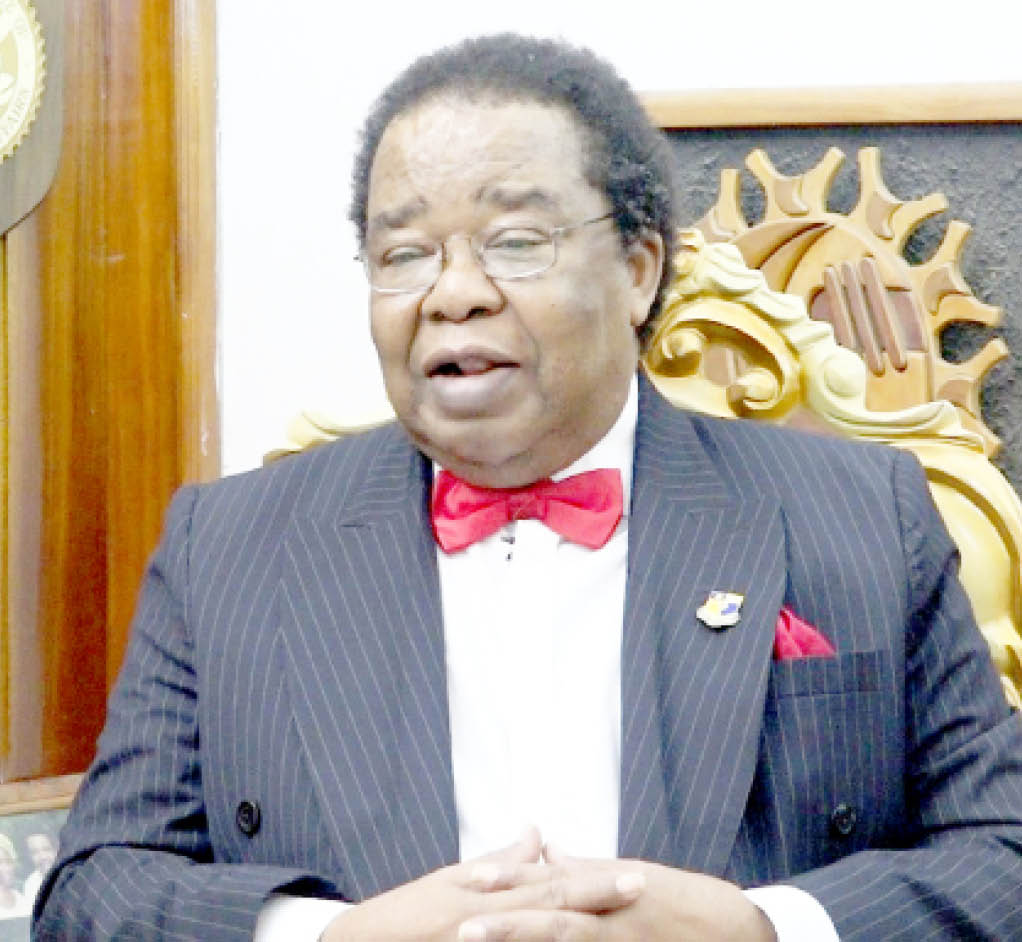
Professor Bolaji Akinyemi, a Nigerian professor of political science who was Nigeria External Affairs Minister from 1985, to speaks on the recent ceasefire between Israel and Palestine. Born in Ilesa, in what is now Osun State Akinyemi attended Igbobi College in Yaba from 1955 until 1959, Christ’s School Ado Ekiti from 1960 to 1961, Temple University, Philadelphia, Pennsylvania, United States, from 1962 to 1964, Fletcher School of Law and Diplomacy, Tufts University, Medford, Massachusetts, US, 1964 to 1966, and Trinity College, Oxford, England, from 1966 until 1969.]
He was a visiting professor at the Graduate Institute of International Studies in Geneva and at the Diplomacy Training Programme, University of Nairobi, Kenya, both in 1977. He was Regents Lecturer at the University of California, Los Angeles, US, in 1979, professor of political science at the University of Lagos, from 1983 until 1985, and visiting fellow, St John’s College, Cambridge, England in 1984.
Akinyemi was director-general of the Nigerian Institute of International Affairs (NIIA) from 1975 until 1983.Akinyemi was appointed Minister of External Affairs by military leader Ibrahim Babangida in 1985. While in this position, he originated the Technical Aid Corps (TAC), a program which sent Nigerian professionals overseas to engage in volunteer work. It was designed to “promote the country’s image and status as a major contributor to Third World and particularly African development”.[ He also came up with the concept of the “Concert of Medium Powers
Hamas has released all the living Israeli hostages, and, of course, Israel in turn has released nearly 2,000 prisoners as part of the landmark ceasefire deal brokered by President Donald Trump. Trump claims that the war is over and says he received guarantees from both Israel and Hamas on compliance. How reliable are such guarantees in Middle Eastern conflicts? And as someone who has observed decades of the Israeli–Palestinian conflict, how significant is this moment?
Well, I’ve listened to the comments made on your program this morning, and I must say I agree. That is, what is all this song and dance about what has just happened, as if there haven’t been wars in the Middle East before?
There was the 1948 war. we’ve had other wars, too. So, in a way, there’s really nothing unique about the fact that we are once again midwifing the end of another war.
However, what I think Trump’s style represents is that, instead of making this a purely bilateral issue between Israel and the Palestinians, he has adopted a multilateral approach. He has brought in many “midwives” — those who can handle Israel, which we all know he can do, but also those who can handle Hamas, especially the rich Arab countries in the Middle East. He’s brought in European nations who, because they’ve committed themselves to recognizing the two-state solution, can also exert influence on any attempt to derail the process.
Still, I’m holding my breath. We’ve been in this situation before — where we go through the first stage, only for Israel to derail the second stage and start the war all over again. It’s how the second stage is handled that should keep our fingers crossed and our eyes open.
I hope Hamas realizes that it did not defeat Israel. Look, I seem to be adopting, if you like, a realist approach to this issue. I’m assessing it through the lens of power — in terms of where we are going and how we will get there.
When I some people are adopting a humanist approach, what I mean is that Hamas has a strong case. The Palestinians have a strong case. From 1948, when this issue started, the Palestinians have always gotten the wrong end of the stick. They have always been given the wrong conclusion.
It is the power that Israel has used to defeat Hamas or the Palestinians, not the strength of Israel’s argument. In life, power seems to dictate the outcome of issues.
It’s the support of the United States for Israel — the weapons, the money, the political backing — that has determined Israel’s dominance in these matters.
So, we should hope, first, that Trump will not lose interest in the issue simply because he hasn’t won the Nobel Peace Prize, and second, that he will continue to put pressure on Netanyahu (whom I don’t trust at all. I don’t even know who trusts Netanyahu) not to start this war again. Israelis were booing his name each time it was mentioned because they know their man. He’s likely to revisit the conflict.
What I hope to see is a United States that continues to put pressure on Israel not to reignite the war.
There have different approaches to finding solutions to the Israeli Palestinian issue. There was the proposal to resettle Israelites in Uganda, we’ve seen Oslo I, Oslo II, we’ve seen how Israel broke those agreements. Do you think a two-state solution, which many regard as justice, will ever happen in your lifetime or ours?
Well, thank you for those questions. They’re actually easy to answer.
The first one — yes. If Israel had been planted in Uganda, believe me, there would still be African countries that would side with Israel. You only need to cast your mind back to Côte d’Ivoire, Uganda itself, and a few other countries that supported South Africa during the fight against apartheid. You will always find African countries willing to betray our collective commitment.
Now, if I’m going to be practical, I don’t believe we’ll see the two-state solution in my lifetime. Because progress in international relations is usually gradual — unless there’s a major war that reverses things. And I don’t see the United States backing a two-state solution in the next ten years. I just don’t see it.
But it will come. It’s inevitable.
If you look at public opinion polls in the United States, the American people — not the government — have gradually turned against Israel. And I think a time will come when Israel’s supporters will no longer dictate the outcome of elections in the U.S. I think the majority of Americans will then start to dictate a pro-Palestinian attitude among voters.
So, we’ll get a two-state solution, but I don’t think it will happen in my lifetime.
Do you believe that this international peacekeeping presence can succeed at this moment with the peace deal Trump has proposed? Will it succeed where previous efforts have failed?
I don’t believe in the Trumpian approach. You see, the United Nations has long experience in setting up peacekeeping or peace enforcement operations. What Trump has done, by bypassing the United Nations, is come up with a program that’s not been properly thought through.
Let me give you an example. The Israeli troops have pulled back to the line Trump has drawn. But the United States didn’t think about who would occupy the areas vacated by the Israelis during this transition period.
So, what has happened is that, in order to maintain peace, Hamas has had to bring back its troops — which frightens Israel. And I don’t really know what Netanyahu’s reaction will be. But he’ll probably tell Trump, “See, I warned you that Hamas isn’t going to keep its side of the bargain.”
And now, there’s talk of a civil war starting within Hamas itself. The United Nations has not admitted this mistake. Perhaps the UN’s delay in reaching a conclusion is because it’s trying to ensure there are no loopholes.
My fear, however, is that Trump’s 20-point program has left too many loopholes. It could end up giving multinational troops a bad name. I think the earlier the United Nations is brought into this, the better — for everyone, and for the success of this program.
Just yesterday, Hamas reportedly started fighting with local clans in Gaza, killing about 27 people. That’s more trouble brewing. Is it not deceitful to say Trump has a plan?
No, you’re quite right. I think Trump was racing to meet the deadline for the Nobel Peace Prize. In that rush, he didn’t get experts to sit down and put real substance — real “teeth” — into the plan he was proposing.
Now we have a 20-stage program, or whatever you want to call it. But the connection from one stage to another isn’t properly articulated. I think Trump wants peace in the Middle East, yes — but for his own personal aims.
He didn’t get the Nobel Peace Prize this year. Everyone’s now talking about maybe next year. But let me answer a question you haven’t asked: I’m actually happy that the Nobel Peace Committee didn’t succumb to the bullying tactics of Trump, Netanyahu, and the Prime Minister of Pakistan. They wanted to pressure the committee into giving the prize to Trump. That would have devalued the Nobel Peace Prize — its gravitas, its integrity. I’m glad the committee stood firm against such bullying.
There’s growing scepticism about the Gaza ceasefire deal. Many believe it would only sustain a fragile peace. But laying a governance structure in Gaza has become a major concern, especially considering the $53 billion deficit in the 10-year reconstruction plan. How do you respond to this?
Well, there are a lot of wealthy Arab countries — the Qataris, the Saudis, and others — who have the money, if the political will exists.
But if Trump and Netanyahu expect these Arab countries to fund a program that essentially implements Israeli policy, then they’re whistling in the dark. I don’t believe the Arab states will underwrite an Israeli or American peace plan that ignores the Palestinians.
However, if the Palestinians are brought on board, and if the Arab countries themselves are part of designing the peace plan, then yes — Saudi Arabia or Qatar might be willing to commit funds to underwrite the program.
What I’ve seen so far, though, is the exclusion of both the Palestinians and the Arab nations. This so-called 20-year plan is an American plan — one that incorporates Israeli interests, not Arab interests. We must separate Arabs from Palestinians. They are not the same. The Palestinians themselves must be brought on board.
I agree with the Irish and Spanish presidents who said that the Palestinians must democratize. But you can only democratize if you remove the Israeli boot from their neck. People keep saying the Arabs and Palestinians haven’t held elections — but how can they, when Israel controls everything, even tax collection? Israel dictates governance in both the West Bank and Gaza.
So, in truth, it is Israel that must first lift its jackboot off the neck of the Palestinians.
*Professor Bolaji Akinyemi granted this interview to Arise TV on itsThe Morning Show on Tuesday, 14 October 2025
Leave a Reply