
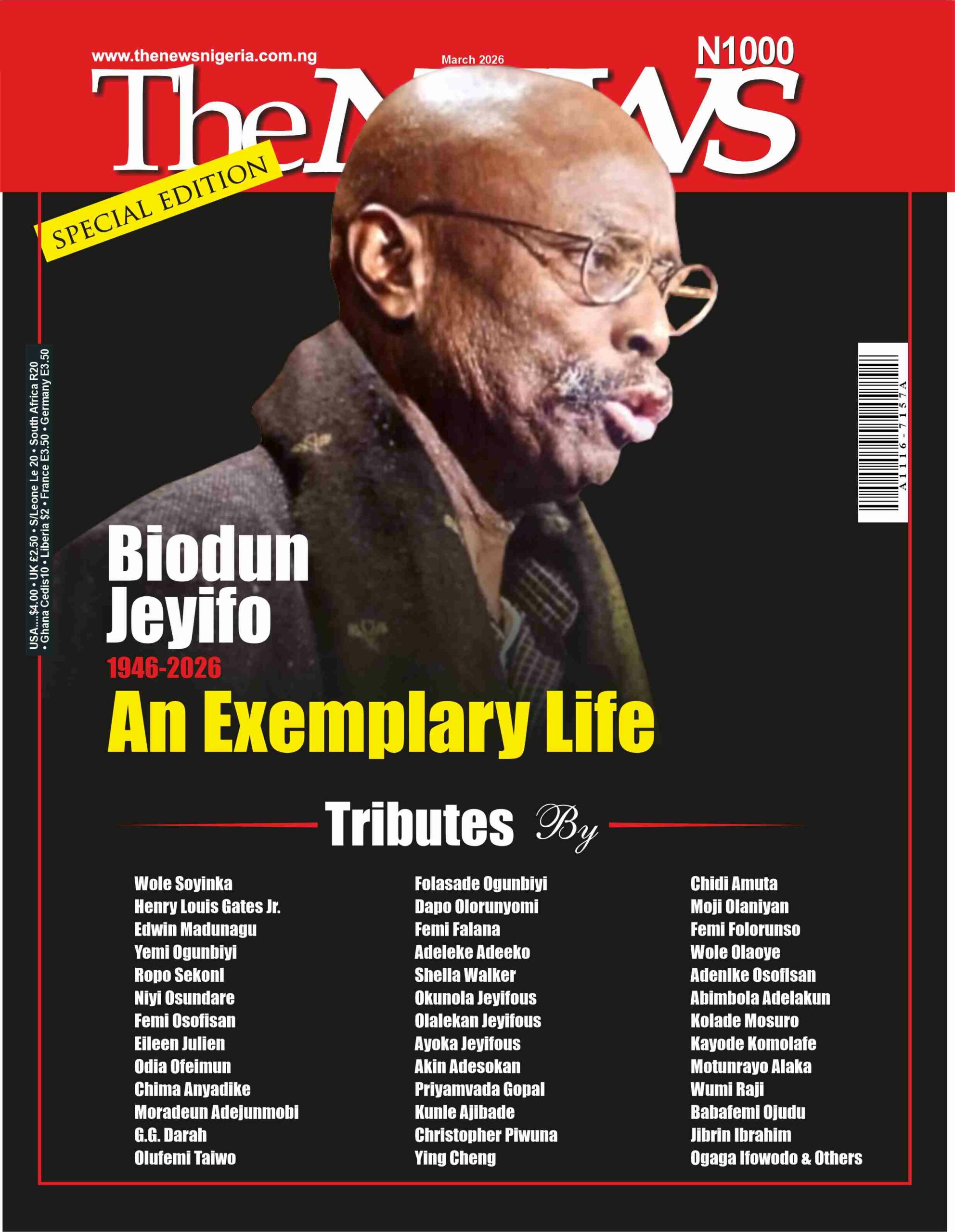
The Glorious Exit of Biodun Jeyifo
By Nehru Odeh
In life, Biodun Jeyifo was many things at once: a scholar of formidable range, a Marxist critic with a poet’s sensitivity, a unionist who believed fiercely in justice, and a teacher whose intellectual generosity shaped generations across continents. But to friends and students, he was simply BJ—a booming voice, a restless mind, and a man who refused to separate scholarship from the struggle for a better society.
The uncanny way he built bridges, broke boundaries, collapsed differences, and combined the seriousness of an intellectual with the everyday concerns and pastimes of the people, especially the poor, endeared him to many. He was indeed at home with the rich and the poor, the highbrow and the unsophisticated, as well as the cultured and the uncultured.
At the heart of his social interactions and encounters was his legendary generosity, his deep concern for the plight of the poor, his boundless appetite for conversations, and his unbridled capacity for letting his guard down, which many sometimes mistook for a carefree attitude.
Many will never forget the way his berets and hats sat slantingly on his cerebral head, his characteristic smile, his inquisitive questions, and insatiable intellectual curiosity. He was simple in his complexity and complex in his simplicity.
This is indeed the story of BJ.
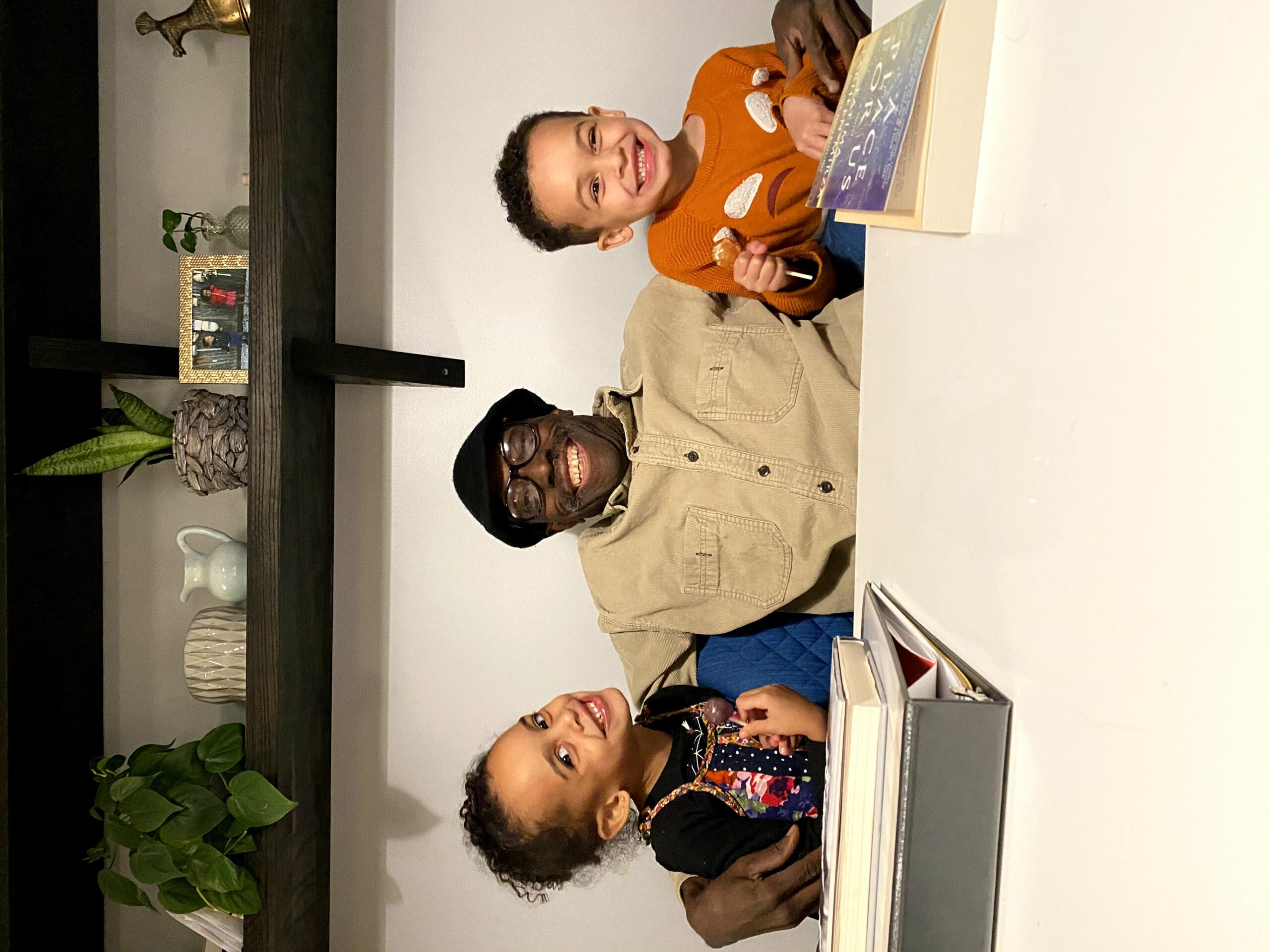
It was as if he had a premonition of his impending death when he wrote a poem to his grandchildren before he flew from the US to Nigeria for his 80th birthday.
His poem
Poems and prose-poems for Taiwo (Lola) and Kehinde (Darragh)
Sunday, December 21, 2025
At the Dulles Airport, DC, en route to Lagos
I have lost count but I am
Fussless about it!
My first transatlantic flight?
Summer of 1969, Lagos to London
Uncountable flights since then!
But THIS flight is different
Because I am flying home
So my 80th year on Earth
Will find me where I am
Most at home on the planet!
This flight is thus like my first flight
But in the other direction
Efufu lele, gbemi dele o!
(Ye winds bear me safely home!)
(Love ya, Lola and Darragh!)
Grandpa BJ
Jeyifo died in Ibadan on 11 February 2026. He was 80.
It was for these and many other reasons that his family, former students, comrades, colleagues, and friends converged on the Omolayole Hall at the International Conference Centre, University of Ibadan to celebrate the man whose life traversed Ibadan, New York, Cornell, Harvard, and Beijing, and whose mind had shaped theirs, in an evening of tributes held in his honour on Tuesday, March 3, 2026.
Bola Tinubu, the President of Nigeria, had earlier sent his condolences to the family, friends, and associates of Jeyifo.
In a statement by Bayo Onanuga, Special Adviser to the President (Information and Strategy), Tinubu noted that the renowned literary scholar, critic, and public intellectual would be sorely missed for his contributions to African literature, postcolonial studies, cultural theory, and his masterful interpretation of the works of Professor Wole Soyinka.
Tinubu recalled the temperance, foresight, and wisdom that Jeyifo brought to the leadership of ASUU over many years, providing guidance and appropriate negotiation frameworks with the government to improve the working conditions and the learning environment in Nigerian universities.
The President said Professor Jeyifo’s longstanding advocacy for academic freedom and social justice would be remembered. At the same time, his influence on political and cultural journalism will forever remain a reference for many generations, especially among the many scholars, writers and activists he mentored.
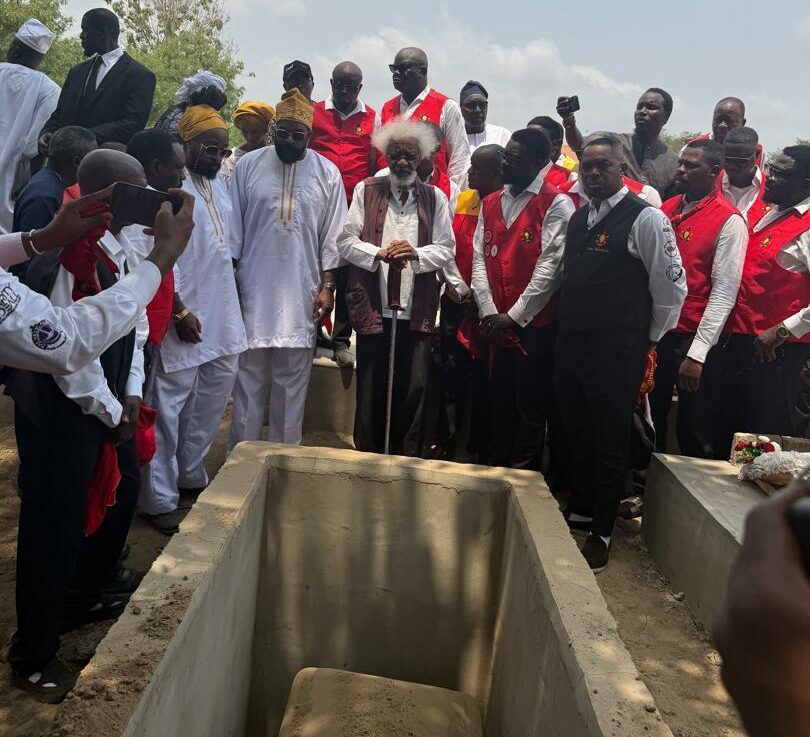
It was a solemn yet symbolic farewell on Wednesday 4 March 2026 as Nobel Laureate Wole Soyinka led members of the National Association of Seadogs, popularly known as the Pyrates Confraternity, to pay their final respects to Jeyifo at the Anglican Cemetery, St James the Great Cathedral Burial Ground, Ijokodo, Ibadan.
As guests from across the country, including members of the Academic Staff Union of Universities (ASUU), of which Jeyifo was pioneer president, walked quietly into the cemetery, the Pyrates, dressed in white shirts, black trousers, and red regalia, were already inside, sailing (drumming, singing, and dancing) as they awaited Soyinka’s arrival.
No sooner had Soyinka arrived than he led the way, holding a sword aloft, as he walked majestically to Jeyifo’s graveside while other Pyrates sailed alongside him, singing a number of pyratical songs, notably “Another sayle, Jellu sayle / Pyrates are sailing to Tortuga.”
At Jeyifo’s graveside, Soyinka and members of the Pyrates Confraternity paid their final respects to him. At the graveside were his children, Okunola, Olalekan and Ayoka.
As the pyratical song, “Pyrates sail again / We shall sail on earth / We shall sail in heaven / Pyrates sail again,” rent the air, it dawned on everyone that Jeyifo was not only a committed Pyrate; he lived a full life.
The Pyrates Confraternity was founded by Soyinka and six others (known as the “Magnificent Seven”) at the University College, Ibadan in 1952. Registered as a humanitarian organization, it is known for advocacy for good governance, charity, among other activities.
Members of the National Association of Seadogs always give their members pyratical burials as they sayle on with the foregone terrors to Elysium.
The group, under Soyinka’s leadership, celebrated the late scholar’s enduring contributions to African literature, theatre, and intellectual discourse.
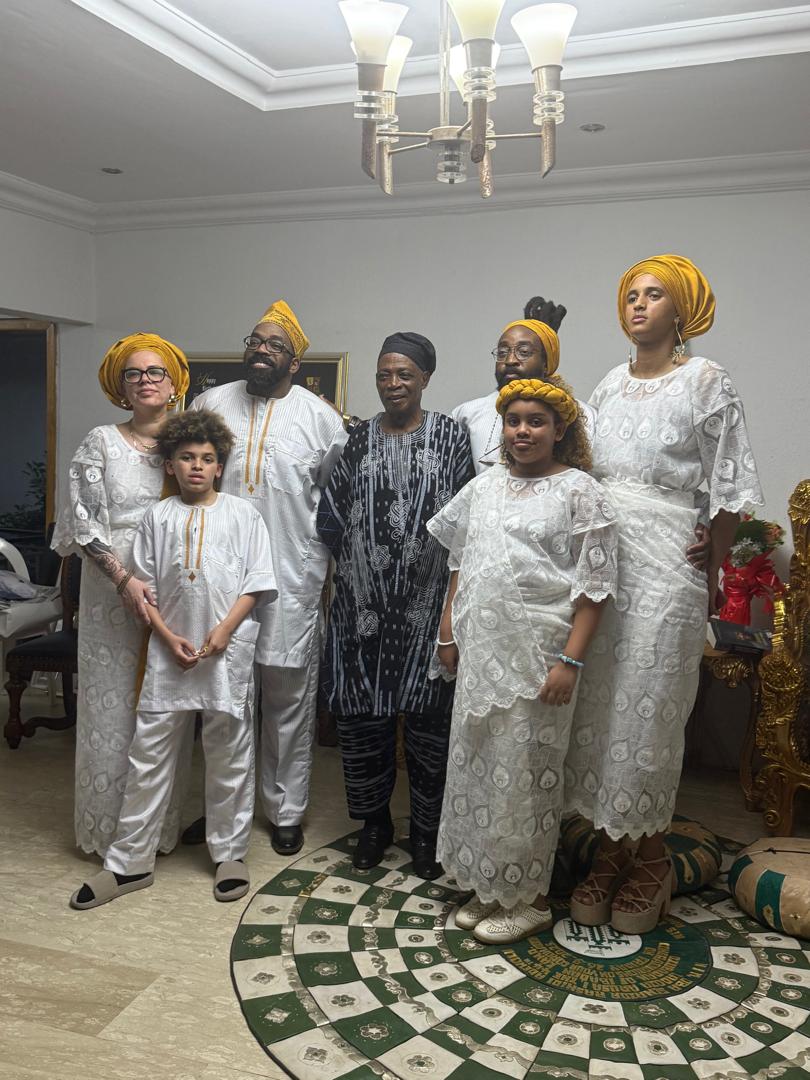
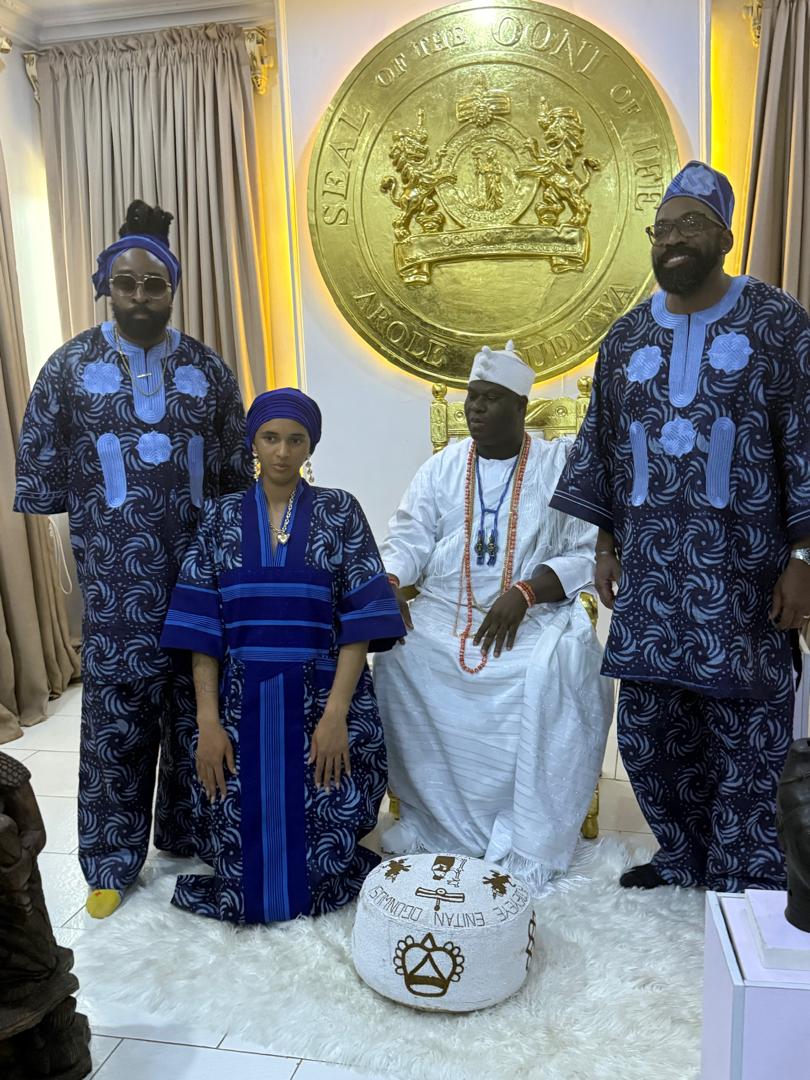
After the pyratical burial ceremony, his family and colleagues later paid a courtesy visit to the Olubadan of Ibadan, Oba Rashidi Ladoja and the Ooni of Ife, Oba Adeyeye Ogunwusi.
*Nehru Odeh is Assistant Editor, TheNEWS.
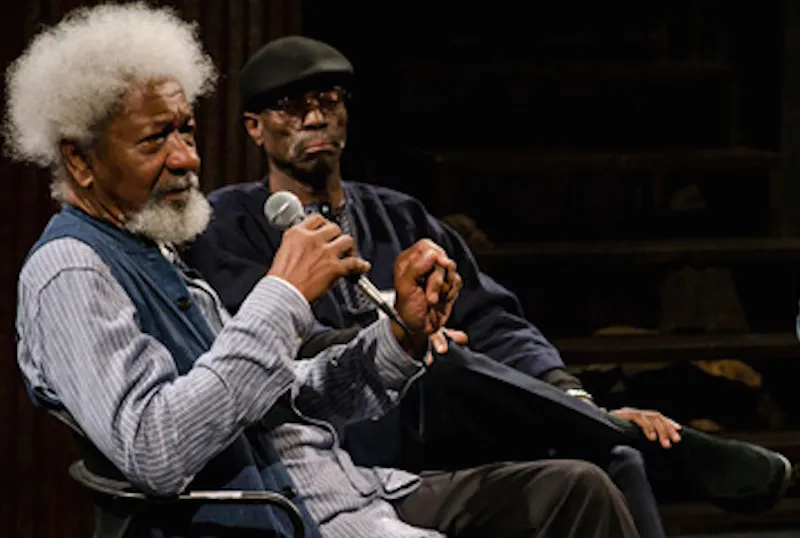
Marxist Jailer, Pyratical Mutineer
By Wole Soyinka
Any attempt at a linear seizure of the being that became known simply as “BJ” is bound to collapse under the weight – not of contradictions, but – of new, detailed revelations of his variegated engagements with the society within which he matured, and against whose deficits he honed both instinct and intellect. Even the episode with which I am about to cite as illustrative expositor, turned out to have been factually mis-recalled. Thanks however to editorial fact-checking, I found myself confronted with a quite significant adjustment in my portraiture of this recently departed colleague. I fully expect that his closer associates will help us with a more detailed, juicier account of his little known career as a prison warder, albeit set apart from the decrepit system of the so-called State Correctionals. Here goes!
BJ was a member of a commune – actualizing communism as in commune, one is tempted to commend! That entity was set up on a farmstead (donated, lent or leased?) in Ode Omu, off Ipetumodu en route Obafemi Awolowo University, Ile-Ife. Their ‘landlord’, and general overseer and provisioner was the medical doctor, Seinde Arigbede who, by the way also took a principal role in my KONGI’S HARVEST.
BJ revealed all of this himself during his 60th Birthday Symposium at The Jazzhole, Awolowo Road, Ikoyi, Lagos. Was it an authentic, viable commune? Doomed to degenerate into a praetorian order of utopian delusions – like the Japanese Red Brigade? Or simply pacific, even monkish in temper? I was no insider, kept a wary, detached watch from a safe distance. Membership commitment seemed well-founded and genuine enough. There were, inevitably, dissidents over ideological niceties, some, I learnt, even requiring arbitration by visiting ideologues, carapaced in degrees of textual rigidity, directly from Source.
My stubbornly held version among several variants goes as follows:
On one of his rounds on Security watch, BJ caught a colleague – none other than Edwin Madunagu – engaged in some kind of anti-commune activity and promptly “arrested” him. The crime involved some newly harvested yam. With or without the involvement of other members, this cerebral felon was placed under confinement, pending formal arraignment and sentencing. It was a loose confinement, predicated on Madunagu’s word of honour that he would neither attempt to escape nor violate the terms of his detention. However, the following morning, Madunagu’s ”cell” was empty. The search was brief. He was discovered calmly breakfasting on the evidence – none other than the same roasted yam – in BJ’s apartment. Participating in this morning feast was his captor-cum-megadi, Biodun Jeyifo!
True or false? Allowing, confessedly, for my own exercise of poetic licence over a few details, this can now go on record as my authenticated version, since it would be entirely in character. Never a simplistic, text-bound application of cause and effect, of programmed thinking or automated responses, but nurturing a camaraderie of ideological identity. One’s mind leaps immediately to the humanizing base of thought and act most colorfully expressed – no pun intended! – by the black American writer-critic Randall Kenan in those famous words: “I yam what I am.”
Let me stress, however that the Ode Omu communards took their venture quite seriously. It was their physical expression of a rejection of, and physical separation from, a society designated decadent, reactionary, and in need of revolutionary salvation through praxis.
Of course, there were dissidents. A mild study of BJ’s writings makes him stand out as typifying what, in a different environment and under absolutist state control, could have earned him a long spell in a Stalinist gulag for reorientation, leading to the notorious outcome of recantation recitals. Such a risk would be no deterrent for BJ’s temperament, however. Securely anchored ideologically, his intellectual integrity forced him into disputational positions that separated him from the bane of “vulgar Marxism”, the inflexible doctrinaire species that contributed to the demise of an alternative social order to capitalism. For BJ, material base remained tethered to theory, not clipped halfway for authoritarian diversion – witness his tireless media series that he titled Talakawa Liberation Courier, or indeed his stint in the experimental commune. Tracking these multiple. intertwined strands in the making of an “action Marxist” belongs to a diligent biographer, and there lies the promised solace of unique testaments for the patient reader and/or student in, hopefully, the immediate future.
Did this connection provide the base for Edwin Madunagu’s spontaneous acceptance, years later, to deliver the Annual Lecture of the Pyrates’ Confraternity, I wonder? By general response, it was one of the most stimulating lectures of the series. Unlike his erstwhile prisoner, BJ was a member of the Confrat, a continuum of his measured dissident, yet collective temperament, and manifested in both profound and offhand ways. It would be impossible to propose a more defining illustration of this than his most recent caper!
Two years or more ago, I learnt of an alarming deterioration in BJ’s health. We had recently lost two of his companion seadogs in quick succession. I became alarmed that this might become a habit, so I issued orders that all members should line up behind their Founder and sole surviving Mentor, and take their appropriate turn in tune with the clockwork of Nature. No more unruly queue jumping would be tolerated thenceforth, and any contravention would be met with severe sanctions.
So now, typical of this incurable maverick’s habit, he sets off an ideological conundrum – no different from consuming roasted yam with his “awaiting trial” prisoner. Our man has gone the limit, defiantly taken a step that amounts to the serious crime that the Confraternity designates – MUTINY! How on earth or ocean does a believer in rigorous justice deal appropriately with such a willful mutineer? Odas is Odas within the PC, the historic catchphrase with, however, the sacrosanct qualifier – unlike some panicked MAGAphone declarations across the Atlantic – No illegal orders!
To make matters even more daunting, a “favorite son” regarding, spanning decades, has existed between this errant member and his present accuser and judge. Surely, issuing odas to followers NOT to jump a queue cannot be considered illegal, even if an element of self-interest is involved, since it encourages the issuer himself not to be in any hurry but linger over the moment’s existential challenges. So, what to do?
The solution constitutes a pyratical paradox, not unknown to followers of Zen – a petal enfolded within the thorns of a dialectic, a rosette between the horns of a dilemma. I affirm that Biodun Jeyifo remains one of the top five students world-wide it has been a delight and stimulus to engage, and cite as a model of intellection – across cultures, generations, and ideologies. Since I stand accused of favoritism on account of this very attribution –
I recuse myself.
(CB of Tortuga,
National Association of Seadogs)
*Wole Soyinka is the winner of the 1986 Nobel Prize in Literature.
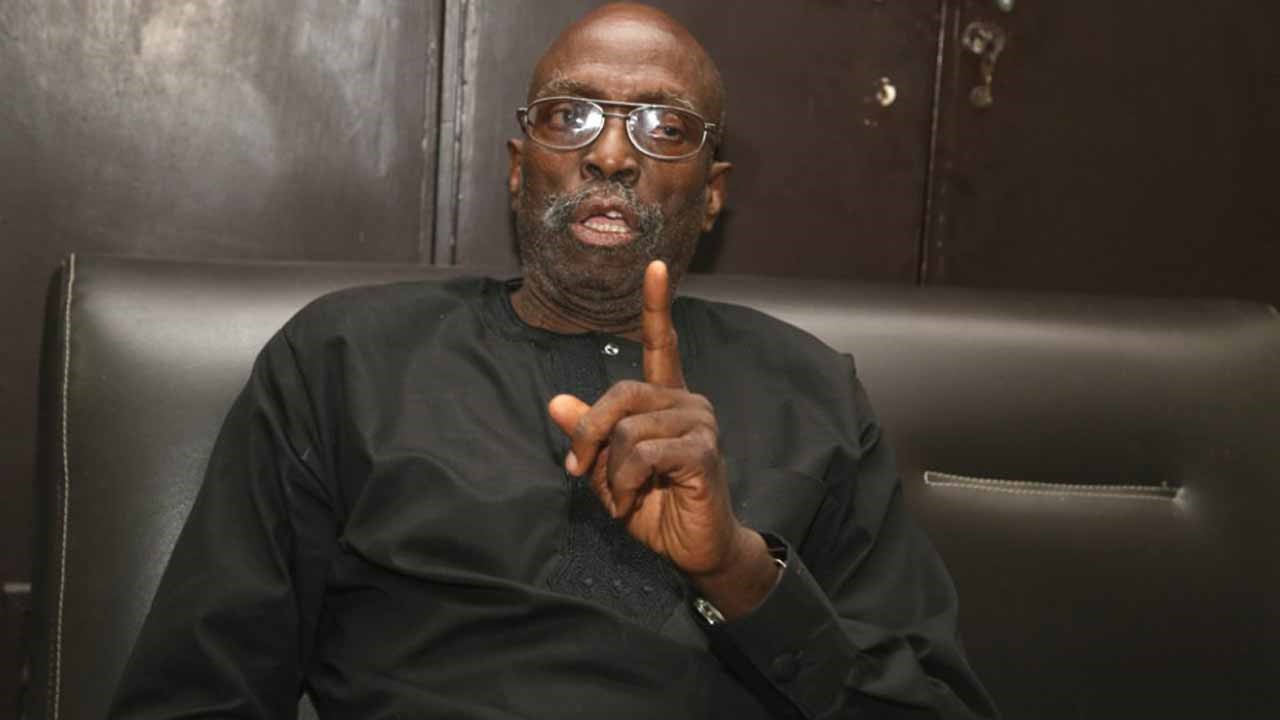
Biodun Jeyifo, travel safely as you cross over to the other side
By Henry Louis Gates Jr.
BJ and I had the distinction of sharing a mentor in common: he studied with Wole as an undergraduate and I studied with Wole as a graduate student, and that difference gave us a way to broker our competition over which of us was Soyinka’s greatest student (in our own minds, of course!). BJ took the undergraduate laurels, and I the graduate accolade, and that peace treaty enabled us to preserve our friendship, a deep and abiding friendship that we celebrated as colleagues in Ithaca, New York, and of course in Cambridge, Massachusetts.
If we found a creative way to resolve the tension that highly motivated students inevitably feel about their relationship to the tutor whose work and teachings led them to their chosen profession, there is no question that BJ was the superior between us as a close and careful reader of Soyinka’s plays. And not only superior to me, but superior to all other critics. BJ brought an intensity to his analysis of Wole’s master works of tragedy and comedy that brooked no rivals—that, and a keen ear for the music of language and myth that Soyinka has forged as his very own poetic discourse. I learned something about those plays every time I read, and re-read, BJ’s take on them. And long will BJ’s legacy live as the master critic of the master playwright’s oeuvre.
My favorite memory of BJ—of so very many memories—is of a night in Stockholm, Sweden, following the presentation of the Nobel Prize in Literature to Wole, on December 10th, 1986. BJ and I were so deliriously happy that a stranger could be forgiven for assuming that it was our birthday or that we had won a prestigious honor ourselves. But our happiness was for our friend and mentor, a happiness that justice had been served, that of all of the writers on the African continent and spread throughout the Diaspora, it was Wole who had earned this honor, had earned his admission to this tiny and most exclusive club.
I am not sure if it was too much wine or too much aquavit, but the effects showed in the raucous way that we roamed the streets around Stockholm’s Grand Palace Hotel, determined to resolve once and for all whether Soyinka’s greatest play was “The Road” (BJ’s choice) or “Death and the King’s Horseman” (my choice). Explicating act, scene, and verse, the combat—which lasted far into the night—was as heated and as contentious as that between Euripides and Aeschylus as depicted in Aristophanes’s hilarious play, “The Frogs,” as we hurled punches back and forth in the literary version of “The Thriller in Manilla” or “The Rumble in the Jungle.”
I have no idea what passing Swedes thought of these two crazy black men shouting at the top of their voices about which of Wole’s plays was the “true” masterpiece, which would last a thousand years. It was an argument that ended only because of sheer exhaustion, as the two combatants fell into each other’s arms, laughing hilariously at the top of their lungs, bemused at the magically delightful absurdity of this moment, two weeks before Christmas in the frigid land of the midnight sun, so very happy for our friend, so ecstatic that a committee of Swedish literary scholars had affirmed what we knew all along, even as we sat in his classroom, that here was a poet of the ages. And the experience that we shared in common as Wole students gave us membership in a most exclusive fraternity, forging between us a bond that can never be broken, a bond that stood the challenges and ravages of time.
My only complaint about BJ, my stubbornly cantankerous brother, is this:
“You left us all too soon, dear brother. Thank you for the pleasure of your company all these years. Our dining table will always have an empty chair that can never be filled, our little fraternity a missing member. Travel safely as you cross over to the other side, take your rest and find ultimate peace.”
With Love, Your Brother,
Skip
*Henry Louis Gates Jr. is the Alphonse Fletcher University Professor and the Director of the Hutchins Centre for African and African American Research, Harvard University.
BJ: Comrade, Revolutionary Collaborator, Friend, Brother
By Edwin Madunagu
Within a space of less than 15 months — November 26, 2024 to February 11, 2026 — I lost two exceptional comrades who made it possible for me to become a professional revolutionary, and then remain so for more than 50 years. These two comrades, two of Nigeria’s frontline revolutionary socialists and Marxists of my generation, were Bene Madunagu and Biodun Jeyifo (BJ).
I met BJ in students’ union politics at the University of Ibadan during Nigeria’s Civil War, or Nigeria – Biafra War (1967 – 1970). I met Bene, also in students’ politics, but at the University of Lagos in 1973. History then brought the three of us together in national and international revolutionary socialist and Marxist politics in 1975. Bene and I were married in mid-1976. Comrade Bene died on November 26, 2024, while Comrade BJ died on February 11, 2026. I, Edwin Madunagu, remain the only one standing as a founding member of the revolutionary union which included Bene, BJ and myself, that was set up on Christmas Day, December 25, 1975.
Within 6 months of setting up this union, I became a professional revolutionary. BJ and Bene stood at the apex of my ideological, political and personal relationships. In strategic ideological matters, BJ and Bene could predict me almost exactly, just as I could predict them. With the departure of both comrades within 15 months of each other, I have definitely lost a big fraction of my person.
But beyond that, I can also say that Marxism, Socialism, Feminism and Humanism in Nigeria and beyond have lost unquantifiable and immeasurable fractions of themselves. I did not call BJ and Bene comrades because they were beyond comrades. They cannot be replaced. But there is hope beyond them.
I salute BJ and Bene: Comrades and Comrades-in-arms, Revolutionary Collaborators, Friends. I salute them: Brother and Wife, respectively.
*Edwin Madunagu, former Mathematics lecturer, Universities of Lagos and Calabar, worked full-time between 1985 and 1994 as member Editorial Board of The Guardian newspaper. He is a revolutionary socialist.
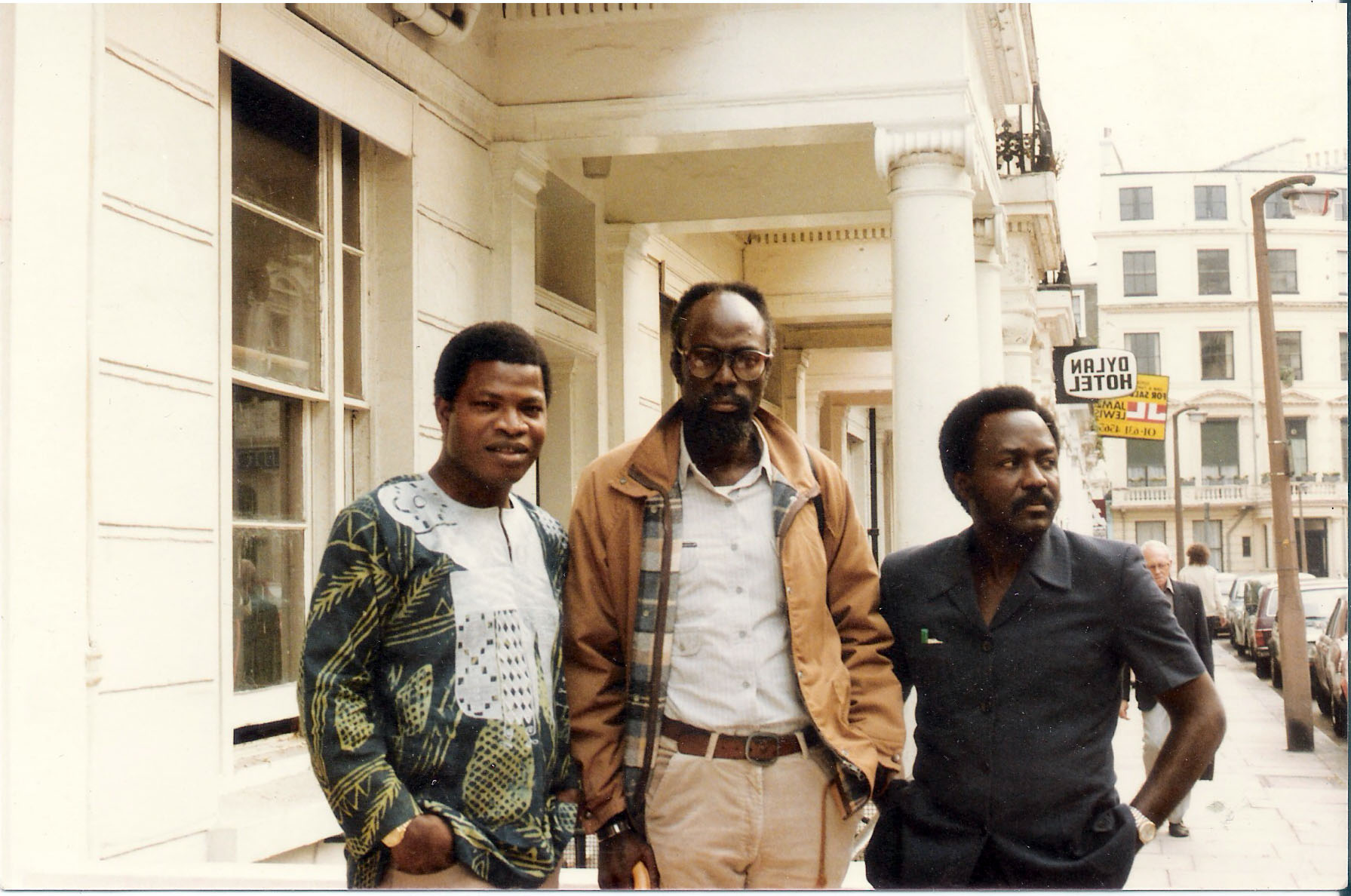
For My Friend, Brother, and Mentor
By Yemi Ogunbiyi
I also made friends at school, some of whom have gone from being just childhood friends to ‘siblings’. One of such friends is Biodun Jeyifo (then known as Biodun Jeyifous!). Following in the footsteps of his older brothers, Eddie and Ade, Biodun (BJ) had entered Ibadan Boys’ High School the year before me, and so was a year ahead of me. I do not now remember how we started getting chummy, considering that interaction with a ‘senior’ was generally a no-go area in those days! When I first met him, he appeared frail, shy, and, like all of us at that age, a bit of a gauche teenager. Yet, BJ managed to stand out in several ways. For one thing, he spoke such flawless ‘pidgin’ English that I was compelled to take notice! Coming from Kano, where we prided ourselves on our impeccable ‘pidgin’ English language skills, BJ blew my mind. I didn’t realise at the time that he had grown up around the multi-ethnic and multi-lingual surroundings of a police barracks in Oke-Bola, where his father had worked as a famous police officer. With the possible exception of another of his classmates, Wole Sule, he spoke ‘pidgin’ English, as we say, like a Warri boy. Then, gradually, we discovered our shared interests in literature, particularly crime fiction at the beginning, and would exchange Agatha Christie and Arthur Conan Doyle’s works virtually weekly. Then, when he moved to the boarding house in his final year, and we shared the same floor at Okuseinde House, we got even closer.
But BJ was unlike me in one fundamental respect: he always got into trouble at school! There were latent streaks of bohemianism in him, an anti-establishment stance that oozed from every part of his body, even as a young teenager. It was not surprising that he was fingered, whether rightly or wrongly, as one of the ringleaders in the strike action that led to the brief closure of the school in 1964.
Yet, different as BJ was, he was generally an admixture of great admiration, bewilderment, and puzzlement for many of us! Many of us, his juniors and classmates alike, were all in awe of him in a strange way. He was a great lad to be with, with a capacity for rib-cracking jokes, in flawless ‘pidgin’ English that left you in stitches. And the fact that he wrote so well set him apart and endeared him to many. But then, he was such a nonconformist in the most puzzling of ways that he always got himself into trouble with the school authorities. Consider, for instance, his general interaction with school teachers.
As part of Nature Study, every student was allocated a portion of land to plant and tend flowers and plants in the junior forms. Because of the constraints of space at the school, these were small ten-by-three-foot beds. The flower beds would be inspected regularly as part of our Nature Study practical class during the rainy seasons. Failure to properly tend and weed the flower beds attracted poor scores in Nature Study and a few strokes of the cane from Pa Osunyejo. BJ hardly complied with Nature Study directives, and it didn’t matter how many strokes he received; he would flunk the next inspection! So, one day, some of us, admirers of his in the lower forms who were ever so sorry to see him get whipped so often, decided to help tend his flower bed for him as if he had done it himself. Then came the inspection day, and all that BJ needed to do was just show up. He doesn’t show up and ends up getting whipped again. This happened several times, with the same results, until we finally gave up on him!
My brother, Lai, who’s also quite close to BJ, has many similar stories about BI’s blatant refusal to just fall in line at school and be a good boy! Despite these stories, or perhaps because of them, BJ and I got even closer!
And as would become more apparent in the subsequent sections of this volume, he was to have a tremendous impact on my life. Almost intuitively, and quite naively, it seems now, I wanted to be like him. The moment BJ got admitted to Government College, Ibadan, for higher school, I said that I could get into any higher school of my choice! Similarly, once he opted to study English at Ibadan, I suspect that he may have, unwittingly, had a hand in my decision to study English at Ibadan rather than my earlier desire to read Law at the University of Lagos. And I am not sure how it happened, but once I got admitted to Ibadan, I ended up in Kuti Hall like BJ. However, I am reminded that he had his summer holiday job in the months before my resumption in the office that processed hall allocations for new students! It would be fair to assume that BJ may have switched my hall allocation from a different Hall to Kuti Hall!
And when he ended up at New York University in the United States for his higher degree, I ended up there too, in the same department, under the same teachers. But I failed woefully in one regard: my miserable Lower Second Class degree in English from Ibadan was an anguished cry from his exemplary First Class, the third in the history of the university and, I believe, the last ever since. Although, I should, in fairness, add that in lighter moments, BJ has conceded that there’s one area of human capacity where I am miles ahead of him!!!
*Excerpts from The Road Never Forgets
*Yemi Ogunbiyi, former MD/ CEO of Daily Times, is the Chairman of Tanus Books.
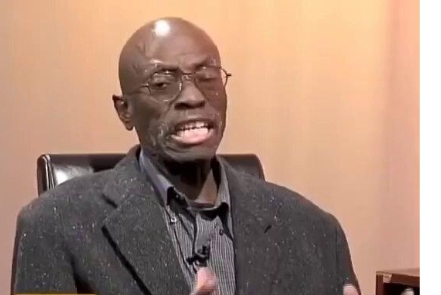
BJ: Exit of a global Master Teacher
By Ropo Sekoni
By great good fortune, I met BJ for the first time in 1976 at the African Literature conference in Boston. Ever since, it has been a lesson in learning and sometimes in teaching all the way. We were, for most of our relationship, what the Yoruba call joking partners.
As joking partners, we always give each other space to joke without inhibition and laugh at each other, despite the two years between us. In other words, each always had the license to behave as Otu or Awe in the Ondo dialect of Yoruba, i.e., persons of the same social group, regardless of age or professional status. Therefore, I would not publicly mourn BJ in this piece. I would laugh with him because we had been joking partners for over 40 years. During his ‘Reaction Time’ or Transition Phase from the physical realm to the Ancestral phase, which Catholics call Purgatorio, a common African belief is that the deceased can hear and laugh with or at us as we bid him our final farewell in ways undetectable to us.
BJ! I feel privileged to have benefited from your vast intellectual, ideological, and emotional support since 1976. Without being your student, I learnt substantially from many of the values you promoted throughout your life, in particular your humanism, generosity, selflessness, humor, and workaholism.
On a personal level, I benefited immensely from all the values above and others not identified. Without your assistance, I would not have joined the Ife faculty when I did! I can still hear your advice on when and why I should come to Ife when you visited Ilorin: “RS, someone who loves his family the way you do should not live too far from them, especially your father, who was already in his 60s. In addition, you will fit into the project of decolonising teaching and pedagogy that has sprouted in Ife.” And the rest has become history.
As a sincere humanist yourself, you have consistently fueled the university’s solidarity with those characterized by the season’s military hegemony as “people that teach what they are not paid to teach.” The broad support from a faculty already stimulated by your leadership of ASUU years earlier shaped the management’s lukewarm attitude toward the plot of the season’s dictator to erase the nascent culture of critical or liberation pedagogy at Ife. The Ife tradition of liberation pedagogy survived its military dictator and many others until new dictators emerged later, to ‘stimulate’ the scattering of the tribes across many Nigerian universities, soon after the Structural Adjustment Plan turned the educational system on its head.
Everyone who has interacted with you must have experienced your readiness to assist others. Your selflessness and gladness to assist others with your books, time, and creative devices to ensure your books remain fresh in in the mind of borrowers, especially, the speed with which you reminded me about “overdue books” or the readiness with which you brought new books from your many travels to the U.K. and U.S, to Banke unsolicited but with warnings on orange papers with notes in capitals in red to be returned on the first day of my return to work after my usual 3-day sick leave for my frequent gout attacks. BJ, you increased my reading speed phenomenally much faster and more sustainably than my teacher in my undergraduate school, principally because of your tyrannical deadlines to return your books loaned to me unsolicited! But I remain grateful even in my Arugbo years.
BJ’s sense of humor was always on hand to lessen the seriousness that was always obvious once in his usual pensive mood, especially how quickly he switched from his philosopher pose to the levity that often accompanies moments of humor. One day in the mid-80’s, we left my house in Omole Estate to go as external examiners to Ahmadu Bello in BJ’s beetle car. I tried to volunteer my car for the long trip because it was more spacious and newer than his Volkswagen. He laughed and said, “RS, my car is better than yours in many ways that you should know.” I asked him in what ways?
He started laughing while inhaling his pipe and advised me to press him for his reasons later. My wife came out to wish us travel mercies. After we turned right onto Ondo Road, he asked if I still wanted to know why his car was better and safer. He started nodding his head triumphantly and quickly said with all seriousness, “RS, I don’t want to hurt your feelings, but if you insist, let me tell you, you are the first reason. You are an illiterate driver, and you know this!” He later reminded me of many years ago, when he left his house on campus for my house in town because I did not know how to start my manual Peugeot, which was more spacious and posher than his Volkswagen… I waited till now because I did not want your wife to hear the whole truth about you.”
BJ had suddenly gone dramatic. He reminded me that when my American car stopped working five years ago, I found someone to bring me to his house to leave a message with Sheila about what I considered a crisis. He kept watching my reactions, and I kept giggling. When he finished, we kept looking at each other, and he looked at me intensely to identify if I was uncomfortable. I suddenly started laughing, and he asked me if he had hurt my feelings. He offered me some of his higher-grade tobacco for my own pipe, and we both laughed at each other. He said he was gauging my sense of humor. I then assured him that I was enjoying every second of it and that he looked too engrossed to be so humorous. I told him about the principle of joking partnership in my part of Yorubaland and immediately pronounced him a joking partner!
Finally, years later, BJ asked me to drive him to Ikeja Airport from Ife. When we arrived at the airport, we got his usual Hippie bags out of the car. He had said many years back that I was not literate enough to drive. I suddenly heard him say, “RS, we are in trouble! We forgot my passport on his reading table in his house.” I told BJ that he was not a literate traveler. He smiled, adding that there was no room for humor from any of us for the rest of our travel time, because we still had to drive back to Ife. I shut my mouth, but we spent most of the trip from Ibadan, after spending the night with Femi Osofisan, arguing about the psychology of forgetfulness. It was my turn to pay him back by giving him step-by-step tutorials on travel literacy. Of course, BJ got the point right away. “RS, you are hitting me back for the factual observation I made five years ago! Remember that you are the egbon here.” I quickly shot back, reminding him that we had voluntarily agreed to operate as joking partners!
BJ, you died without preparing us for anything like this in the space of two weeks of your well-deserved birthday celebrations by your friends, admirers, and academic mentees, during which many of us, your fellow octogenarians and soon-to-be octogenarians, danced graciously. You certainly must have been the Ajantala, (a ‘wonder-child’) that I often called you. You have put the fear of premature death to shame! You have also shamed death by dancing for two weeks to receive him/her, and as an octogenarian! You came as Ajantala, omo olokiki, worked like olokiki, and exited like olokiki. You had made the best of what you thought would be a short life!
Awe! At death, you were part of the 43% of human beings who currently cross the line to the septuagenarian side, enough to ridicule death, as our ancestors would say. BJ, Bi Onirese ko baa le singba ma, eleyi ti o ti sin ko lee parun. Sun re o!
If the master artist is no longer able to create wonderful images, the ones he has already completed cannot be deleted from human memory. Rest in peace!
*Ropo Sekoni is the immediate past Chair, Board of Trustees of the Wole Soyinka Centre for Investigative Journalism.
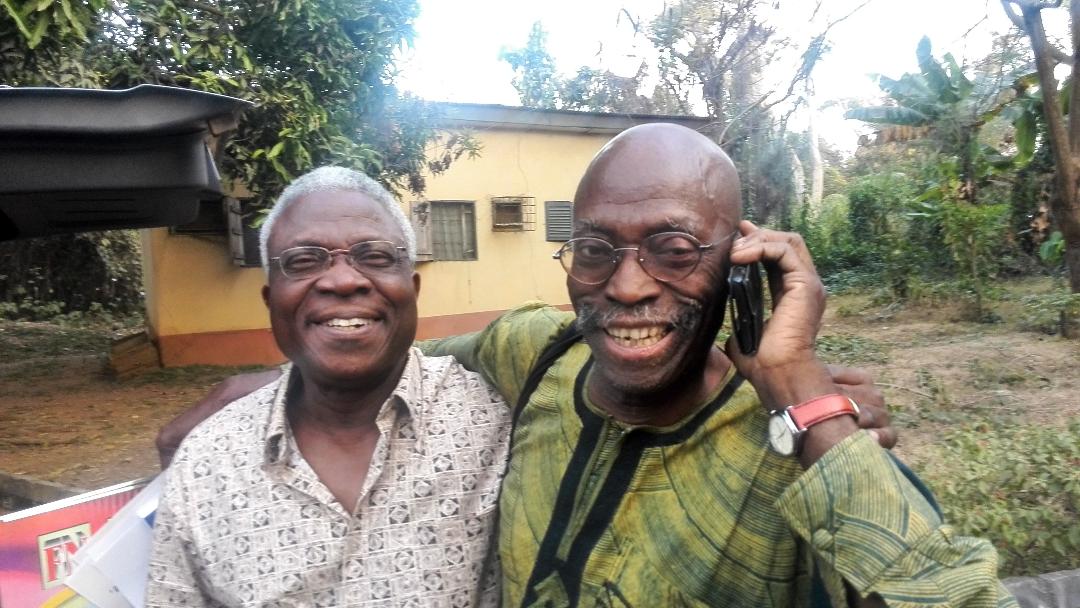
FOR BJ
(A friend who makes GOODNESS so attractive)
By Niyi Osundare
Tall Daring
like a tower like a dream
yet in timeless communion yet achingly real
with ants who live like the penetrating touch
at the grass’s root of the morning dew
Sober Leader
like a Stoic by unanimous acclaim
yet the palm tree yet a follower
pleasures his laughter whose humility needs neither
with its happiest juice prop nor craven mask
****************
A mind Denizen
capacious as the ocean of that liminal space
and countless times as deep between the head and the heart
intense as the midday sun you enrich the learned enterprise
generous as the moon in its prime with a flair so rare in its seminal force
********** *********
Wit is your wand
Compassion your compass
You bring to Friendship
An energy so compelling
To Trust
A covenant so true, so enduring
To Humanity
Light which succeeds the night
Thank you, BJ, for making GOODNESS so attractive…
*Niyi Osundare, an award-winning poet, is Emeritus Professor of English at the University of New Orleans, USA.
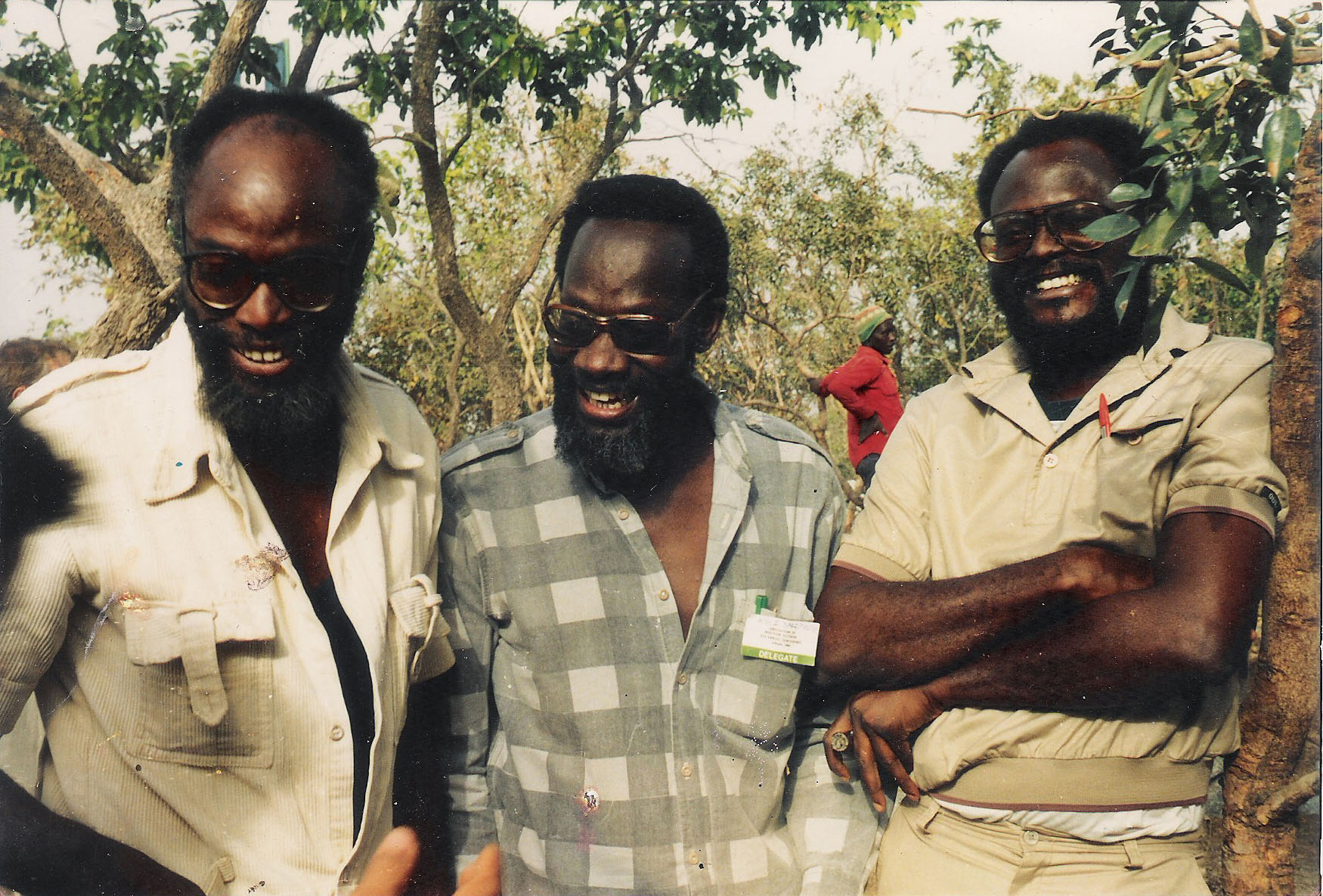
BJ and I: A friendship that caused me troubles
By Femi Osofisan
Now, what should I say about BJ? This is someone who I have known for many years or so; travelled with to so many places in the world; taken advice from and given advice to, even when not solicited; and shared my most intimate secrets with. He is simply my best friend.
Which should I reveal or not reveal? What would sound like mere banality or careless gossip and what would be a betrayal of trust? Those who have known true friendship will understand this dilemma. It is not just easy to speak in public about someone who is, to all intents and purposes, almost like your alter ego. And yet who could possibly speak better about BJ, if not me? Thousands of people know him, of course. Some of you here had shared other secrets with him, which I may not even know about. Some of you have, no doubt, been in places with him, to which I have had no access. You will all, as I understand, give your own testimonies as we go along today. But there is one advantage that you would not have shared. And that is one of physical resemblance which we used to share. Only Kole Omotoso can know what I am talking about. So incredible, as it may seem now, the three of us- BJ, Kole Omotoso and myself- used to look remarkably alike to the confusion even of our close relations. Years have now intervened. I have put on weight, the result some say of good marriage (I don’t know about that). Whereas, BJ has lost a lot, perhaps caused by years of illness. But at one time, particularly when all the three of us were graduate students in Ibadan, it was a hard task for many people to distinguish one from the other.
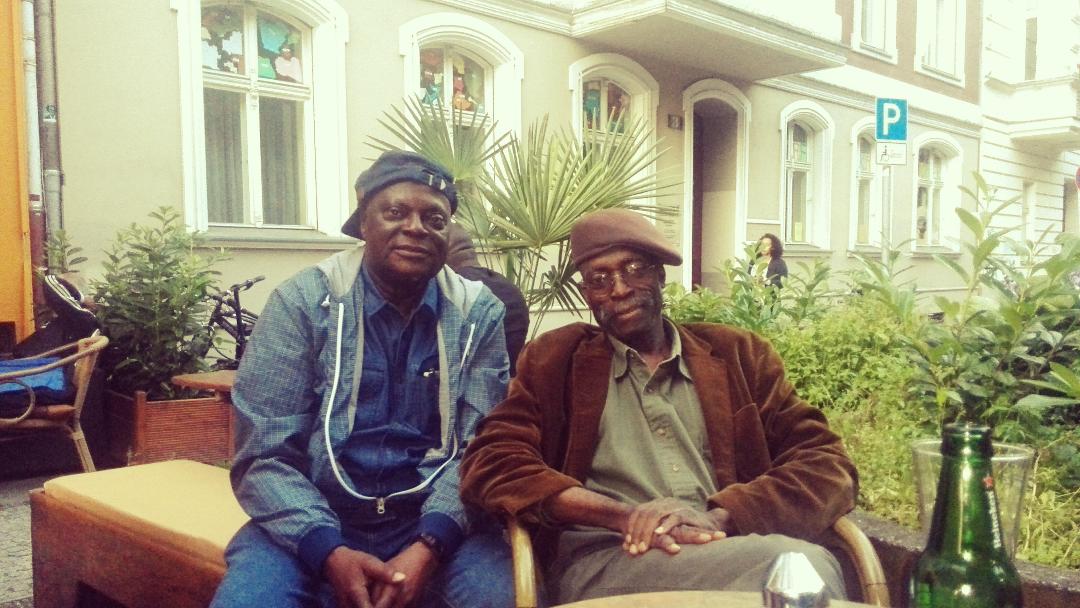
You can imagine, therefore, what sorts of escapades, what kind of adventures- some unpleasant, some irritating, and some plainly salacious that this similarity of physical looks led to. I am not going to tell you about these yet but I can complain that given the fact that I was the least rascally among us, the most harmless and the least likely to go on searching for trouble. I am talking here of searching for trouble just for its own sake, like one possessed by Ajantala. You can imagine how I was the hapless victim, on several occasions, of their crimes. How I was made to pay for crimes I had not committed and, indeed, not even known about.
The most remarkable of them is the one I call “The Library Incident.” This was in fact the main library of the University of Ibadan, now called the Kenneth Dike Library. I had gone with all innocence one morning to continue my studies as usual. To my great astonishment, no sooner did I sit down to arrange my books and note bags on the table around me for convenience than I saw four security guards marching towards me. “Excuse us Oga,” said the one who was their leader. “They say make you just pack your books quickly, sir and commot the library quick quick.” I was naturally taken aback. “Why?” I asked. “They say make you no ask any question, just respect yourself.” They didn’t allow me to finish. Before I could stop them, they had gathered my books, stuff them inside my bag. “Follow us now sir. We no want make trouble with you.” I looked round desperately. What could have happened? Had that part of the library been recently closed to readers without my knowledge? But there were other readers on adjoining tables all of which eyes were fixed on me. Or had I forgotten to renew my reader’s card? But even then there would be a prior notice of warning and so on. The eyes looking at me were too embarrassing now. I could not stay any longer nor start an argument with them. I could not but follow the guards. They led me to the entrance door and threw me out of the gate. I was so really perplexed what could have happened? This was the place I had been coming to for months. I had sat at the same table that I had been using. So, why would these ones unceremoniously send me out without giving me any explanation?
When I began to stagger back towards the hostel, in a kind of daze, then just by Sultan Bello Hall, I saw my friend BJ coming. “BJ,” I called out to him. “BJ, something terrible has happened. They’ve gone mad in the library. Some lunatics-yes, plain lunatics- have seized control there!” BJ asked me what happened. And I narrated to him what I had just gone through. And what do you think BJ did? He burst out laughing. I got worried. Is this madness spreading now? What would cause someone to laugh at what I have just told him? Then he explained to me what must have happened. It turned out that the day before he had had an altercation with the deputy librarian. It had been so serious that the Chief Librarian had to intervene. And BJ was asked to apologise. But my friend refused; even after several entreaties, he would not apologise. The result was that the Chief Librarian seized his card and suspended him from the library until further notice. So, it was easy to see now what must have happened. They had obviously mistaken me for him that morning. Once again, I had been humiliated and punished on his behalf. And there he was laughing.
I can recall several such occasions. But you see now the kind of friend I have. When people ask me, therefore, why I had put on weight, I tell them simply that it is because God loves me. He saw that I have suffered enough for other people’s transgressions. So, mercifully, He changed my looks so that some people can begin to pay for their own sins themselves. This is one of the reasons our friendship has grown more solid over the years; for apart from those physical characteristics, we share so many other things in common. Literature, for instance, is one passion that we both share; but just as crucial is our belief in compassion. We are both critics and writers, journalists as well as literary theorists, actors, directors and teachers. It is the emphasis that differs. Perhaps, best way to put it may be to say that well, while I have been more of a literary activist and writer, BJ has been more of a political activist and theoretician. The time will come to explore these new axes but not here this evening. I did not wish to bore you. But all I wish to say is that today, BJ is unarguably one of the three foremost literary theorists in the field of writing and literature but certainly the leading authority on Soyinka’s works. This, you must know, is no mean feat, given the diversity and complexity of Soyinka’s works; and also the equally formidable list of brilliant critics the works have attracted. To stand tall without company is a distinctive achievement. I am very proud of my friend, BJ; proud to say, Happy Birthday!
*Femi Osofisan, an award-winning poet, playwright, and distinguished Professor of Theatre Arts at Kwara State University. He gave this speech in Lagos 20 years ago when BJ turned 60
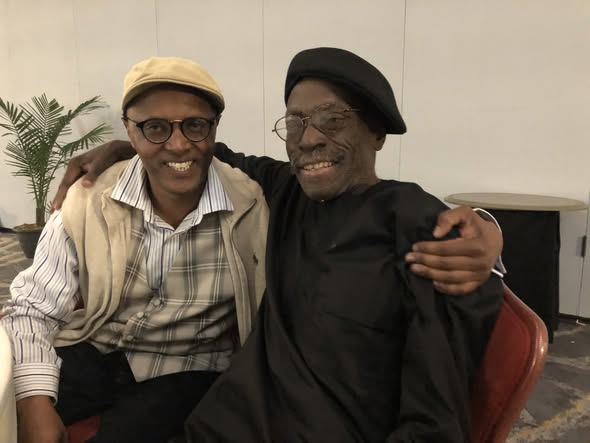
Traces: In honor of Biodun Jeyifo
By Eileen Julien
Ten years ago, to mark BJ’s 70th birthday, I wrote an essay which appeared in JALA, the Journal of the African Literature Association. That essay, entitled “On Duality,” began with several epigraphs which you all know and which are surprisingly relevant as we take stock of BJ’s death. They are known around the world, thanks to Chinua Achebe:
“Where one thing stands, another stands beside it.”
“The world is like a Mask dancing … If you want to see it well, you do not stand in one place.”
The final epigraph in my article is a citation from Bertolt Brecht who writes: “Our hope lies in contradiction.”
Over the last days as I have struggled to communicate my deep appreciation of BJ and to find appropriate language to celebrate his 80 years and to accept his departure, I scrolled through our numerous email exchanges over the many years in which we were a team, working together. These epigraphs structure BJ’s message on the death of Harry Garuba whom you may have known or known of. And they are a perfect reflection on BJ’s own death.
On March 1, 2020
BJ wrote: Death has played a terribly tragic game on us!
So wrote BJ to James Ogude with copies to several others including myself when he learned of Harry Garuba’s death just two weeks after the wonderful symposium in my honor which BJ attended along with others.
He goes on, referring to Ogude: You and I met again in Bloomington two weeks ago in a memorable reunion and talked a lot about Harry. You informed me of his illness and of his brave and unrelenting struggle against the ravages of the illness. There was not the slightest hint in your account that he was losing the struggle, that he was close to death! Woe is me that I didn’t write him right away when I got back to Boston after Bloomington!
His loss is of course colossal, like Teju’s five months ago. I mention Teju here not because they were both former students of mine, but because just as is the case with Teju, I do not and will never let death have the last word on Harry. In this I am not in denial of the immensity of my sadness on his death. Perhaps the best way to put across what I am saying here is to say that more than the fact that he is gone now, I am far more stricken by the fact that he was here. In his writing, his actions and his person you were never in doubt that he affirmed life and living with restrained irony, grace and poetry. I shall find much to relieve my sadness in my remembrance of these traces that he left behind.
There is yet another email of interest, dated April 25, 2016 in which BJ wrote:
… “eniyan l’aso mi” whose English transliteration he presented as “the human community is the only clothing I have,” even as he complained that this transliteration “does not remotely do justice to the poetry and insight of the proverb in its original provenance.” This can be read as a plea to “clothe” the dying, to remember them so that death shall not have the last word!
It has been an enormous privilege and joy to have known and worked closely with Biodun Jeyifo. We worked together on many occasions and on two major projects: the first, when I was a member of the Joint Committee on African Studies of the Social Science Research Council and the American Council of Learned Societies. BJ had submitted the sole humanities grant proposal among dozens of social science proposals. Thus, we wondered why the “humanities” got short shrift and to what extent literature was viewed as “evidence” for social scientists and, alternatively, to what extent the social sciences–anthropology and ethnology, history and sociology, for example – offered evidence critical for an adequate grasp of literature. We published The Locations and Dislocations of African Literature: A Dialogue between Humanities and Social Science Scholars (2016). More recently, we worked closely and intensely for well over a decade as we constituted the Africa team for the four-volume book, Literature, A World History (2022). I want to signal just one of the precious and powerful insights shared by Karin Barber and BJ in this project.
Not surprisingly, BJ drew out deeply thoughtful and dialectical correlations between history, politics, and writing. He then offered this gem which is simple enough but jolting in his formulation: colonial languages, he tells us, “belong” to an infinite number of non-Europeans more than they belong to Europeans themselves. This seems to be one of BJ’s last major arguments and legacies for students and scholars of colonialism and its aftermath. It echoes the epigraph in an article, “Traversing the global and the local: Fújì music and praise poetry in the production of contemporary Yorùbá popular culture” by Karin Barber and Chris Waterman, found in Daniel Miller’s book, Worlds Apart: Modernity Through the Prism of the Local: “Imagine!” said the Yoruba lady referring to lace, “the Whites put it on their windows!”
These and other projects took us around the world—from Cambridge, Bloomington, and Ann Arbor to Bayreuth, Istanbul, Hong Kong, and from Dakar to Harare.
The Jeyifo-Julien collaboration has been an extraordinary journey in discovery, learning, friendship, and deep affection.
*Eileen Julien is Professor Emerita, Comparative Literature, French & Francophone Studies, African Studies at Indiana University, Bloomington.
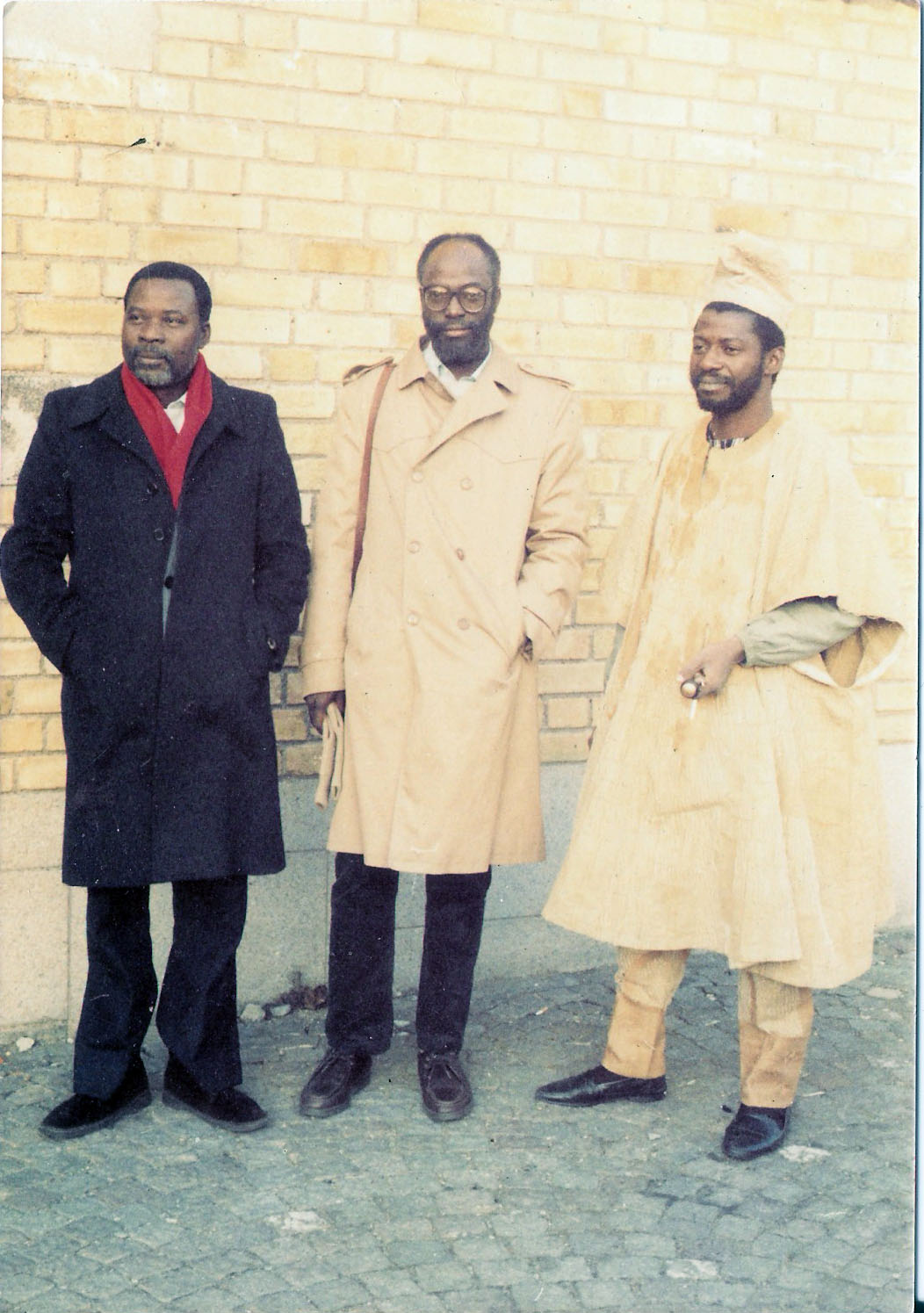
for B.J.
By Odia Ofeimun
Soon, we shall see
the naked bottom of the matter
unclothed by the flighty theorems
flailing awash in the wind
above our heads
Soon we shall clip our eyes
on the heart of the matter
beyond impotent questions
roaming uncommittedly
in the butcher’s yard of
un-interpreted reality
Soon enough
between the false paths
and the roads untried
between wish and will
we shall awaken
We shall awaken
to sight and judgement
in the common-fare
of struggle
II
A grandmother’s broken pipe
leaves the nursery
a whistle to name
the naming of things
in the streets –
that’s struggle
Over wall and fence
from turn to twist and stretch
of roads
threshing a new tongue
we struggle
New words reopen our eyes
our eyes challenge our mouths
new words reclaim our blood
our blood challenges our hands
in struggle
A madman’s joke can wrest
the world
for sanity
*Odia Ofeimun, an award-winning poet, is former Private Secretary to Chief Obafemi Awolowo and former Chairman, Editorial Board, TheNEWS, TEMPO, P.M. NEWS.
*Prof Chima Anyadike is a distinguished scholar of African Literature and a retired Professor of English, Obafemi Awolowo University
A Season of Remembrance
By Moradewun Adejunmobi
Since the sad news of BJ’s passing broke on February 11th 2026, I have not tired of reading the many encomiums devoted to this colossus in the world of literary scholarship, often replete with personal anecdotes. Alas, I was not a student of BJ’s, nor was I a colleague of his, and most definitely not a peer. In that respect, I do not have the bounty of personal recollections that his former students, peers, and friends have to share on the occasion of his passing. I belong to the generation of his students and knew him principally as a guiding light in African literary and cultural studies because my career evolved over many years and in different venues under the beneficial shade cast by BJ and others like him. Many of my closest colleagues in the field of African literary studies and fellow travelers had been his students (Teju Olaniyan, Kunle Ajibade, Leke Adeeko, Kunle George, Akin Adesokan and others). He was a close associate and later colleague of my own PhD advisor, the late Abiola Irele, whom he affectionately called “egbon.” And finally, he was one of several soon-to-become-famous creative writers and critics present at the founding of the African Literature Association, the largest professional association dedicated to the study of African literatures and founded in 1975 in Austin, Texas. I can say, therefore, that my career has unfolded in a field plowed by brilliant and insightful predecessors among whom BJ holds a prominent position.
Let me also add a confession. Not having been BJ’s student, and not having studied African drama, it was not until a couple of years after I completed my PhD that I became fully acquainted with his scholarly publications. I of course knew of him as an activist, but I had not yet read any of his scholarly writing. He was by then already a very famous scholar, but his affiliation was with English and drama/theatre arts while I was a student of French in what used to be called the Department of Modern European languages. In my student days, the walls separating academic study in one department from another were quite entrenched. Thus, I did not seriously venture into his work until after I had moved to the University of California, where as a member of an interdisciplinary department, I was for the first time free from the disciplinary straitjackets that characterized academic study while I was a student.
Nonetheless, our paths did cross a number of times, principally at events meant to honor other scholars in African literary studies where we recalled and remembered their great achievements. If my memory serves me right, BJ was one of those, possibly the prime instigator for organizing a one-day symposium at Harvard University to honor Abiola Irele when he turned 70 in 2007. After the symposium, BJ then gathered several of us to contribute to an edited volume, titled Africa in the World & the World in Africa: Essays in Honor of Abiola Irele that was subsequently published in 2011. When Irele passed away in 2017, BJ wrote to ask if I could join family and friends for a celebration of life event held in 2018. Though I was unable to attend, he invited me to contribute to a booklet of tributes for Irele. He was also at Columbus Ohio in 2019, when a surprise 60th birthday party was held for Teju Olaniyan, after the annual conference of the African Literature Association. As many of us know, Teju would pass away unexpectedly several months after that birthday party. The last time I saw BJ in person was at the April 2022 launching of the Tejumola Olaniyan Foundation. He was the keynote speaker at the day long event to honor his then deceased former student. I no longer recall the exact title of his speech, but I do remember that it was about death and the appropriate ways to commemorate our departed friends and associates.
BJ made too many contributions to the study of African literature and culture to be recounted here. Given the limitations of space, I will mention only two of those contributions. His study of Yoruba Travelling Theater in his first monograph, titled The Yoruba Popular Travelling Theatre of Nigeria (1984), as well as in other articles was one of the first studies of the travelling theatre specifically as a form of popular art. Other books on related subjects like Ebun Clark’s Hubert Ogunde: The Making of Nigerian Theatre (1980) had been published earlier but did not dwell particularly on the travelling theatre as a form of popular culture. Furthermore, BJ’s monograph was published several years ahead of the article by Karin Barber that would later provide a template for studying the popular arts in Africa. In a sense then, our study of Nigerian popular culture today, especially in its performative dimensions, whether we’re talking about Afrobeats, Nollywood, or Standup comedy goes back to the writing of scholars like BJ and Emmanuel Obiechina.
Many tributes to BJ highlight the fact that he was a Marxist scholar. That is true, but to my mind, what is more important is the style of political analysis of African literature that he proposed. In so many essays, as well as in his second monograph (The Truthful Lie: Essays in a Radical Sociology of African Drama 1985), his political analysis was sharp and deft. It was not reductive or superficial. It called upon the reader/listener to engage in deep analytical reflection. He was able to read the creative work for its politics as well as for its literariness or its creativity. BJ demonstrated an alertness to both the political and the literary in his interpretations of the works of major Nigerian writers like Chinua Achebe, Wole Soyinka, and Femi Osofisan among others. This is a skillset that has unfortunately become rather scarce in the current time. Now, we more often encounter analyses of the creative text that evaluate the creative work for its politics but not for its creativity and not for its literariness as if the two could not be conjoined in the same work.
Although BJ was a scholar’s scholar, he never once forgot his humanity in matters of life and scholarship as so many of his associates have testified. One example comes to mind. It will come as no surprise if I say that Nigerians love hierarchies, both professional and personal. The Yoruba are no exception to the rule and are perhaps even more enamored of the principle of hierarchy. But not so, BJ. In 2016, Akin Adesokan and Teju Olaniyan organized a series of panels on BJ’s work to commemorate his 70th birthday at the annual conference of the African Literature Association. The papers presented were later collected in a special issue of the Journal of the African Literature Association, published in 2019. Unfortunately, BJ was unable to attend the ALA conference that year and could not be present. The majority of us who participated in that series of panels were either his students or the generation of his students. We were definitely not peers, and yet he took the time afterwards to send us all a collective expression of thanks. In that email from 2016, he wrote: “I am deeply appreciative and humbled by your tributes. Don’t know what else to say to express my appreciation than to look to that Yoruba proverb which says “Eniyan l’aso mi” whose English transliteration as “the human community is the only clothing I have” does not remotely do justice to the poetry and the insight of the proverb in its original provenance…”
In ending, I would like to continue invoking BJ’s own words. For the loss we feel at this moment, I cannot express myself any better than he did on occasions such as these. For example, and in response to Abiola Irele’s passing, BJ wrote in the Nation Newspaper in July 2017: “Egbon, we shall not forget you. I testify that you have left us a prodigious legacy, a bountiful bequest that will never perish.” These words could very well have been written for BJ himself. For BJ as well, I say that we will not forget, and we shall never forget. In the coming months and years, I will pay regular tribute by remembering and returning to your books and essays, by remembering and returning to your practice as a scholar.
*Moradewun Adejunmobi is a Professor in the African American and African Studies Department, University of California, Davis.
Biodun Jeyifo: By Whatever Means Necessary
By G. G. Darah
Biodun Jeyifo graduated in English in Ibadan in 1970, the year I was admitted to the same Department. He earned a First Class degree and a scholarship for graduate studies. Being fresh students, my set did not have much to do with him. Then he went to the US for graduate studies, again, on scholarship. In the University of Ibadan records his name was also unique; in the 1973-74 calendar, the name appears at page 369 thus: JEYIFOUS, Ernest Abiodun Owolabi. How the name ended up being simply BJ is part of the transfiguration that cradled his identity. In his memoirs, The Road Never Forgets (2022), Yemi Ogunbiyi observes that “But BJ was unlike me in one fundamental respect: he always got into trouble at school! There were latent streaks of bohemianism in him, an anti-establishment stance that oozed from every part of his body, even as a young teenager.”
By the time BJ returned to Ibadan as a lecturer in the mid-1970s, the campus atmosphere had changed dramatically. The Nigerian Civil War (1967-1970) had ended, radical ideological and anti-imperialist outlook had spread beyond the Faculty of Social Sciences. The ideas of Marxism and Socialism were no longer taboo, even in English and the Arts. There were several student groups spotting the label “Marxist-Socialist”. From our first year in 1970, we took part in demonstrations in Lagos to protest Portuguese invasion of Guinea Bissau and Cape Verde. In February1971, police invaded the University campus and shot dead a student, Kunle Adepeju. The government probe of the tragedy exposed the inherent injustice of the military regime. Avatars of social justice defended the students – Ola-Oni, Wole Soyinka, Gani Fawehinmi, Akin Ojo, Omafume Onoge, Ebenezar Babatope, Baba Omojola, etc. General Gowon’s military regime and its neo-colonial ideology were on trial. With these turbulent events, our generation lost its innocence and political timidity.
For us in English and the Arts, the greatest change came with Omafume Onoge’s postgraduate course, “The Sociology of Literature”. The course featured radical ideas and historical world figures – Karl Marx, Friedrich Engels, Vladimir Lenin, Leon Trotsky, Mao Zedung, Kwame Nkrumah, Nelson Mandela, Amilcar Cabral, Agostinho Neto, Frantz Fanon, Aime Cesaire, Marcus Garvey, George Padmore, C. L. R. James, W.E.B. DuBois, Frederick Douglass, Malcolm X, Claude McKay, Sembene Ousmane, Ngugi wa Thiong’o, etc. We were not just studying literature for aesthetic and academic purpose; we were bearing witness to revolutionary transformation in the world and its dramatis personae included leaders of African armed liberation movements. This historical momentum began from the 1940s with anti-colonial uprisings around the globe. Nigeria’s independence in 1960 was seen as a stop-gap; a brighter and more egalitarian future beckoned. The oil boom years after the civil war nourished our optimism, even utopian expectations.
At the time BJ returned there were other liberals and radicals in Ibadan – Dapo Adelugba, Oyin Ogunba, Dan Izevbaye, Abiola Irele, Omolara Ogundipe Leslie, Sam Asein, Isidore Okpewho, Kole Omotoso, Femi Osofisan, Niyi Osundare. BJ arrived with a bountiful luggage of works on Marxism and revolutionary experiences of African American peoples – from the era of slave revolts to the Civil Rights years of the 1960s and beyond. His voice joined almost seamlessly with that of Onoge on the radical approach to literature and culture. Controversy and ideological divergence were emerging. An Ibadan/Ife radical grouping crystalised around these debates. In 1977, the Ibadan/Ife Group held a conference on “Radical Perspectives on African Literature and the Arts” at Ibadan.
My set of students did not interact much with BJ before he relocated to Ife. It was here that his career blossomed as a Marxist literary critic, teacher, public intellectual, activist unionist, and revolutionary dreamer. The presence of Wole Soyinka, first at Ibadan and later Ife, was a decisive factor. BJ was “formally” in the Department of Literature in English headed by Oyin Ogunba, an outstanding scholar of African drama and theatre. BJ was the moving spirit in the Department; his companions were Ropo Sekoni, G.G. Darah, Funso Aiyejina, Chidi Amuta, Adebayo Williams, Segun Adekoya, Chima Anyadike. BJ was virtually always on the road yet hardly ever absent in the classroom. His revolutionary methods of work connected us dialectically to other radicals in the Faculty – Akinwunmi Isola, Olasope Oyelaran, Olabiyi Yai, Karin Barber (British), Omofolabo Ajayi-Soyinka, Dipo Fashina, Femi Taiwo, etc.
He coordinated the Departmental Seminar Series that attracted scholars from diverse areas. He edited and published the seminar series in mimeograph format; the University recognised the publications for academic promotion. The Ibadan/Ife Group published the Positive Review journal, featuring an editorial collective of BJ, Omotoso, Osofisan, John Ohiorhenuan, Darah, and Odia Ofeimun. It was an instant success.
Under BJ’s impetus, our course offerings in literary theory and criticism attracted staff and students from other units. There were courses on Marxism and African Literature, Oral Literature/Folklore, Popular Literature/Theatre, Literature and Media, Caribbean and African American Literature. In our regular seminars and symposia BJ ensured Femi Osofisan and Niyi Osundare from Ibadan were present. One such event was the memorial symposium for Walter Rodney, the radical Guyana historian of the How Europe Underdeveloped Africa fame who was assassinated in 1980. BJ headed the editorial collective of the Socialist Forum and Positive Review that edited a monograph on the symposium with the title, And Finally, They Killed Him.
BJ was in the larger Ife Socialist Collective of radicals, including Segun Osoba, Seinde Arigbede, Olutoye Olorode, Idowu Awopetu, Bayo Ademodi, Dipo Fashina, Femi Taiwo, Segun Adewoye, Abiodun Adetugbo, and Sesan Dipeolu (University Liberian).. The moral rectitude displayed by members of the Socialist Collective became a barometer for measuring the humanist ethos of university workers. Students and staff who were victims of authoritarian management benefited from the justice-for-all stance of the leftists. The entire student population long radicalized by their anti-military actions from the 1970s became more assured of crusading for humane and democratic causes.
The radical profile of the Academic Staff Union of Universities (ASUU) was fashioned after BJ’s methodology of popular struggles. He was elected president of the union in 1980; it marked a turning point in the annals of academics and intellectual workers in Nigeria. His executive committee turned a near moribund association of ‘bourgeois’ lecturers into what could be described as a fighting proletarian force, certainly the best organised and the most militant in Africa by the 1990s.
The BJ executive called a strike action to demand improved service conditions for all university academic staff. The main political issue in the strike was the demand for the recall of university staff sacked in 1978 by the military junta regime of General Olusegun Obasanjo for allegedly influencing students to revolt against hikes in education costs. The affected staff were Comade Ola-Oni, Akin Ojo, Omafume Onoge, Bade Onimode, Laoye Sanda, Ebenezer Babatope, Edwin Madunagu, Bene Madunagu, and Bassey Ekpo Bassey. The uprising was code-named “Ali Must Go”; Col. Ahmadu Ali was the federal commissioner (minister) of education at the time. The students called for his removal from office for betraying a trust as Ali was a student leader during his years at the University of Ibadan in the 1950s. The sacked staff were all recalled.
The ASUU strike took place soon after the election of the civilian government of President Shehu Shagari (1979-1983). ASUU applied another Marxist tactic during the period; BJ “stepped aside” as president and Mahmud Tukur of ABU, another Marxist, was elected. This “change of guards” was effected because the union did not want President Shagari to think that the strikes were sponsored by Chief Obafemi Awolowo, the main opposition leader of the time. BJ was “Yoruba” like Awolowo; Mahmud Tukur was Fulani like Shagari.
In pursuit of its revolutionary methods, ASUU joined the Nigerian Labour Congress (NLC) to broaden its constituency of working and oppressed peoples. The BJ tradition of struggle was sustained by the union executives headed by Tukur, Festus Iyayi, Dipo Fashina, Attahiru Jega, and others. It was largely because of this tradition of incorruptible leaders that ASUU remained the spearhead of the mass revolts against military dictatorship from the 1980s.
BJ and Omotoso guided us into alliance with the African Diaspora in the United Kingdom. John La Rose from Trinidad and Tobago headed the movement. In 1982 the groups held the maiden edition of the International Bookfair of Radical Black and Third World Books. The fair was a gathering of the continents, featuring publishers, distributors, writers, artists, pro-democracy and anti-imperialist cadres from Europe, the Americas, Africa, and Asia. BJ attended eleven of the thirteen editions. He appeared on platforms with other Nigerian radicals – Soyinka, Omotoso, Ogunbiyi, Bala Usman, Jonathan Zwingina, Ifi Amadiume, Ofeimun, Darah, Osundare, Ben Okri, etc.
Marx and Engels concluded the Manifesto of the Communist Party (1848) with the summons that “philosophers have interpreted the world in various ways; the point, however, is to change it”. BJ and the rest of us believed in this historic task, acutely aware that, in Nigeria, it will be a long revolution.
*G. G. Darah is Professor of Literature in English, Delta State University.
For A Great Mind
By Olufemi Taiwo
I was in the Nigerian equivalent of my junior year when Professor Biodun Jeyifo, BJ, moved to the then University of Ifẹ̀ (now Obafemi Awolowo University), Ilé-Ifẹ̀, Nigeria, from the University of Ibadan, Ibadan, Nigeria, in 1977. He was part of a group of literary scholars who moved together and joined Professor Wole Soyinka, who had earlier moved there on his return from exile back then. The arrival of this cohort of scholars inaugurated a new conjuncture in the history of the institution that burnished the already storied identity of the university captured in the moniker “Great Ifẹ̀”. But my relationship with BJ was not structured by the usual teacher-student model. It was principally in the realm of social, labor, and political movements that BJ became my teacher, a comrade, a family friend, and a lifelong interlocutor.
Three things stand out when it comes to my recollections of BJ. First, the movement of the group of which he was a part, mentioned above, led to the renaming of the then Department of English at our university as the Department of Literature-in-English, becoming only the second on the continent to do so, following the pioneering efforts of the late Ngugi wa Thiong’o at the University of Nairobi, Nairobi, Kenya. It was also a time that heralded a distinctive school of radical thought in Literature, Philosophy, African Languages and Literature, with participation from scholars in Agriculture, Biology, and Physics. He led the group of literary scholars that curated the Radical Perspectives in Literature Conferences that would forever change the practice of Literary Criticism in Nigerian academia, with impact beyond our borders. We all partook of and were amply expanded by the conversations engendered by those conferences, as well as the journal of radical literary criticism, Positive Review, founded and edited by BJ.
Second, that cohort’s arrival expanded the circle of radical—Socialist, Marxist, etc.—professors already on campus, organised in what was called “The Wednesday Club,” which published a different popular journal, Socialist Forum. These two elements of the conjuncture, where radical scholarship and politics were concerned, were complemented by a strong radical student movement, both within the university and across Nigeria at large. I was an active participant in this radical student movement, both on campus and across the country. Ifẹ̀ was at the forefront of the radical, as in Marxist and Socialist, student movement in Nigeria at that time. As I remarked above, this was the principal theatre in which unfolded the bulk of my relationship with BJ, marked by energetic conversations about Marxism, philosophy, trade unionism, the revolutionary movement, and the possibility of a socialist revolution in Nigeria and other parts of Africa, and so on. Our disagreements were profound and sharp, and this is where my description of him as my teacher, comrade, and lifelong interlocutor took shape. He and our other older comrades modelled for us, for life, how to manage and interact with unruly youth, even when they thought we were out of our depth. That lesson continues to structure my interaction with my students and my juniors till date.
It is, however, in the realm of family that BJ’s legacy is most lasting for me, and I close this tribute with some comments on that aspect of our friendship. As we say in Yorùbá, ẹni tó múni dé ìlú kò tó ẹni a dé ìlú mọ̀, this could not be truer of how, beyond my relationship with BJ as I have just described, my relationship with his family has not only been long-lasting, it continues to be most rewarding in my life. From the time of their arrival in Ifẹ̀, many of us in the radical student movement referenced above were welcomed to their residence by his then wife, Professor Sheila Walker, who, at that time, taught Psychology at our university. There began my friendship with Sheila and her two boys, as they were then. To continue to have Professor Okunola Jeyifous, an accomplished molecular neurobiologist, his young family, and Architect Olalekan Jeyifous [Lek, this is Nigeria catching up with you], a storied artist whose works now grace cities on at least three continents—not to mention prize-winning appearances at the Venice Biennale—as part of my life remains a lifelong testament to how much the BJ connection has enriched that life.
In all, we have lost a fecund mind, an original thinker, an incredible raconteur, and simply a good human being. It is a privilege to have known and interacted with him. Goodbye, BJ.
*Olufemi Taiwo is a philosopher and a professor of African political thought at the Africana Studies Research Center, Cornell University.
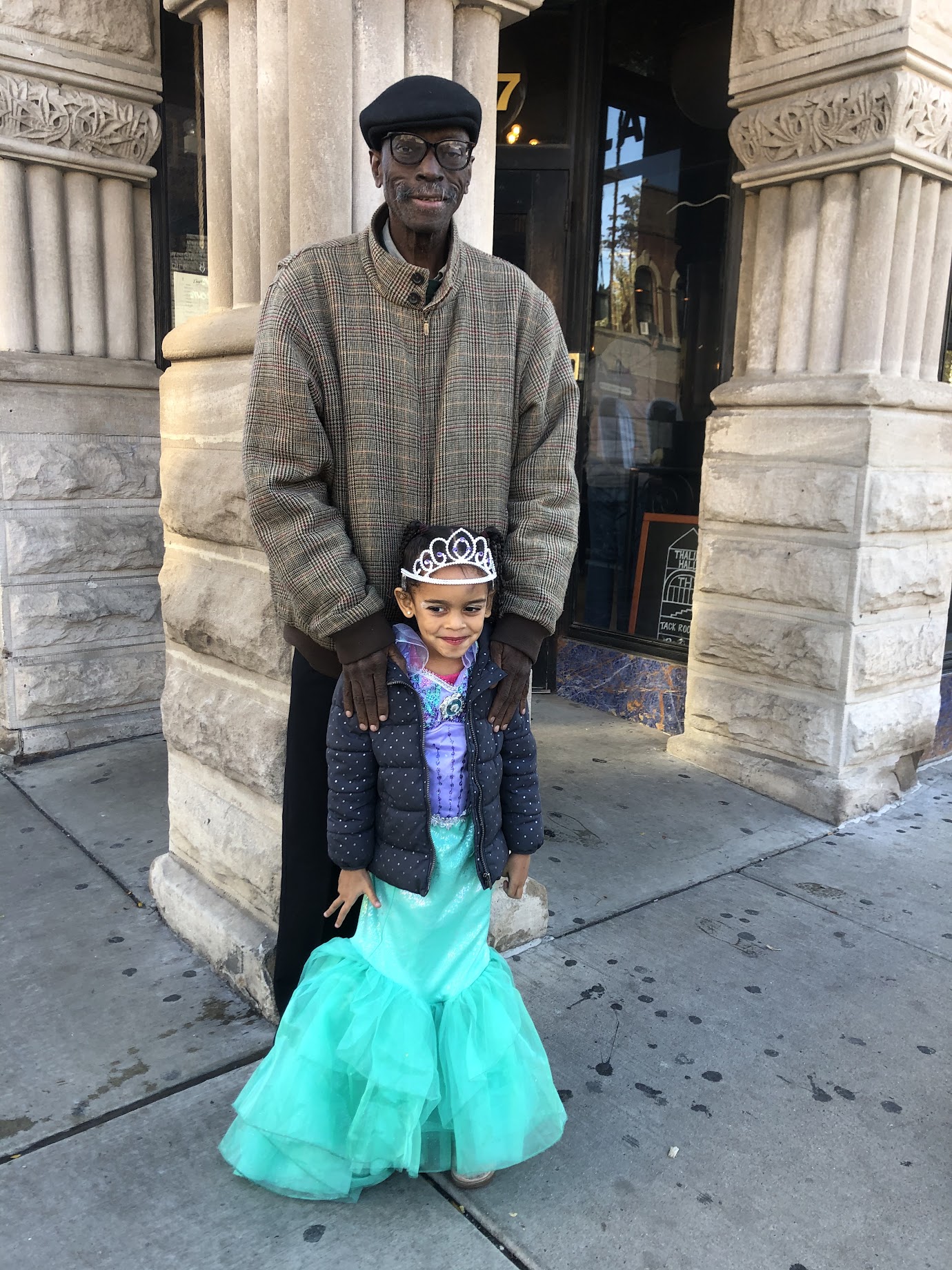
He was a friend, a loving brother, and an endearing uncle
By Folasade Ogunbiyi
I am still in shock and can’t believe that BJ is gone forever. He left Yemi and me two days after his 80th birthday seminar and dinner, promising to return for a two-week stay before heading out to Boston, U.S.A. I have known BJ since I was 12 years old, or thereabouts, growing up in Oke Bola, Ibadan. We didn’t socialise that much then, but his father and mine belonged to the same church society, the Young Men’s Christian Society of St. James’ Church, Oke Bola.
I can’t remember if he attended Sunday service with us then, but I would be surprised if he did because he was too ‘serious-minded’ and didn’t interact much with the “girls.” Maybe he did with the boys, especially my late elder brother, Yomi, who later became a classmate of his at Ibadan Boys’ High School. BJ was rascally but not mean, and definitely not a bully.
BJ was not a Christian in the real sense of it, i.e., the ‘born again’ or church-going type. For him, Christianity was a lifestyle – your character, your behaviour, the impact you make on other people’s lives, and your contribution to the community and the nation at large. He called it – “Iwa lesin – a good character is the core of religion or faith,” and he definitely lived it – generous to a fault, a fighter and defender of what was right, very principled and humane. His years at Ibadan Boys’ High School really showed the kind of person that he would be in later years. He was expelled in his final year for spearheading a strike for better living conditions in the boarding house. He recounted the details of that incident at the dinner held in his honour on his 80th birthday. Though hilarious, that dinner gave us an insight into his earlier years and why he chose to fight against any type of repression or injustice.
Our paths crossed again in September 1967 when we were both admitted to read English at the University of Ibadan. We spent the next three years attending lectures and tutorials together, and BJ was outstanding intellectually. No wonder he graduated with a 1st Class Honours, to the pride of all his classmates. It was during those years that I met my husband, Yemi, who was in the same hall of residence, Kuti Hall, as BJ was. Though he was not instrumental in my meeting him, BJ ensured that the relationship has flourished to this day – 57 years and still counting – to the glory of God.
After our graduation, he went on to New York University, USA, for his graduate studies, and there, once again, Yemi joined him as a graduate student, while I was teaching high school students, first as an exchange teacher from Nigeria in upstate New York and later at the United Nations International School, New York. Those were memorable years for us, and BJ didn’t stop being a fighter. Even as a graduate student at New York University, he fought ceaselessly for the right of students to study in an enabling learning environment on different occasions, which time will not permit me to delve into.
BJ got married to Sheila Walker while we were in New York, and, of course, yours truly and Yemi were the main witnesses at the civil marriage at Brooklyn City Hall. Years later, in September 1977, we returned to Nigeria to work at the University of Ife, Ile-Ife (now Obafemi Awolowo University (OAU)), and there was BJ to welcome us with Sheila and their two (2) boys – Okunola and Lekan. Our years at Ife were full of endearing moments and fond memories, again, which time will not permit me to recount.
BJ had remained in our lives ever since. He had a room in our house in Victoria Island and a chair, his favourite chair, in our sitting room, where he loved to watch African Magic movies with my late mum for hours, far into the wee hours of the morning, and also his favourite sports channels. On his 80th birthday on January 5, 2026, after we came back home from the private dinner, all three of us – BJ, Yemi, and I – spent hours reminiscing about our years together, enjoying old jokes and reliving past events in our families and lives, not knowing that that was going to be our last time together.
He was not just a friend but a loving and endearing brother and uncle to my brothers, our children, and grandchildren. BJ will be remembered most for his character, his kindness, his loyalty to family and friends, his impact on the lives of others, and his faith – what he believed in and fought for all his life.
Sun re o, A-BJ.
Folasade Ogunbiyi is the Iyalode of Remọlánd.
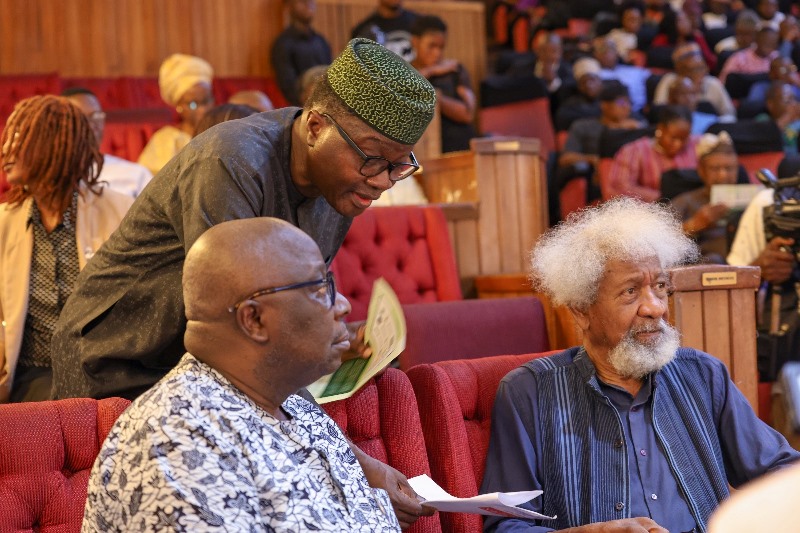
Biodun Jeyifo: In the Company of a Teacher
By Dapo Olorunyomi
There are teachers, and then there are those rare presences who reorder the architecture of your mind, who enter your life not as instructors but as events. Biodun Jeyifo, BJ to those of us privileged to orbit his intellectual and human warmth, was one of such events. His passing has not merely taken away a scholar of immense distinction; it has ruptured a living bridge between thought and action, between theory and the stubborn, unfinished business of justice. And for me, the loss is deeply, almost unbearably personal.
I first encountered BJ not simply in the classroom, but in that charged atmosphere that defined the old University of Ife, where ideas were not decorative but urgent, where theory was not an abstraction but a weapon, and where intellectual life carried the weight of historical responsibility. BJ stood at the centre of that world with a kind of restless intensity. He was obsessed, with theory, with contradictions, with the uneasy spaces where clarity breaks down and deeper truths begin to emerge. That obsession was infectious. It shaped not only how I thought, but how I came to inhabit the world.
There is one moment, etched in memory with the clarity of destiny, that captures the essence of who BJ was to me. Admissions into graduate school had closed. The door, by all formal accounts, had shut. But BJ would not accept the tyranny of bureaucratic finality. He personally obtained my graduate form, filled it out, and insisted, quietly, firmly, that I belonged in that intellectual journey. He told me, with a conviction I did not yet possess, that I would make a great academic. And when I spoke of my pull toward journalism, he brushed aside the apparent contradiction with characteristic ease: journalism, he said, would always find a home within the academy. That intervention did not ultimately alter my academic trajectory; it however, reordered my sense of possibility. It was BJ’s way, seeing in you a horizon you had not yet glimpsed, and then nudging you, sometimes gently, sometimes insistently, toward it. In that one episode he was not successful as I finally chose journalism.
Around him gathered a constellation of young intellectuals, among them Femi Taiwo in philosophy, whose own sharp engagements with questions of reason, justice, and society deepened the intellectual ferment of that period. Between BJ’s relentless probing of literary and cultural theory and Taiwo’s philosophical rigour, my intellectual life found its early scaffolding. They taught us not what to think, but how to dwell within complexity, how to resist easy answers, how to embrace contradiction not as confusion but as a method.
That method extended beyond the classroom into life itself. There was a time—now distant, yet vivid—when BJ and a few of his comrades took their convictions to Ode Omu, in present-day Osun State. There, alongside Dr. Seinde and Dunni Arigbede, they immersed themselves in the lives of peasants, animated by the audacious vision of a revolutionary transformation rooted in the lived realities of ordinary people. It was a moment of intellectual courage, but also of vulnerability: the willingness to test theory against the stubborn textures of life.
Years later, I would find myself on a similar path, in the same place, with some of the same actors, though under altered historical conditions and with a renewed emphasis on building alliances among workers, peasants, and students. I had long hoped to sit with BJ, to reconstruct those parallel journeys, to ask what remained of that revolutionary impulse, what had endured, what had been lost, and what had been transformed. That conversation never happened. His sudden passing has left that chapter unwritten, a silence that now feels heavier than words.
One of the last vivid encounters I had with BJ was at the Wole Soyinka Centre for Investigative Journalism’s July 11 Lecture in 2024, marking Soyinka’s 90th birthday. The Centre’s tradition has always been to bridge literature and journalism, a task that often demands intellectual dexterity. But that year, the theme imposed itself with stark urgency: the proliferation of falsehood, the corrosion of public truth, the gathering storm of disinformation amplified by digital technologies and artificial intelligence. If there was ever a moment that called for BJ, this was it.
His lecture, “The Death of Truth? Realism, Literature and Journalism in an Age of Disinformation,” was, in every sense, a diagnosis of our times. But what remains with me most is not only the brilliance of his argument, but a deeply human, deeply unsettling moment. Mid-sentence, BJ froze. Repeatedly and for a few seconds, seconds that felt like an eternity, in which the hall held its breath. Here was a man whose mind had always moved with such fluency, suddenly suspended, as though time itself had faltered. It was a terrifying glimpse into the frailty that shadows even the most formidable intellect.
After the lecture, I told him, perhaps more candidly than I intended, that for the first time in my life, I had felt afraid of old age. He laughed it off with that familiar mix of warmth and irony. When I spoke of organising a grand celebration for his 80th birthday, he responded with a quiet, almost offhand remark: “Let’s hope I am still around then.” There was something chilling in that sentence, something that lingered. I remember pushing back, half in jest, half in defiance: “BJ, stop it you better be alive!” We both laughed, but beneath the laughter was an unease I could not quite name.
Looking back now, that moment feels like a premonition.
The making of that 2024 lecture itself seemed guided by a kind of historical inevitability. Soyinka at 90, BJ as the chosen voice, and a world slipping ever deeper into what can only be described as a dystopia of lies. Conspiracy theories, orchestrated disinformation, algorithmic manipulation, these were no longer peripheral disturbances but central features of our public life. BJ understood, perhaps more than most, that this was not merely a technological crisis but a crisis of epistemology, of power, of the very conditions under which truth can exist.
It is my earnest hope, and indeed my responsibility, to continue building that bridge between literature and journalism that the Centre represents, as a living tribute to BJ. And perhaps, in time, to situate his work within a broader intellectual constellation, in conversation with figures like Umberto Eco, who wrestled in his own way with the instability of meaning and the dangers of interpretive excess in an age of media saturation.
In the aftermath of his passing, memory returns insistently to January 5 of this year, his 80th birthday celebration. There is a quiet solace in knowing that we were able to gather, to honour him, to let him witness, while still with us, the depth of gratitude he inspired. That day stands now as a luminous counterpoint to the grief that has followed.
The credit for that remarkable event belongs, in no small measure, to Motunrayo Alaka and her indefatigable team at the Soyinka Centre, to Kunle Ajibade, the writer and journalist, and to Professor Akin Adesokan of Indiana University. Akin’s role in bringing Professor Priyamvada Gopal as the keynote speaker added a profound intellectual resonance to the occasion. Gopal’s lecture, with its incisive account of the colonial experience and the necessity of an emancipatory pedagogy, felt like a fitting extension of BJ’s own intellectual project, a project that had produced generations of critical, engaged, and restless minds across the world.
What remains most striking in the recollections of that day is BJ’s joy. He was radiant, fully present, moving through the crowd, taking photographs, engaging with friends, students, admirers. There was no hint, in that moment, of the finality that lay so close ahead. If anything, there was a sense of completion, not in the sense of an ending, but of a life fully inhabited, a circle richly drawn.
As tributes continue to pour in from across continents, what emerges is not only the portrait of a great scholar, but of a profoundly generous human being. A teacher who saw beyond the immediate, a mentor who invested in futures he might not live to witness, a thinker who refused the comfort of easy certainties.
For me, BJ remains the one who opened the door when it seemed closed, who insisted that contradiction was not a problem to be solved but a condition to be lived through, who showed that truth is not given but fought for, patiently, rigorously, and with an unyielding sense of ethical responsibility.
His death leaves a silence. But it is not an empty silence. It is one filled with questions, with unfinished conversations, with the quiet insistence that the work must continue. And so, in grief, but also in gratitude, I return to what he taught us: that the pursuit of truth, however fraught, however contested, is still the most necessary labour of our time.
My full respect, BJ!
*Dapo Olorunyomi, co-founder of TheNEWS and TEMPO, now publisher, PREMIUM TIMES
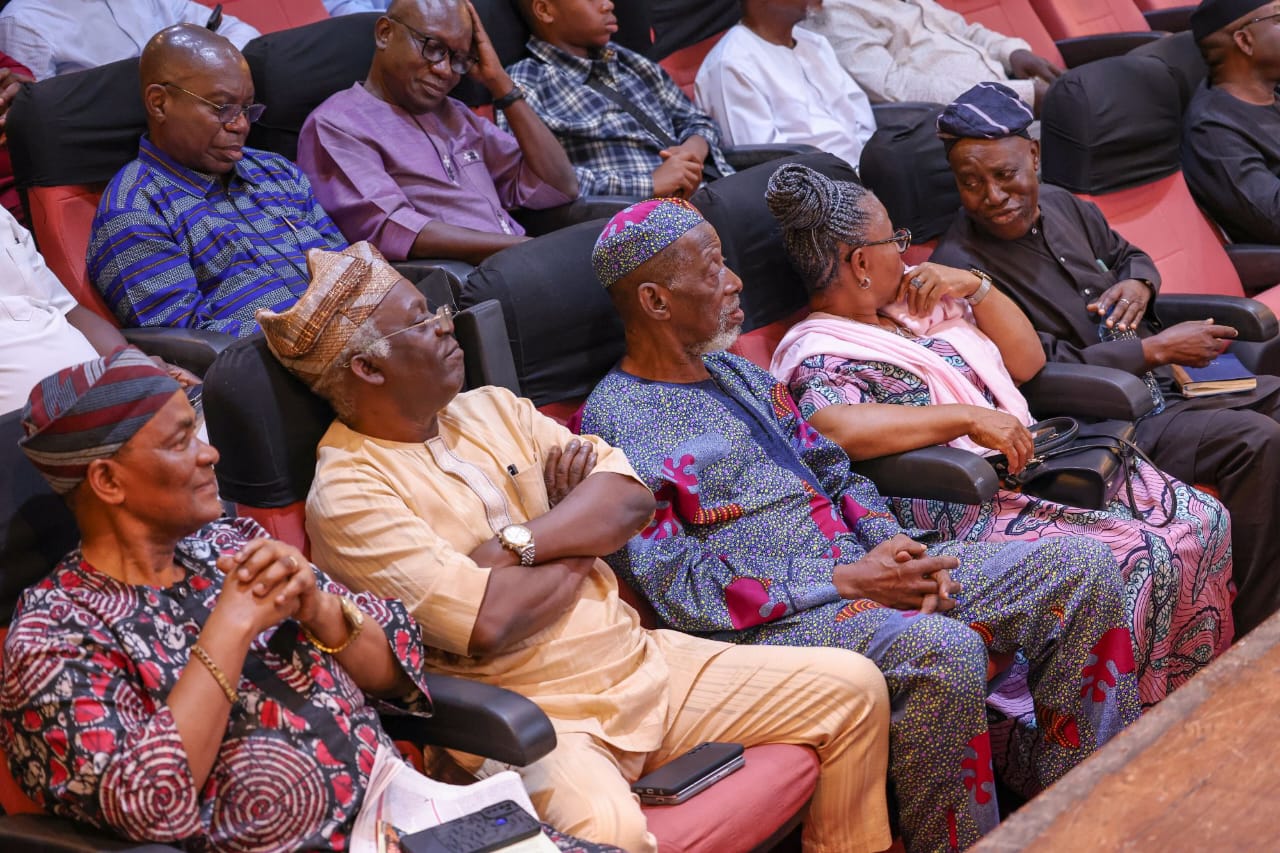
In Memory of BJ, My External Teacher
By Femi Falana
Following the commercialisation of tertiary institutions in 1978 by the Olusegun Obasanjo military junta, at the behest of the World Bank, Nigerian undergraduates embarked on a boycott of lectures and street protests. The violent disruption of the peaceful protests by the police led to the brutal killing of some students at the University of Lagos and Ahmadu Bello University. The federal government instituted the Usman Judicial Commission to probe the crisis. At the end of the inquiry, the Vice Chancellor of ABU, Professor Iya Abubakar, was forced to resign by the Supreme Military Council, while Professor Ade Ajayi, the Vice Chancellor of the University of Lagos, was sacked for attending the burial of Akintunde Ojo, one of the slain students, at the Atan Cemetery in Lagos.
In a bid to deradicalise the campuses, some Marxist lecturers, including Comrade Ola Oni, Bade Onimode, Omafume Onoge, and Akin Ojo of the University of Ibadan; Eddie and Bene Madunagu of the University of Calabar; Laoye Sanda of the Ibadan Polytechnic; and Ebenezer Babatope of the Yaba College of Technology, Lagos, were dismissed. Owing to the principled stand of the management of ABU and UNIFE at the material time, the many Marxist and radical lecturers in both institutions escaped the purge.
As a law student at the University of Ife (now Obafemi Awolowo University), Professor Biodun Jeyifo (BJ) did not teach me in the classroom. But as one of the staff advisers of the Alliance of Progressive Students (ALPS), a student socialist body on the campus, BJ was our mentor. As a fresh law student, I visited him in his office sometime in 1978. In the course of our discussion, BJ made me realise that “even though the law is an instrument of oppression in every class society, it can be turned into a liberating tool.” He recommended to me a number of books on Marxist jurisprudence. I read them, and we later discussed them. Although BJ described himself as a layman, he addressed the topic of our discourse like a learned gentleman!
During the 1979/80 academic session, I served as the Public Relations Officer of the Student Union of the University of Ife (now Obafemi Awolowo University). The union president, Mr. Wole Olaoye, was BJ’s student. Since Wole had great admiration for him, BJ became our adviser, based on his rich experience as a former student leader at the University of Ibadan. Both Wole and I were delighted when Dr. Biodun Jeyifo was elected the National President of the Academic Staff Union of Universities (ASUU) in 1980.
With the encouragement of BJ and other progressive lecturers, we decided to resuscitate the NUNS. We rejected the plan of the federal government to lift the proscription of NUNS and have it run like a parastatal under the Federal Ministry of Education. We rejected the conditionality and inaugurated the National Association of Nigerian Students (NANS) on December 10, 1980. ASUU recognised NANS and met its newly elected leaders. The student leaders sought the support of ASUU in ensuring the recall of student activist leaders who had been expelled for mobilising students to resist the unlawful control of student unions.
Upon BJ’s request, the NANS leaders furnished him with the list of the expelled student activists. To the credit of ASUU, the dismissed lecturers and student activists were recalled by the Shehu Shagari administration. Thus, in 1980, former NUNS President Segun Okeowo, who had been expelled from the University of Lagos, was admitted to UNIFE, where he completed his course. In 1982, Isa Aremu, Bala Mohammed, and Chom Bagu, who had been expelled from Ahmadu Bello University by Professor Ango Abdullahi, were admitted to the Universities of Port Harcourt, Lagos, and Jos, where they eventually graduated.
On the campus, the UNIFE Student Union worked with the local chapter of ASUU. In particular, we jointly organised programmes, including two memorial lectures in honour of Dr António Agostinho Neto, who served as the first President of Angola from 1975 to 1979 after leading the Popular Movement for the Liberation of Angola (MPLA) during the war for independence and had died of cancer, and Dr Walter Rodney, who was killed by a remote-controlled explosive device planted in his car in Guyana on June 13, 1980. The deceased had become popular in the university community in Africa on account of his book entitled How Europe Underdeveloped Africa.
As a result of the 1978 restructuring of the labour unions, ASUU was registered as a trade union. It was under BJ’s leadership that ASUU became the intellectual wing of the Nigeria Labour Congress. He repositioned ASUU to fight for improved working conditions for the academic and non-academic staff in all universities in the country. It is on record that BJ succeeded in laying a solid foundation for ASUU because he enjoyed the maximum cooperation of the Socialist Forum, constituted by Dr. Segun Osoba, Toye Olorode, Idowu Awopetu, Dipo Fasina, G.G. Darah, Biodun Jeyifo, and other members.
As a columnist in some newspapers, BJ regularly consulted me with a view to avoiding a conflict with the law of libel. He also wanted to ensure that his views on certain aspects of the anti-graft laws were accurate. I once threatened to charge him professional fees for the consultations. But BJ quickly reminded me that, upon receipt of my bill of charges, he would file a counterclaim, since I had once said, in a public programme, that he and other members of the Socialist Forum were my external lecturers in my undergraduate days at Ife.
A couple of months ago, I attended the ceremony held in Lagos to mark the 80th birthday of BJ. It was put together by his comrades and former students. BJ was full of gratitude to the organisers of the event and the many admirers who had converged to honour him in his lifetime. In his memorable speech on the occasion, he said that abundant evidence had proved, over and over again, that capitalism could not save humanity. He therefore charged his comrades to intensify the struggle for the socialist transformation of the world.
With respect to Nigeria, BJ urged Nigerians to demand the urgent actualisation of the fundamental objectives and directive principles enshrined in Chapter Two of the nation’s bourgeois Constitution. He was, however, elated when I disclosed that the ruling class had been compelled to enact a number of laws for the actualisation of the fundamental objectives. As I bid him farewell at the end of the programme, BJ tasked me to make the welfare laws available to the trade unions, to enable them to demand their implementation and prepare them to pave the way for the establishment of a society that is solidly erected on the foundation of social justice.
Femi Falana is a Senior Advocate of Nigeria.
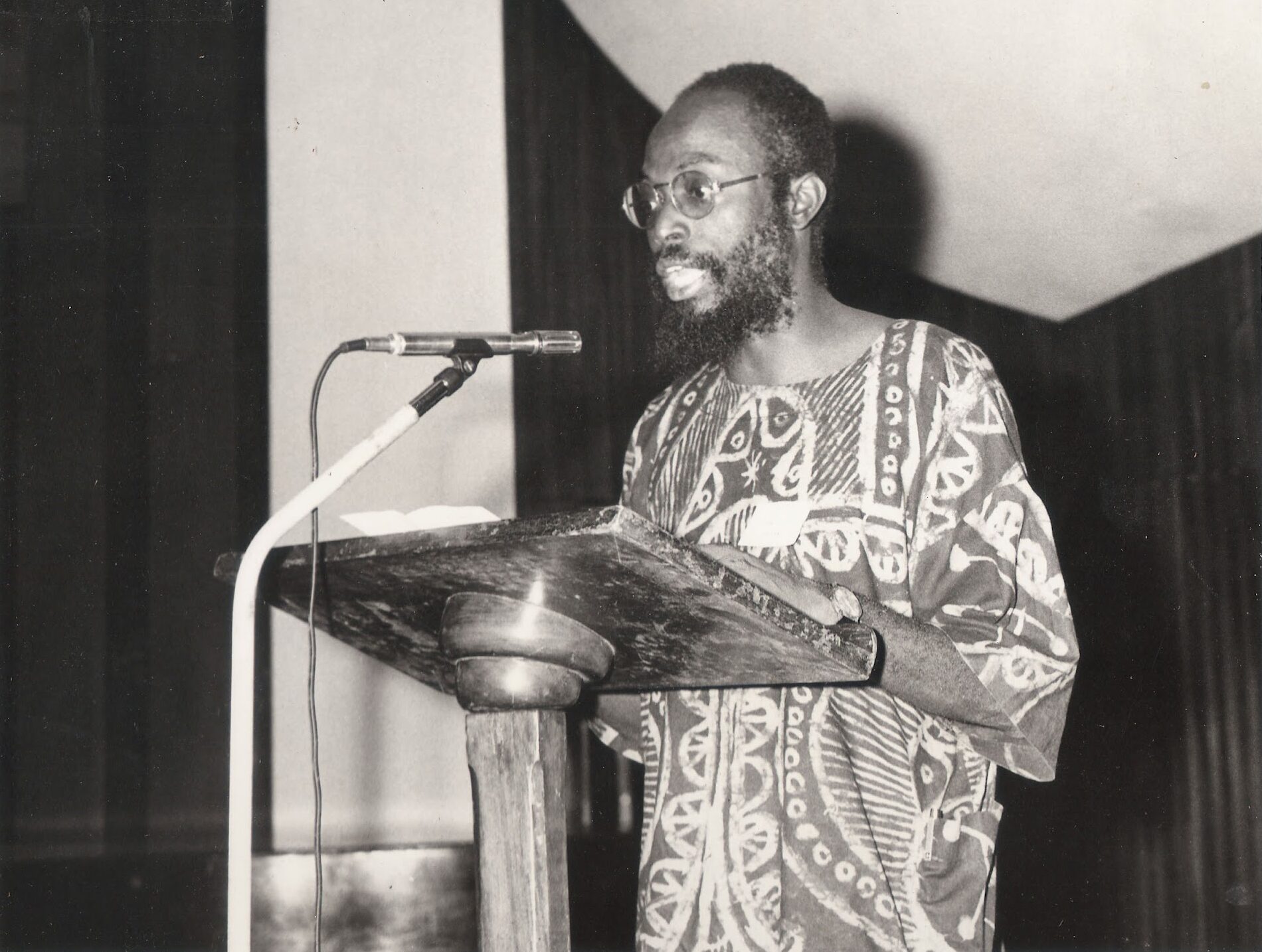
*Adeleke Adeeko is Humanities Distinguished Professor in the English and African American and African Studies Departments, Ohio State University.
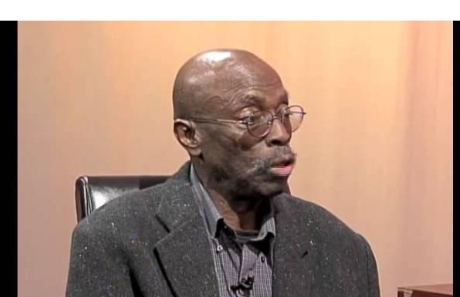
To My Inimitable BJ
By Sheila Walker
I first met the inimitable Biodun Jeyifo—the man who would become my husband and the father of my two sons—on a chilly September afternoon in 1971 in New York City, where we were both new graduate students at NYU.
He strode into my life, tall and imperious, both literally and figuratively, and that auspicious day set off a decades-long pattern of endless talk between us. Several years into our marriage, after one of our long and satisfying discussions, he turned to me and said, “You know, Iyawo mi, the French philosopher Louis Althusser wrote: ‘What is marriage, after all, but good conversation.’”
Despite misunderstandings, bad patches, and even divorce, my “good conversations” with Biodun Jeyifo never ceased. Just two weeks before his death, he phoned me from Nigeria, and we had one of our “good conversations.” Yes, in a way, BJ is gone, but I know—and he knew—that our “good conversations” will never end.
*Sheila Walker is a retired Professor of Psychology.
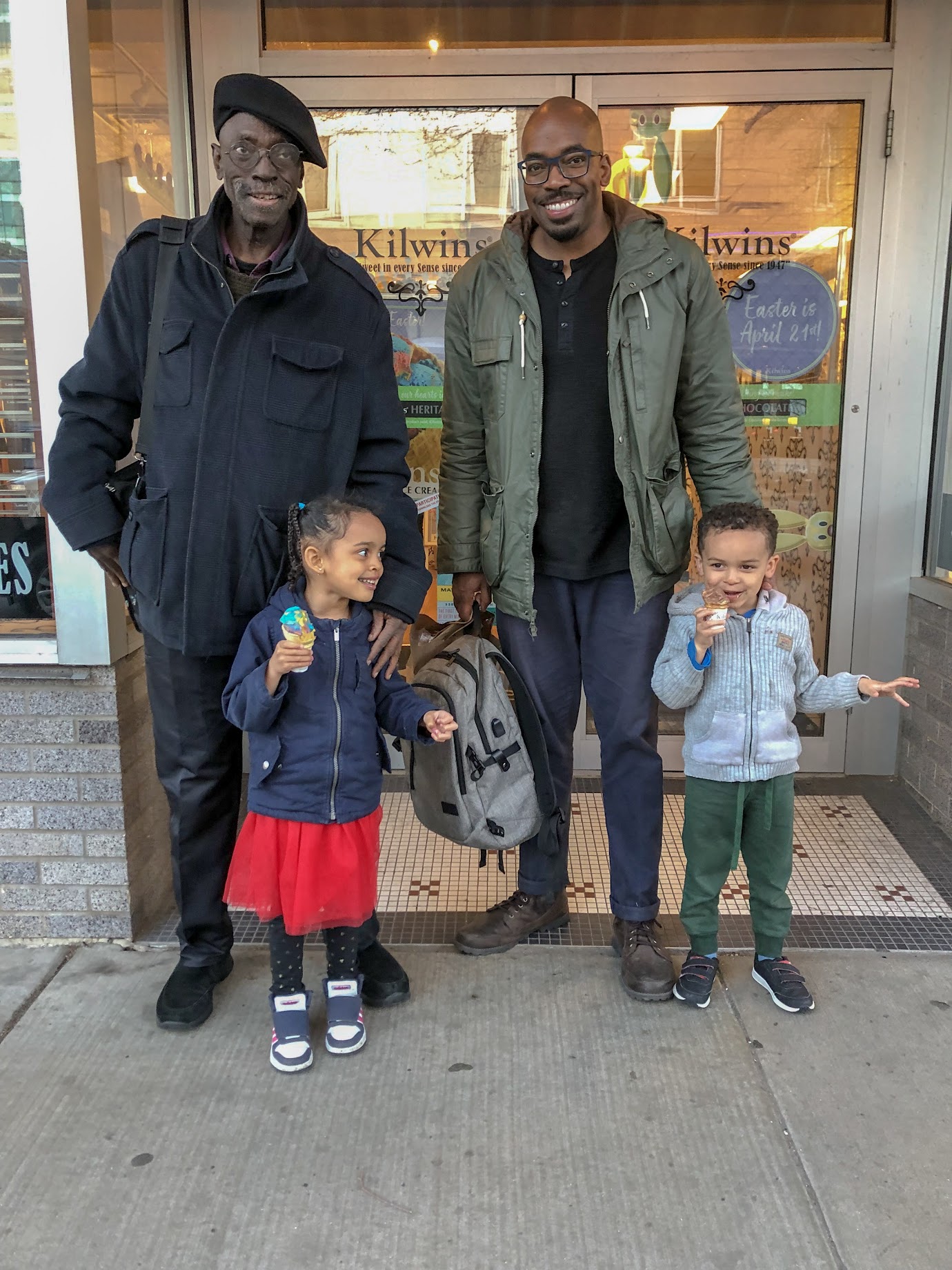
For my formidable Dad
By Okunola Jeyifous
My father had (and has) a formidable “presence,” and this is something I was keenly aware of even before I explicitly understood its meaning. Yes, his oratory volume was famously loud, and he gesticulated emphatically when making any point, but the quality I’m referring to wasn’t merely peacocking or pulpit bullying. It was an amalgamation of genuine fearlessness, strong conviction, confidence, brilliance, and an unwavering need for substantive dialogue, exchange, and action.
In the conversations I’ve had with my brother over the past week, we’ve ruminated over the fact that this quality of his is what has been most difficult to reconcile with his passing. Even when we weren’t sharing physical space or hadn’t spoken in a while, he was, and is, always so “present.” These are foundational elements of the force we all knew as “BJ,” and it is something I saw repeatedly referenced in the many tributes that have populated the digital media space in the last couple of weeks. It has been a salve to read how former students, colleagues, comrades, and others have described their interactions with my father, detailing the merit and influence of his scholarship and activism, two pursuits that were thoroughly intertwined for him.
As a counterbalance of sorts to those tributes, I would like to highlight a couple of more mundane, or perhaps less widely known, attributes that I greatly enjoyed and admired about my father, and that I am really going to miss.
Several people mentioned the ubiquitous white VW Beetle he drove around Ife, and indeed all over the country, in the 80s and early 90s. Driving was both a practical and requisite endeavour for someone with as many commitments as he had during those days, but it was also something that brought him great clarity and peace, and served as a vehicle—pun intended—for focused and lively exchange with anyone fortunate enough to be a passenger. This was an early form of what we now term “self-care,” and I know how much he relished the exercise because it is part of my genetic endowment as well. Time on the road was an incubator and testing laboratory for his writing and speeches, allowing focused meditation, consideration, and quiet solitude. Throughout my childhood, and especially beginning in my early adulthood, many of the most resonant and substantive conversations we had, about all manner of topics, unfolded on long drives, some with no particular destination.
This is a practice my children are intimately familiar with. We refer to them as “missions,” and they involve driving excursions in and around the Chicago metro area, during which we engage in spirited discussion, storytelling, the sharing of musical playlists, and regular laughter. It is such an endemic feature of their childhoods that, if too much time passes between one of our “missions,” they specifically request it. The last such request came just two days ago, as we have been consumed for the past week and a half with the business of planning around his death.
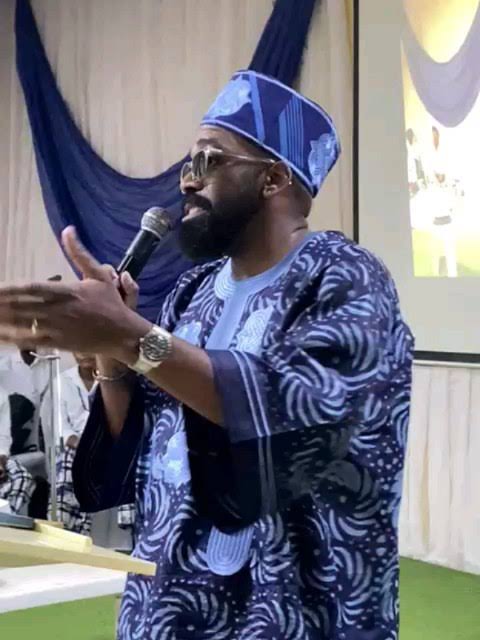
The driving portion of these missions was but one of the endearing and enjoyable aspects of the ritual. The other was another important gift bestowed upon me by my father: a deep and profound appreciation for natural landscapes. My favourite moments with my father, throughout my entire life, have been the impromptu stops we made during our driving expeditions to experience beautiful vistas or take spontaneous walks around any ponds or lakes we encountered. Anytime we saw a “scenic lookout ahead” sign on any highway or roadway we traversed, you knew we were stopping, no matter what obligation lay ahead at our final destination. These moments frequently consisted of joint, silent reflection, but they were also occasions when we would engage in discussion of serious familial matters and concerns.
In recent years, when he would visit us in Chicago, we would inevitably find ourselves at the lakefront, intermittently walking in silence and taking in the constantly shifting vista of both built and natural structures. These walks were often punctuated by his twin grandchildren running in and around the two of us, while he playfully engaged with them, earnestly amused by their distinct and budding personalities. I am eternally grateful for those moments, especially now. It is no surprise to myself, or to those friends who were with me in the first moments after I learned of his passing, that I headed straight to the lakefront at dusk—both to have a moment of solitude to parse my feelings and thoughts around his loss, and also simply to be with my father.
Okunola,
Son
*Okunola Jeyifous is a Neuroscientist and Cell biologist at DePaul University, Chicago.
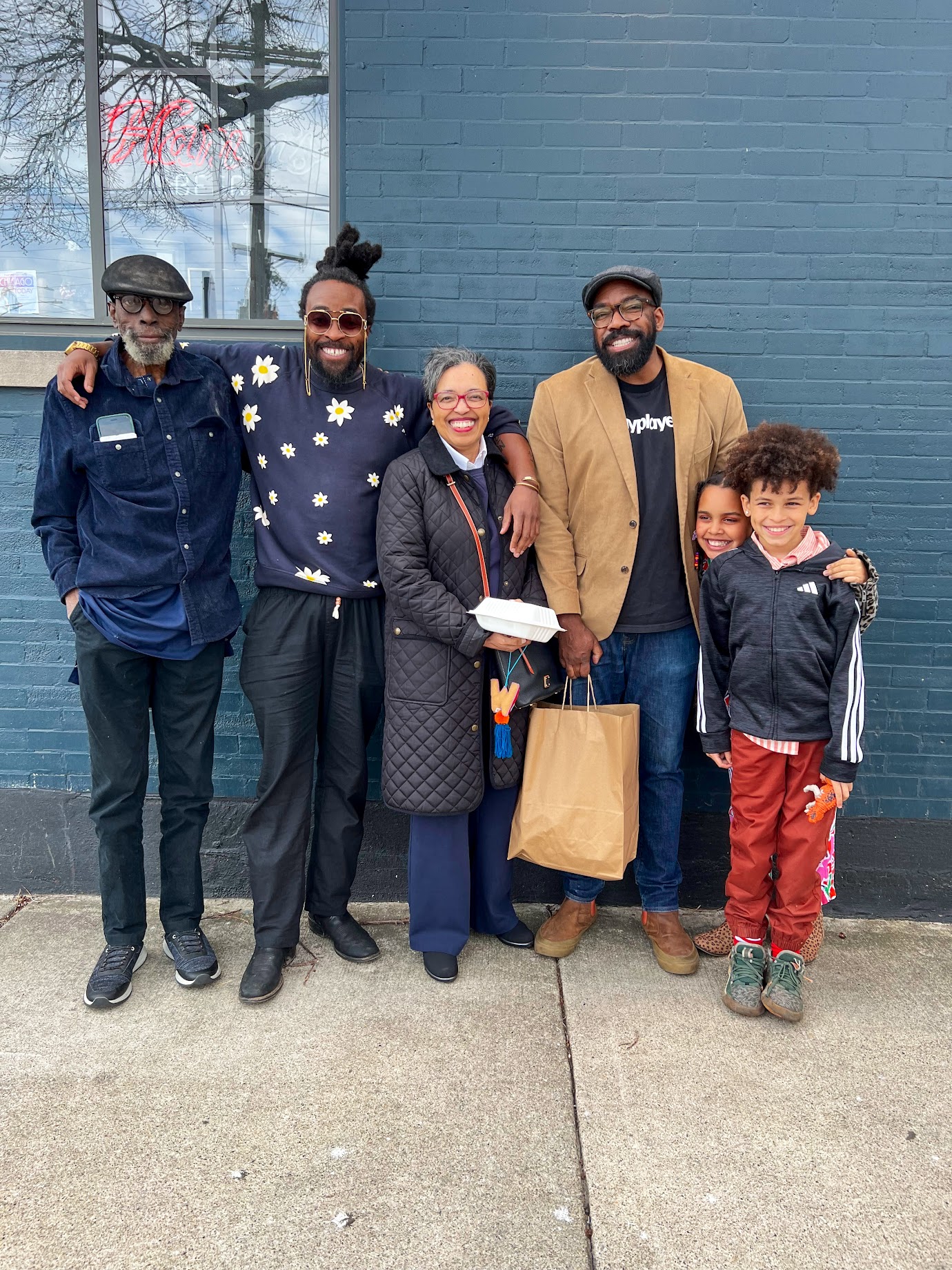
For Dad… A Legacy Greater than Life
By Olalekan Jeyifous
In the days since my father’s passing, I have found myself thinking less about grief and far more about clarity—about how to explain a relationship that was real, profound, and formative, but never easily categorized.
I was raised by my father. I grew up with my mother and older brother, yet in my earliest years in Nigeria, I often recall him stretched out on the yellow-cushioned daybed in our sitting room, one arm bent behind his head, either asleep or with his eyes closed in deep stillness. Otherwise, he would be in his study, reading or typing, fully immersed in the orbit of his own intellectual world. Even as a child, I understood him to be deeply contemplative, absorbed in a dense rhythm of reading, writing, and thinking. He was profoundly interior, endlessly inquisitive, romantic to a fault in the way he translated lived experience into ideas and language that often rendered reality more abstract and lyrical than pragmatic. His work was the axis around which his life turned, and I do not believe he would have chosen differently if given the chance to live it again.
It feels inaccurate to say that my father and I “were not close.” Closeness, for me, has never been defined by constant contact. Even with my mother, whom I consider myself very close to, we do not speak every day or even regularly. And still, there is a sense of ongoing wonder between us. She has often remarked, half amused, “What a peculiar child you are!” Our bond is measured in the depth of our conversations, in our recognition of one another, and in the spoken and unspoken discoveries that continue to unfold between us.
By that same measure, though shaped by different circumstances, my relationship with my father was unique and legible in its own way. It unfolded at the pace he set, and I met it there, accepting it as it was, never wishing it to be otherwise. A friend recently described our relationship as “complicated,” but I did not experience it that way, though I recognize it has shaped me in lasting and meaningful ways.
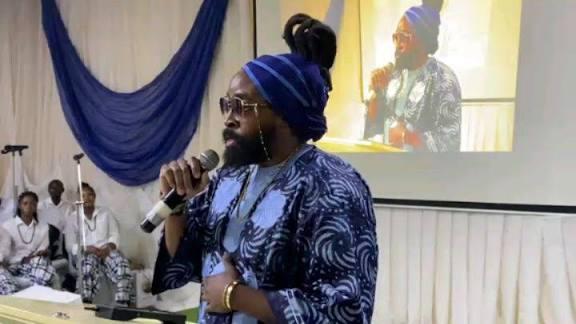
What remains most vivid to me now are the small, human details that animated him.
So many of my memories of him are comical, articulated by a humor he possessed that could be jovial, exuberant, warm, and deliberate, but occasionally unintentional. There were countless absent-minded professor moments—like the time we boarded a boat from Trinidad to Tobago during one of the many father-son trips we would take over the years. My father, a heavy duffel bag slung over his shoulder, pivoted uncertainly down the narrow, bench-lined aisle toward the open deck of the ferry, searching for seats. His bag struck one person after another in the head as he murmured vague apologies, never fully aware of the chaos of disgruntled and enraged passengers in his wake. My brother and I, while self-conscious and embarrassed, were also in tears, laughing.
For all his comic aloofness, a result of being so often lost in thought, he was incredibly fascinating and fascinated. He asked questions and listened closely to your answers. He offered challenging reflections and did not hesitate to disagree when he felt it necessary, never in a way that diminished us, always constructively. He cared about our opinions and observations, engaging them with patience and generosity. He valued intellectual curiosity, honesty, and the bravery it takes to speak openly, and he encouraged all of it.
He loved sharing stories about his life and his comrades, about the nuances of Yorùbá spirituality and culture, and about the intrigues and shifting dynamics of his social and professional worlds. He took pleasure in the telling itself, recounting moments with detail, nuance, and a precision that could make even mundane encounters feel vivid and absorbing. He was drawn to the texture of human interaction—the misunderstandings, rivalries, and reconciliations that shaped individual and collective experiences. Conversations with him could stretch for hours, moving easily between reflection and debate, anecdote and analysis.
He showed affection in awkward, genuine ways, too. On walks, he would pull you into a one-armed side hug, holding you close while continuing forward stiffly, almost mechanically, like two participants in a three-legged race with unmatched strides. It was not smooth or even comfortable, but it was unmistakably tender—an endearing gesture that remains a core memory of our times together.
In the coming weeks, I know I will meet many people who knew him in ways I did not—students, colleagues, friends, family. I will hear stories that reveal the greater depths of who he was that existed outside the span of my own time with him and experience of him, each one broadening and enriching my understanding of the person I will always carry with me.
There was a vast world of him that lived beyond my orbit—in classrooms, in letters, in political thought, in friendship, companionship, camaraderie, and in the interior life he inhabited so fully. His sharp and profound intellect, his principled convictions, and his contributions to Nigeria, to literature, and to generations to come form a legacy far greater than the life I shared with him. I hold that inheritance with pride. Amid the surreality of my grief, as I come to terms with what feels so sudden, though not entirely unexpected, I find myself curious about that wider world, even looking forward to encountering it, to seeing more of who he was beyond the edges of my own knowing.
And now that he is gone, what I feel most is a sense of awe and regard for the man he was—a thoughtfully considered acknowledgment of the layered dimensions of his life: brilliant, introspective, outwardly effusive, awkwardly tender, warm in his own way, fearless and resolute. Spiritual, too, holding an almost sacred, enduring reverence for Yorùbá beliefs and ancestral continuity alongside his political materialism and Marxist atheism. Entirely and irreducibly himself, singular in the way only he could be.
That was my father.
LEKS
*Olalekan Jeyifous is an award-winning visual artist based in Brooklyn. He is also a visiting lecturer at Cornell University.
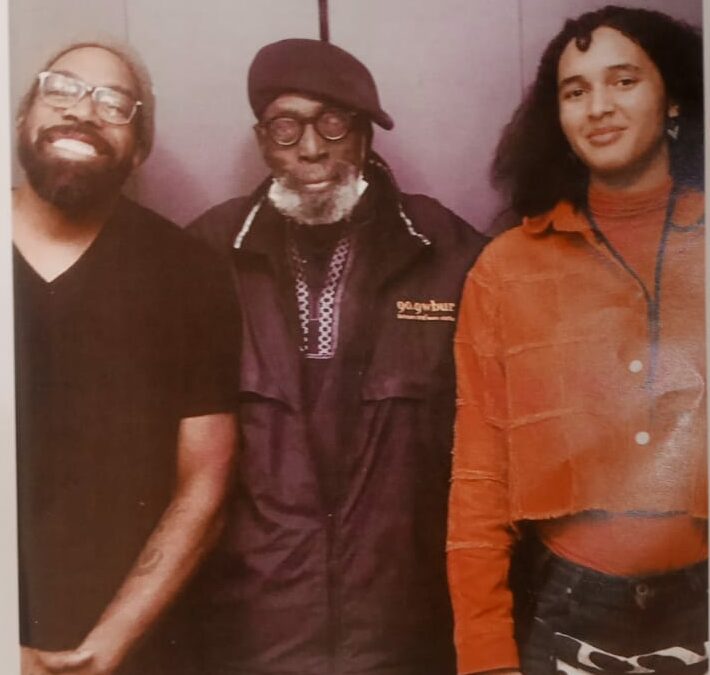
The Virtues I Inherited from My Father
By Ayoka Jeyifous
Thank you all for being here, and for gathering in this space. I am deeply grateful to everyone who made this moment possible.
The loss of my father has led me to reflect deeply on legacy—what it truly means. I see legacy as the sum of all we leave behind: the totality of our experiences, the relationships we build, and the knowledge we cultivate. It is a form of wealth, not measured in monetary terms, but in human connection. Legacy also includes the complexities of our lives—the struggles, the habits of thought, the temperaments, the patterns of relating, and even the grief we pass on.
May we all strive to be self-possessed, deliberate, thoughtful, and elevated in our choices about what we leave behind.
My father was largely absent from my life, and I know this absence weighed on his spirit as well. Much of my grief stems from that loss of connection, a severing that feels like a kind of dismemberment. It is the loss of access to family, to history, to continuity. Without knowledge of one’s history, it becomes difficult to fully inhabit the present or to envision the future.
I was denied that wealth of relationships and grew up with a sense of deficit. Yet, I extend grace to that experience, to how it shaped me, challenged me, and ultimately opened me. It opened my mind, my heart, and my being to deeper lessons. While I cannot change the past, I can choose, in the present, to build and sustain meaningful relationships, to create a different kind of wealth here and now.
I am grateful to be here.
Another legacy my father left me is grace, a quality he shared with my grandfather. I understand grace as a philosophy: a way of being in the world. It is how one carries oneself, how one balances and moves through life with intention. Grace is the discipline of self-possession, a kind of intelligence in motion, knowing when to act and when restraint is the greater power. It is strategy, alignment, self-control, and an awareness of one’s destiny. This philosophy of grace is itself a powerful inheritance.
I also share my father’s fire, a restless, transformative energy that seeks liberation. It is a drive toward freedom: freedom from the colonial gaze, from systems of oppression, and toward creative, strategic ways of shaping a more just world. I am grateful for this fire.
I have inherited a strong mind, and I recognize my intellect as one of my greatest strengths. I have also inherited vision, the ability to see clearly, to discern, and to believe in the possibility of success and purpose in this life.
My father was a bright light, and I feel deeply that a light has gone out in the world. And yet, his brilliance does not disappear. It lives on in us, in the ways we carry his light, his energy, and his legacy forward.
Thank you.
*Ruth Ayoka Jeyifous is a student at Cornell University.
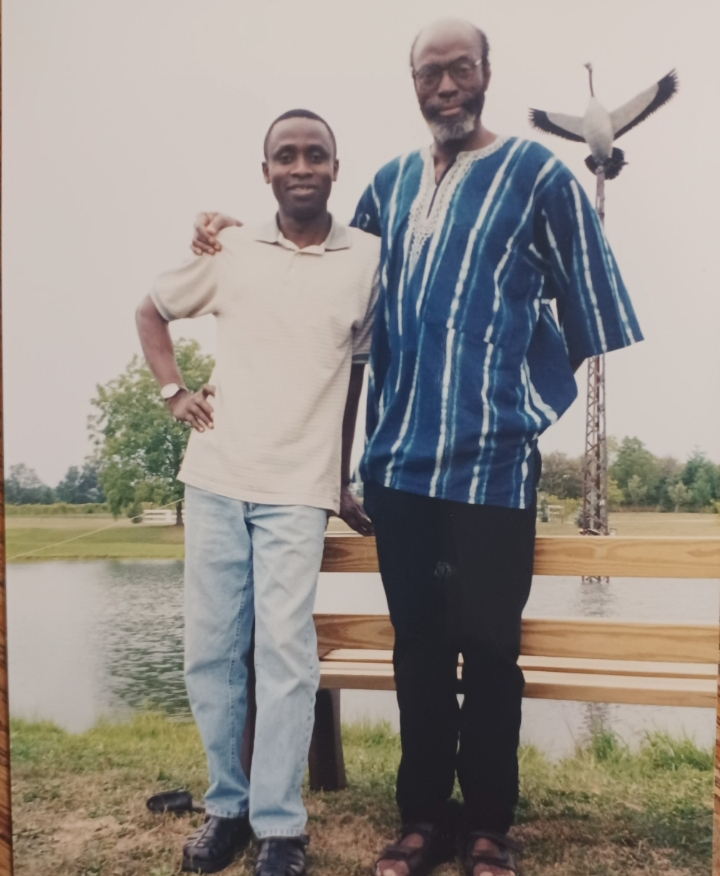
BJ: Of Memories Strong, Sweet and True
By Akin Adeṣọkan
“We never really know how wide and deep a hold someone who has passed had on us until they’re no longer here.”
–Biọdun Jeyifo, in tribute to Abiọla Irele (2017).
I: Where, How to Start?
Friday, February 13, 2026: A message composed but not sent:
“I woke up this morning feeling isolated and lonely because since Tẹju Ọlaniyan passed away, I’ve had fewer and fewer intellectual/ideological companionships on this side. But I’m not alone in this; it’s just that BJ and I grew very close in the past two decades and I realized that I trusted too much his usual quip, ‘kòsí’kú l’ójú mi’ (‘there’s no death coming for me’) whenever I inquired about his health. Alas.”
A text message from a friend trying to comfort me: “Take a look at the latest issue of African Studies Review that Cambridge just announced. It includes an essay in memory of Mudimbe by Aliko Songolo. You might do something like it for BJ.”
And I replied: “Yes, I intend to write something once the darkness has lifted somewhat. One of my last text messages to him, oddly, was about the fact that I hadn’t written a formal tribute to him, and that I meant to rectify that beginning with a post-birthday interview that three of us, his former students, were planning to do with him. Alas.”
The message sent on Sunday, January 18, 2026:
“If I may, I would like to contribute to the list of questions that will jump-start the interview. I’m particularly eager to have answers to those questions (about style, reading habits, CLR, Borges, Benjamin, etcetera) that your nonnegotiable 15-minute office hours slot made me shelf during our rendezvous in Goldwin Smith! Andrea learned much at Galileo’s feet, but that was before Fordist time regulation imposed itself. The most decisive must be the one where I shared my enthusiasm after reading CLR’s short chapter on Nkrumah as we discussed imperialist onslaught against Mugabe circa 2001, and you asked me to read THE book [Nkrumah and the Ghana Revolution] for a broader view. That was how I found CLR as my intellectual guide.
“I’m putting all this here in part because speaking with [….] about a week ago made me realize that I haven’t written a tribute to you, yet. I’ve long formed an idea of what I would write…
“Thank you. I was very lucky to be with you at Cornell.”
But what inhibited me for so long from writing a tribute to BJ?
II: The Protagoras’ Wager
In January 2016, during a symposium marking his 70th birthday anniversary at the Ọbafẹmi Awolọwọ University, Ile-Ifẹ, I composed and sent the following as a solidarity message to be read in public:
“Dear Colleagues and friends:
“Simply put, there’s no other place on earth that I’d rather be today. Today’s honored guest, Professor Biodun Jeyifo, this space, the Ọbafẹmi Awolọwọ University, Ile-Ifẹ, are two indispensable figures in my imagining of a fulfilling creative and intellectual pursuit in Nigeria. I hold Professor Jeyifo responsible for my absence because it was largely through his guidance that I’ve been able to find my current habitation. It is a case of the Protagoras’ wager. The Sophist Protagoras demanded his fee from his former pupil, Euathlus. The student refused to pay, saying, “But I haven’t won a victory yet.” Protagoras replied, “But if I win this dispute, I must be paid because I have won, and if you win it I must be paid because you’ve won.”
“The teacher wins fair and square if his logic triumphs, but he also wins if his student’s logic triumphs because that is evidence of the teaching the student received [from his former teacher].
Such is the nature of the teaching I receive from Professor Jeyifo that it cannot be spoken of in the past tense: I’ve not found the opening for departing from or opposing his example. I will be frank and say that my sense of the force of his example is that of the manifestation of a great personal will, of the ability to triumph by the sheer strength of will. Three political figures provide comparable examples: Vladimir Lenin, Amílcar Cabral and Fidel Castro. I take comfort in the knowledge that his is a lasting example, that my knowledge of the scope of that example is minuscule but expansible, and that I will get to know him better.”
III: Àyìnlá Gbóguntìwọ́n, Mentor of Multitudes
I went to graduate school at Cornell because BJ was there. For about a decade before arriving in Ithaca, I had several interactions with him, mostly in the company of his close friend, the playwright Fẹmi Ọṣọfisan, and I reached out to him directly when I began thinking of graduate work. The five years under his direct tutelage at Cornell have shaped my intellectual life in immeasurable ways. The decisive conversation about Robert Mugabe and C. L. R. James was typical of our exchanges in those years, but there were many others: about Cabral, Frantz Fanon, Claudia Jones, Jorge Luís Borges, Michel Montaigne, calypso, Walter Benjamin, Toni Morrison, Western Marxism, and Ṣoyinka, of course. A demanding but compassionate advisor, BJ did not stint with making his students embrace the rigors of intellectual work, though he always allowed that they would do so in their own way. I quickly realized that that was how graduate supervision worked and started to fend for myself, to his great satisfaction. No one who took his advising seriously could fail to see what an excellent mentor he was.
Hands-off and seemingly detached, he nevertheless treated me with steady kindness and encouragement and began signing his emails to me with “Prof BJ.” Seeing me in the stacks at Olin Library while going to his study, he would nod briefly and say, “Kúu’ṣẹ́, Akin.” We marched with the others at Ho Plaza, protesting George W. Bush’s War on Terror. When the department of English at Cornell decided to celebrate the publication of my first novel, Roots in the Sky, with a public reading, the staff asked him to introduce the event. It was a reversal of the mentor-protégé relation, but he gladly accepted, and he gave a very touching introduction. (Years later, I returned the favor on numerous occasions.)
Everything went smoothly between us; from the day in September 1999 when I sent him a draft statement of purpose to the day in April 2005 when he shook my hand following the dissertation defense. I grew increasingly closer to him, suggesting that he thought of me as his nephew, and he made me feel welcome to him all the time, even when he didn’t have much time. The last time I visited him at Cambridge, I told him I was hungry, and he pointed toward the kitchen saying, “Go help yourself. Mi ò lè máa rokà fún ẹ now!” He hardly ever took advantage of my solicitude, even when I offered to help. Whenever I sent him something that he might not have seen, he accepted it with enthusiasm. The historic 1976 exchange between him and Kọle Ọmọtọṣọ on the pages of Afriscope magazine was one such instance. About three years ago, after searching in vain for an important document that he thought he’d shared with me, he took to sending me some of his writings, just in case. But only some.
The personal stories were a different matter. Among the things he disclosed to me of his radical attitude as a young person, I played with one in my recent novel, through the character of Yacouba. And there was another about how Ṣoyinka’s swift intervention once kept him and some of his comrades in check, fatefully…
When he started writing the weekly column, Talakawa Liberation Courier, for The Guardian On Sunday (Lagos) in 2006, among the first things he did was to create a Gmail account. He rarely used it, and on the few occasions when I received an email from him at the address, the correspondence was copied to another email address. But the name was significant, and endearingly so. Àyìnlá was his personal oríkì, a form of naming essential to his self-conception. When coupled with Gbóguntìwọ́n (literally, “take the fight to them”), it captured the spirit of that column as his compact with the downtrodden, the talakawa, on whose behalf he did battles with the oppressors, particularly in the realm of political economy. Hence, Against the Predators’ Republic, the title of the massive selections from the column published as a book in 2016. It is in those essays, the political and cultural journalism, that the various aspects of his intellectual and ideological impulses engaged in sustained dialogues, and undoubtedly on grounds that his academic writings prepared and where they occasionally returned.
For the battles against predators had victory in sight. Yes, Ogun’s errant warrior (the very apt title of a volume of essays in his honor) saw liberation as the ultimate goal. He was never a careerist scholar who wrote and published to get a promotion or a pay raise: everything he wrote, published or unpublished, had a goal in sight, even when written for the sake of pleasure as such, and even when, seasoned intellect that he was, memories of past disappointments could have weakened his idealism. And he never separated or suspended the pleasure principle from the objective, often harrowing, task of political engagement. Yet it was not foolhardiness or naiveté; just stubborn, stubborn hope. Stubborn hope, undying faith in the power of mind, as reason or intuition, to shape matter.
As I began to form an idea of what I would write about BJ, and how, the cultural and political journalism served as my compass. The reluctance I expressed in the solidarity message during his 70th birthday might be due, I sensed, to an unwillingness to write about him if I couldn’t convey some of his core ideas, however provisionally. By this time, circa 2017, I had taken considerable measures of his political and intellectual work to sketch a persona. Marxism was fundamental to his intellectual development. But he was also an African who came of age in the era of independence on the continent, meaning that his Marxism was grounded in a political outlook deeply invested in the humanity of the non-European, the African first of all. As he once said during a public lecture, had he encountered the historical Hegel before the philosophical Hegel, he doubted that he would set any store by the German thinker. Marx’s Thesis Eleven took care of everything!
That he was a first-rate scholar was a matter of universal acceptance. (Among the stories about him at Cornell, the one about how Ernesto Laclau, the Argentine political theorist and a man of great erudition, watched him in total awe during a panel presentation often tickled us the most.) Unlike many postcolonial scholars, however, BJ’s distinction went beyond the standard expectations of buttonholing scholarly ideas to topical relevance.
A defining quality of his lifework, such as it is, is the astonishing capacity to make a complex idea feel like the lived reality of an individual while making an ordinary detail in that individual’s experience rise to the level of theoretical significance. Anyone curious about how this dialectical process manifests itself in writing should read his tributes to the Trinidadian poet and culture activist John La Rose and the formidable Nigerian socialist Baba Ọmọjọla, published in 2006 and 2013 respectively. In those two essays, BJ held both the radical and reformist, the revolutionary and evolutionary, forms of being in an uneasy but compelling balance. He made his living from books—reading, teaching, and writing them—but he never lost sight of the primacy of what he called “the endlessly open Book of life.”
The capacity to articulate and embrace the world in its uneven oneness. That was a unique gift, but it was all his.
*Akin Adesokan is Professor of Comparative Literature and Cinema and Media Studies, Indiana University, Bloomington.
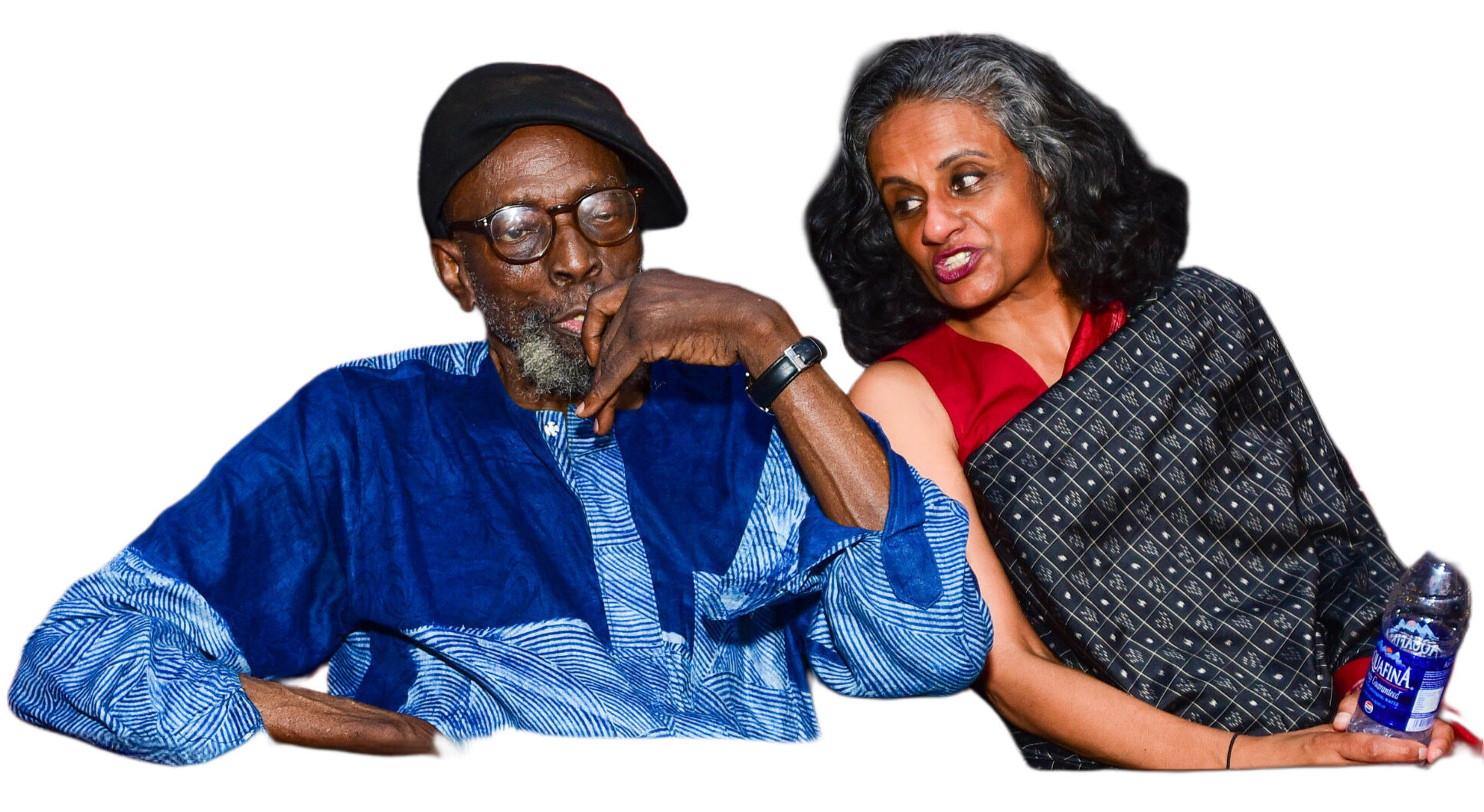
BJ Influenced My Work in Many Ways
By Priyamvada Gopal
I did not know till I saw, first thing in the morning, a friend’s condolence message. She is a senior Nigerian scholar. I stared at it, uncomprehending. ‘We knew this day would come,’ she had written, expressing her sadness.
I did not know, BJ, that it would come so soon. It was just over a month since I last saw you and a bare week since we exchanged affectionate text messages, committing to being more regularly in touch, to not let space and time have their way so completely as the years gallop inexorably on.
Later that day, still in a haze of disbelief, I wrote a post for friends and family:
“My doctoral supervisor and comrade, Professor Biodun Jeyifo, BJ to his friends and students, passed away yesterday. The news has come as a terrible shock, even though I knew he was not in the best of health.
Last month, I was deeply privileged—and now, I realise, frankly blessed—to be able to see him on his 80th birthday at a major event in Lagos at the Wole Soyinka Centre for Investigative Journalism. The affection and admiration in which he is held in Nigeria is extraordinary, if not at all surprising. We reunited ourselves after some years of little contact (‘meaning to get in touch’, as one always does).
So, the loss is more painful because of the reunion, which was magnificent, and the renewed hope of more regular contact. BJ influenced my work in many ways, something I spoke about at the event. Right now, I can’t recollect them all in composure, but I know that he gave me the permission, indeed an instruction, for intellectual work to be excellent and rigorous, but always in dialogue with the imperative to change the world.
BJ was able to be friendly and congenial even with those with whom he disagreed (within limits, of course). It didn’t always serve him well, but it was a remarkable quality, not one that I am able to practise very well myself. I wish I were better at it. Perhaps I will practise it more now in his honour.
At the same time, you didn’t want to get on his wrong side: you would not want to be the subject of one of his broadsides.
Please pick up the phone to those you haven’t been in touch with for a while and keep meaning to have a chat with. I was thinking just yesterday that I should call.
His first words on seeing me were a Yoruba proverb: ‘The Young Shall Grow,’ he said softly.
Fare thee well, dear teacher and friend. Rest in power, until we meet again.”
When BJ uttered those words to me on his 80th birthday, it was his way of marking time, noting the passing of the years that had brought him to the ceremonies of honour in Lagos. He was also marking where I was in the journey that I had begun with him all the way back in 1994. Books got written, lives got lived; there were also lives that didn’t get lived, lives we had meant to live. I had seen BJ several times in the early part of this century when he came more frequently to London, and he also visited me in Cambridge. When I wrote my 2019 book, Insurgent Empire, I researched and wrote about George Padmore, the great Trinidadian Pan-Africanist, among others. BJ had first brought that name to my awareness through his brilliant friend, the late John La Rose, at whose apartment I visited him in London and who then ran the George Padmore Institute there.
At the 80th birthday celebration, I spoke—and how glad I am I did—of BJ’s influence, introducing us to the works of African dramatists like Soyinka and Fugard, writers like Ngugi wa Thiong’o and Ken Saro-Wiwa, as well as the classic liberationist thinkers, including Ngugi himself, Edward Said, and Frantz Fanon, among others. I myself still teach many of these texts. In writing my own dissertation, after conversations with BJ about dissidence in postcolonial contexts, I wrote about the All-India Progressive Writers’ Association, oppositional figures who were particularly interested in questions of radical transformation after the end of colonialism, including familial structures and gendered relationships. These writers, mostly Muslim, dissident from the mainstream of the new nation of India and their own generally conservative communities, were no friends of colonialism, but were insistent that the moment of independence was also laden with possibilities for radical social and economic change within the new nation. For them, decolonisation was a historic opportunity for more wide-ranging change. Literature and drama, they believed, could help transform national consciousness towards those goals. Flag independence was a new beginning rather than the end goal of decolonisation.
It was a journey to write that dissertation. After I sent him my first couple of chapters, there was a long silence. And then a letter arrived. A long letter. BJ gave me a dressing down. I still have the letter, and I’ve shown it to my own students. He told me how I was wasting time arguing with this or that theorist, dropping this or that scholarly reference, spiralling into the realms of abstract argumentation without paying due attention to the text. First, pay attention to the text itself, he scolded. Let it teach you something. Draw out its own implications. Let it help you develop an argument. Don’t smother it with preconceptions and theoretical baggage.
This advice shaped me as a reader and writer for good. BJ trained me to focus on the text and be in dialogue with theories, but not to let those determine ahead of time where you go. I think that was sound advice, and I try to pass it on to my own students.
At Cornell, several students, mostly, though not only, from ethnic minorities, organised themselves into the Radical Caucus of the English Department. We wrote a bold, some might say foolhardy, report which invited this scholarly community (as we thought it was) to debate in good faith and engage in discussion about its weaknesses, oversights, and unrealised possibilities. Whether it was a good or bad document, posterity can decide, but what took us aback was the snarling ferocity with which liberal academia bared its fangs, spitting hot, single-origin organic espresso all over us.
BJ was also taken aback, and he wrote a passionate polemic, not so much supporting us as taking his colleagues to task for how they were dealing with a group of idealistic, slightly bonkers, but bright young people, for refusing to have discussions which needed to be had. He was one of a tiny handful of senior scholars who stood by us as we faced the department’s wrath. In Lagos, he told me how proud he was that members of the RC had gone on to greater things, and he also told me, still amused, about the graduate students who came to him, worried they would be associated with us. “I always felt close to you all,” he said. “I think it was because you were the closest thing to the fervent campus politics of Nigeria he had cut his teeth on. Let a thousand flowers bloom,” he urged us then.
In our last conversation, over coffee at Dr Yemi Ogunbiyi’s house, we ranged over the dismal situation in the USA, and in India and in the UK and, of course, Palestine. We spoke of children, and friends and ex-lovers, of betrayals and disappointments, but also of love, loyalty, and joy in the midst of the gloom and struggle. I left a little earlier than I had wanted to, not wanting to tire him out after his dialysis earlier that day, but cheerful in our warm reconnection, certain it would be a matter of months before I saw him again, perhaps in Boston, perhaps in London.
That was the arrogance of the expectation of futurity.
Dear BJ, the young have indeed grown. They grow old too now. But the young shall grow again. You are still with me, in my classroom, in discussions with my graduate students, through the wonderful new friends I have made through you in Nigeria and beyond, in the words I write for my new book, slowly, painfully, making sure I am paying attention to the text at hand, making sure I historicise. That is the final tribute I can pay you now as you set off on your last journey in this world. Let my last words, then, be of thanksgiving for all you taught me, for your immense life, for the way in which you held indignation and love together in your large heart. Thank you, dearly beloved preceptor. Rest in power, but also in the infinite peace you so richly deserve. We shall see you anon.
*Priyamvada Gopal is Professor of Postcolonial Studies, University of Cambridge, UK.
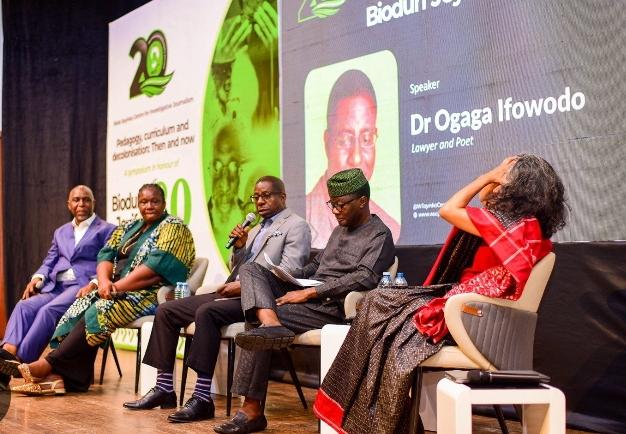
BJ, An Exemplary Teacher
By Kunle Ajibade
BJ was one of the best teachers we ever had. He was a deep thinker whose knowledge was always on full display in class. You wanted to listen to him because he was very compassionate. You wanted to argue with him because of his blazing intellect. Time and time again, BJ would say, “Let me explain.” And one explanation would lead to other explanations as he grappled with seemingly intractable ideas, granular details, and some imponderables of life. In his teachings, BJ went beyond the materialist reading–a focus on the economic and social conditions of the production and reception of literature. He made subtlety and complexity easy to grasp. Bespectacled, intense, hard-working, ebullient, and very driven, the fully bearded BJ in his mid-30s, when he taught our undergraduate and graduate classes at the University of Ife in the mid-eighties, would often turn out in his khaki or adire tops on jeans trousers with his pipe or Cuban cigars or both in his breast pockets. He and Dr Yemi Ogunbiyi used to get their regular supply of Cuban cigars from Professor Wole Soyinka, who was friends with Fidel Castro and some cultural figures in Cuba.
Both inside and outside of the class, he introduced us to the Western canon, meaning the significant texts in literature, the foundational philosophy, and the influential art and music that shaped the culture of the West, even as the Department of Literature-in English gave a prime of place to the study of African literature and culture. With his formidable intellectual capacity, BJ would reference appropriate radical books in economics, political science, philosophy, social anthropology, history, and so on, as he taught. He was, to the best of my knowledge, the most erudite, brilliant and sincere of the literary theorists on the left in Africa at that time. Check out his rigorous, theoretical academic articles. Check out his books, particularly his Wole Soyinka: Politics, Poetics and Postcolonialism. Check out his lucid and liberating journalism. And check out his eloquent interviews. He was a taskmaster of a teacher who would intentionally make a long list of books compulsory mainly to boost our radical questioning and critical thinking. Adventurous and creative, he taught, with new materials, graduate courses like Modes and Genres. The panache with which he discussed high culture in class was only matched by the ease and passion with which he regaled us with his knowledge of pop culture, most especially football, maybe because he was a terrific midfielder in his youth.
Most of the time, when BJ travelled abroad, he would buy two copies of a single title: one for his library at home, the other for his library in the office which his colleagues and graduate students could borrow. Some of those books never returned even though he kept a register of borrowers! BJ did not hector; he did not preach in class. If you want to have a feel of the tone he used, just read aloud in solitude his essay, “Literary Drama and the Search for a Popular Theatre in Nigeria,” published in his book, The Truthful Lie. The superb oral quality of the essay is the kind that BJ delivered. Moment by moment, felicitous words and carefully crafted phrases would filter through the silence of the lecture auditorium. When The Truthful Lie was published in 1985 by John La Rose’s New Beacon Books in London, we went to his office to congratulate him only to be confronted with a question by the author, “What do you make of ‘The Truthful – Lie’ part of the title?” As we sat down, trying to gather our thoughts, BJ calmly posed a rhetorical question: “What is imaginative literature if it is not a truthful lie?” He agreed with Balzac, one of the finest French writers, that “Fiction is the secret history of nations.” As an interpreter, an explainer, and a teacher, BJ frequently untangled the intricate web of fiction, peeled the multiple layers of narrative arcs seamlessly, broke the knot of its myths and mysteries, and made its wonder come alive magnificently.
In December 1984, BJ called our attention to that month’s edition of South magazine in which the eccentric and highly talented Zimbabwean writer Dambudzo Marechera spoke about the great influence that Wole Soyinka and Christopher Okigbo had had on him because, according to Marechera, “within every word, within every phrase they use there is a gigantic experiment going on in the background.” Marechera was quoted to have also said in that interview that “for a writer to have a clear-cut goal usually diminishes from the artistic strength of the work.” This led, expectedly, to an open-ended debate on the works of Soyinka, Okigbo, Achebe and Ngugi wa Thiongo. Here was BJ, who was obviously enamoured of the writings of these authors, presiding over a passionate, if not rancorous, debate of student ideologues on both side of the divide. He thereafter assigned the task of giving a seminar on Modernism and Marechera to one of his graduate students, Dapo Olorunyomi. It was Olorunyomi’s brilliance and confidence at that departmental seminar that instantly drew me closer to him. The seminar culture across academic departments was very vibrant when we were at Ife. BJ would insist that his graduate students attend those seminars, and he, too, would show up and participate actively in them. He drew a hard line between clear and clumsy expressions. He drew a line between straight and crooked thinking.
BJ was deeply involved in campus politics, supporting progressive causes all the way. He would speak stirringly at the Sports Centre, Oduduwa Hall, and other places, ending with solidarity songs, or the South African National Anthem. Remember that Nelson Rolihlahla Mandela and his comrades were still in jail for life at the time because of their struggle against Apartheid. The anthem, then, particularly the solemn prayers in it, found resonance in some of us. BJ would meticulously interrogate the oppressive system and connect the spirit of resistance in our country to the culture of resistance elsewhere in the same way that he connected the predatory nature of our country’s ruling elites to their despicable counterparts in the rest of the world. He would passionately argue against the philosophy of plunder.
The injustice in the world repelled him considerably. He used to take it so personally, the kind of barbarism that we are witnessing across the world today. He would tell the gathering that power would never concede anything willingly; that without a carefully planned struggle, there would be no victory. Although he invested a lot of time, energy, and commitment in the Academic Staff Union of Universities (ASUU) when he was its first president between 1980 and 1982, he never missed any of our classes. He never did. His Volkswagen Beetle was a true people’s car, for he would cram five of us into the car after our tutorials at the amphitheatre on Aristotle’s Poetics and other Greek masters, and we would go to the old Buka, if we were ravenously hungry, for food which he would happily pay for. BJ was generous with his money, but he was very stingy with his grades.
He taught us how to see works of art in society and society in works of art. He shared with us the pleasure of listening to the music of Fela, Miles Davis, Thelonious Monk, Bob Marley, B.B. King, Rex Lawson, Nina Simone, Roy Chicago, and Jimi Hendrix. He called our attention to the beauty in the works of Susanne Wenger, Twin Seven-Seven, Lamidi Fakeye, Agbo Folarin, Bruce Onabrakpeya, Obiora Udechukwu, Yusuf Grillo, Uche Okeke, and others. He was endlessly delighted by the satiric strokes in a significant body of cartoons in Nigerian newspapers. I remember that he and Dr Kole Omotoso invited to Ife Bisi Ogunbadejo, who was then producing very fascinating cartoons in the London-based West Africa magazine. This gifted cartoonist spoke to a crowd of students at the Oduduwa Hall. Ogunbadejo was a man of few words, but he was eloquent in cartoons. After his talk, he drew with absolute ease on a blackboard, procured for the occasion, some biting cartoons on a major political issue of that day. It was a mesmerising master class.
Before our very eyes, BJ wrote for The Democratic Review, Positive Review, The African Guardian, and The Guardian, using his name, or pseudonym, Bamako Jaji. It was only logical that he would teach a graduate course on Literature and Popular Media in addition to the course on Marxist literary theory. After our years in Ife, he continued to write for The Guardian and, much later, The Nation. He has now collected a selection of his political and cultural journalism in two books titled Against the Predators’ Republic, published by Carolina Academic Press, and Apostrophes to Friendship, Socialism and Democracy, published by Bookcraft. You will discover on the pages of these books the enduring relevance of his thought. Well before these books, he had published By Popular Demand: The Yoruba Popular Travelling Theatre of Nigeria, and Contemporary Nigerian Literature: A Retrospective and Prospective Exploration. In the Perspectives on Nigerian Literature, the anthology of the best essays of The Guardian Literary Series, edited by Dr Yemi Ogunbiyi, BJ has the highest number of articles in the two volumes. The Ife Monographs on Literature and Criticisms Series, which he edited with Dr B.M. Ibitokun and Dr Adebayo Williams, when he was head of the Department of Literature-in–English, published some original works of creative writings and criticisms. Indeed, it was in these Monographs that Niyi Osundare’s collection of poems, A Nib in the Pond, and his insightful and lyrical essay, “The Writer as Righter,” were first published. BJ also wrote some plays. His Haba, Director! directed by Chuck Mike, was a convocation play at the University of Ife. I acted in his Anniversary. He wrote some poetry too. It is such an honour to call BJ our teacher. It is a privilege to call him our friend. We feel a huge sense of loss. But we are consoled by his exemplary life. May his excellent work remain a source of inspiration.
– Mr Kunle Ajibade is a co-founder of TheNEWS, PM NEWS and TEMPO
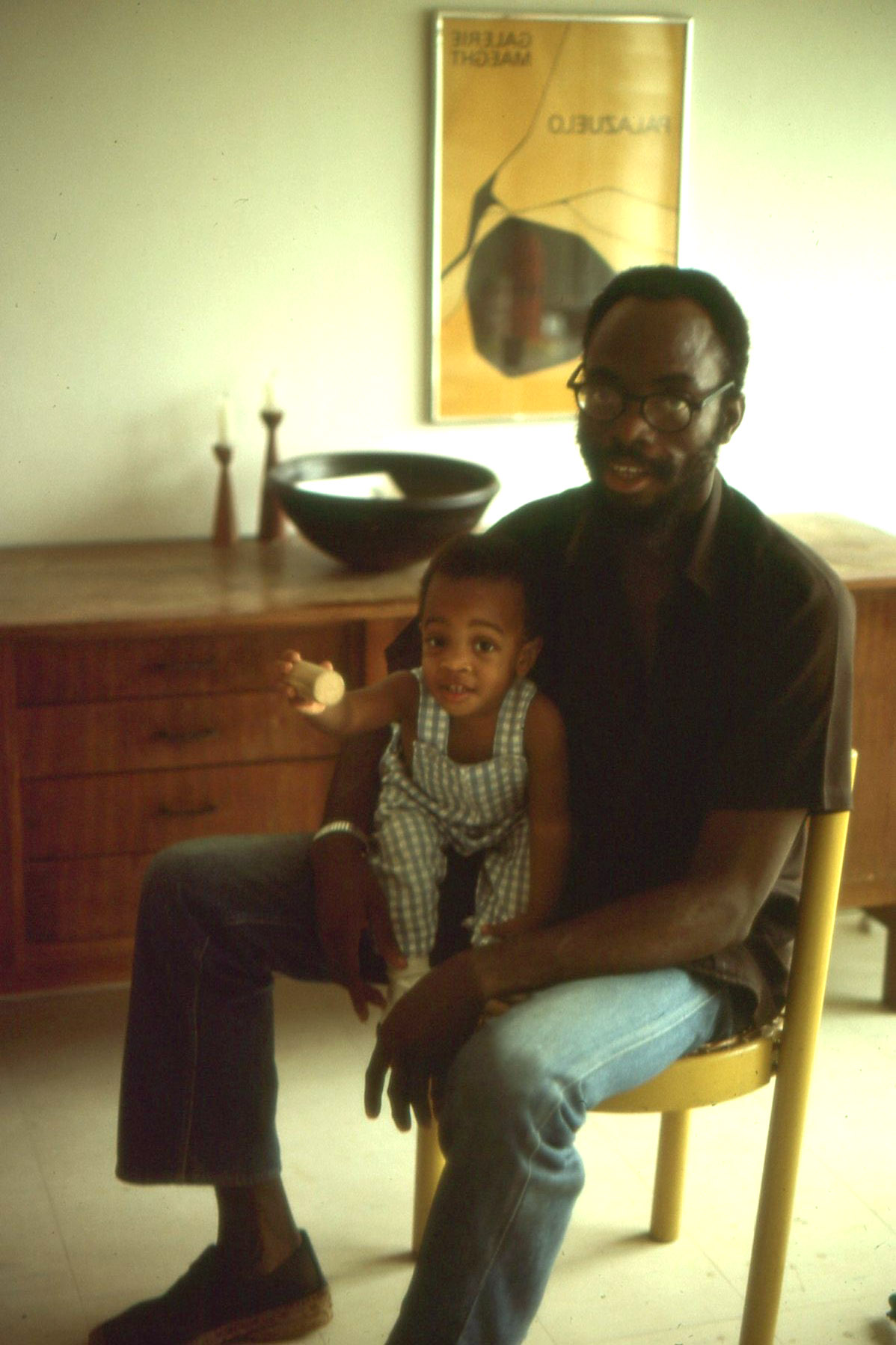
Biodun Jeyifo: The Legend Lives On
By Christopher Piwuna
So much has been said and written about the iconic Comrade Biodun Jeyifo, fondly called BJ, since his passing on 11th February. Much more will still be written and said about his humanism, his scholarship, and his activism. But no account would be complete without referencing his imprint on the Academic Staff Union of Universities (ASUU). It was in ASUU that Comrade Jeyifo’s humanist, scholarly, and activist credentials were most productively tested within the Nigerian firmament. As the pioneer president, he held everything about ASUU very close to his chest—mentoring many presidents who came after him—until he breathed his last.
BJ was a revolutionary Marxist who saw the need for a movement that would outlive him and his contemporaries. He knew that it is people who make things happen, and that nothing will change if the people themselves are not changed. He embraced praxis and indeed tested his revolutionary thoughts, along with trusted comrades, at the then University of Ife (now Obafemi Awolowo University), Ile-Ife, and other Nigerian universities. They became actively involved with students, labour, artisans, market men and women, as well as public intellectuals, to work for the socialist transformation of Nigeria. They confronted military dictators headlong and were severely bruised on several occasions in the 1970s and 1980s. They experimented with the idea of “communes.” They championed resistance to neoliberal educational policies and teamed up with students to drive the “Ali-Must-Go” national protest. They also transformed the lame-duck National Association of University Teachers (NAUT) into a vibrant and ideologically driven union of intellectuals, which ASUU has remained since 1978.
It was not out of personal desire or inordinate ambition that BJ became the pioneer president of ASUU; rather, it was a responsibility bestowed on him in recognition of his self-sacrificing commitment and unwavering dedication to making the union an intellectual vanguard for resisting the capitalist invasion of Nigeria’s intellectual, economic, and socio-political life. Thus, it is stating the obvious to say that BJ and his generation laid the philosophical foundation for ASUU’s engagements beyond the four walls of the university, or what infamously became “teaching what you are not paid to teach.” In actuality, BJ’s generation taught us the rudiments of what it means to make a difference in an organisation, in a system, and in society: clear vision, passion, and commitment; collective leadership, accountability, and transparency; unity of purpose, selfless service, and resilience, among others. Another past president of that generation, the late Festus Iyayi, later codified these tenets into five clusters: (i) integrity, transparency, and accountability; (ii) professionalism, objectivity, and hard work; (iii) courage, sacrifice, and total commitment; (iv) internal democracy, teamwork, and group solidarity; and (v) patriotism, anti-imperialism, and working-class solidarity. By all known standards, BJ exemplified and espoused ASUU principles throughout his working life.
Biodun Jeyifo’s academic profile is intimidating to the uninitiated. Beginning with a First Class degree in English at the University of Ibadan in 1970, and strengthened by graduate studies at New York University, where he obtained his Master’s and doctoral degrees in 1973 and 1975 respectively, BJ rose phenomenally to become a formidable global scholar. He began his teaching career as a Lecturer II at Ibadan in 1975 and transferred his services to Ife in 1977. At Ife, his recommendation to the rank of full professor by the Senate was halted when Jeyifo resigned over the university’s failure to grant him research leave for a commissioned book project on Wole Soyinka, and he moved to America in 1987.
BJ was appointed Professor of English by Oberlin College the same year and later moved to Cornell University, where he plied his trade until 2006. He was subsequently appointed Professor of African and African American Studies and Comparative Literature at Harvard University, before serving as emeritus professor at both Cornell and Harvard. In all of this, BJ did not prioritise career advancement; rather, his exceptional brilliance earned him placements in world-class universities and attracted several national and international awards, honours, and fellowships that took him to many countries and continents across the world.
BJ’s scholarship is multidimensional. He was a poet, an essayist, a literary critic, a revolutionary thinker, and a newspaper columnist—all at the same time. His methodology is rooted in mythology and cultural theory. While receiving the award of D.Litt. (Honoris Causa) at Obafemi Awolowo University (OAU) in 2018, Jeyifo spoke of his profession and methodology through “the Afro-Cuban myth on the body of Truth and the head of Falsehood.” He said, “in my profession of critical theory and literary studies, this is the kind of ambiguity, conundrum, or enigma that we love to work on.” He went further to counsel: we “must see Truth and Falsehood not as mere opposites but as inevitable contradictions that we must do our utmost to decipher in order to make the contradiction work for us and not against us.”
At home or abroad, BJ never lost touch with “the talakawa of the land to whom restitution and justice will come one day in our country.” His weekly Talakawa Liberation Courier column in The Sunday Guardian from its inception in 1983, and the Talakawa Liberation Herald in The Nation forty years later, were dedicated to this underprivileged class—the poorest of the poor—who are neglected by opportunistic and egotistic ruling elites with an insatiable appetite for state-enabled privileges and corruption. In both America and Nigeria, BJ saw the condition of the talakawa declining each day, not for lack of resources but due to denial of access to the basic necessities of life. Barack Obama’s 2014 State of the Union address, in which the president acknowledged the existence of poverty and inequality in America, prompted BJ, in one of his essays, to remark: “there is the widespread phenomenon of the working poor as a social and economic category distinct and separable from the jobless, non-working poor. Indeed, in Nigerian parlance, I would call the former the talakawa of America and the latter the almajiris of the USA” (The Nation, 2 February 2014). The two-part essay underscores BJ’s abhorrence of the ills of capitalist exploitation everywhere, noting “that the inevitable great climatic differences should not obscure the common sources and linkages between inequality and poverty in our world.”
Jeyifo’s skilful deployment of profound intellectual prowess in his decades of discursive journalistic engagement served more than pedagogical purposes; it provided (and still provides) useful platforms for generating ideas to address complex socio-political problems. His optimism in the possibility of the Nigerian revolution, when viewed against the recorded impacts of revolutionary thinkers like Amilcar Cabral, Frantz Fanon, and Paulo Freire, is not in any manner misplaced. To overcome the expected ambush of reactionary state agents like Chris Ngige, BJ passionately stressed the imperative of organic solidarity among those working for a socialist alternative—calling for a deeper and clearer understanding of the dialectics of change. Contradictions are bound to arise, but they must be quickly dispensed with, lest they derail the struggle for the talakawa’s liberation. BJ’s last major assignment for ASUU hinged on resolving such complex issues.
As the lingering crisis at the OAU branch festered around 2016/2017, BJ saw the split in Ife and quickly stepped in to avert its snowballing effect on ASUU nationwide. At the Ife convocation in 2018, he openly expressed his displeasure at the way OAU authorities and academics were handling the crisis. Specifically, he noted with regret that “Ife is the birthplace of ASUU; today, ASUU is in a state of profound and crippling crisis at the University.” He did not stop there. He relocated to Ile-Ife for days, engaging the dramatis personae in order to reconcile the warring parties and reconnect detached members with the national body of ASUU. He expressed shock when presenting the report of his efforts to the ASUU national leadership in January 2019, saying: “while historically ASUU had had many local and national crises, none was as critical as the current ASUU-OAU crisis.” He further stressed that “no previous crisis in ASUU had ever led to the formation of a breakaway faction that had taken its separation from ASUU to the point of seeking the registration of a rival national association of Nigerian academics—named, in this instance, the Congress of Nigerian University Academics (CONUA).” He made far-reaching recommendations that could have laid the matter to rest permanently if the arrowhead of the separation movement had seen reason with BJ. Unfortunately, the splinter group remained adamant and rebuffed all his reconciliation efforts.
Once more, ASUU invites the breakaway group to honour the memory of Comrade BJ by returning to the fold. The greatest honour that Nigerian academics can do to his memory is not to approach his graveside as a divided community. His immutable admonition is very instructive: “contradictions are there not to crush us if we study them carefully.” The transition of our teacher, mentor, and pathfinder from mortality to immortality presents a rare opportunity for us to act in unison to reclaim the lost glory of our universities and reposition ASUU for the progressive transformation of the country. His inability to achieve a united collective of scholars in his last days was perhaps one of his greatest regrets. He would turn for joy in his grave if we give him this well-deserved honour now that he is no longer with us.
The renowned historian and African scholar, Toyin Falola, organised an international event to celebrate the life and times of BJ on Sunday, 22nd February, where it was asked whether BJ would be remembered more for his scholarship or his activism. We in ASUU can boldly submit, as many participants did at the event, that BJ lives forever both as an iconic scholar and as a revolutionary activist. Biodun Jeyifo cannot die on either front. His legendary intellectual contributions, his outstanding record of humanistic interventions, and his teeming mass of achiever-mentees within and outside academia will continue to speak for him. Live on, Comrade BJ!
Christopher Piwuna is the president of the Academic Staff Union of Universities.
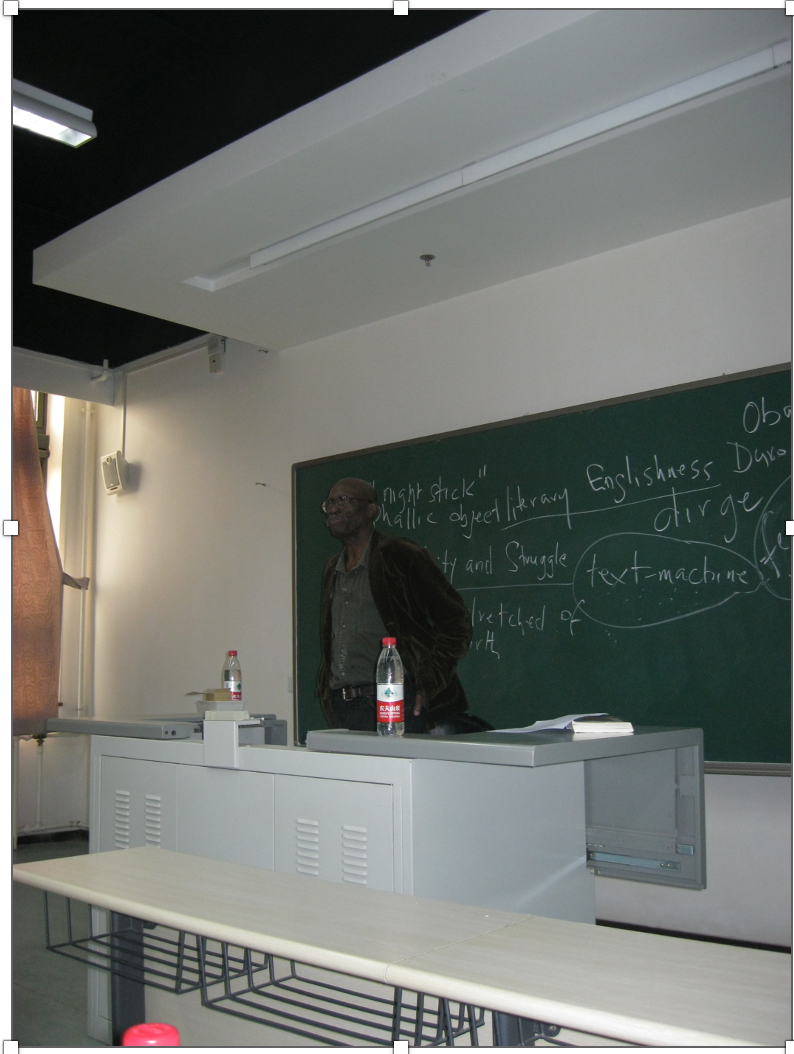
*Ying Cheng, is an Associate Professor, Department of Asian & African Languages and Cultures, Peking University, China
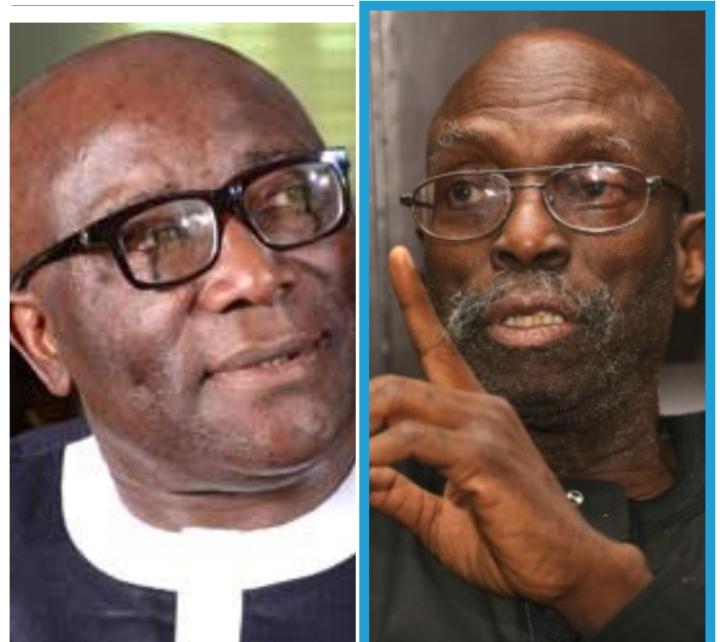
Biodun Jeyifo (BJ), A Radical Humanist
By Chidi Amuta
Tomorrow in Lagos, scholars and intellectual expeditioners will gather to honour and celebrate a most unique and outstanding Nigerian intellectual. Prof. Biodun Jeyifo, easily one of Nigeria’s most outstanding humanities intellectuals, turns 80 tomorrow. Jeyifo, fondly called BJ by his colleagues and students alike, is concurrently Emeritus Professor of English and African Literature at Cornell University and of African and African American Studies at Harvard University. The roll call of his former students, both in Nigeria and in the best universities across virtually every continent, reads like a telephone book—an A-list of successful people in diverse fields in Nigeria, the United States, and especially Europe.
But by far the most important landmarks in BJ’s career are the early stages of his work as a teacher, intellectual gadfly, trade unionist, and socio-political catalyst at the University of Ife (now Obafemi Awolowo University).
With a first-class honours degree in the literary arts from the University of Ibadan and later a Ph.D. from New York University under the supervision of Richard Schechner, BJ came to lead an intellectual and ideological revolution at the University of Ife (now OAU) in the late 1970s and 1980s. From his station in the Department of Literature in English, BJ’s radical sociological approach to the study and teaching of literature marked a decisive shift in a curriculum that had been originally informed by the bourgeois liberal formalist tradition of the Ibadan British classical school. In that school, literature was seen as a self-justifying enterprise that could be created, consumed, and taught independently of the society that informs it and gives both the writer and the work life. Literary criticism, in turn, was virtually a closed cult of scholarly devotees.
In contrast, BJ came to Ife with a fierce advocacy of a manifestly radical Marxist approach to the study and teaching of literature. The key axioms of this new catechism included the recognition of literature as social practice, the need for social commitment in the work of the writer, and the imperative of ideological commitment in the literary enterprise.
These were the canons of a new pedagogy in literary studies, and BJ led the charge with full force. Other like-minded members of a younger generation of scholars and students enrolled as the years went by.
This radical departure from the norm endeared him to students and unsettled faculty whose careers had been built on decades of idealistic intellection and cultic enclosure.
BJ’s radical departure was founded on an existing ferment of political division based on the capitalism-versus-communism divide of the Cold War era. Throughout Africa and parts of the Third World, anti-imperialist sentiment was the hallmark of a growing opposition to capitalism and its ideological domination of global economic and intellectual realities.
As a teacher of literature, BJ stood out not only for the ideological departure of his pedagogy but also for the rigour of his scholarship. He was deep, insightful, and thorough—hardworking and painstaking.
I joined the Department of Literature in English in this environment of ideological ferment and transformation. As an apprentice academic, I was also a graduate student. For my MA thesis on the works of the Ghanaian novelist Ayi Kwei Armah, BJ was a natural choice of supervisor. His classes were thorough and learned. His sense of work was exacting. He challenged his graduate students not to consider any literary work too taxing. He had us read and analyse texts like James Joyce’s Ulysses and Leo Tolstoy’s War and Peace, which are among the largest creative works in world literature. You completed any of BJ’s graduate courses not only informed but better educated and more learned.
For me, as an apprentice scholar and teacher, BJ’s rigorous teaching and research methods had an indirect impact on my own lectures and tutorials. In the process, the constituency of younger Marxist scholars and radical students continued to expand. The sociological thrust of the new pedagogy resonated directly with our immediate socioeconomic conditions. Literature and literary criticism were reconnected to our social experience and found relevance in the struggle to liberate the masses from their class enemies.
When I later enrolled for a Ph.D., again BJ was my supervisor. The coursework was gruelling, often consisting of marathon three-hour lectures on literary theory or research methods. Through it all, he was a trusted guide as I ploughed through the vast body of literature inspired by the Nigerian Civil War to produce a thesis which both Professors Emmanuel Obiechina and Abiola Irele (now both late), as my external examiners, agreed was an original contribution to African literary scholarship, especially to the then-emerging Nigerian national literature.
I must confess that the theoretical foundations for my book, The Theory of African Literature, were laid during my tutelage under BJ. I owe him a great deal of my knowledge and grounding in literary theory. This is partly why it was a privilege to ask BJ, then at Harvard, to write an updated foreword for a new reprint of the book after it had been in circulation and on the reading lists of graduate programmes around the world for over three decades.
As a scholar, BJ was naturally combative in defending his intellectual and ideological turf. At one point, Wole Soyinka came to see BJ’s ideological revolt and growing followership as a threat to his reputation. In his inaugural lecture, “The Critic and Society: Barthes, Leftocracy and Other Mythologies,” Soyinka took a consistently hostile swipe at BJ and the devotees of the new Marxist school of literary scholars and critics. BJ subsequently responded with several rebuttals in articles and books, especially his seminal The Truthful Lie.
As a member of the Ife campus community, BJ was deeply engaged in university affairs. He led numerous protests for accountability in the administration and once opposed a frivolous foreign trip by an Ife delegation under then Vice-Chancellor Professor Cyril Onwumechili.
He complemented his deep academic work with an active, hands-on role as an executive of ASUU, the national union of university teachers. In this capacity, BJ traversed the length and breadth of the country in his trademark weather-beaten Volkswagen Beetle, often doubling as driver and, at times, a minor mechanic.
He was actively involved in all the struggles of ASUU against the military despotisms of the time. It is important to note that he engaged in these struggles not for personal gain but in the national interest, defined as the greatest good for the greatest number. For BJ, the common good represented the egalitarian aspirations of the masses, whom he saw as victims of colonial plunder and post-colonial betrayal.
A man of simple tastes and unpretentious manners, BJ has remained the quintessential embodiment of honest living and disciplined lifestyle. He was content with his old VW Beetle. Not for him the garish materialism and ostentation of the Nigerian elite. Not for him indulgence in wasteful habits and tastes. Instead, he has always made do with a simple adire outfit or a pair of jeans and a green combat khaki top—perhaps as a tribute to Fidel Castro and Che Guevara. It was from BJ, and from my own experience of hardship during the civil war, that I learnt that the most durable sandals could be fashioned from slices of disused motor tyres and thick rubber straps.
There was a distinct aesthetic sensibility in BJ’s sense of fashion. It lay in the perception of class struggle as a total war in which the vanguard must avoid any resemblance to bourgeois opulence. There was an inherent beauty in the profound scholar who embodied the simplicity of the masses. It was the beauty of Fidel Castro’s perennial green khaki fatigues or Yasser Arafat’s combat gear. Some Nigerian class rebels and labour union “combatants,” like the late Tai Solarin and Adams Oshiomhole, adopted similar khaki attire as a symbol of resistance to oppressive values.
Beneath the rugged, disciplined socialist academic persona lies what I consider BJ’s enduring virtue. Beyond being my most impactful teacher, I have found him over the years to be an abiding friend and unwavering personal advocate. Beneath his stern mien lies an intensely humanistic core. His empathy is spontaneous, and his solidarity is enduring.
BJ’s strength as a person lies in his embodiment of humanist attributes in a broadly Renaissance sense, avoiding extremes. He is ideological without being an ideologue, assertive without being a demagogue, and committed to political schools of thought without being doctrinaire. Yet he remains a highly accomplished scholar—modest and unassuming. Neither arrogant nor pompous, BJ neither seeks to intimidate nor to impress. In a national culture often marked by empty noise and bluster, he stands out as a humanist in the finest tradition. His scholarship reflects profound knowledge and self-evident mastery.
Above all, BJ is intensely human. Observing his relationship with his family reveals an admirable duality in his personality. During my graduate studies, when I fell in love and decided to marry, I sought BJ’s counsel. He gave his blessing and offered his support. On an epic journey from Ife to Osogbo to seek the consent of my future father-in-law, BJ volunteered to accompany me, along with another colleague. We travelled in his battle-tested VW Beetle. After a difficult meeting, our host, seeing our mode of transport, cursed us heartily for bringing him what he considered the bad news of future poverty.
Many attain distinction in their chosen careers, but few become institutions in their fields through sheer grit and hard work. BJ belongs to that rare class of self-made, near-genius figures.
*Dr. Chidi Amuta is a Nigerian journalist, writer, intellectual, and literary critic. He is CEO of Wilson & Weizmann Associates Ltd, a firm of Public Relations/Affairs Consultants. He wrote this tribute in celebration of BJ’s birthday on 5 January.
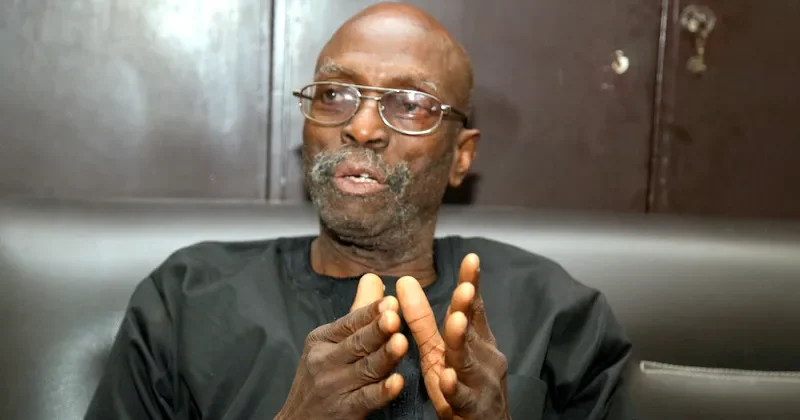
BJ: A Man of Integrity Has Passed On
By Mojisola Olaniyan
“Some people come into our lives and stay briefly. Others stay for a while and leave footprints on our hearts, and we are never, ever the same.” (Flavia Weedn)
It’s been a ‘short’ but impactful 40 years since I was privileged to meet Professor Emeritus Biodun Jeyifo (BJ). Circumstances of life allowed him to “stay for a while” in my life, and I have been blessed at every stretch. BJ was my professor during my undergraduate studies at the University of Ife (now Obafemi Awolowo University). He subsequently became the seasoned mentor that I needed, and a true and steadfast family friend, despite the age and status differences.
I am not a scholar, so I will leave BJ’s intellectual achievements and his incredible knowledge production over the course of his distinguished career for other scholars to share. This is what I know about BJ: he was consistently a man of integrity throughout his very active and public life. As Plutarch once said, “Character is simply habit long continued.” No matter the lens through which you view BJ’s life, integrity is all you see—he had a habit of being sincerely truthful, with a healthy dose of brutal honesty when needed.
I celebrate BJ as a guiding light who shaped not only my professional journey (and that of my late husband and his former student, Tejumola Olaniyan), but also who wisely steered my personal growth through wise counsel, though he was not obligated to. Unlike most professors of his generation whom I encountered, BJ patiently encouraged me with an unwavering belief in my potential from my student days well into my adult years—even when I could not see the potential in my situation.
Indeed, BJ came into my life and my family’s life, and he left footprints on our hearts, ensuring we were changed for good.
BJ was a ‘mentor for life’ to hundreds of his students, and he will be sorely missed.
Although BJ has passed on, his spirit remains and his legacy lives on!
*Mojisola Olaniyan is the Director, Institutional Effectiveness, the African Institute, Global Studies University, Sharjah, United Arab Emirates
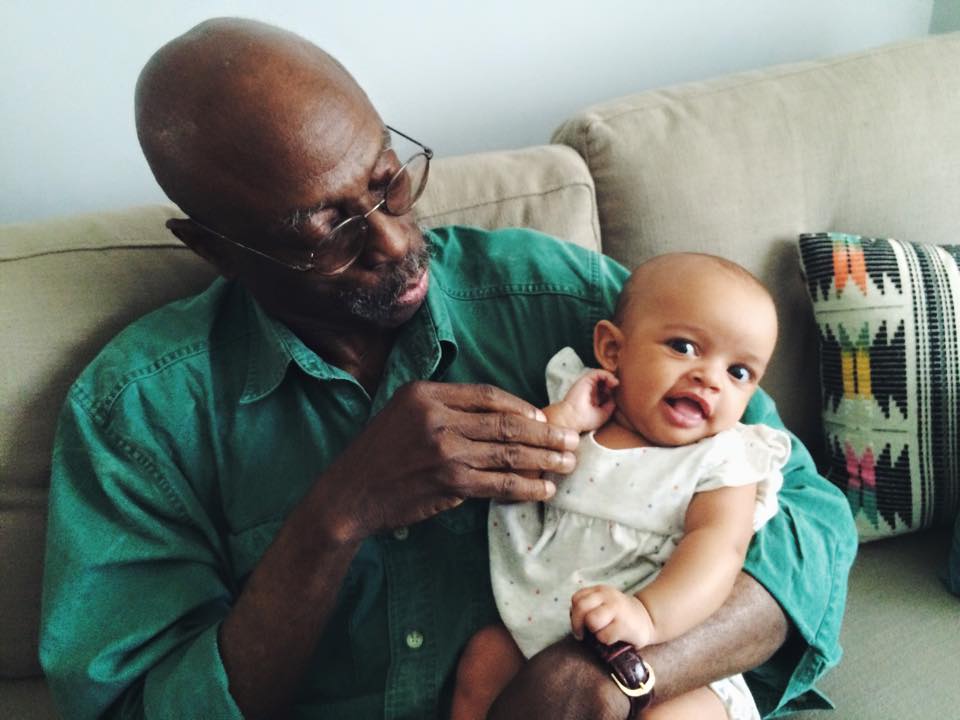
Remembering BJ
By Femi Folorunso
It is difficult to remember now if A Portrait of the Artist as a Young Man was ever among the texts that I studied under BJ at Ife (that is, our University of Ife). Yet, since my undergraduate and postgraduate studies—during both of which I had the privilege of being taught by BJ—I have not stopped having the uncanny feeling that he bore a resemblance to Stephen Dedalus, the eponymous character of James Joyce’s novel. Dedalus’s well-known aesthete perfectionist restlessness remains a potent symbol of the self-conscious craftsman. Dedalus is motivated by ideals, not ambition. He is, of course, a decoy for Joyce’s own struggle with the irreconcilable split between the artist and what we loosely call his social condition.
In the context of Joyce’s life and work, that social condition is a metaphysical conditioning directly linked to the Irish homeland. The last three or so sentences of A Portrait offer an interpretation of the novel that demonstrates that Stephen’s self-consciousness owes much—indeed, not less—to the political and cultural preconditions of Joyce’s Ireland. In Dedalus’s ordinariness, we find a character with “the weight of an entire culture” bearing heavily on him.
Interpretation of Dedalus’s character comes to us from the knowledge of how his creator, Joyce, was possessed less by self-doubt than by a restless desire to explore the inexhaustibility of art. And this is where the connection between BJ and Dedalus lies, in my opinion—the scholar, teacher, and activist who constantly explored the inexhaustibility of scholarship. His social condition was the neocolonial space, against which he set his exploratory spirit.
I make this connection because those who knew BJ personally—especially those of us who had the privilege of talking and arguing with him in his classes, which were certainly formative to our professional development—will hardly know how to describe our loss at his passing. Like Joyce before him, he was cosmopolitan, yet rooted and convincing in his attachment to the “homeland.” I would argue that it was through his classes and his manner of unpacking texts that he influenced many of us.
It was not unusual—indeed, it was the norm—to come away from every one of BJ’s classes restless, yet burning with the belief that one had stumbled upon the same interpretation, but that BJ had given it the desired, though elusive, formulation.
The Department of Literature in English at Ife was itself a nursery of new thinking—a place where the idea of literature as culture, text, history, and ultimately cultural translation thrived. This was, in itself, an acknowledgment that the condition of a society such as ours—which is continually shaped by the manipulation and social engineering of imperialism—warranted no less.
BJ’s teaching was unique for its range and the tenacity of its intelligence in pressing this underpinning as a culture of the mind. So too are his essays and books.
His Yoruba Popular Travelling Theatre of Nigeria offers an example of sustained sociological engagement with an art form that is central to everyday life, yet often casually dismissed by the “educated classes” on grounds of lacking aesthetic sophistication. In that work, BJ not only engaged with the centrality of popular theatre as a cultural mirror, but also demonstrated how its themes and subjects respond to the residual and emergent crises of unfolding bourgeois culture in a developing country such as ours. The book challenges the schematic interpretation of expressive art forms produced in such settings as nothing more than anthropological documents.
At the time, the book offered a badly needed departure from the older idea of reading popular forms strictly on the basis of their anthropological worth. It complemented work in oral literature in which the late Oyin Ogunba had excelled, and which Godini Darah had continued, as well as semiotics, the specialization of BJ’s contemporary and friend, Ropo Sekoni. As a matter of fact, the Department introduced a course in popular culture/literature. The course challenged the very status of the literary text by highlighting different kinds of writing on the one hand, and language on the other. In doing so, students were drawn to seeing literary production in a wider frame.
I recall with fond memory how, in the year I took the course, BJ brought a cassette recorder/player to class to play a recorded Tafsir by an obscure Muslim cleric from somewhere in the old Kwara State. The discussion that followed addressed language, literary production, and how grassroots communities interpret political and economic disadvantages from their own social realities. The course focused on “native idiom” to theorise culture as a way of life, rather than as the abstract ideal of “civilising arts.” Such an innovative approach effectively quashed any narrow assumptions about literary value.
Looking back today, the course offered a rare opportunity for Ife literary scholars of the time to grapple with the theoretical question of how virtue and social visions are created outside the barbed-wire enclosure of middle-class virtue-hoarding or the constipated fin-de-siècle assumptions about distinctions between “serious” and “popular” forms. Yoruba Popular Travelling Theatre of Nigeria can be said to have emerged from the innovative radicalism of literary studies at Ife from the 1970s through the early 1990s. Yoruba Popular Travelling Theatre itself was a phenomenon during this period, perhaps at its peak in terms of aesthetic consolidation, stylistic diversity, and movement. BJ’s scholarly contribution was to show the way forward for an informed understanding of popular theatre as both an aesthetic and political form.
There is also a sense in which Yoruba Popular Travelling Theatre anticipated his later engagement with the ideas of “space” and culture, which became more pronounced in his post-Ife essays and books, particularly his work on Wole Soyinka. In those writings—produced largely within the US university system—BJ actively resisted what I would call the temptation to be absorbed into the ritualised language gamesmanship of much contemporary criticism. If he sometimes sounds ambiguous in these writings, it is precisely because he was; and that ambiguity reflects both his cosmopolitanism and the grounding of his Marxism.
The former denotes his scholarly fascination with ideas and what might be described as a “common cause” with knowledge. With Marxism as his framework, BJ clearly—though often implicitly—rejects some of the unsettling claims that have taken root across the humanities over the past four decades, particularly in Euro-American academia. One such claim is that there are no longer grand narratives—that all narratives are merely signs or simulacra, mimicking reality without profound meaning. But can the wars over resources and the mass killings of recent decades—many of which have taken place on the African continent—be dismissed as illusion?
In essays such as “Wole Soyinka and the Tropes of Disalienation,” and in the book Wole Soyinka: Politics, Poetics, and Postcolonialism, BJ is at his most forceful, insisting that the Black—and indeed African—experience stands as living evidence against postmodernism’s claims, even as he departs from some of his earlier interpretations of Soyinka’s tragedies. His synthesis of theory and his sustained inquisitiveness about the Black experience help reposition not only our understanding of Soyinka’s work, but also its depth and its place in the history of Black literature.
Given the authority of Marxism and his own awareness of the illusion of narrative equality between the Global North and the Global South, BJ—like Joyce through Dedalus before him—seemed to have succeeded in reconciling aesthetics, culture, and space. Most significantly, with his uncompromising vigour, he steered us away from misguided readings of history as mere eclectic scholarship.
For generations of Ife literary scholars, BJ was our prince of letters in a royal court full of enchantment. E sun re o, Bamako-Jaji, the unforgettable old master!
As we mourn his passing, we also acknowledge the debt of gratitude we owe to members of that court such as Oyin Ogunba, Funso Aiyejina, Desmond Hamlet, and Wole Ogundele, all of whom preceded him. We also extend our thanks to those still with us—Ropo Sekoni, Gabriel Godini Darah, and associates such as Yemi Ogunbiyi, as well as the Ibadan duo, Femi Osofisan and Niyi Osundare.
*Femi Folorunso is a retired academic based in Scotland, UK. He is currently a visiting professor in theatre anthropology at Mozarteum University, Salzburg, Austria, among other engagements.
Prof Biodun Jeyifo
𝗕𝗝: 𝗔 𝗟𝗶𝗳𝗲 𝗢𝗳 𝗜𝗺𝗽𝗮𝗰𝘁
By Wole Olaoye
“A life is not important except in the impact it has on other lives.”
— Jackie Robinson
There could only have been one BJ in any academic environment—Biodun Jeyifo! Bee-Jay! Like a hawk flying high above the terrain, he had a bird’s-eye view of goings-on among mortals—our daily struggles to make meaning of our sojourn. He chose to do this through the field of literature.
He was a book that could not be judged by its cover. If you did, you were doomed to regret it. His lean stature belied his titanic intellect and fiery oratory. Yet, he was as simple as your next-door neighbour.
IMPACT
It was just like the self-effacing BJ to slip away just as we were welcoming him into the conclave of elders. When he clocked 80, I thought it was merely a precursor to what to expect in the next decade. The BJ that many of us knew, loved, and trusted at the University of Ife—the BJ so well profiled in Yemi Ogunbiyi’s The Road Never Forgets—was the stuff of which centenarians were made. Or so it seemed. The funeral train of mourners, from Ibadan to Ife, from Harvard to Cornell, and from Africa to the rest of the world, tells the story of a life of enduring intellectual impact.
BJ, as president of the Academic Staff Union of Universities (ASUU), was one of the first lecturers I approached when the students’ union was trying to process the admission papers of Segun Okeowo, the national president of the National Union of Nigerian Students (NUNS). The federal government had declared that no Nigerian university should offer admission to any of the NUNS leaders rusticated on account of the “Ali Must Go” protests for the democratisation of education in Nigeria. BJ and ASUU opposed the government ban. So did the students’ union.
BJ helped to reach out to other lecturers, including Prof. Soyinka, to quickly register Okeowo for their courses. The federal government was confronted with the fact that Okeowo had already been admitted at Ife before a rogue instruction from the education ministry—backed by the rump of military apologists in the new civilian government—banning him from all Nigerian universities was received. The authorities demanded an undertaking from the students’ union that Okeowo would not be involved in politics in Ife—an ordinary A4 paper which I was glad to sign as the union’s president.
MEMORIES
If I had attended BJ’s 80th birthday, which was held last month, I would have taken him down memory lane and retold the story of how instrumental he was in strengthening my resolve at a particularly tempestuous moment for the students’ union of the University of Ife.
I had finished serving my tenure as president of the students’ union and was looking forward to graduation when law and order broke down on campus. The rumpus was caused by the ritual beheading of a student, Bukola Arogundade, in Ife town, allegedly by unknown traditionalists during the celebration of the Olojo Festival. (Rumours were rife on campus to the effect that only strangers or non-indigenes could be used as sacrifices to the gods during the annual festival. As with such rumours, you never knew what to believe.)
Protesting students poured into town. However, at the end of that tragic day, four more students lay dead: Paul Alonge, an Associateship student in Education; Wemimo Akinbolu, a 23-year-old Part III Arts student; Fatimo Adebimpe, a 22-year-old Part II Education student; and Bukola Arogundade, a Part III student.
The turmoil spread to the governance structure of the students’ union; the falcon and the falconer were broadcasting on different wavelengths. The student leadership was suspended by the Students’ Representative Council (SRC). The campus was ready to burn.
It was at that stage that the Vice-Chancellor, Prof. Cyril Onwumechili, reached out to me through BJ and ASUU, requesting that I help navigate a path out of the crisis, as examinations were imminent. Seeing trusted faces like BJ, Jingo (Fashina), Yemi Ogunbiyi, and other progressive lecturers at the crucial meeting held well after midnight was quite reassuring.
I was requested to come out of retirement to restore normalcy so that examinations could be held and the university calendar saved. It would be a full-time assignment. I would have to shelve my own final examination until a later date. I didn’t mind helping out, but I required some guarantees too. I was not prepared to spend one minute extra to graduate—I wasn’t exactly a spring chicken when I enrolled.
BJ said I should feel free to state my terms.
I requested a full complement of the university’s logistical support (including ceremonial robing) for the burial of the fallen heroes. I reiterated my support for the proposed institution of an independent tribunal (backed by ASUU). I insisted on a written approval from the presidency that I, together with any member of my executive who joined me in stabilising the polity and facilitating the work of the independent tribunal, would still be allowed to embark on the National Youth Service Corps in July, even though we were technically not yet graduates. We would return in September/October to take our final papers so that we could graduate with our mates in December.
HISTORIC BARGAIN
We delivered, and the government kept its part of the bargain. That was how I went on national service before graduating. My secretary-general, Greg Obong-Oshotse, joined me in the task. The other members of my former executive could not take the risk because their courses were designed in the “Almighty June” format, which meant that if they missed the exams, they would have to spend an additional academic year.
The federal government sealed the deal with a letter assuring me that I had been granted presidential approval to proceed on national service before taking my final papers.
The point is that not every lecturer can walk up to a student leader and request him to put his academic prospects on the line in order to resolve one “aluta” or another. The fact that BJ evoked trust—the fact that his stern exterior was just a shield protecting his humane brand of talakawa radicalism—and the fact that BJ was an onion with many layers—the more you peeled, the fleshier it got—made his advocacy irresistible.
BJ was special. Between 1984 and 2006, he showed the world his brand of literary criticism, cultural theory, and social activism. He made the great works of Wole Soyinka and their oracular underpinnings digestible by cracking the palm kernel of the Soyinkean worldview with the hammer of dialectical analysis, instead of resorting to magisterial name-calling disguised as literary criticism. His standpoint was so authentic that he is credited with shifting African literary criticism from traditional colonial frameworks to more rigorous, radical, and Marxist-informed perspectives.
Even as dust returns to Mother Earth, BJ will always be BJ—teacher, friend, oracle. He was the frontline horse that set the pace for other stallions. He was Iwalesin personified. Two birds cannot both be named hawk—Eye meji ki i j’asa! Fare thee well!
*Wole Olaoye is a journalist and public relations practitioner based in Abuja.
I Will Miss BJ
By Adenike Osofisan
I knew you as my husband’s bosom friend, who looked so much like a blood brother and acted that way too. You were kind and generous to a fault to many people. I cannot but recount the role you played in my academic life. You and Sheila encouraged me to go to Georgia Tech for my Master’s degree. You bailed me out of a difficult situation at the University of Ife.
My then Acting HOD refused to send my PhD thesis to the PG School for assessment for many months. I became frustrated and decided to be rude to him and forget about getting a PhD degree. You asked me to stay in your office and took another lecturer with you to look for him in the department I had just come from. You met the HOD and told him that you were looking for your friend’s wife. As soon as you left, the HOD immediately sent my thesis to the PG School. Why? He did not want ASUU palaver, because you were then ASUU National President, and the other lecturer who went with you was the ASUU local President.
Ever since then, you believed in my academic ability. You paid my Association for Computing Machinery (one of the leading computing associations in the world) annual subscription and for many of its journals in the US for many years. I remained current in my field as a result of your generosity.
I once asked you to get me a particular software in data mining that had just come out. You went to the Harvard School of Computing to request help, but the person you met had no knowledge of the software and was almost sure that it did not exist, especially as you told him that it was a colleague in Nigeria who had requested it. Because of who you were, you did not give up but asked your two sons, Okunola and Lekan, to assist. One of them got the software CD and sent it to you. You were so happy, and you proudly went back to your colleague at Harvard to show it to him. The software assisted my postgraduate students and me in our research work. BJ, you played a critical role in the success of my academic life.
On the home front too, you did a lot for my family. Our children always looked forward to seeing you because you were always interested in their progress. You made sure that you and Hudita took our daughter out when she went for a two-week programme in Boston. You were my ally any time I needed my husband to do something for me.
BJ, words are not enough to express my gratitude to you. It is so difficult for me to come to terms with the fact that I will not see you again on this side of the divide.
You attended the Chapel of Resurrection Yoruba service any time I was giving the sermon. You not only attended but also read one of the Bible passages. On one occasion, many people, including the late Prof. Bisi Sowunmi, in attendance could not believe their eyes. BJ, you were also one of the people who read Bible passages during carol services in our home. Your favourite Bible passage was the Beatitudes, Matthew 5:3–12.
My last encounter with you on February 10, 2026, in the hospital was singing with you, my husband, and Yinka: “Igbagbo mi duro lori Eje ati Ododo Jesu…” I was told that you sang the same on February 9 by yourself before others joined in. You told me that you were once the Secretary of the Christian Students Union.. We argued a lot about your belief in “Iwa Lesin.” You gave sacrificially to many people. BJ, you were Christlike. I am sure that you died in Christ Jesus.
Adieu and goodnight until we meet to part no more at the feet of our Lord and Saviour, Jesus Christ. May the Lord comfort all the loved ones you left behind.
Adieu and goodnight, BJ.
*Adenike Osofisan is a Professor of Computer Science, University of Ibadan.
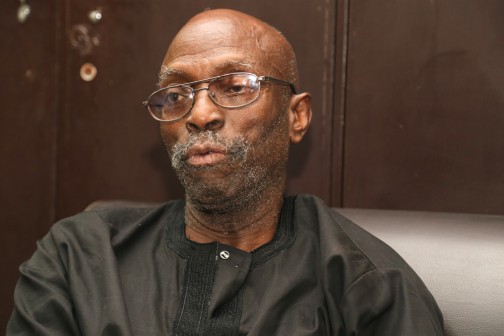
BJ, Grandteacher and Grand Human
By Abimbola Adelakun
Unlike most people who have written tributes since his recent passing, I was not Professor Biodun Jeyifo’s student. Yet, I was just as fortunate to have him as a teacher and even a friend. I first heard of him from one of my lecturers at the University of Ibadan, who spoke about him in such reverent tones that I was fascinated. The second time was when my father told me he had been Jeyifo’s student during his HSC days. He greatly admired the man and his brilliance, and he said to me, “That is my wish for you, too—to be a high-flying professor like him.” I was around 19 at the time, preparing to write JAMB for the third time. The thought of becoming anything close to such an eminent man was intriguing, even though I had no idea how that could be possible.
Years later, I would finally meet him through my novel, Under the Brown Rusted Roofs. He got a copy of the book, reached out to me, and said he would like to meet me. I was delighted. When I mentioned that he had once taught my father, he was astonished and amused. “That makes me old enough to be a grandteacher!” he said. I remember that, contrary to my expectations of being intimidated, I felt completely at ease in his genial presence. We talked about my book, but also about many other subjects that lent themselves to engaging conversation: life, poetry, Nigeria, politics, his talakawa ideology, and religion (he always described his religious persuasion as “ìwàlẹ̀sìn”). The first question he asked me was, “What does it mean to be a young person living in Nigeria today?”
Looking back now, I realise what a privilege it was that a man like him would dedicate time to someone like me, who had barely seen the world. Even more remarkable was that, despite the vast gap in age, knowledge, and experience between us, he was never condescending. I looked up to him, and he never looked down on me. When I told him that my father wished I could be like him, he said it made him proud that, despite being a young teacher during that brief teaching stint, he had made such a lasting impression on a student that he wanted his daughter to emulate him. When I mentioned I was pursuing graduate studies in the USA, he was equally encouraging. I have revisited our email exchanges from as far back as 2008, when I first knew him, and I was struck by how many of them were pep talks during a period when I was deeply uncertain about my path. He had sensed—correctly—that I was grappling with despair, and he kept sending encouraging messages until that phase passed.
In Lagos, he usually stayed in Victoria Island. There was a beach near the house—I cannot recall its name now. When I casually mentioned that I liked beaches, although I had only visited one as a child—and even then, could only watch from a distance because the relatives who took us to Bar Beach were afraid of water—he offered to walk there with me. He was generous in both big and small ways.
When I moved to the USA for graduate school, the pressures of the transition made it difficult to sustain relationships, so we kept in touch mostly by email. In 2016, I received a summer fellowship to Harvard, which gave me the opportunity to see him again. He was delighted by the progress I had made and, as always, offered to assist with my research or anything else I needed to succeed. We did not see each other again until 2019, when I visited him in Ibadan. He had expected me to come with my children so he could meet them, but I arrived alone. I explained that my children could be as excitable as feral hogs unleashed on a sugarcane farm, and I did not want them turning his house upside down. He swept his hand across his sparsely furnished living room—evidence of his lifelong commitment to an anti-materialist lifestyle—and said, “There is nothing here for them to turn upside down. You can bring them whenever you want.”
I promised to visit him again the following year, but then COVID-19 happened. Communication slowed and became sparse. At some point, my emails went unanswered. I considered calling him but could not find his number on my phone. I have a habit of saving contacts under code names, so that if my phone is lost, my friends are not exposed to scammers. Unfortunately, I had forgotten how I saved his number.
When I saw the news of his 80th birthday in January, I realised I could ask Uncle Kunle Ajibade for his number. I retrieved it and sent him a message. The following day, he responded and promised to call me after the Nigeria–Morocco match. As soon as the match ended, I dialled his number. He answered, “Àdùnní, wọn ò tí gba tán, ní sùúrù. Má pè ẹ́, má worry.” He eventually called after the penalty shootout. His voice sounded as strong as ever. I told him he did not sound 80 at all.
He replied that although he had experienced some health challenges, he was doing well. He often joked that, at his age, he was already in the departure lounge—the liminal space before one exits the world—but he had been there for so long that there was no need to fear he would suddenly depart. He mentioned it again in January when we spoke. “But I am still here on this side,” he said. He told me he planned to be in the USA in February, once the winter had eased, as he was no longer tolerant of the Boston cold. I promised to visit him when he returned. I had some international trips scheduled, but I expected to be back by February 21. “Just give me a time and date,” I told him, “and I will be on a plane the very next day.” He promised he would.
I had planned to tell him how much his book, The Yoruba Popular Travelling Theatre of Nigeria, had inspired my current work. I looked forward to discussing several ideas with him.
On Wednesday, February 11, I was waiting for the Uber that would take me to the airport to begin those same trips when the news flashed across my phone: he was dead. He had died that very morning. My legs wobbled. Dead? How could he be dead? We had an appointment—he was supposed to call me. But that was not to be. Death makes no appointments. Whenever Death is ready, it comes calling; we have no choice but to rise from the departure lounge and answer that final boarding call.
So, yes, Professor Biodun Jeyifo—grandteacher and grand human—farewell as you embark on your journey to the great beyond.
*Abimbola Adelakun, a columnist with The Punch, a novelist and author of two critical books on Pentecostalism, is Associate Professor of Global Christianity, University of Chicago
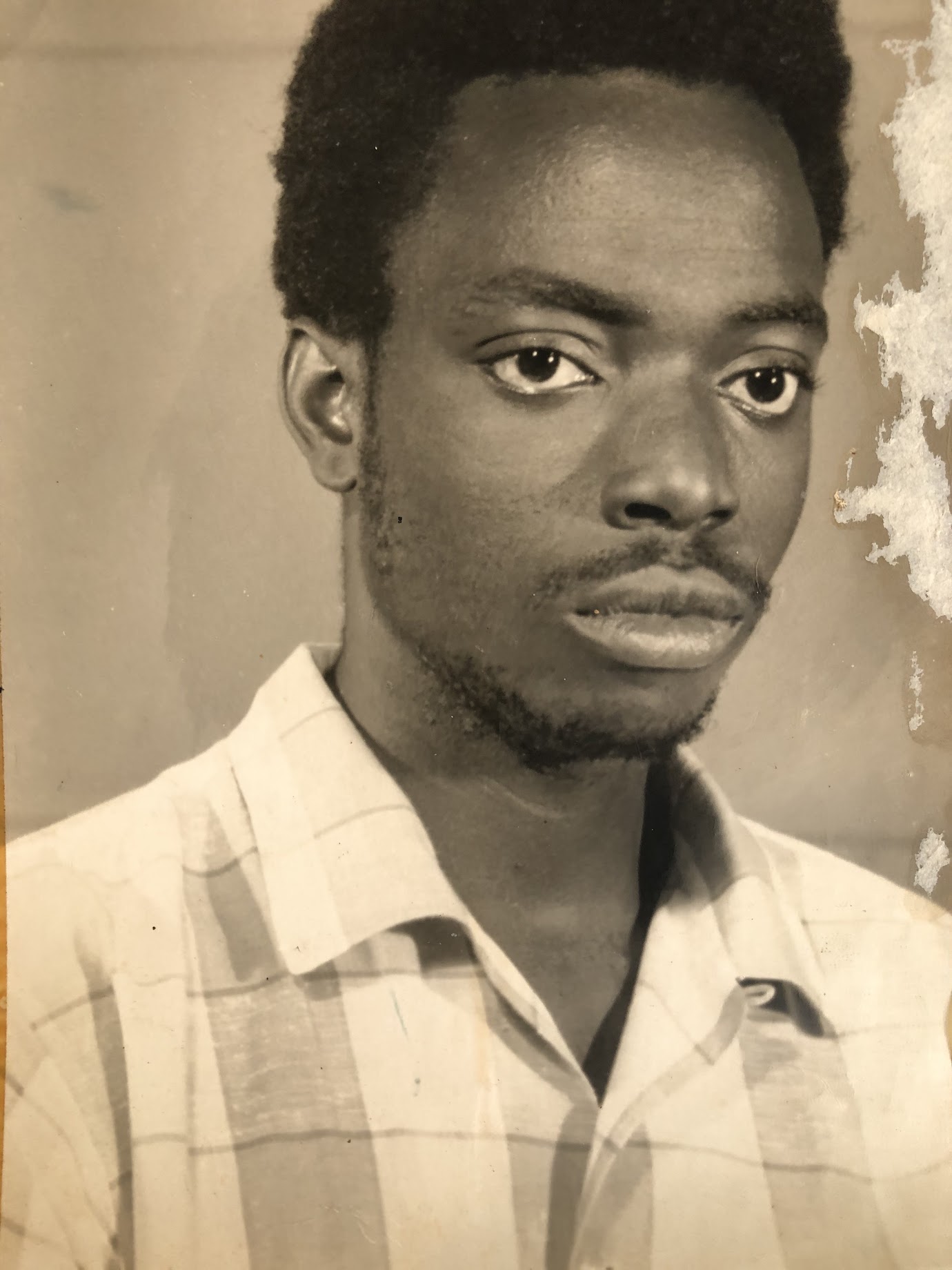
The Last Dance
By Kolade Mosuro
For three decades, he was away from his roots, engaged as an itinerant teacher at Oberlin, Cornell, Harvard, Cambridge, Berlin, and Beijing. Everywhere he went, he left his mark, leaving his colleagues and students in awe of his high intellect. He was quick to let the world know that he was from Ibadan. Ibadan here refers to his upbringing and schooling. Ibadan is as good as any great city in the world, and its university is—some may say was, but perhaps we should leave that argument for another day and simply say—the university is good enough to hold its own in the universe. Biodun Jeyifo, BJ as he was fondly called, was one of Ibadan’s intellectual ambassadors, and so he criss-crossed the globe, particularly the Ivy League schools in the US, to share his towering academic gifts.
Every year, he would return to his roots for its sun, smell, and people. This is where our paths crossed. He was joined at the waist to Prof. Femi Osofisan, and I knew Osofisan; I was bound to know BJ. If you saw him in Ibadan, you did not have to look far before you saw Osofisan. They both blended friendship with scholarship, producing an intellectual alchemy that fed on itself, thereby yielding conversations, studies, texts, and papers of very high, seminal content.
BJ’s eyes gave him away. They seemed sunken, or pierced with rigour. What distinguished him most was that he was a very deep thinker. I have often wondered whether the circumstance of birth played a role in giving us Prof. Abiola Irele, Prof. Dan Izevbaye, Prof. Ben Elugbe, and Prof. Biodun Jeyifo—all acclaimed literary critics, all hailing from the same axis, all interweaving their native tongue with Yoruba, and going on to a university that set them aglow with critical thinking.
BJ struggled with his health. However, no matter how ill he felt, the sun, the food, and the people sufficiently invigorated him—enough to carry him back and forth and sustain him through the wintry North American climate for a while, until his next visit. While overseas, his heart never left Nigeria. You knew this because he kept a weekly column in one of the Nigerian dailies. He successfully combined rigorous academic work with periodic literature, reaching multitudes. Through this medium, he was one of the social links between the government and the ordinary man, offering counsel to the government and bringing their sores to the fore, proffering solutions to knotty issues, or unbundling their double-talk. BJ wrote prodigiously, but his language was dense. You needed to read his essays twice or more to grasp them. He wrote as his mind directed him, and his mind was often high up there in the celestial.
One day, we got in the car, and we were off to see Soyinka in his kingdom at Ijegba. I looked at Jeyifo and Osofisan. Their fiery youthful academic relationship with Soyinka had thawed. Maturity had brought some convergence in ideologies. BJ had become, arguably, the pre-eminent scholar on Soyinka. Cambridge University stated clearly of BJ’s works that “no existing study of Soyinka’s works and career has attempted such a systematic investigation of their complex relationship to politics.” Our conversation in the car that day drifted from literature into old age, its manifestations, and how we now readily forget things. Osofisan said that, but for his neck, he would have long lost his head. Jeyifo indicated that he was always searching for his keys far afield when they were in his pockets. I said that I would sometimes get into the bathroom to shave, lather my chin, and then discover it was toothpaste. We all laughed at one another. We couldn’t really complain about age because we were going to see the ageless king. Nevertheless, it was telling, because we discovered we were each nursing one pathology or another under our skin. In the case of BJ, the skin no longer concealed his pathology; it revealed it.
At 80, just recently, BJ deserved a bash. We were going to celebrate his birthday, so his friends threw a party for him at Odunlade’s Art Gallery in Ibadan. This was on the 9th of January. He was born on the 5th of January, and so he was christened Biodun as his birthmark to herald the new year. On the 9th, the year was still new enough—but more importantly, BJ was 80. It really was worthy of celebration. At the party, glowing tributes were paid to him in acknowledgement of his outstanding scholarship, his activism, and his compassionate care for his fellow man—his general kindliness. Speaker after speaker spoke of the gratification of their association with him.
Prof. Adenike Osofisan spoke differently, but most poignantly, from the rest of us. I had said BJ bore his illness with equanimity and courage, which was a lesson for all of us. Adenike went further. She said: “BJ, you have not been fair to yourself; you have not been fair to your body. Now, at 80, you must stop to look after yourself as much as you tirelessly and compassionately look after others.” When she took her seat, you could hear a pin drop. She spoke to BJ, and indirectly to the rest of us. Adenike is a teacher and a caring mother; her admonishment may well apply to those of us whom BJ left behind.
Let us not forget that we were gathered to celebrate BJ’s 80th. So the band struck a note—it was Easy Motion. The music beckoned to BJ, lifting him off his feet. He was in a buoyant mood. Prof. Adenike Osofisan joined him in a dance; Prof. Tunde Adeniran joined him on the dance floor; Prof. Niyi Osundare couldn’t resist the music and so got up and held the left flank; Tunde Odunlade and Femi Osofisan swayed at the back, while I flanked on the right. BJ was in the middle. He said that, as much as the party was very good, it was the best he had ever had. He swayed to the left and right, nodding his head to the beat of the music.
It was his last dance.
Adieu, BJ.
Dr. Kolade Mosuro is a Publisher and Bookseller.
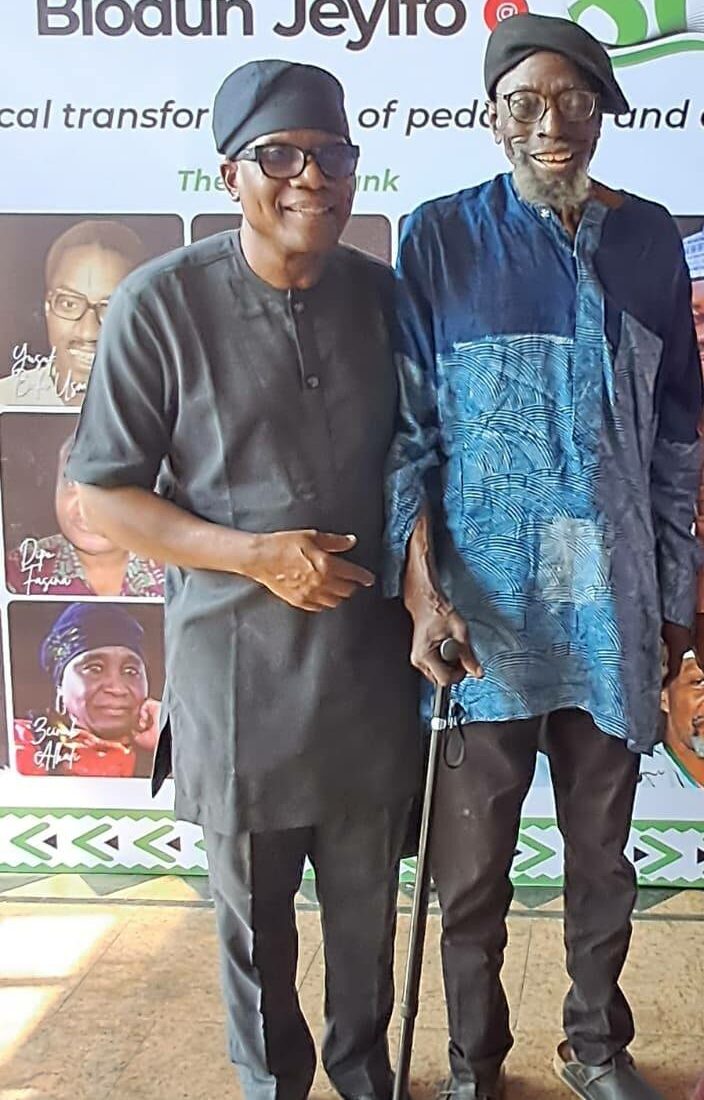
For BJ the Revolutionary
By Kayode Komolafe
Comrade Biodun Jeyifo (BJ), whose body was buried in Ibadan recently, was a revolutionary till his last breath.
A day before the interment, members of his family, friends, colleagues, and comrades held an evening of tributes in honour of the accomplished emeritus professor of African and African American Studies and Comparative Literature at Harvard University in the United States.
Since BJ passed away on February 11, it has been soul-lifting for his comrades to read the outpouring of testimonies about his life and times.
The common thread in these affectionate comments is that BJ’s exit from our midst is a huge loss. Indeed, it requires a multidimensional approach to explore the BJ phenomenon. This exemplary personality of BJ was manifested in his immense humanity, instructive humility, and remarkable selflessness. For those who benefited from BJ’s genuine kindness, the common saying that someone is “generous to a fault” would not be a cliché. By exhibiting these virtues first and foremost as a human being, BJ was doubtless a great ambassador of the revolutionary movement, whose goal is to advance human progress. On this goal, BJ never wavered.
BJ’s revolutionary career was indubitably defined by consistency, commitment, and clarity. It is noteworthy that when he turned 80 on January 5, he reaffirmed unequivocally his socialist convictions. A symposium was commendably organised by the Wole Soyinka Centre for Investigative Journalism to mark the oak jubilee of his birth. Responding to tributes from former students, friends, colleagues, and comrades, BJ said that at 80 he was more convinced that “capitalism could not be entrusted with the future of mankind,” given the deepening crisis of the incurably exploitative and dehumanising system. He exuded so much satisfaction at this most fitting forum, where the story of his childhood through to the apogee of his career was told. BJ thoroughly enjoyed himself, with banter and fond memories recalled by his childhood friends—Iyalode Sade Ogunbiyi and Dr. Yemi Ogunbiyi, among others.
As a leading light of the Nigerian Left, BJ will be remembered for his stupendous comprehension of Marxism and its application. Many years ago, BJ’s ideological soulmate, Comrade Eddie Madunagu, made a remark in his writings which some might not have noticed. Madunagu listed BJ among the giants of the Left from whom he had benefited philosophically in their comprehension of Marxism. Others on that list included Eskor Toyo, Bala Usman, and Segun Osoba.
Now, BJ’s Marxism can be explained by reflecting on his exceptional life. In a 1913 essay, the leader of the Great October Revolution in Russia, Vladimir Lenin, identified “three sources and three component parts of Marxism,” which remain valid today. The three components on the basis of which a Marxist could be assessed are philosophical, economic, and political. As some friends and comrades of BJ have acknowledged in their tributes, he was rigorous in professing Marxism, but he was also averse to cant.
The first component of Marxism is philosophical—that is, dialectical materialism. BJ applied it in his daily life as well as in his professional career as an accomplished literary scholar with global acclaim. As a cultural theorist, BJ embraced the materialist conception of history. In that wise, BJ could be called an able disciple of Karl Marx, who himself formulated the doctrine as follows: “It is not the consciousness of men that determines their existence, but their social existence determines their consciousness.” This was handy for him as a tool for literary criticism, just as it served as a guardrail in his social relations. His dialectical approach was certainly a distinguishing feature of his highly respected scholarship. Even those on the opposite side of a debate would appreciate the efficiency of his application of Marxist theory.
However, BJ was not a vulgar atheist. He firmly respected the faiths of others and was at home with religious discussions. He was conscious of the imponderables of life and devoted some space to this aspect in his journalistic writings. While he could not be described as a churchgoer (hence his funeral was deliberately secular), he professed what in Yoruba is called Iwalesin, meaning character is the soul of faith. Without laying claim to any piety, BJ related humanely to fellow human beings (beginning with members of his extended family) in a way some born-again Christians might not be credited with. His commitment to the struggle for a humane social order had this Marxist philosophical underpinning.
The second component is Marxist political economy. In his writings, the conviction about the socialist mode of production is unmistakable. Hence, one encounters his polemics against “predatory capitalism,” the “rentier state,” and the rejection of the “republic of poverty, inequality, and misery” that the capitalist system breeds. He took his theoretical cue from that inimitable passage in Marx’s essay entitled Critique of the Gotha Programme. In that essay, Marx formulated the socialist law of redistribution thus: “From each according to his ability, to each according to his needs.” This has been a socialist credo since 1875. BJ clearly made redistributive justice a battle cry in his lifelong struggle against a system that normalises poverty and inequality.
Little surprise, then, that BJ the literary critic was so fond of a famous line from Shakespeare’s King Lear (Act 4, Scene 1): “So distribution should undo excess, and each man have enough.” BJ took matters of political economy seriously as a Marxist. He was convinced that the structural basis of poverty and inequality in society could not be understood without a good knowledge of political economy—the political motivations and consequences of economic choices. This goes beyond technical economics. He exemplified comrades who believed that a Marxist should be versed in political economy regardless of formal training.
Listening to BJ confront the ideas of bourgeois economists in the policy arena was often reminiscent of the story of Fidel Castro and Che Guevara after the Cuban Revolution. Castro offered Che the position of governor of the Central Bank, but Che declined, reminding his comrade that he was trained as a medical doctor. Castro admonished him, saying, “I thought you were a Marxist.” As a Marxist, BJ had a firm grasp of the dynamics of political economy.
The third component of Marxism is socialist politics, whose goal is the radical transformation of society, economy, and polity. The scientific method to achieve this is class struggle. It was on this score that BJ could never be dismissed as an armchair theoretician. He was not just a Marxist theorist; he was a man of praxis—the dialectical combination of theory and practice. His theory illuminated his actions, while his actions gave his theory historical relevance.
In his late twenties, he embraced anti-poverty politics and was a member of the Anti-Poverty Movement of Nigeria (APMON). Other members of the movement included Tony Engurube, Bene Madunagu, Edwin Madunagu, Gbolaga Akintunde, and Charles Akinde.
At a point in his revolutionary career, BJ and some comrades elected to live in a commune as a strategy of struggle. Madunagu is the only surviving member of the group of scholars who embarked on that experiment, which eventually collapsed. The story of that experiment has yet to be fully told.
With the reorganisation of the Academic Staff Union of Universities (ASUU) in the late 1970s, BJ became the president of the association. In his Volkswagen Beetle, BJ crisscrossed the length and breadth of Nigeria to organise this trade union of academics. Under radical leadership, ASUU became affiliated with the Nigeria Labour Congress (NLC) during the presidency of Comrade Hassan Sunmonu. It was a period when an alliance of workers, progressive intellectuals, and students was effectively forged. BJ represented ASUU at the National Executive Council of the NLC.
BJ was also active in the laborious efforts to build an organisation of the Left strong enough to serve as the vanguard of the struggles of the oppressed and exploited. His thoughts were always directed at the organisational response of the Left to the Nigerian condition. His solid conviction about the class character of politics guided his practical steps.
In the last few years, BJ immersed himself in a project focused on knowledge and record-keeping as part of the struggle. He invested his time, energy, and resources exemplarily in this effort: the building of the digital Socialist Library and Archives (SOLAR), based in Calabar. The library currently houses thousands of books, papers, and archives of several comrades, including BJ himself. The project originated from the donation by the Madunagus of their entire library and archives as the nucleus of SOLAR five years ago. Other comrades whose materials are part of SOLAR include Eskor Toyo and Curtis Joseph. Until his death, BJ was the chairman of both the Board of Trustees and the Board of Advisers of SOLAR. Even while hospitalised, he continued to remind comrades of the tasks ahead, including the need for occasional publications.
Finally (as BJ himself would often say in concluding a speech), the comrade was never a pretender in the pursuit of the people’s cause. He was genuine through and through. His commitment was total.
No, he was never dogmatic. Yet one could easily locate BJ on the ideological spectrum. In matters of class struggle, he stood clearly on the side of the oppressed and exploited. He confidently espoused his convictions as a Marxist revolutionary to the end. With the benefit of hindsight, some of the audacious steps he took in his younger days may appear idealistic. But, to paraphrase one thinker, some of the positive realities of today were the utopias of yesterday. BJ unyieldingly held to his conviction that what may be dismissed as idealism today will become the reality of progress tomorrow.
May his dream of the socialist transformation of Nigeria come true.
*Kayode Komolafe is Deputy Managing Director of ThisDay newspapers, Lagos
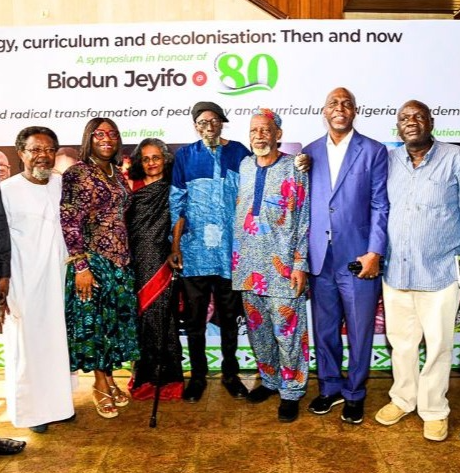
BJ: The Squeeze of Honour
By Motunrayo Alaka
I can still feel Professor Biodun Jeyifo squeeze my hands tightly and vigorously shake them as he said, smiling, “Motunrayo, thank you, thank you!”
It was the evening of Monday, 5 January 2026, during the after-dinner gathering following the symposium organised by the Wole Soyinka Centre for Investigative Journalism (WSCIJ) and its collaborators in honour of his 80th birthday, with the theme Pedagogy, Curriculum and Decolonisation: Then and Now. That moment remains vivid in my mind. I can still feel the warmth of his grip, the brightness of his smile, and the generosity of spirit that characterised the man fondly known as BJ.
Throughout that day, he had said “thank you” many times—to me, the organisation I lead (the WSCIJ), to his mentee who is now my mentor, Dapo Olorunyomi (Dapsy), to another mentee, Kunle Ajibade, and to many others who had gathered to honour him. Each expression of gratitude came with the sincerity and humility of someone who had spent a lifetime giving far more than he ever asked to receive, and who did it all with pleasure. That was BJ.
For many who knew him primarily through his towering scholarship, his formidable intellect, and his global stature as a public intellectual, such warmth might appear surprising. Those who encountered him in person recognised it as entirely consistent with who he was. Biodun Jeyifo was a giant of African literary criticism and Marxist cultural theory; at the same time, he was deeply human, gracious, attentive, and profoundly respectful of others.
My own encounters with BJ go back more than a decade, and each memory is threaded with that same graciousness.
I recall vividly the first time I hosted him in Nigeria in 2013. He had been invited as the keynote speaker at the fifth Wole Soyinka Centre Media Lecture Series. When I went to pick him up from the airport and took him to his lodging at the Blowfish Hotel in Victoria Island, Lagos—modest, yet the best we could afford at that time—I was quietly anxious.
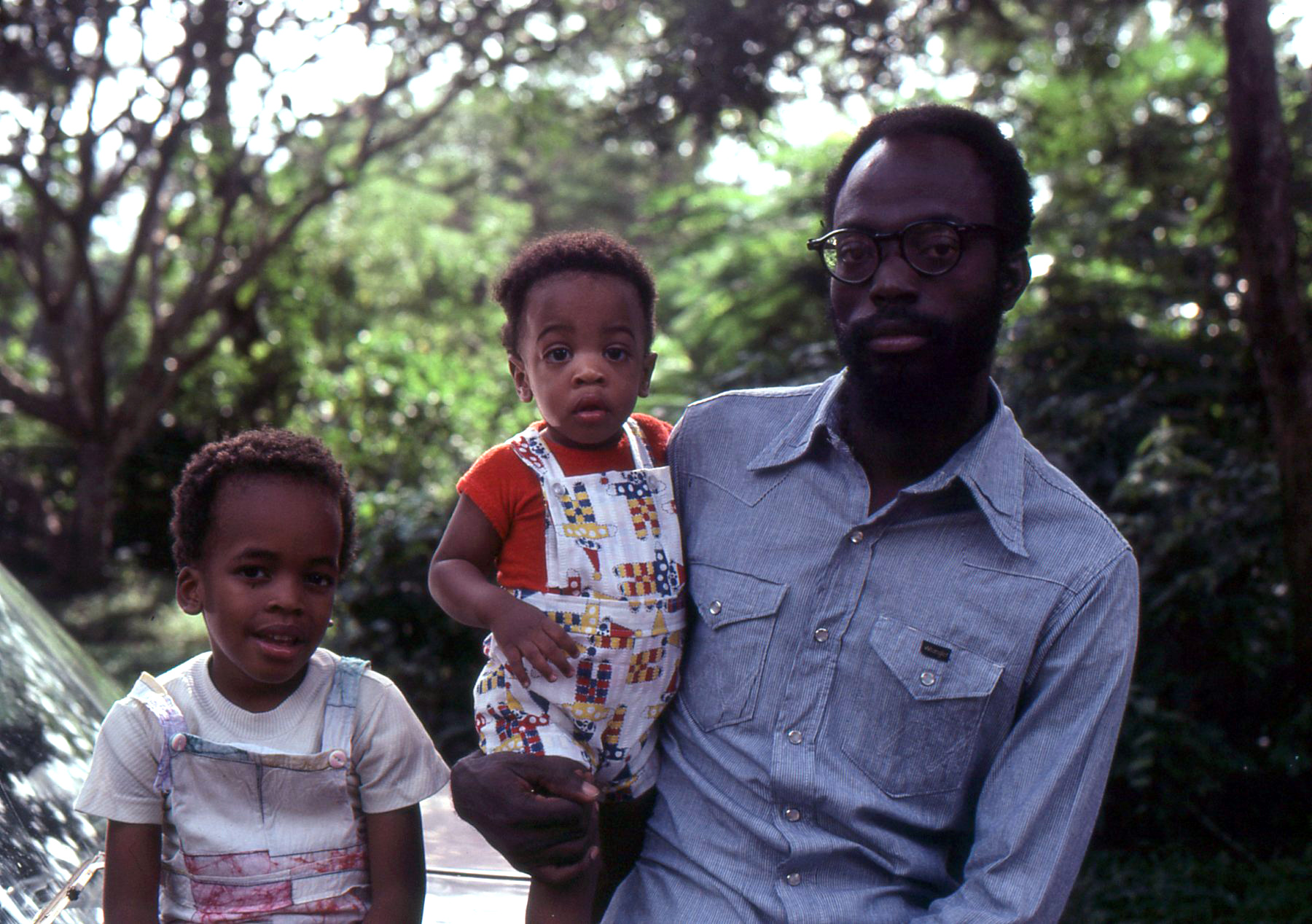
To me, BJ was larger than life. He was already one of the most distinguished scholars of African literature in the world: Professor Emeritus of English at Cornell University, Professor Emeritus of Comparative Literature and African and African American Studies at Harvard University, a foundational scholar of Wole Soyinka’s works, and the first president of the Academic Staff Union of Universities (ASUU). Hosting such a figure felt almost beyond me—and I loved it. It was an opportunity to host history, to be part of history, and to acknowledge one of the people whose lived experience and honourable choices made my current realities possible.
Yet our organisation, like many institutions committed to public-good work, operated within modest means. Budgetary constraints prevented us from providing the kind of luxury we might have wished for. Still, my team and I did everything we could to ensure that he would feel comfortable and welcome. As I opened the door to his room, I held my breath.
The first thing I noticed was that the bed seemed a little too short for his tall frame. I also worried that the room might not be quite as spacious as he deserved. My mind raced through a dozen possible apologies before he had even taken two steps inside. Then he turned to me, smiled warmly, and said simply: “Thank you. This will do.” With those four words, most of my anxieties dissolved.
BJ had a way of doing that. He restored perspective and reminded us that dignity resides in the spirit of human exchange, far beyond material excess. That “thank you” returned once more when I escorted him back to the airport for his flight to the United States. I asked if we could take a photograph together. Again, he smiled, obliged me kindly, and repeated that familiar phrase: “Thank you.”
Years later, the same generosity surfaced again when we invited him to deliver the keynote at the 16th Wole Soyinka Centre Media Lecture Series, in honour of Professor Wole Soyinka’s 90th birthday, with the theme The Death of Truth? Realism, Literature and Journalism in an Age of Disinformation. True to form, BJ attended and brought with him the depth of scholarship, intellectual courage, and moral clarity that had defined his career. Moments like these are the reason I chose a profession rooted in impact.
In my opening remarks at the symposium celebrating his 80th birthday, I said something that I believe even more deeply today: the opportunity to belong to the same circle as people like Wole Soyinka, Biodun Jeyifo, Ropo Sekoni, Banke Sekoni, Dapo Olorunyomi, Kunle Ajibade, Priyamvada Gopal, and others like them is one of the true privileges of my work. I consider them rare perks because they deliver more than money or any form of affluence has the capacity to do. I value comfort and affluence, yet essence lies beyond those shores, on the solid ground that purpose provides.
These are individuals who have devoted their lives to ideas, justice, culture, and society. Their influence stretches far beyond titles or accolades. They shape institutions, nurture minds, and expand the possibilities of public life.
My parents of blessed memory, Joseph Olukunle Famuyiwa and Ibiyemi Oluremi Famuyiwa (née Odu), taught me a concept that has guided my life: honour. They taught me to be a person of honour; to honour others; to recognise people of honour; to understand when I am in the presence of honour; to court honour; to leave no room for comparison between honour and money or any material possession; and, ultimately, to live a life of honour.
It was from that upbringing that my decision emerged when the opportunity arose to host BJ’s 80th birthday symposium. Despite the absence of sponsorship and the logistical challenges that accompanied such an undertaking, I recognised immediately that this was an honour. Although it came with many burdens, I bore them with joy—and would do so again. This is where I want to be. It is where I have been for the last 20 years, honouring the name of Wole Soyinka by leading an initiative named after him with the highest level of care possible.
It was a rare opportunity to celebrate a man whose intellectual courage had shaped generations. Little did I know then that it would also become the final public celebration of his remarkable life—an eternal reference point for his glorious homecoming and a final rousing stage of honour for a man whom Nigeria, perhaps, failed to celebrate nearly enough. BJ’s life invites us to confront an uncomfortable truth: we often fail to honour our greatest thinkers and change agents while they are still among us.
The conviction that tributes belong to the living is one I hold firmly. We must tell people how great they are while they can still hear us. We must thank them while they can still smile. We must celebrate them while they can still experience the warmth of appreciation. Too often, our societies, especially in Africa, wait until the silence of death before offering words that should have been spoken long before.
BJ embodied the spirit of intellectual engagement that insists on confronting society’s contradictions. A committed Marxist thinker who also understood the complexities of political and economic systems, he spent decades exploring the tension between capitalism and socialism as lived realities shaping human lives. I remember my love for literature in secondary school and my political science course—Marxism—in my undergraduate days, and how seeing BJ live what I read in books made me feel like I was living my dreams.
Through his writings, lectures, and mentorship, he urged us to think critically about power, culture, and justice. His scholarship reshaped the study of African literature and culture across continents. His book Wole Soyinka: Politics, Poetics and Postcolonialism remains a foundational text for scholars seeking to understand the relationship between literature, politics, and postcolonial thought. BJ’s influence extended beyond lecture halls.
As the founding president of ASUU, he stood at the centre of one of the most consequential struggles in Nigeria’s educational history: the defence of the integrity and autonomy of the university system. His leadership helped establish a tradition of academic resistance against the erosion of educational standards and the politicisation of knowledge. That struggle continues today.
I also recall the times I would receive scathing notes from Dapsy conveying BJ’s feedback on things we had presented poorly in writing or in our use of language at the Centre. Those moments became lessons in intellectual discipline and respect for scholarship.
One WhatsApp exchange between BJ and Dapsy, which the latter forwarded to me, remains particularly vivid. It followed a poster we had designed for Wole Soyinka’s 90th birthday lecture event.
BJ wrote: “Dapo, I have just seen a poster of the symposium where I am described as ‘Professor of African and African American Studies and Comparative Literature’. I am five years into my retirement, and at Harvard you become Emeritus Professor from the first year of your retirement. Please change the designation on the poster to reflect this.”
Dapsy replied: “Oops. OK. Sorry for the slip.”
BJ responded again: “The ‘slip’ also includes absence of where I am emeritus professor. Whether professor or emeritus professor, people ‘profess’ somewhere, in a named institution, not in the market or on the internet. Actually embarrassing for me to point this out, Dapo.”
His feedback was blunt, and I appreciated it. I welcomed every opportunity to do better. I received those moments as honest corrections delivered with passion and clarity. They reflected BJ’s lifelong commitment to intellectual precision, rigorous language, and respect for institutions of knowledge.
Perhaps one of the most powerful reminders of BJ’s legacy came during the symposium organised in his honour earlier this year. The keynote speaker was Professor Priyamvada Gopal of the University of Cambridge, one of BJ’s former students, who spoke movingly about the profound influence he had on her life and scholarship.
That testimony echoed what countless students across the world have said: BJ did more than teach literature. He taught people how to think, how to question, and how to live intellectually honest lives.
His own story as a mentee also offers an enduring lesson.
During the dinner after the symposium, BJ shared how he moved from the English department to take courses in drama simply to study under Wole Soyinka. That decision led to decades of scholarship dedicated to interpreting and expanding understanding of Soyinka’s work.
It was a striking example of intellectual pursuit guided by admiration and discipline. Mentorship, BJ reminded us, is an active relationship. Mentees seek mentors, pursue learning, and invest the time necessary to grow. In that sense, BJ’s life stands as both inspiration and challenge.
Nigeria’s academic ecosystem needs more scholars with BJ’s depth, courage, empathy, openness, and intellectual independence. Our world needs more thinkers willing to interrogate society with clarity and courage. It needs more mentors willing to nurture the next generation of scholars, journalists, and public intellectuals.
Even now, after his passing, I return to that moment on 5 January 2026. With fulfilment, I recall the firm squeeze of his hand, the gratitude in his voice, and the smile that radiated both kindness and conviction.
In that gesture lay the essence of Biodun Jeyifo: a man of towering intellect who remained grounded in humility; a critic of power who kept faith in humanity; and a scholar whose influence touched the broader currents of society.
As I reflect on his life, I find reassurance. The path of impact—the path of building institutions, nurturing ideas, and striving to make the vulnerable more comfortable—remains worth choosing. It is the path BJ walked with courage and brilliance. Many of us will continue that path, inspired by the enduring squeeze of his hand.
*Motunrayo Alaka is the Executive Director, Wole Soyinka Centre for Investigative Journalism, Lagos.
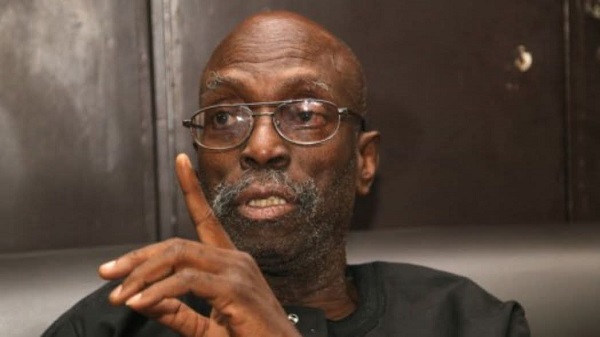
BJ: “Ba o Ku, Ise o Tan”
By Wumi Raji
The title of this short tribute was excerpted from a WhatsApp chat exchanged between BJ and me in July/August 2020. I was in need of three recommendations, and those who requested them had just informed me that one of the referees whose names had been submitted had written back to express his/her inability to do the recommendation.
I need to make it clear immediately that this person who declined wasn’t somebody who would want to hurt me deliberately and, in any case, he/she went out of their way to explain the reasons in detail, and I was fully satisfied with them. But what was more important at the time was that I still had to find a third name, and it was considered urgent. I knew BJ had serious health challenges and had, at the time, just been discharged from the hospital. But, all things considered, I still decided to let him know—in any case, but for his health condition, his name would have been the first on the list!
His reply was instant: he would do it, and he urged me to go ahead and submit his name immediately. I was moved and wrote back to thank him. I also mentioned the very important matter of his health. Again, he replied, and I would like to quote him now: “Thanks, Wumi. Yes, my health, sugbon ba o ku ise o tan” (my emphasis).
It turned out, in the end, that BJ did not have to do the report. The other two names on the original list responded promptly and positively, so much so that those who had asked for them considered them sufficient! But this little fact is immaterial. The point was already made: BJ had agreed—he was going to do it. His commitment to humanity was total, and his sense of service profound. No risk was too much for him to take when it came to assisting others. No stone would be left unturned if the matter had to do with helping others or providing service.
II
I first met BJ in 1986. It was during the same trip that I wrote about in “The Exemplary,” my tribute to Dr. Dipo Fasina. I was an undergraduate at the University of Ilorin but had travelled to Ife to distribute letters of invitation for activities lined up to mark the fifth anniversary of Ajon Players, an amateur theatre group founded by Olu Obafemi at the University of Ilorin. While I missed Dr. Fasina during that trip, I met BJ in his office.
Now done with Ife, the next leg of my trip would take me to Ibadan, where I was to deliver Osundare’s and Adelugba’s letters. It happened that BJ himself was going to Ibadan that same day, so he offered me a ride in his famous Volkswagen Beetle.
We kept talking throughout the journey. He asked many questions, listened attentively to my answers, took issue with some of them, and interrogated a number of my positions. At a point, I decided to ask him a question about Femi Osofisan’s Esu and the Vagabond Minstrels, which had just run for two weeks at the Pit Theatre. He asked if I had seen the play, and when I said no, he told me to wait until I had watched it. But we discussed Chinweizu’s six-part review of the production in “The Observatory,” his column in The Guardian, and the first part of Osofisan’s response, which had just been published in the same newspaper. He smiled at an aspect of the opinion I expressed on the exchanges, adding that he had no comments.
I got a lot from the journey. I was touched by BJ’s simplicity and accessibility, the respect he extended to me, and the unassuming disposition he displayed throughout. I would learn more about him with time: his undergraduate days at the University of Ibadan; his membership of the Pyrates Confraternity; his tenure as PRO of the Students’ Union while in his second year; how he graduated, in spite of all this, with a First Class degree in English; and how he spent only four years completing two postgraduate programmes (MA and PhD) at New York University.
I got to know of his appointment as a lecturer in Theatre Arts at UI following his return to the country in 1975; the famous quotation from Shakespeare’s King Lear on his door (“that distribution should undo excess and each man have enough”); and how he resigned his appointment after barely one year to join a commune at Ode Omu in 1976. I learned how, following the dissolution of the commune in 1977, he joined the Department of Literature-in-English at the University of Ife (now Obafemi Awolowo University). I also learned how, as president of the union between 1980 and 1982, he transformed ASUU from a petit-bourgeois organisation into a militant trade union—one that took interest in, and intervened in, not just matters of the welfare of its members, but also urgent contemporary social and political issues affecting the country.
BJ exuded charm, had boundless energy, and could be brash and impatient. He was a revolutionary to the core—honest, kind, generous, and compassionate. He had strong convictions and followed them to the letter.
III
BJ showed great concern when the Unilorin crisis broke out in early 2001. He made sure the issue came up for discussion anytime we met, spoke on the phone, or exchanged emails during that period. He found it difficult to believe that a Vice Chancellor could terminate the appointments of 49 senior academics on a single day without any justifiable reason. It was clear he was getting information on the matter from other sources and that it did not align with what he heard from me whenever we discussed. Once I spoke with him, however, he always made it clear that he believed me.
But the conversations were always fragmentary and brief—until the day after the get-together organised for him in Ife by Dr. (Mrs) Bisi Anyadike after he turned 60 in January 2006. His interest that day was more on how the crisis affected the doctoral programme of my friend, Femi Dunmade, and how his result was withheld after he had fully completed and defended his thesis.
I took time to give him the details of the story, supporting my account with documents directly related to the issue, copies of which he collected. BJ vowed to pursue the matter. Within a week, he was on his way to Ilorin. He drove down in the company of his friend, Femi Osofisan. In Ilorin, they met Olu Obafemi, Femi Dunmade’s supervisor, and Charles Bodunde, the then Head of the Department of English. He also tried to meet Shamsudeen Amali, the Vice Chancellor, who was his mate at the University of Ibadan, but did not succeed.
He did not mince words when reporting back to Femi Dunmade and me. He said he was convinced it was a clear case of victimisation and that the University would continue to drag Femi further if he allowed it. He added that if Femi made the mistake of apologising to anyone over the matter, he would lose all the respect he had hitherto reserved for him. He advised that Femi should simply register for another PhD and linked him up with a professor at the University of Ibadan who could serve as his supervisor. Femi never took up the offer—but again, the point was already made.
So this is BJ: committed, humane—always giving, always offering help, forever available—but principled nonetheless, highly principled.
When I won my case against the illegal termination of my appointment by Obafemi Awolowo University, BJ insisted on celebrating it for me. As he stated, it was not always that such a struggle ended in decisive victory. So one great day, he came to Ife and took me out, inviting Dr. Dipo Fasina to join us—and we had a wonderful time together.
In 2022, about midway into ASUU’s eight-month strike, I suddenly received a WhatsApp message from him. It contained details with which to cash an amount of money he had just wired to me via Western Union. It was a huge surprise—but BJ even apologised, saying it was too small. The amount was by no means small, and it went a long way in solving some pressing financial problems.
In 2024, while congratulating me on the publication of A Diary of Little Things, my second collection of poetry, I told him I also had a volume of short stories that I planned to send to the press soon. He asked who the publishers were, and I told him. He then asked if I would mind him taking a look at it before I sent it off, adding that it might take a while before he got around to it. For me, this was an honour, and I forwarded the manuscript to him immediately.
Again, this is BJ—our own BJ.
The stories I have relayed here are just a tip of the iceberg. They are of a kind man—one who never stopped giving, never stopped offering himself, until he drew his last breath.
Ba o ku ise o tan…
*Wumi Raji is Professor of Drama and Postcolonial Literature, Obafemi Awolowo University, Ile-Ife.
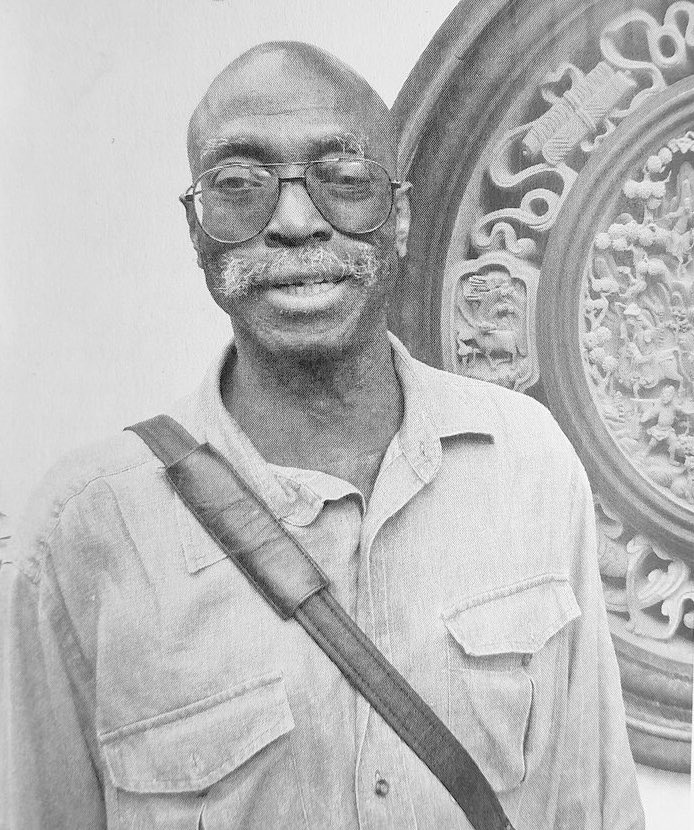
The Teacher Who Refused to Manufacture Disciples: Reflections on Biodun Jeyifo
By Babafemi Ojudu
In every generation, there are teachers who do more than transmit knowledge; they awaken minds. They refuse the comfort of intellectual obedience and instead cultivate the restless habit of questioning. Professor Biodun Jeyifo belonged to that rare lineage. To encounter him in the classroom at the University of Ife in the early 1980s was not simply to attend a lecture on African literature—it was to enter a furnace of ideas where texts, politics, history, and moral responsibility collided. For many of us who passed through his classroom, BJ was not merely a teacher of literature; he was a maker of minds, a provocateur of thought, and a quiet architect of intellectual courage.
Is BJ truly dead? No—he cannot be. People like him do not die. They live on in the minds they shaped, in the convictions they nurtured, and in the courage they stirred in generations of students. Death may still the body, but it cannot silence a voice that has taken root in so many hearts.
I had originally planned to share some of these reflections during a panel discussion organized in his honour. I had prepared carefully. However, on the morning of the event, I was invited to an important meeting with the Ooni of Ife in Ile-Ife. I assumed it would last no more than an hour; it extended to five.
After the meeting, I reached out to apologize to the panel host, Professor Toyin Falola. To my surprise, the discussion was still ongoing. I joined briefly to correct an impression that Professor Biodun Jeyifo imposed his Marxist ideology on his students. But I did not have the time to fully express my thoughts—partly because of time constraints, and partly because I was observing the Muslim fast and feeling its physical toll.
I have therefore decided to set down my reflections here.
Let me begin not with theory, but with memory.
When my colleague, Kunle Ajibade, and his darling wife arrived a little late at my son’s wedding on January 5, their explanation was simple and touching: they had just come from the venue in Lagos where BJ’s 80th birthday activities were being celebrated. But for the demands of the wedding, I too would have been part of that gathering of former students, colleagues, and admirers. Another friend and classmate, Mrs. Bisi Anyadike, also came from there. I could easily imagine the hall—surely filled with our generation from the University of Ife, men and women whose lives he had shaped in ways both profound and lasting.
When I first encountered Professor Biodun Jeyifo in the early 1980s at the then University of Ife, I did not realize that I was sitting before a man who would shape not only my intellect but also my moral architecture.
The University of Ife in those years was not merely a campus. It was an arena of ideas. The air itself felt argumentative. Debates were not extracurricular—they were oxygen. Literature was not ornamental—it was political. Scholarship was not neutral—it had consequences.
And at the center of that ferment stood BJ.
He belonged to that formidable Ife tradition shaped by giants such as Wole Soyinka and Dr. Segun Osoba—a tradition that insisted African literature must speak to power, interrogate injustice, and refuse silence.
Yet BJ was not anyone’s echo. He had his own intellectual signature.
What struck many of us was not only what he knew, but how he taught.
He did not intimidate.
He did not humiliate.
He did not impose conclusions.
He invited argument. He challenged assumptions. He asked questions that followed you back to your hostel room and refused to let you sleep.
He treated us not as empty vessels, but as minds under construction.
And that is rare.
Because true teachers do not manufacture disciples. They manufacture thinkers.
The Ife Intellectual Climate of the 1980s
To understand BJ’s influence, one must understand the intellectual climate of the University of Ife during that period.
The campus was one of the most intellectually vibrant environments in Africa. Ideas were not confined to lecture halls. They spilled into corridors, cafeterias, hostels, and student political meetings. Debates about literature, Marxism, nationalism, imperialism, and African cultural identity were not abstract exercises; they were part of the moral education of a generation.
The university produced scholars who believed that the life of the mind must engage with the life of society. Faculty members did not pretend that the world beyond the university gates did not exist. Many of them were themselves public intellectuals whose work shaped national and continental debates.
In such an environment, teaching literature was never merely about texts. It was about history, power, ideology, and the moral obligations of the writer.
BJ thrived in that environment.
His classroom was not a site of passive reception but of intellectual engagement. He expected students to think, to question, and to interrogate both texts and the social realities that produced them.
His course on Politics and Ideology in African Literature was one of the most formative experiences many of us encountered. In his hands, literature became a window into colonial history, postcolonial contradictions, and the persistent struggle for justice on the continent.
Through his voice, literature ceased to be ink on paper. It became a living conversation about Africa, society, and the responsibilities of the thinking mind.
The Teacher and the Man
BJ was never just a lecturer to us. He was, at once, a father, a friend, and a teacher.
You could approach him with intellectual doubts, personal anxieties, or even the uncertainties of youth, and he would listen—truly listen—before responding in that calm, reflective manner that made you feel wiser simply by being in his presence.
He corrected without humiliating.
He encouraged without flattery.
He guided without imposing.
He had the rare gift of making each of us feel seen and valued.
Those were not merely lectures we attended; they were encounters.
They shaped how many of us came to see the world—to question authority, to interrogate power, and to appreciate the profound link between art and the destiny of a people.
Years later, when some of us found ourselves confronting authoritarian power—in journalism, activism, or public life—we realized that what BJ and his generation had given us was not merely literary theory. It was intellectual courage.
The courage to ask:
Who benefits?
Who is silenced?
Who took what does not belong to him?
Whose narrative is being normalized?
That training does not leave you.
Scholarship and Global Reach
Those of us who first encountered BJ as a teacher later came to appreciate the wider intellectual architecture of his scholarship.
His works, such as The Truthful Lie: Essays in a Sociology of African Drama (1985) and Wole Soyinka: Politics, Poetics and Postcolonialism (2004), demonstrated his deep engagement with the intersections of literature, ideology, and society. In these writings, as in his teaching, he insisted that African literature could not be separated from the historical and political conditions that produced it.
For BJ, criticism was never merely aesthetic. It was ethical and political.
As his scholarship traveled beyond Nigeria, he became a global intellectual voice. Yet he never lost his rootedness. He was cosmopolitan in reach, but African in his center of gravity.
That is important.
Because too often, intellectual migration becomes intellectual detachment. BJ did not detach. He carried Africa into global discourse without apology.
The Scholar-Activist Tradition
In remembering BJ, we are also remembering a larger tradition in African intellectual life—the scholar who refuses to separate thought from responsibility.
Across the continent, figures such as Wole Soyinka, Ngũgĩ wa Thiong’o, Ali Mazrui, and Chinua Achebe helped define a generation of intellectuals who believed that the university must remain a site of moral and political engagement.
These thinkers understood that scholarship was not merely about interpretation but about responsibility to society.
Biodun Jeyifo stood firmly in that lineage.
He embodied the scholar-activist tradition. He understood that ideas are not decorative; they are disruptive. They shape movements. They unsettle power. They equip citizens.
In those days at Ife, there was no artificial boundary between the classroom and the street. The campus was politically alive. Students were engaged. Faculty did not pretend that the world beyond the university gates did not exist.
BJ stood firmly in that tradition—rigorous in scholarship, unapologetic in conviction.
And yet, he was never doctrinaire.
He debated fiercely, but he listened.
He critiqued sharply, but he encouraged generously.
He held strong ideological commitments, but he respected intellectual seriousness wherever he found it.
That combination—conviction without arrogance—may well be his most enduring lesson.
Legacy
So what is BJ’s legacy?
Certainly the books.
Certainly the essays.
But beyond publication, his true legacy is the generations of students who learned to think critically, question authority, read power structures, and insist that ideas matter.
The tragedy of our present moment—and I say this gently—is that many of our universities are no longer ideological furnaces. They are quieter. More cautious. Less daring.
BJ belonged to a generation that believed the university was a moral site—not merely a credential factory.
If we truly wish to honour him, our tribute must not end in nostalgia. It must provoke renewal.
Are we still producing scholar-activists?
Are we nurturing dissenting thinkers?
Are we equipping students not only to pass examinations, but to interrogate society?
These are the questions his memory places before us.
A Personal Note
How one wishes it were possible, even for a fleeting hour, to return to those days—to sit once more in that classroom, to listen, to argue, to laugh, and to leave with the mind stirred and the spirit awakened.
But perhaps that is the wrong wish.
Teachers like BJ do not truly leave the classroom.
They migrate.
They migrate into memory.
They migrate into argument.
They migrate into the moral reflexes of their students.
Lights such as his do not go out.
They simply move from the world of sight into the world of memory, where they continue to shine.
And as long as some of us still pause before speaking and ask, “Is this intellectually honest?”—BJ lives.
*Babafemi Ojudu, co-founder of TheNEWS, TEMPO and P.M.NEWS, is a Senator of the Federal Republic of Nigeria (from June 2011 to June 2015).
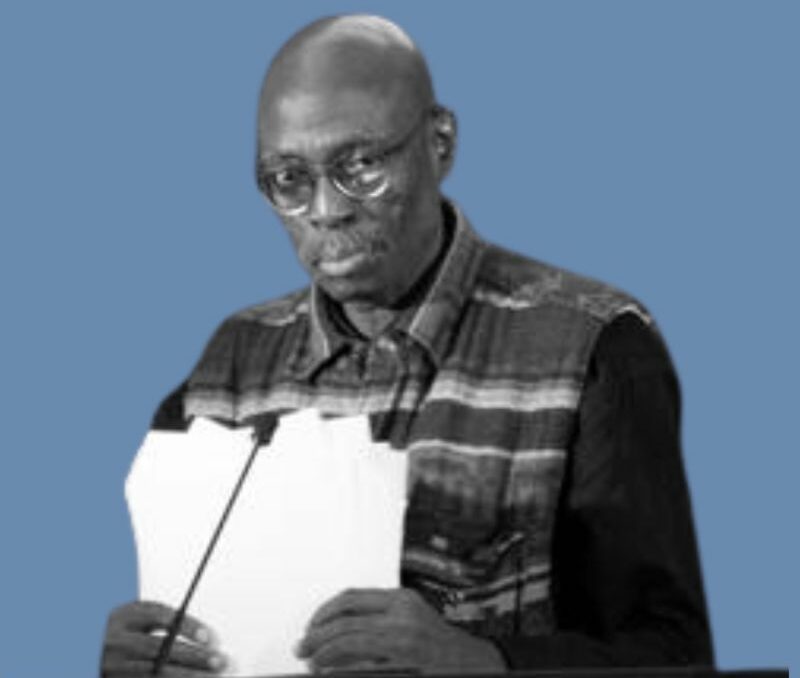
Biodun Jeyifo (BJ): Fond Memories of a Committed Intellectual
By Jibrin Ibrahim
We lost Prof Biodun Jeyifo, or BJ as we fondly called him last week, not long after we organised an 80th anniversary symposium in his honour. At the event, his bosom friend. Dr Yemi Ogunbiyi explained he was not supposed to have reached the ripe old age of 80 as much earlier in life, he had been diagnosed with a disease that was supposed to guarantee a much shorter lifespan. It was for this reason that he relocated to the United States to have access to better medical facilities. We thank God for giving him a long and fulfilled life.
I had known BJ as a young Marxist student in Ahmadu Bello University, Zaria, who travelled frequently to Ife, to engage with the relatively large number of student and lecturer comrades who flourished within the university community. I always found him to be an inspirational figure with total commitment to revolutionary struggle. He loved polemics and was never one to shy away from an argument as he was endowed with the gift of the gab. BJ also never hesitated to criticise the older generation of Marxists, who he felt had failed in their task of leading the country into the desired socialist future we deserved.
I remember a meeting of Nigerian revolutionaries, a word we used to describe ourselves in those days, a big debate over who had the correct understanding of the social forces in the country and how to combat them and open a path for genuine revolutionary struggle. The meeting which took place in Jos was strongly marked by an age divide which crept up between BJ and Eddie Madunagu on the one hand and the older comrades on the important question of revolutionary capacity and strategy. As often happens in such situations, labels emerge to counter stronger arguments and BJ and Eddie were labelled with the “insult” word of Trotskyites to delegitimize their arguments. Maybe one day, I will write about my recollections about labelling in Nigeria’s left history- the Trotskyites, the labour aristocrats, the opportunists, the Stalinists, the Maoists, the suspected state agents and other false pretenders. It has been a significant baggage for left movements throughout history.
This is the reason why after over a century of organisation, at no time did the left ever develop a unified movement. The numerous conferences and movements starting with the Zikist Movement which was denounced by Zik himself in the 1950s, Tunji Otegbeye’s Socialist Workers and Farmers Party in the 1960s: The Movement for People’s Democracy (1975), All Nigeria Socialist Conference, Zaria (1977 and !978) all failed to achieve the unity goal. The left has been in a situation in which its objectives were always clear – building a better life for the masses of our people after displacing the ruling class that has neither the intention nor capacity to do so has always floundered.
As a young lecturer in Ahmadu Bello University in 1980, I was already in the progressive caucus when Biodun Jeyifo, (BJ), and Uzodinma Nwala, newly elected pioneer President and Secretary of ASUU, stormed our Samaru campus to bring the good news. The transformation has occurred, they proclaimed, by the law of 1978, the Nigerian Association of University Teachers, then existing in the five pioneer universities, was dead and from its grave emerged the Academic Staff Union of Universities (ASUU), a trade union. We were in exquisite excitement as BJ explained to us that intellectuals can now join the working-class struggle as trade unionists and bring our intellectual support to the larger struggle to improve the educational system, but even more important, make our contribution to creating a progressive Nigeria. We celebrated the irony of a repressive military regime accidentally creating favourable conditions for the revolution.
I was in the team that dashed off to the Department of Electrical Engineering to inform Prof Buba Bajoga, the last head of the association, that a new regime had arrived and his association had been annulled by law. Always a gentleman, he accepted the new state of affairs and moved on. We organised elections and George Kwanashie and Raufu Mustapha emerged as the first leadership of ASUU in ABU, the bedrock of campus radicalism in Nigeria. We immediately engaged in organising the first ASUU strike and in 1982, I spent months in the Ibadan headquarters providing support for the ASUU negotiating team. In 1983, I became the secretary of ASUU in ABU with Yahaya Abdullahi as Chairman and the struggle continued.
BJ’s core argument was that with a joint umbrella coordination of the organizational work of workers and intellections, an opportunity could be created for a revolutionary vanguard to emerge and create the necessary impetus for the Nigerian revolution, which could completely transform the entire African continent. It would be recalled that before “fabricating” ASUU from a law that the universities were not even aware of, BJ and some of his comrades had established the Ogi commune in rural Osun State where they worked with the peasantry hoping to emulate the Maoist revolution in Nigeria. The commune failed and ASUU became the next revolutionary stepping stone.
The revolution did not happen then. BJ moved to the United States, became one of the world’s finest literary critics and constructed the poetics and aesthetics that justified why Wole Soyinka deserved the Nobel Prize for literature. Thanks to BJ’s work, Soyinka got it and placed Nigeria on the literary map. As BJ joins the ancestors, his footprints and polemics continue to inspire revolutionaries and others with the gift of the gab.
.
A Professor of Political Science and development consultant/expert, Jibrin Ibrahim is a Senior Fellow of the Centre for Democracy and Development, and Chair of the Editorial Board of PREMIUM TIMES
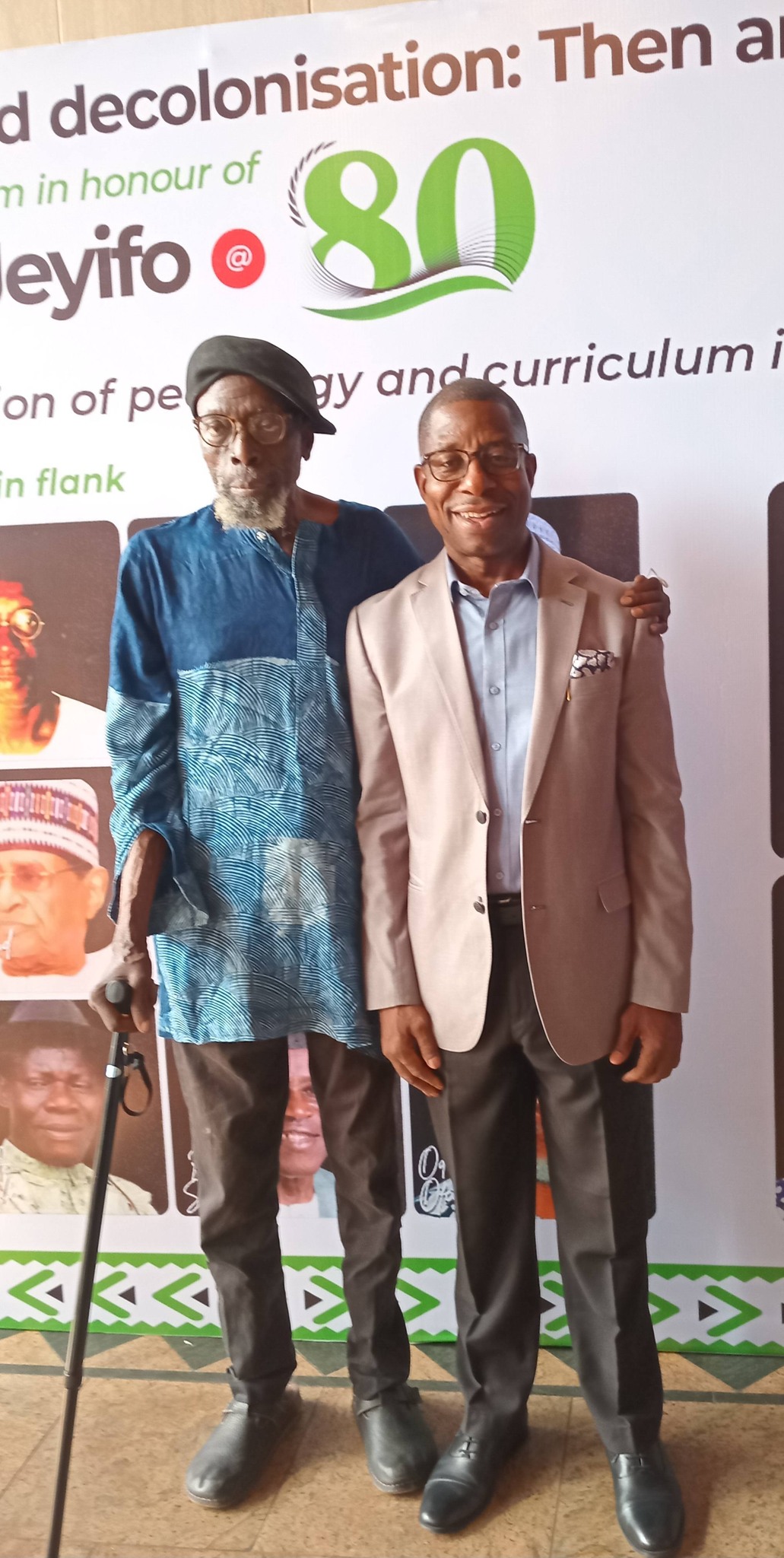
BJ: The Example of a Radical Scholar, Activist, and Humanist
By Ogaga Ifowodo
For his 80th anniversary on earth, Professor Ernest Abiodun Jeyifous, better known as Biodun Jeyifo, and endearingly as BJ, willed his body long sabotaged by illness for a fitting and memorable celebration of a life truly well-lived. His spirit soared higher than the ceiling of the Agip Recital Hall of the Music Society of Nigeria Centre in Lagos, where a public lecture delivered, fittingly, by a former student of his at Cornell University, now professor at Cambridge, took place. If death was a mere month and six days away, BJ betrayed no sign of it. Responding to the lecturer, Professor Priya Gopal, the speakers on the two panels that followed, proposing the more salutary idea of equitable wealth redistribution in place of the shibboleth of restructuring as the answer to the crippling woes of Nigeria’s upside-down federalism, and later at a dinner in his honour graced by Wole Soyinka whose most astute and expansive interpreter who would later become at the height of his powers as a scholar, BJ could have been mistaken for the younger version who betook himself to a commune to prepare, alongside his fellow communists, for the revolution to end poverty and neo-colonialism in Nigeria. Only the unmistakable traces of a four-decade existence in defiance of a genetic condition which took the life of his brother in childhood, and the cane he needed now to walk, belied his surprising vigour. As Soyinka, former teacher and subject of his most penetrating scholarly labour, might have put it, BJ, revelling in a new lease of life among his peers, friends, mentor and mentees, as well as future blazing intellects among the throng of students and younger admirers gathered for his birthday, mustered his last reserves of energy and “danced [lately] then joined the ancestors.”
When BJ turned 60, I became his student in the strict sense at Cornell by enrolling in his seminar “Broken English: English Studies in Postcolonial, Postmodern Frame,” just before Harvard lured him away. I paid tribute to him with a narrative essay entitled “For BJ at 60: A Student’s Random Recollections in Lieu of a Tribute” (West Africa Review, http://www.africaknowledgeproject.org/index.php/war/article/view/275). I have excerpted what follows from the piece I wrote when he turned 70, entitled “The Communist as Teacher: The Example of Biodun Jeyifo.”
BJ’s name spells R-I-G-O-U-R and E-R-U-D-I-T-I-O-N. His vast body of scholarly articles, books, monographs, edited volumes, and journalistic essays, attest to this universally acknowledged fact among his peers and students. If in doubt, see Wole Soyinka: Poetics, Politics, and Postcolonialism (Cambridge University Press, 2004), his acclaimed study of Soyinka’s oeuvre, a task not for the intellectual feather-weight! To BJ, no human problem is quite as simple as it may appear. Thus, we must always probe beneath the surface of ideas and things to apprehend their truer meanings; an ideological task that requires mental agility served by erudition and a constant scrutiny of extant knowledge.
For me, the most poignant example of BJ as scholar and critic is in his readiness to subject himself to scrutiny and review his earlier positions if convinced of their inadequacy in the light of new insights. As is well known, BJ was at the beachhead of the Marxist criticism of Soyinka’s work as being too rarefied. In BJ’s often quoted words, Soyinka’s theory of art and being reflected the familiar predicament of bourgeois aesthetics, one where “thought, in a bewitched, becalmed, vaporous zone of absolute self-subsistence, frees itself from its moorings in the sea of real life processes.” Simply put, BJ believed that Soyinka’s deployment of myth and ritual was insufficiently attuned to historical reality: “in so far as the logic of myth sublimates historical trauma, the playwright’s vision risks being iconic but protean, wise but aloof, brooding but conservative,” he asserted. Many years later, BJ would jokingly refer to the early phase of his career which produced this view as his Jacobinist years. And so starting with “Wole Soyinka and the Tropes of Disalienation,” the introductory essay in Art, Dialogue, and Outrage, his edited volume of Soyinka’s essays, he began the process of a more complex apprehension of Soyinka’s ethics and aesthetics, culminating in Politics, Poetics and Postcolonialism, widely acclaimed as the most definitive study of the author’s prolific and profound work spanning the three literary genres of plays, poetry and prose fiction. BJ named the organising principle of his new understanding “freedom and complexity.”
As chair (later co-chair on leaving for Harvard) of my dissertation committee, BJ lived up to his reputation as a hard taskmaster. He posed the toughest question at my candidacy exam. I had proposed the theoretical framework of post-positivist realism developed as a counterweight to the growing insidiousness of post-structuralism/post-modernism in the humanities by a community of scholars in which he was active. Naturally, there remained several questions to be answered by this theory. Sensing that I had addressed myself insufficiently to complexity, BJ asked, “So, Ogaga, how would your framework respond to (primary) texts that are resistant to realist readings?”
I’m happy to report that his “unfriendly” question was a major impetus towards the integration of a psychoanalytical approach into my post-positivist realist paradigm. It led me to recall Frantz Fanon’s famous prescription in Black Skin, White Masks that “only a psychoanalytical interpretation of the black problem can lay bare the anomalies of affect that are responsible for the structure of the complex,” a theme with which he began his career as a supreme interpreter of colonialism and theorist of decolonisation and on which he would end with “Colonial Wars and Mental Disorders,” the closing chapter of his last and most famous work The Wretched of the Earth. Fanon and Freud became the guides towards my heuristic framework: if colonialism was nothing but a historical catastrophe, could it have inflicted only material damage and spared the psyche of the colonized? What, then, would it mean to read postcolonial narratives under the prism of trauma, as opposed to the cultural-materialist approaches that dominated the field? A hard taskmaster had led me to derive new insights into the postcolonial predicament. And once I had begun the task, I found confirmation that I was on the right path, among other things, in BJ’s 1993 essay “Okonkwo’s Mother: Things Fall Apart and Issues of Gender in the Constitution of African Postcolonial Discourse.” In my reading, BJ came close to a psychoanalytic reading even when his overarching framework was a Marxist-materialist one, and no surprise as a Marxian derivation of the Unconscious, the Ur-trope of psychoanalysis, is “the political unconscious.” The impulse for the essay is the sheer absence of Okonkwo’s mother in Things Fall Apart. Needless to say, in psychoanalysis, the repressed, the unnamed and unacknowledged, is even more significant than the said.
That is the teacher and scholar. There is also BJ the unrepentant Marxist and humanist critic of society that every reader of his newspaper contributions towards progressive change knows. Even before he would become the first president of the Academic Staff Union of Universities and publicly announce his activist side, he resigned from the University of Ibadan and withdrew with a few comrades, among them Edwin Madunagu, Seinde and Dunni Arigbede, Tony Ngurube and Segun Akintunde to a commune in Ode Omu, Osun State, to prepare for a socialist revolution. It was only after the dissolution of the commune a year after that BJ returned to academia. In his 80th and last year on earth, his passion for change burned with as much wattage as in his commune days, even if without the same zeal for revolutionary vanguardism, summoning Shakespeare for a society in which redistribution would undo excess.
BJ’s professional life is as a critic of literature, so I will end on a poetic note. In one of his Talakawa Liberation Courier newspaper series, BJ expounded on the Haiku form, and even attempted some of his own. In a correspondence around that same time, I wrote two haikus dedicated to him. I have added one more, which does not adhere strictly to the 17-syllable form: BJ it was who first made me understand that the contemporary Haiku terrain accommodates poems of up to 25 syllables, which of course means that it may also dispense with the classic 5-7-5 verse form. Indeed, as I would later confirm in my own researches, the contemporary haiku form, especially in English with a far stricter grammar than the Japanese of its provenance, is less insistent on the classic requirements — nature, seasonal imagery, for instance — and on syllable count, even accepting poems of two and four-line verses. Perhaps this is truer to the idea of the haiku as “little drops of poetic essence” as Sir George Sansom described the form, or as “meditations . . . starting points for trains of thought” as Harold Henderson, an early populariser of the form in English, put it. Here, then, is a poetic coda to my tribute to an exemplary man of learning and culture whose life was given in service of town and gown.
1
Town hall or classroom?
The world parted by forked tongues
Melds with a word in autumn.
2
Heard first through palmgrove
Night labours at voice and song,
Noontide melody.
3
Man steals goat, bags three years,
Man steals bank —
Commander of the Republic!
*Ogaga Ifowodo is an award-winning poet, lawyer, human rights activist and public commentator.
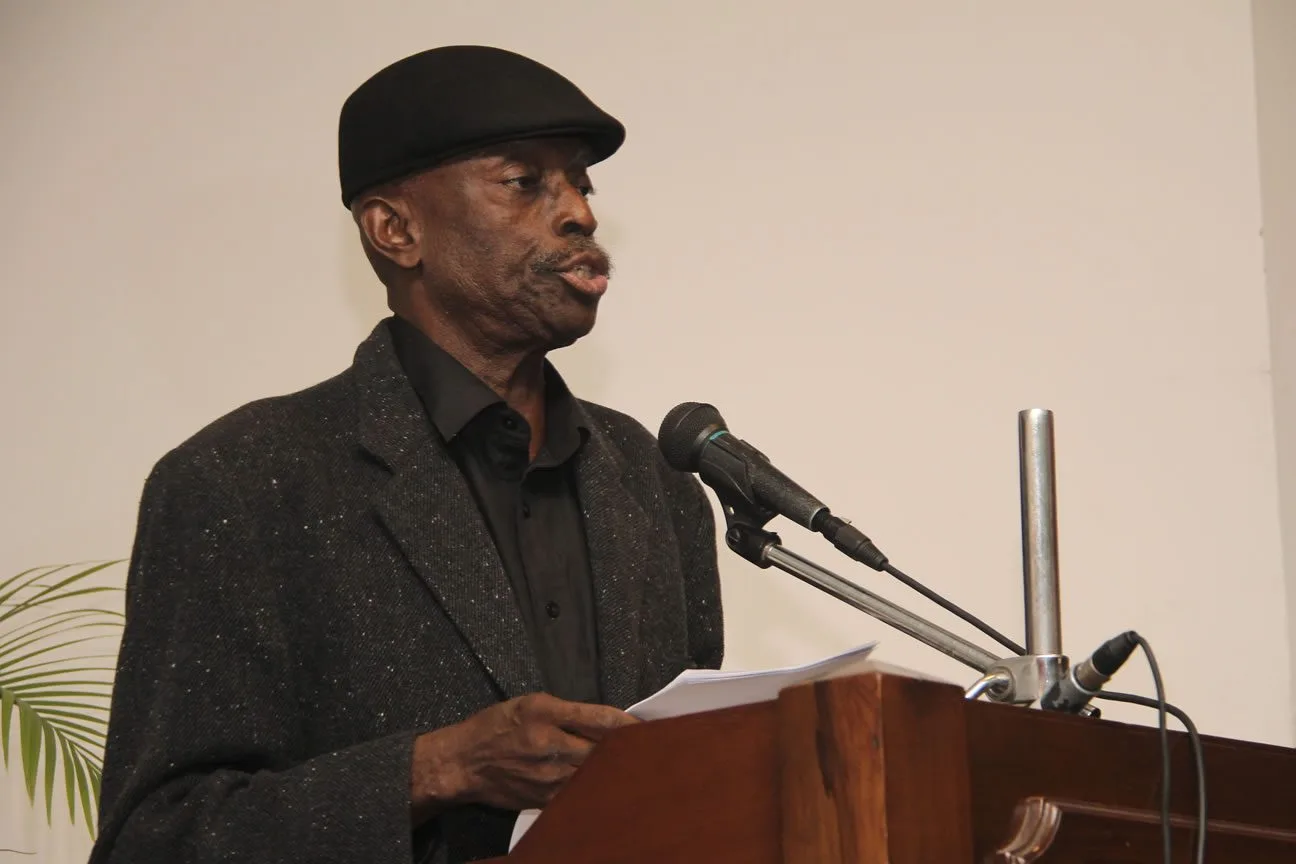
He called on us to formulate methods and logics of struggle
By Cheryl Higashida
I was incredibly fortunate to have been one of BJ’s students. Of course, BJ would attribute this not to luck but to the structural conditions of what he called the “new cosmoliberal” university, which assembles cosmopolitan faculty and student bodies to reproduce neoliberal citizens. Yet these conditions also afforded time and space in BJ’s classes to study affiliations and debates between Marxism and postcolonial theory, subaltern refashionings of English-language literature, liberal vs. critical multiculturalism, and global histories of the Left.
BJ’s brilliant lectures and the discussions they sparked opened my eyes to analyzing literary aesthetics, genres, and discourse in relation to the stages and crises of capitalism, uneven modernities, and popular uprisings. To this day, these foundational learnings shape my research on media, racial formation, and social movements. BJ’s insights invaluably guided my dissertation on the U.S. literary Left, as when he urged me to look into Lorraine Hansberry’s interventions in debates dominated by Black men such as Harold Cruse and James Baldwin. As a result of his advice, I was able to contribute to the florescence of scholarship on African American women radicals, and Hansberry in particular, beginning in the early 2000s.
In extensive comments on seminar papers, BJ illuminated the weakest areas of my argumentation, theoretical framework, and writing style, while providing the sources, prompts, and encouragement to address them. His feedback became my model for peer review.
Conditions at Cornell also made it possible for a small yet committed group of graduate students—many of whom were BJ’s advisees—to set aside self-interest and create our own undercommons of the university, as Fred Moten and Stefano Harney have since conceptualized fugitive practice rooted in Black radicalism. We practiced mutual care, radical joy, and collective action, culminating in our 1998 English Graduate Student Radical Caucus Report on the State of the Department.
This report presented our collective research and critique of our department’s curricula, policies and processes, and relationships with other units. Skeptical and outright hostile faculty attributed our work to BJ’s masterminding! While this was done in the long reactionary tradition of denying subaltern agency, the assumption of BJ’s control was indicative of his established reputation as an unapologetic Black radical. Indeed, of all the faculty with whom the Radical Caucus consulted and contended, BJ was the nearest and dearest—ideologically, intellectually, and socially—to many, if not all, of us. One of my fondest memories of graduate school is a Caucus gathering with BJ in his finest state of storytelling, bantering, and debating.
Over the course of the Caucus’s work, we had a central disagreement with BJ over tactics and strategy—a leitmotif not just in our struggles at Cornell but throughout our careers: how could we create the maximal change we envisioned—substantive equity, diversity, and excellence in academia—as opposed to minimal, co-optive reforms?
Some of us wrote to BJ, critiquing what we determined to be his reformism and complacency, while more broadly posing the responsibility of Left intellectuals in the university. In response, BJ wrote his own lengthy (fifteen-plus-page) missive, asserting that, depending on structural conditions:
Both “minimal” and “maximal” goals and objectives can be advanced by a judicious combination of the same set of tactics and strategies: open, rational persuasion or deliberate non-cooperation; peaceful, legalistic action or deliberately intransigent and confrontational maneuvers; protests, rallies, electoral platforms, or armed warfare and its surrogates.
He called on us to formulate methods and logics of struggle based on structural analysis of class struggle within Cornell and the neoliberal academy at large. He concluded by asking how we would relate our “local” goal of transforming departmental culture to “global” objectives of transforming “the Swiftian world of the mendacious, bungling but extremely malevolent imperium of places like Wall Street, the Capitol, the Pentagon, the money-changing Washington, DC twins—the IMF and the World Bank.”
I have striven to answer BJ’s call and question over decades of campus struggles against war, racism, the suppression of academic freedom, and university complicity in Zionist genocide.
My point with this last anecdote, then, is not to readjudicate our argument but to reflect on BJ’s principled generosity, which ran as deep as his intellect. A generosity that led him, amidst severe overextension that affected his health, to write lengthy essays (this was not the only one!) in critical solidarity with graduate organizing. A generosity that attracted and inspired generations of advisees. A generosity that lives on in all of us who, with BJ, found ways to steal back from the university our lives, labor, and love.
* Cheryl Higashida, Associate Professor of English, University of Colorado-Boulder
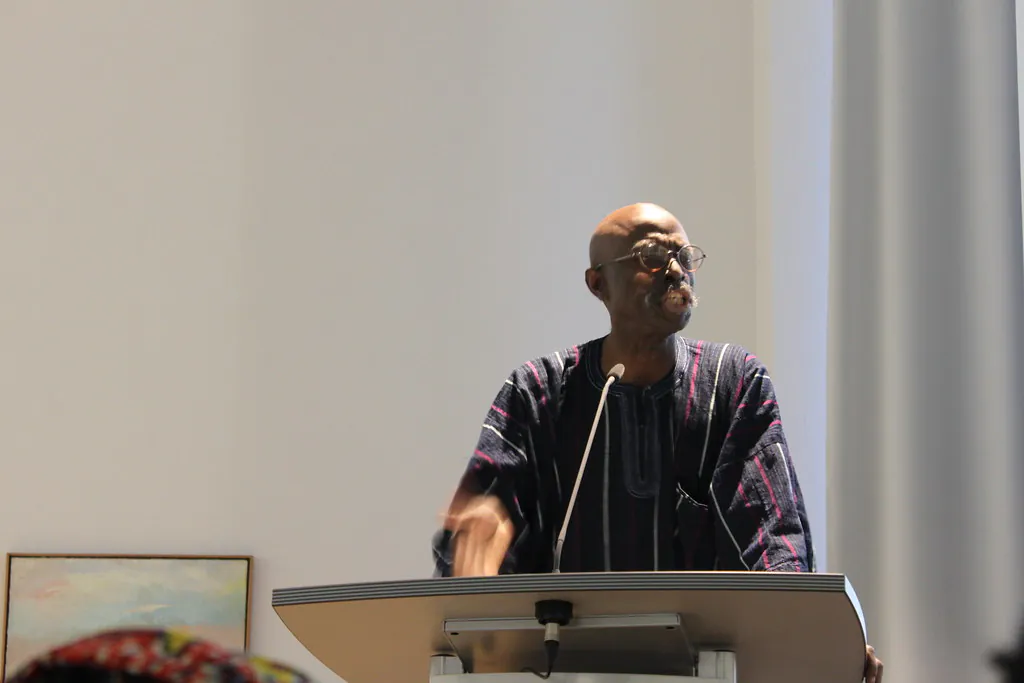
From the records and testimonies of Comrade Eddie Madunagu
By Ikenna Edwin Madunagu
Comrades, friends, and the younger generation to whom the future belongs,
What I present here are not merely written words. They are drawn from spoken reflections, personal testimonies, and historical recollections of Comrade Eddie Madunagu — a man who stood shoulder to shoulder with Biodun Jeyifo (BJ) for more than five decades. Because ill health has prevented him from being physically present at this moment, I stand to transmit what he has consistently affirmed about his comrade, collaborator, friend, and brother.
From Comrade Eddie’s testimonies, one truth is unmistakable: BJ was not merely a friend. He was not merely a colleague. He was not merely a comrade in an abstract ideological sense. He was, in his own beautiful formulation, a “friend of my spirit.”
And when BJ once named four friends of his spirit — Femi Osofisan, Niyi Osundare, Yemi Ogunbiyi, and Eddie Madunagu — Comrade Eddie understood that what bound them together was not geography, convenience, or professional alignment, but conviction.
Their story did not begin in 1975. It began earlier — in 1968, in the heat and bitterness of the Nigerian Civil War, at the University of Ibadan.
From Eddie’s account, the atmosphere was tense. The country was fractured. Suspicion was everywhere. Ethnic identities were politicized and weaponized. It was in that climate that he first encountered BJ, who was contesting for the position of Public Relations Officer under the National Union of Nigerian Students (NUNS).
What impressed Eddie was not merely that BJ contested, but how he campaigned. His campaign was radical — unapologetically progressive, intellectually sharp, and ideologically bold. He did not dilute his message to seek comfort. He articulated conviction in a period defined by fear. Eddie admired him.
The second decisive encounter came when Eddie himself contested for the position of General Secretary of NUNS. BJ was among the panel of executives assigned to interview candidates. The war had deepened divisions. Eddie was an Igbo-speaking candidate seeking national office during a civil war. Opposition to his candidacy carried ethnic undertones that were difficult to ignore.
From Eddie’s testimony, BJ privately confirmed his Igbo identity — not to disqualify him, but to confront the political terrain honestly. Having done so, BJ supported him resolutely. In a climate poisoned by suspicion, BJ chose principle over prejudice. He chose ideological clarity over ethnic opportunism.
Eddie still lost that election. But what he gained, as he repeatedly testified, was a lasting understanding of BJ’s character. BJ was capable of separating historical tension from moral judgment. He understood that class solidarity must not collapse under ethnic pressure. That lesson endured.
The third decisive stage of their journey came in 1975.
In the second half of that year, following their release from military detention, APMON — the Anti-Poverty Movement of Nigeria — was engulfed in internal conflict. The debate that triggered the rupture had begun even while they were still in detention. The question was simple but profound: when freedom came, would they take a revolutionary leap, or proceed gradually within the limits of the existing order?
Comrade Bene Madunagu and Comrade Eddie opted for the revolutionary leap. They believed that moments of rupture demanded boldness; gradualism, under certain conditions, risked accommodation.
At that decisive point, BJ entered APMON — brought in by Bene and Eddie — through a student member, Femi Gbamiloye. He aligned with their faction. From Eddie’s testimony, BJ’s entry strengthened them intellectually, morally, and organizationally. During the internal struggle, his clarity sharpened arguments and his courage reinforced resolve. They emerged victorious — or declared themselves so.
The victorious faction — BJ, Bene, and Eddie — constituted what they named the Revolutionary Directorate. It was not a boast. It was a responsibility. That marked the beginning of a 51-year ideological journey together.
In 1976, Eddie embarked on what he called an extraordinary expedition, lasting from June 1976 to May 1977. During that period, Bene had moved to Calabar. At the end of the expedition, Eddie joined her there. He remains in Calabar to this day — anchored not merely by geography, but by history.
BJ’s path later carried him into global academia. Yet, from Eddie’s consistent reflections, BJ never abandoned the ideological ground from which he rose. His scholarship was never neutral. It was partisan in the most principled sense. He understood that literature is not innocent, that culture is not detached from class struggle, and that intellectual work divorced from the oppressed becomes sterile.
BJ was brought into APMON’s socialist and Marxist tradition by Bene and Eddie. He embraced that commitment fully. For 51 years, they stood within that ideological framework together.
From Eddie’s testimony, his own ability to operate as a professional revolutionary Marxist was deeply shaped by his relationship with both BJ and Bene. Bene departed first. BJ has now joined her. The impact, Eddie has said, has been devastating.
To lose comrades, he insists, is to lose fragments of oneself. Shared memories — detention debates, strategic disagreements, laughter after fierce ideological exchanges — do not disappear; they echo differently.
Yet, as Eddie repeatedly affirms, grief must not paralyze the revolutionary.
BJ believed struggle was not ritual but necessity. He believed capitalism’s brutality could not be softened by appeals to conscience alone. It required organized resistance, ideological clarity, and generational renewal.
To the younger generation, Eddie’s charge — which I now transmit — is clear: Do not romanticize them. Do not turn them into relics. Study them critically. Surpass them. Where they hesitated, move boldly. Where they were divided, build unity. Where they faced repression, develop strategy. Above all, refuse neutrality in the face of exploitation.
The debate that defined their early struggle — leap or gradualism — remains before us today in new forms. Will we accept cosmetic reforms, or interrogate structural inequality? Will we seek comfort within the system, or question the system itself? BJ chose the leap.
He chose alignment with the oppressed. He chose ideological discipline. He chose friendship grounded in shared historical responsibility.
From Eddie’s recollections, BJ possessed immense intellectual generosity. He could argue fiercely and embrace warmly. He valued disagreement as a means of sharpening thought, not as a weapon of destruction. In a political culture often infected with ego, he balanced firmness with humility.
BJ named Eddie a friend of his spirit. Eddie returned that affirmation publicly and eternally.
As Eddie remains in Calabar, unable to attend BJ’s funeral due to failing health, he feels the weight of time. They entered this ideology together more than half a century ago. They watched movements rise and fall. They endured repression, victories, defeats, exile, and internal fractures. Through it all, they did not renounce their fundamental commitment.
He stands today diminished in number, but not in conviction. His pledge — which I faithfully convey — is to continue the struggle for an egalitarian society; for socialism grounded in the concrete realities of our people; for a Nigeria liberated from class exploitation and intellectual cowardice. This is not nostalgia. It is continuity.
BJ has not been defeated by death. He has been transferred to history. And history, as Eddie reminds us, is both unforgiving and generous. It remembers those who aligned with justice.
The Revolutionary Directorate was never merely three individuals. It was a spirit of refusal — refusal to accept poverty as destiny, refusal to normalize injustice, refusal to substitute intellectual comfort for commitment.
If we wish to honor BJ, we must not merely praise him. We must organize. Study. Debate. Act.
The journey that began in 1975 did not end with his passing. It continues — in us.
Farewell, Comrade BJ.
Friend of the spirit.
Revolutionary collaborator.
Brother.
The struggle continues.
*Ikenna Edwin Madunagu is a Research and Documentation Officer at the Socialist Library and Archives (SOLAR), Calabar, Cross River State, Nigeria.
BJ, My Former Teacher and Mentor at Cornell
By Shital Pravinchandra
My abiding memories of BJ will always be from the classroom.
His impromptu (and tuneful!) singing of the calypso from Derek Walcott’s Dream on Monkey Mountain, his obvious delight in reading aloud the entirety of Lucky’s speech, and his explanation of Fanon’s writings in The Wretched of the Earth—so impassioned that his glasses flew off and landed on the table just in front of me.
His praise, when he gave it, made you soar with confidence and pride; his probing questions—and there were many—made you look again. Thank you, BJ.
*Shital Pravinchandra, Senior Lecturer in Comparative Literature, Queen Mary University of London, UK
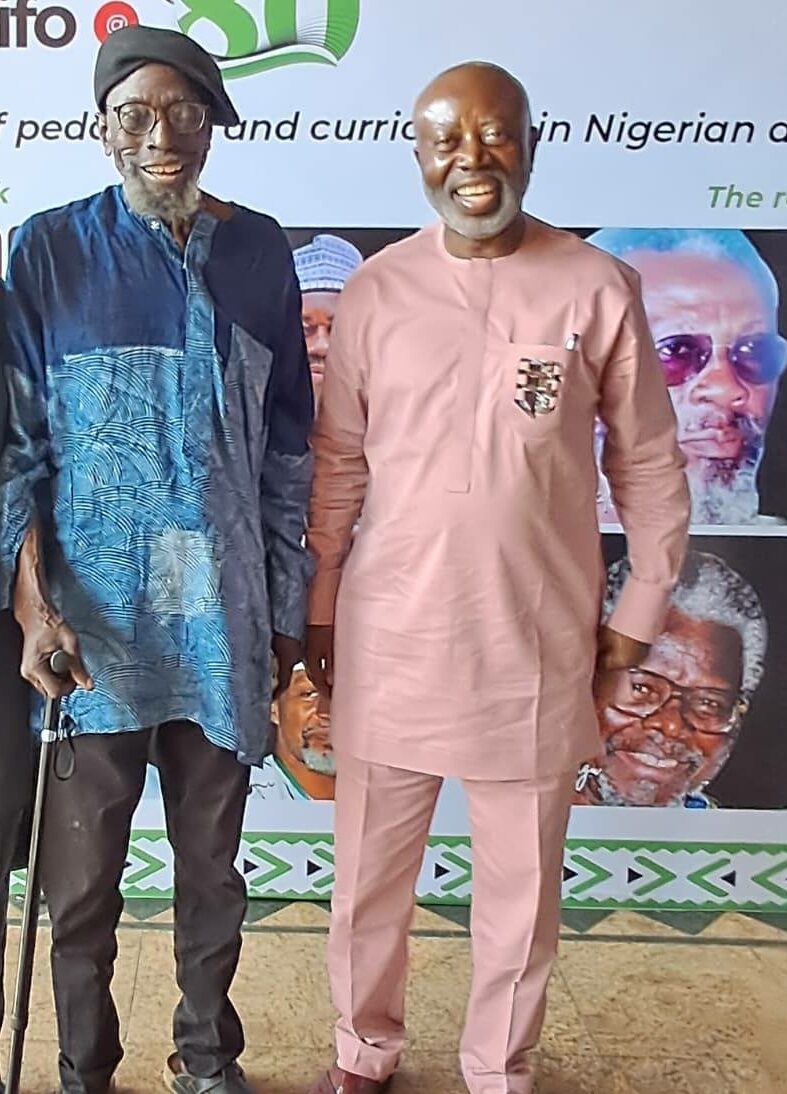
For Comrade Biodun Jeyifo (BJ); For Nigeria
By Chido Onumah
Comrade Biodun Jeyifo (BJ), who will be interred on Wednesday, March 4, 2026, in Ibadan, Oyo State, was a man of many distinguished parts: first-class student; Professor Emeritus of English at Cornell University and Professor Emeritus of Comparative Literature at Harvard University; journalist; author; literary critic; President of the Academic Staff Union of Universities (ASUU); labour activist; revolutionary; and Chair of the Board of Trustees/Advisers of the groundbreaking Socialist Library of Nigeria (SOLAR) in Calabar, Cross River State.
Almost two months ago to this day, on January 5, 2026, comrades, scholars, activists, friends, students, and admirers gathered at the Agip Recital Hall of the Music Society of Nigeria (MUSON) Centre, Onikan, Lagos, to mark Comrade BJ’s 80th birthday with a lecture by one of his students, Priyamvada Gopal, Professor of Post-Colonial Studies at the University of Cambridge, titled “Who Is Afraid of Decolonisation? Pedagogy, Curriculum and Decolonisation: Then and Now,” a reflection of Comrade BJ’s lifelong interests and struggles. It was a fitting moment to honour the legacy of a brilliant and remarkable scholar. We have the Wole Soyinka Centre for Investigative Journalism (WSCIJ) to thank for this important gathering, which turned out to be Comrade BJ’s last public outing.
I am grateful I didn’t miss it. Earlier scheduled trips and flight disruptions over the Christmas and New Year holidays had made travel plans quite hectic. I arrived in Lagos at 2:00 a.m. on January 5. By the time I got to my hotel at about 3:30 a.m., I had just a few hours before heading to the MUSON Centre. I wanted to arrive early so I could discuss official matters of the Socialist Library and Archives, of which he was board chair, with Comrade BJ. I didn’t have the opportunity. Comrade BJ was too busy to entertain such official conversations.
The Comrade BJ I saw was ebullient, almost unrestrained—a sharp contrast to the frail 78-year-old Comrade I saw at the same venue on July 13, 2024, at another event hosted by WSCIJ to mark the 90th birthday of Nobel laureate, Prof. Wole Soyinka, and again in January 2025 in Calabar at the funeral of Comrade Bene Madunagu. He greeted visitors fervently, took pictures, and expressed joy at the gathering and the faces that had come to celebrate his birthday. It was the same energy he exuded when he was called upon to speak at the end of the event. It was a feeling of satisfaction and fulfilment—not because Comrade BJ was given to revelry. I remember in late December 2025, when he informed the SOLAR team that he had returned to Nigeria, I replied jokingly, “Welcome home, Comrade. Compliments of the season. Happy birthday in advance. Any Aso Ebi?” His reply, 23 minutes later, was quintessential Comrade BJ: “God forbid!” with three yawning-face emojis.
Looking back, I am happy Comrade BJ’s 80th birthday event happened. For many years, he struggled with health challenges. I don’t remember the number of times he excoriated me and Comrade Kayode Komolafe (KK) for sending him messages on his dialysis days (Tuesday, Thursday, and Saturday). His joy on January 5 was more of fulfilment of expectation—of years of sustained struggle, of not giving up, and the hope that the struggle would continue now that it seemed he could no longer go the next step.
I knew Comrade BJ for more than three decades. Before our first meeting, I had heard and read a lot about him—from his exploits as President of the Academic Staff Union of Universities (ASUU), an affiliate of the Nigeria Labour Congress (NLC), to his intellectual, academic, and literary prowess—but more importantly, his radical struggle for a humane and egalitarian society. The last part I learnt from his close comrade and collaborator of more than five decades, Comrade Edwin (Eddie) Madunagu, my mentor and teacher.
In the late 1980s and early 1990s, The Guardian newspaper, where Comrade Eddie served as a member of the editorial board, was my second home—literally. I would visit, spend hours reading The Guardian, and watch prominent citizens stop by to submit their opinions for publication or to visit members of the influential editorial board. It was on one such visit to The Guardian that I ran into Comrade BJ. I think he had just returned to the country from the U.S., where he was teaching, and stopped at Rutam House, Isolo, Lagos—the home of The Guardian—to see Comrade Eddie. I was in awe of Comrade BJ. He was simple and self-effacing, his influence in the intellectual and literary world in the country and beyond notwithstanding.
It was through Comrade Eddie that I came to know about Comrade BJ’s interventions, beyond his journalism, critical essays, or literary work, in the quest for a just and egalitarian society. I learnt of the active role he and his comrades played “in the strengthening of the foundations and early development of a post-Civil War revolutionary, Marxist formation in the Nigerian students’ movement; the revolutionary conscientisation of peasants and other rural populations in an area stretching from Ode-Omu to Oogi, Ede, Oyo, Ogbomosho, Ife, Ifetedo, and Okeigbo [in the South West] between June 1976 and May 1977; the ‘Ali Must Go’ students’ protest of 1978 and its aftermath; the radicalisation of the Academic Staff Union of Universities (ASUU) in the early 1980s; and the formation, on revolutionary foundations, of the National Association of Nigerian Students (NANS).”
On Sunday, February 22, one of Africa’s preeminent historians and the anchor of The Toyin Falola Interviews organised a robust panel of colleagues, friends, and ex-students of Comrade BJ. In his intervention, Dr. Ogaga Ifowodo, whom Comrade BJ taught at Cornell University in Ithaca, New York, spoke about the “rigour” that Comrade BJ brought to bear in his work. In furthering that position, I noted Comrade BJ’s consistency, which defied age, time, and physical location.
Interestingly, ten years ago, one of his teachers at the University of Ibadan, Prof. Dan Izevbaye, in his tribute to Comrade BJ at 70, had spoken of the “unrelenting consistency of his intellectual and scholarly activism.” Typical of Comrade BJ, he did not consider the “praise” as an “achievement he had to strive for.” As he noted in his tribute during the 75th birthday of Comrade Edwin Madunagu, titled The Most Humanistic and Scientific Socialist of Our Generation: For Edwin Madunagu @75, “being consistent was completely in the nature of things that I had seen and observed in the lives of many others in the Nigerian Left—and in other parts of the world—who had been as consistent over the entire course of their biological and intellectual adulthood as I had striven to be.” Comrade BJ was right—partially. Yes, he strove for consistency till the very end, but not many people who had the opportunity and the intellect with which Comrade BJ was endowed stayed the course. Very few scholars could make the connection between their work and the emancipation of the downtrodden the way Comrade BJ did, till the very end.
I end this tribute by highlighting two interventions by Comrade BJ that exemplify how comfortable he was with theory and praxis. In 2006, I was travelling in the U.S. when I reached out to him that I was thinking of putting together some of the essays of Comrade Eddie into a collection for his 60th birthday. He thought it was a great idea and asked how easily we could get the soft copies. I told him I had started saving the soft copies of Comrade Eddie’s essays the moment The Guardian began its digital transition, and that we could type any that were not available online. The outcome was the book, Understanding Nigeria and the New Imperialism: Essays 2000–2006 (edited by Biodun Jeyifo, Bene Madunagu, Kayode Komolafe, and Chido Onumah), a critical intervention and “lucid exposé of the policies, worldviews, and assumptions fuelling the operations of [the] so-called ‘international community.’” Comrade BJ wrote the foreword, which I recommend to readers. His son, Olalekan Jeyifous, did the cover design and artwork for the book.
Fifteen years later, in 2021, on the occasion of the 75th birthday of Comrade Eddie, Comrade BJ was instrumental in founding the Socialist Library and Archives (SOLAR) in Calabar, Cross River State. SOLAR seeks to collect and preserve books, pamphlets, journals, newspapers, and documents that capture the intellectual, political, and social struggles of workers, activists, and progressive movements in Nigeria and around the world. This intervention has its origin in the Combined Archives and Libraries of Edwin Madunagu & Bene Madunagu, a product of the joint life of Edwin Madunagu and Bene Madunagu since 1973.
As Chair of the Board of Trustees/Advisers of SOLAR, Comrade BJ walked the talk. His devotion to the success of SOLAR stemmed in part from the loss of his books and documents to the elements, but more importantly from his belief that the torch of revolutionary struggle needed to be passed on through enduring initiatives like SOLAR. Three years ago, as SOLAR struggled with sustainability, Comrade BJ provided a lifeline. He told the management that he had been contracted by a publishing house in the U.S. to write a book on Prof. Wole Soyinka and that he would donate the proceeds from the assignment—minus taxes—to SOLAR. He did exactly that. Today, SOLAR is not only collecting and archiving materials; it has started digitising them. Many of these materials exist only in hard copy. Age, humidity, frequent handling, and limited storage conditions place them at serious risk of deterioration and permanent loss.
SOLAR represents decades of socialist thought, labour history, and the impact of social justice movements. It is a repository of out-of-print publications; educational resources for students, researchers, civil society groups, and activists; and a historical record of struggles, ideas, and organising that shaped not just Nigerian society but the world. It is a deliberate effort to ensure that the knowledge, ideas, and lessons of our individual and collective struggles are not lost, but made accessible to current and future generations. We have Comrade BJ to thank for his leadership and support in this regard.
When he was given the opportunity to speak as his 80th birthday lecture came to an end on January 5, it seemed Comrade BJ was saying goodbye. He struggled to speak, overwhelmed with emotion, promising to do a series of lengthy interviews to tell his story. What I heard Comrade say—not verbally—was that a new Nigeria, indeed a new world, is possible. It was captured in these words: competition would have to take a back seat to cooperation; there has to be a post-capitalist approach to development; we cannot survive as a species under the present system; there must be a restructuring (retribution) of wealth to reduce economic and social inequality in Nigeria and ensure human dignity.
Not many comrades at the “departure lounge of life,” as Comrade BJ liked to describe himself, could be that forthright!
Onumah, PhD., is the Coordinator of the Socialist Library and Archives (SOLAR) and author of We Are All Biafrans, among other books
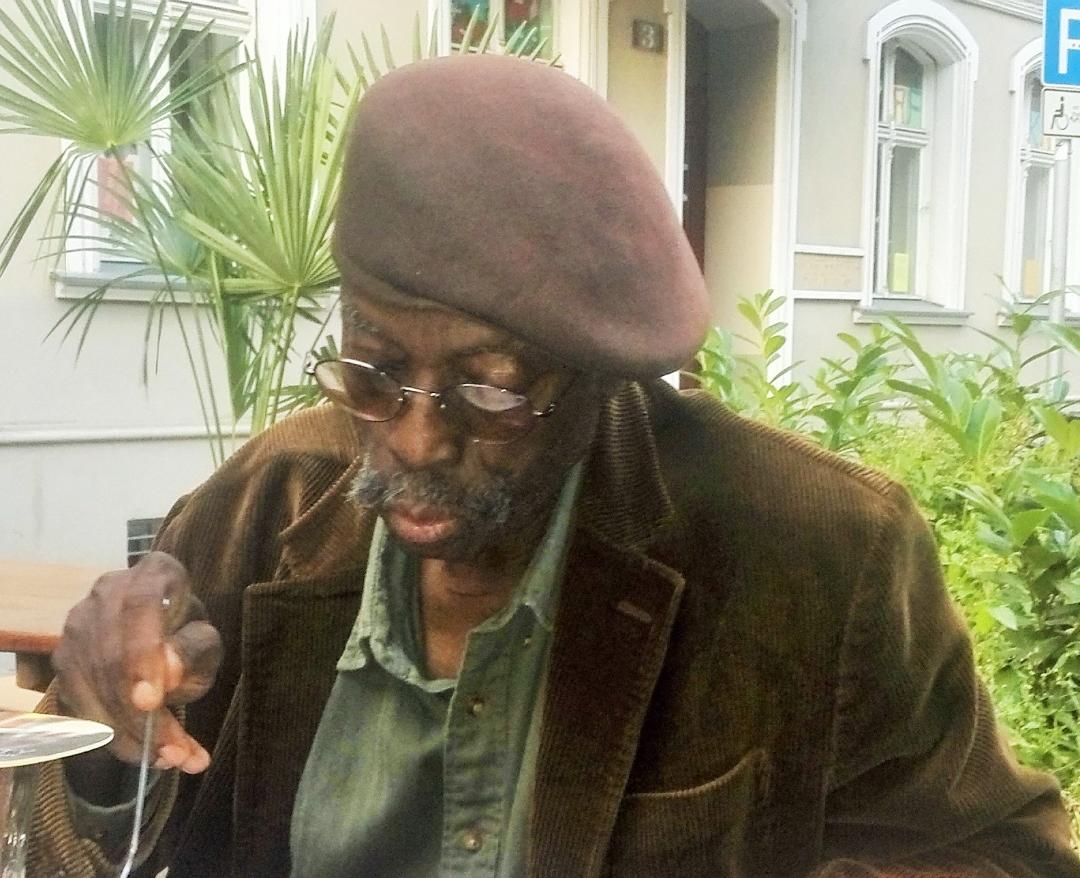
BJ: Incomparable Teacher
By Olutola Mobolurin
ABJ, as he was then called by his friends nearly 56 years ago, was an inimitable and inspirational teacher. He taught me Literature in English at Adeola Odutola College during my HSC (Class of 1969/1970). He taught us for roughly three months, the period between his graduation and his recall to join the faculty of his alma mater university. Three months!
First, the knowledge that he made a 1st Class in English made a folk hero out of him for many students. It was, however, his intellect and his style of literary criticism that built a lifelong lodge in my consciousness. No teacher to date has created such an impact on me.
He took us through three authors: Ibsen (A Farewell to Arms), Okot p’Bitek (Song of Lawino), and James Joyce (A Portrait of the Artist as a Young Man). His review of the first two was gripping and, in his usual style, brought the text and the stories into evocative space. We got absorbed by the texts, nearly becoming part of the stories. In A Portrait…, I was transformed into Stephen Dedalus, the main character, himself a rough fictional incarnation of James Joyce.
A book considered by many of my classmates as difficult and inaccessible, Prof. Jeyifo made it a delightful one to read, making me imagine that I, too, would become an artist in the mould of Stephen Dedalus and James Joyce.
Stephen’s Irish nationalism and his repulsion at English oppression of his people inspired in me an acute awareness of political injustice in Nigeria, moving me to identify with the Nigerian leftist intellectuals of the day. ABJ’s Marxism was not evident in his teaching at the time. I was later surprised when I learnt of his literary criticism pivoting on Marxist analytical evaluation.
For at least three years after Adeola, I kept a scrapbook to record all quaint events in my life, storing them for use in “this budding artist’s” future book(s). After leaving Adeola, I began thinking about how to make a living in Nigeria. The career, social, and economic prospects of English graduates (without a 1st Class) did not appear appealing. I started looking towards degrees in Accounting, Law, and Mass Communication, in that order.
I eventually went abroad on a tuition scholarship and earned a degree in Accounting and Finance, topping it with an MBA. However, I never left the leftist side of politics, and I was delighted that ABJ himself, before his death, was convinced that Nigeria should at least be a social democratic state. That was a rightward shift for him, and in that we are united. His move to the right would have been a delightful subject to discuss if we had met as planned in December 2025.
It was not just the thematic issues that engaged Stephen that impacted me. Professor Jeyifo also introduced us to an appreciation of writing styles (stream-of-consciousness technique, etc.), poetry in prose, and was so detailed in identifying and bringing to life obscure and esoteric figures of speech like onomatopoeia.
The announcement of his death was profoundly disappointing and painful. My class set at Adeola had desired to honour him at our 55th Anniversary Graduation Reunion in November 2025. Dr. Yemi Ogunbiyi kindly put me in touch with him. Prof. Jeyifo was appreciative of the gesture but told me he was in the US and going into surgery the following day. He promised to get in touch when he got back to Nigeria in December. I was away for part of December 2025 and January 2026. We were never to meet again.
After 55 years, Professor Jeyifo’s intellectual deposit in me has not departed. I still visualise him striding across the class in such long strides as his long legs afforded him—a master of drama. Some of our classmates mischievously referred to him as “langalanga.” He was not loved by all, but he was admired by all for his intellect.
I wish I had known him more intimately, as I knew the one he brought as his replacement: the late Major Tunde Sawyerr.
In his last week in Ijebu-Ode, he took a few of us out, and we learnt a bit about him. He was warm, friendly, and, of course, indulgent. He offered us any drink we wanted, including beer. When he himself refused to take any alcoholic drink that night, he allayed our fears about him being a teetotaler. He then spoke about his exploits as a Pirate and, of course, the drama around his 1st Class degree. At the Night of Tributes, I listened to Prof. Wole Soyinka’s narrative of the drama around ABJ’s 1st Class degree. However, I had heard the original, which had some differences from Prof. Soyinka’s. I believe ABJ’s version.
May his soul rest in peace
*Olutola Mobolurin, former Chairman, Board of Directors, First City Monument Bank (FCMB), now Chairman, Capital Bancorp Plc.
Bíọ́dún Jéyǐfò: Petrel Among the Interpreters
By Deji Toye
In the early rainy season of 1975, a battered Volkswagen Beetle carrying two young academics crossed the Togo-Ghana border. The car’s owner, a thirty-year-old lecturer at the University of Ìbàdàn named Biodun Jéyǐfò, had embarked on what he would later call a “special mission”—a journey from Ìbàdàn to Accra to persuade Wole Soyinka to end his post-Civil War self-exile and return home. Jéyǐfò and his colleague Kọ́lé Ọmọ́tọ́sọ̌ were envoys of the Ìbàdàn-Ifẹ̀ group of socialist intellectuals, emissaries sent to haul a big fish for the movement. They believed Ṣóyínká’s “courage of political activism” could be harnessed to their emerging Marxist framework, that the playwright might be persuaded to integrate class analysis into his unmistakable social vision. Ṣóyínká did return shortly afterwards, but not to join their project. Within months, he and the group would be locked in a ferocious public quarrel—preserved forever in the pages of the group’s Positive Review and Ṣóyínká’s inaugural lecture at Ifẹ̀, ‘Barthes, Leftocracy and Other Mythologies’. The mission would appear like it had failed in its stated purpose. But like all true quests, its meaning lay elsewhere: in what the journey revealed about the quester, and in how the failure itself became an education.
That Beetle, crossing borders—an old protégé in search of a reluctant warrior—is as good an image as any for the career it carried. Biodun Jéyǐfò, who died in February 2026 at the age of eighty, spent his life in motion—through institutions, across ideologies, between the certainties of youth and the complicating knowledge of age. He was, at thirty-four, the founding president of the Academic Staff Union of Universities (ASUU), a Marxist polemicist in the seventies, Ṣóyínká’s most profound interpreter in maturity, a Harvard professor in later years. But beneath all these roles ran a continuous current: the effort to understand how intellectuals might serve social transformation without being consumed by it, how movements might discipline without imprisoning, how one might remain faithful to a cause without becoming blind to truth. He was, in the deepest sense, an interpreter, not merely of texts, but—petrel-like—of the turbulent passage between idea and action, commitment and clarity, the revolution that beckoned and the one that never came.
Much has been written about Jéyǐfò since his death, often by friends, colleagues and former students who knew him personally. Taken together, one gets the picture of the elephant in the parable, each testament illuminating a part of what becomes a gigantic whole. One such perspective—one, but important—is that of Jéyǐfò as a leading teacher and theorist of literature. So, it is meet to seek the illumination of literature itself for a different survey of his place in our intellectual history.
Movement as Character, Discourse as Narrative
There exists a recognisable strain of African writing that is best approached not through a single protagonist but through an ensemble of characters whose interactions form the true centre of the narrative. An early, basic archetype appears in D.O. Fágúnwà’s Ògbójú Ọdẹ nínú Igbó Irúnmọlẹ̀ (1938), where a band of hunters journeys in search of a rare panacea for the fatherland. In more complex, modernist works—say, Wole Soyinka’s The Interpreters or Akin Adéṣọ̀kàn’s Roots in the Sky—the ensemble becomes a community of minds engaged in dialogue with one another and, ultimately, with their society. That dialogue, never confined to a single ideological script, circles the quest for meaning in an ethically inchoate world and the choices the characters make in response. Their fraught relationship with the larger society’s drift distinguishes their motive from the uncomplicated patriot-ese of Fágúnwà’s questers. In their most ideological version, they may even form literal communes—Aiyétòrò in Ṣóyínká’s Season of Anomy, Miracle City in Adéṣọ̀kàn’s novel—spaces the poet Níran Òkéwọlé once called “communities of resistance.” Across the broad spectrum I described above, I prefer to call their cohorts the interpreters.
These ensembles are bound not by a single ideology but by argument itself. Their dialogue, with all its contradictions and tensions, becomes a kind of narrative in its own right—almost, in Bruno Latour’s sense, a social interaction that acquires the solidity of a thing outside the constituent actors and their bare aggregates. Over time, the trails left by these debates—Latour’s “traces”—form their own character arc. And because the interpreters almost always operate within the long run of postcolonial deformation, that arc tends toward tragedy: in frustration of unfulfillment, often through quiet attrition, occasionally in more dramatic eruptions.
It was within such an ensemble that Jéyǐfò emerged as an intellectual presence in the years following the Civil War. Military rule was consolidating and raising the stakes for democratisation of choices. Mismanagement of oil wealth made the society the worse for the wear. Older intellectuals—many of them involved one way or another in the crises of the previous decade—were either in retreat or repose. Among younger thinkers, however, there was a sense that the crisis presented an opportunity for reordering society. Jéyǐfò stood at the arrowhead of this generation, helping to articulate an intellectual framework—often Marxist in orientation—for understanding the society’s contradictions and imagining its transformation.
What distinguished him even at this early stage was that he worked across communities of debate. His intellectual life unfolded not as a single trajectory but as a series of journeys across overlapping networks of interpretation—literary criticism, union building, and practical movement work. Even in the politics of broad-based platforms, he sought to channel the era’s contending forces toward radical transformation.
Critique as a Journey of Understanding
The poet Níyì Ọ̀ṣúndáre once mused:
Poetry is
No oracle’s kernel
For a sole philosopher’s stone
Jéyǐfò’s introduction to Ọ̀ṣúndáre’s Songs of the Market Place famously ordained ‘Poetry Is’, the poem from which these lines are drawn, as a poetic manifesto—a rejection of hermetic art in favour of poetry that walked among the people. Even then, in that same essay, he already called for moving beyond the normative parameters of commitment and engagement towards “a different order of discourse” that would attend to form and technique—a task that requires consideration of the poet’s own subjective choices. That call went well-nigh unheeded in the bare revolutionary brushes that continued to rule Ọ̀ṣúndáre critique for a very long time. It is therefore no surprise that Ọ̀ṣúndáre would later appear to give his traditional exponents grief when his verse grew more recondite, as in Waiting Laughters (1990), or when he wrote, in ‘Every Good Poem’ (2017):
Every good poem
Is a jungle of non-sense
A patent madness waiting
For its hidden method.
This was the pattern of Jéyǐfò’s intellectual life: a capacity to hold positions with conviction while remaining open to their complication. In this specific case, as his own critical practice came to embody a productive tension between intellectual curiosity and political commitment, he acknowledged that manifesto alone could not mediate the relation between poetry and politics.
In its long arc, the Ṣóyínká ‘quarrel’ came to exemplify similar intellectual honesty. Looking back in his 2004 book Wọlé Ṣóyínká: Politics, Poetics and Postcolonialism, Jéyǐfò acknowledged what had been missing from the Positive Review critiques: attention to “the subjective dimensions of artistic creativity and cultural politics.” The young Marxist who had faulted Ṣóyínká for insufficient class consciousness had become, over decades of engagement, the most profound expository scholar of Ṣóyínká’s oeuvre. This was not a renunciation of earlier convictions but a deepening of them. Society might need changing, as the Marxian maxim insists, but understanding remained the necessary beginning of change. Interpretation and transformation were not opposing tasks but stages in the same process. It was an education enacted in public—a lesson for everyone who paid attention.
Revolution as Journey of Negotiations
If Jéyǐfò’s intellectual development unfolded through critical debates, it was equally shaped by practical engagements in the politics of academic unions and the broader society. His journeys across Nigeria in that Volkswagen Beetle mobilising for the establishment of ASUU is already the stuff of legend. As its founding president, he gave the union a distinctly radical orientation that would define its role in national debates for decades.
These efforts often ran against the dominant currents within the socialist movement itself. Some activists preferred to concentrate on building pure revolutionary platforms rather than working within broad-based organisations. Jéyǐfò’s choice to invest his energies in unionism reflected an instinct for negotiation rather than doctrinal purity—a recognition that lasting change required engagement with broader constituencies.
The atmosphere of the 1970s nonetheless inspired more ambitious experiments. Across the Third World, there was a widespread sense that revolution might be imminent. Students no longer went on strike merely to reverse a policy on feeding or fee subsidy—even where that was the originating event. They wanted to overthrow the system. In a time of military rule, it often ended in tragedy. Fẹmi Olúgbilé’s novel, Batolica! (1995) dramatised one such tragedy, using the Ifẹ̀ university campus as a setting.
As in Adéṣọ̀kàn’s novel in which young idealistic graduates resolved, in their choices, against “the society’s ways of ‘rising in life’,” socialist cadres made ethical and pragmatic choices in anticipation of a transformed society. Some abandoned professional careers to become organisers and peasant mobilisers. Some others sought refuge in communes that promised both ideological clarity and a measure of distance from the compromises of ordinary life. In Roots in the Sky, Adéṣọ̀kàn has the character Muṣin reflect on that dubious, victim-victimiser, identity of unconscientised citizens, when he calls them “the children of those who queue up for everything and would jump the queue if no one was watching failed to act.” The suspicion is mutual. In the same novel, Kilanko, a veteran organiser, is dismissed by impervious locals who will rather forage for leavings in the margins of the very disaster imposed upon them, than be talked into an uprising: “You stay in Lagos for seven months and come back for two days to accuse us of being docile… You have no stake in this village.”
Jéyǐfò participated in one such experiment at Ọdẹ Òmu, a village on the outskirts of Ifẹ̀ where a small group of activists attempted to build a model of agrarian socialist community in 1976-77. As Edwin Madunagu, a leading resident noted of the experiment, it was an attempt to transform “mere revolutionary intellectuals” into “proletarian revolutionaries” embedded in the peasantry. They wanted to forge “an unalienated and non-exploiting revolutionary agency,” and to “conscientise the rural population” through shared life rather than distant agitation.
The experiment lasted barely a year. Records about the cause of its early death perhaps lies in movement archives—the participants, some of Nigeria’s most prolific public intellectuals, have shown unusual reticence about what went wrong. But in his 2022 obituary to Sẹ̀ìndé Arígbẹdẹ, a doctor whose family hosted the Ọdẹ Òmu commune, Jéyǐfò reflected on what the experience had bequeathed to Nigerian literature. Nearly every major work of the following decades, he noted—Fẹ́mi Ọ̀sọ́fisan’s The Chattering and the Song, Ọmọ́tọ́ṣọ̌’s Shadows in the Horizon, Isidore Okpewho’s Tides, Bọ̀dé Ṣówándé’s Farewell to Babylon, Chinua Achebe’s Anthills of the Savannah, Ọ̀ṣúndáre’s Songs of the Marketplace, Ofeimun’s The Poet Lied, Rotimi’s If—drew on the Ode Omu example for its fictional characters and concerns: “men and women who left their middle class jobs, became full time activists, moved to rural communities, or took it upon themselves to create new patterns of personal and collective identities.”
One remains curious about the cause of the collapse of the Ọdẹ Òmu experiment since it could also provide a window on how it has shaped its participants. In later reflections, Jéyǐfò would emphasise the value of patience and negotiation over the urgency and certitude of earlier revolutionary hopes—what he once described, in his tribute Dr. Arígbẹdẹ, as the importance of “making haste slowly for human equity.”
Perhaps, that is window enough. Maybe what the Ọdẹ Òmu veterans carried away from the village was not the revolution they had sought but a different kind of knowledge: about the patience actual transformation requires, about the distance between theory and lived reality. Jéyǐfò denied the messianic impulse usually ascribed to their retreating party in its literary archetypes. Whatever might have been the case, what came out was a more chastened appreciation of the demands of movement-building. In this respect, Jéyǐfò’s early bet on broad-based organising, against the purists who insisted on only separate socialist platforms, had been vindicated not by the revolution that didn’t come but by the institutions that endured. ASUU, which he had helped found at thirty-four, outlasted every prophecy of its irrelevance.
A Win Unsung
Measured against the ambitions of a socialist revolution, the achievements of the Nigerian leftist movements of the 1970s and 1980s may appear modest. Yet once we step back from those moonshot expectations, their contributions become easier to see. At a time when public policy retreated in the face of fiscal austerity, socialist intellectuals argued consistently for investment in education and health, and global concert against illicit flow of funds—positions that have since become part of the mainstream vocabulary of international development. The transformation they envisioned did not occur in the form they expected, but the debates they shaped left enduring traces.
Jéyǐfò’s career followed a similar arc. The certainties of early ideological commitment gave way to a more capacious intellectual practice, one that retained its moral seriousness while embracing the complexities of interpretation. He remained throughout his life a participant in communities of debate, a figure defined less by solitary pronouncements than by sustained engagement with others.
Seen from this perspective, the ensemble narrative provides the most illuminating metaphor for his life’s work. The interpreters who animated Nigeria’s post-independence intellectual history were bound together by argument and aspiration, and their collective journey forms a story of its own—marked by hopes deferred, insights gained, and energies dispersed across institutions and generations. Among them, Bíọ́dún Jéyǐfò stood as one of the most restless and searching spirits. Like the petrel that rides the storm winds over open water, he moved across the turbulent currents of his time, tracing paths that only become visible in retrospect. The storms through which he travelled have not entirely passed, and the questions that animated his journeys remain unsettled. But in the traces left by those journeys—in institutions built, debates shaped, and students moulded—we may still discern the arc of a life devoted to the difficult work of interpretation.
Deji Toye is a lawyer. He is currently writing a book on the potentially revitalising contributions of the poetry and the thoughts of Niyi Osundare to ecocritical theory.
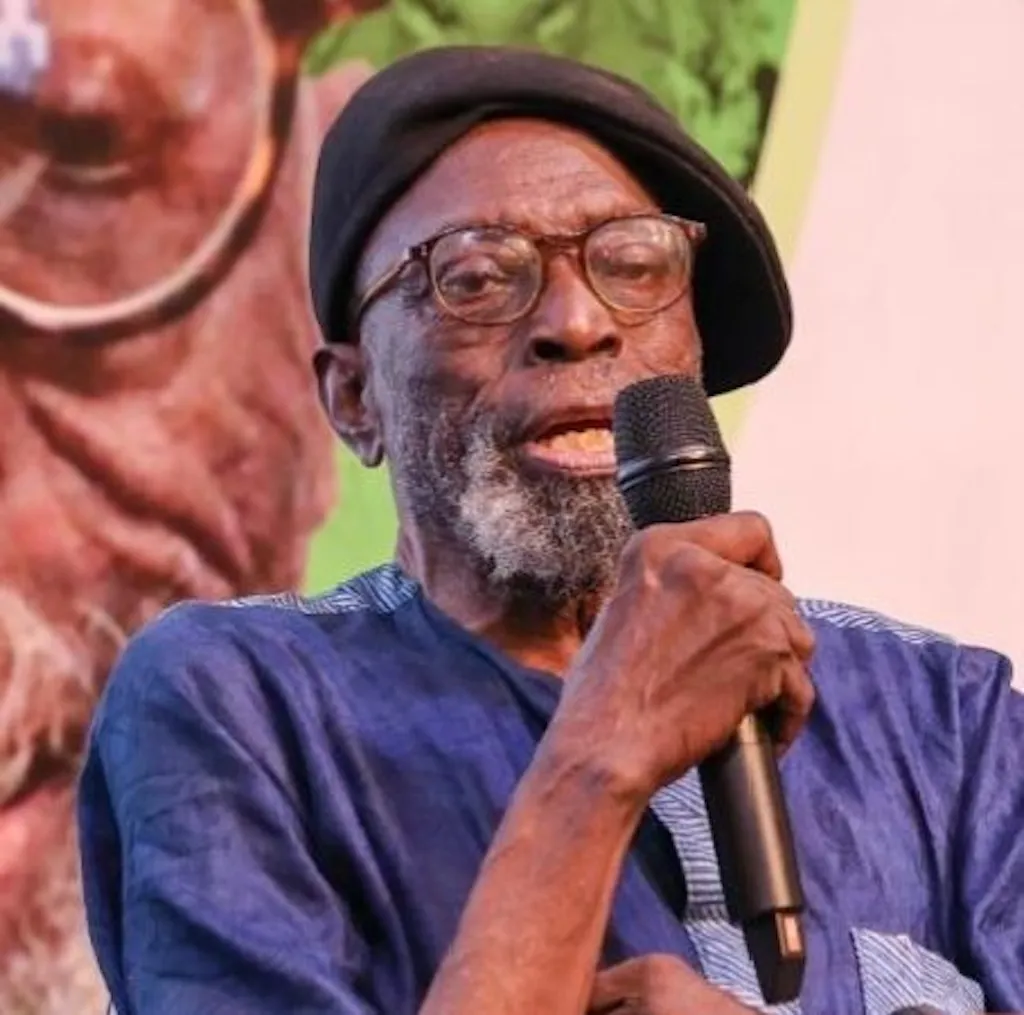
BJ: Painful Exit of a Revolutionary and Literary Iroko
By Lanre Arogundade
I pinched myself that I wasn’t at his 80th anniversary celebration at the Muson Centre, Lagos, on Monday, 5 January. The inability to intervene via Zoom during the tribute session was also painful, although I enjoyed the deserved accolades.
Now, with the news of the passing of the revolutionary and literary iroko simply called BJ, it suddenly looks like a missed opportunity to say farewell, even though no one could have imagined that death was around the corner. He was lively. He interjected even before being called upon to make a formal response as the celebrant. He laughed heartily. Perhaps, unknown to us, he was bidding the world bye-bye.
The good thing, however, is that I encountered BJ on a few occasions in the recent past, during which I reiterated my admiration for his steely character and revolutionary zeal.
One of the encounters was not that palatable but very revealing of his loyalty to revolutionary soulmates and friends. I speak of the burial of Professor Bene Madunagu, the renowned socialist fighter, feminist, and lifelong partner of Professor Eddie Madunagu, in Calabar last year. Despite his health challenges, BJ mustered the energy to be there for both the departed comrade and the chief mourner—Eddie. His tribute was penetrating and perceptive, touching on the personal, the political, the ideological, and the social. Vintage BJ, you might say.
To revisit the beginning: I was barely a year old on the campus of the University of Ife when BJ came into my worldview and that of my Great Ife generation. The journey to the early encounter was the bloody police attack on the funeral procession called by the students’ union to protest the suspected ritual killing of a student, Bukola Arogundade. But, following the police assault, four other students lay dead, with the Nigeria Police ingeniously claiming they were electrocuted. I was part of the protest and got my own dose of police brutality that dark day of 7 June 1981. It was a sad chapter that threw the campus into turmoil and rage.
BJ, as president of the Academic Staff Union of Universities (ASUU) and as a defender of the right to independent student unionism, was furious. Amidst contestation over what actually transpired on the fateful day, ASUU under him took the unprecedented step of constituting an administrative panel of inquiry headed by Chief Gani Fawehinmi, with columnist Labanji Bolaji as co-member. Grieving, restless, panting, BJ was ever-present during the panel’s sittings. As witness number 78, I can attest. The findings and recommendations of that panel occupy a significant place in legal jurisprudence and literature on students’ protests and the student movement of the 1980s.
Later, joining the student socialist movement via the platform of the Alliance of Progressive Students (ALPS) meant that I would know BJ more, especially as one of the prominent members of the Ife socialist-Marxist collective, comprising the likes of Segun Osoba, Toye Olorode, GG Darah, Dipo (Jingo) Fashina, etc.
Listening to BJ’s intellectually informed, fiery polemics at the numerous campus lectures and symposiums of those days was equally delightful. He brought more excitement when he wrote and “directed” a convocation play simply titled Haba Director.
“Director, haba director, haba director, this is too much oooo,” was the theme song and intermittent chorus of the dramatic satire on the excesses of the political and economic elite, symbolised by the Director, whose inhuman, anti–working-class and anti-people irrational behaviour ultimately provoked a revolt. It was a conclusion that served as a warning to the campus and the country’s ruling elites, some of whom were in the audience, even if it didn’t disguise BJ’s desire for popular or mass revolt. Vintage BJ, we might say again.
Streams of tributes have been flowing from students, friends, associates, comrades, and academics who crossed paths with BJ, revealing more about vintage moments with him. They point to the fact that, with his passing, Nigeria has lost one of its finest principled fighters for the liberation of Nigeria from the shackles of imperialist and neo-colonial domination and exploitation.
Thank you, Professor Biodun Jeyifo. We shall miss your intellectual perspectives on the emancipation of the “talakawa.” We shall also miss your humour, laughter, and informed polemics.
*Lanre Arogundade, a member of the editorial board of Premium Times, is the executive director of International Press Centre and former president of the National Association of Nigerian Students.
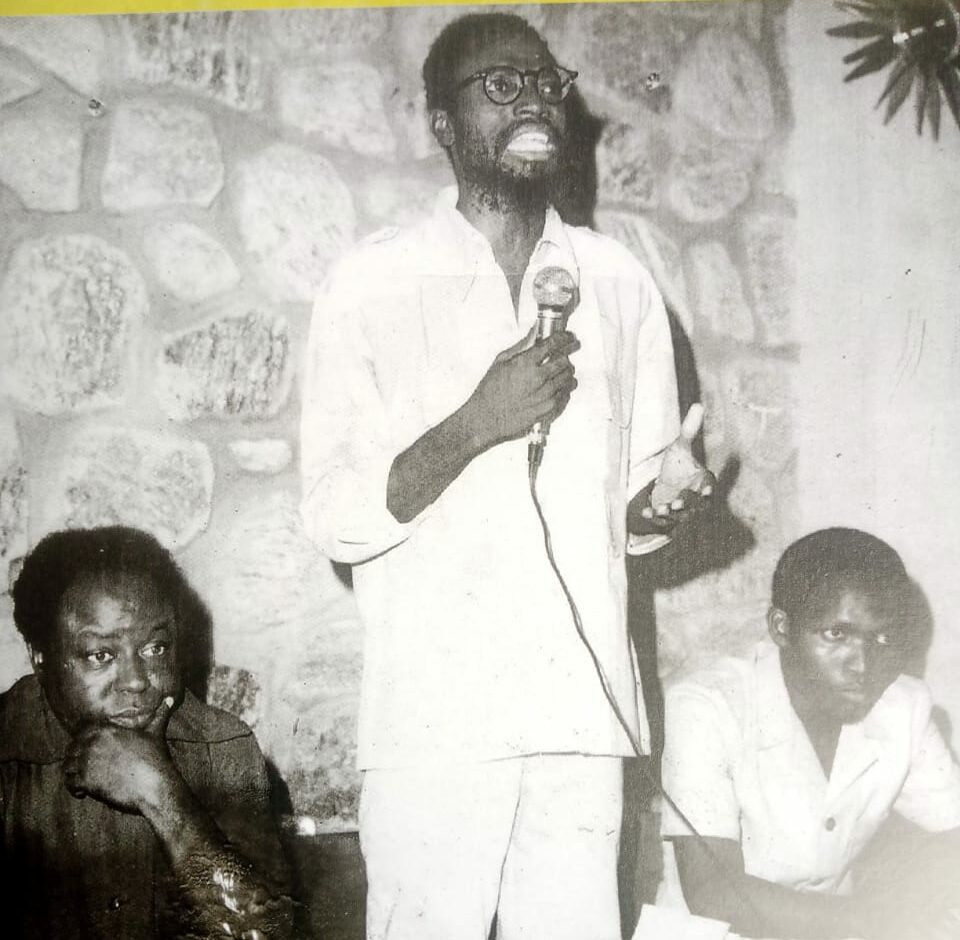
Biodun Jeyifo: The intellectual as a revolutionary
By Owei Lakemfa
The inaugural lecture of Professor Wole Soyinka in the 1980/81 period at the then University of Ife, now Obafemi Awolowo University, was expectedly explosive. Its title, “The Critic and Society: Barthes, Leftocracy and Other Mythologies”, left no one in doubt that this was an ideological offensive.
It was the famous writer’s nuclear-powered intellectual attack of Leftists who had asserted themselves as a dominant force in the academic and students’ circles on campus.
Although the missiles were targeted at the Left community led by respected historian, Dr Segun Osoba, some were also fired at academics who seemed to have one leg in the Leftist camp, and the other outside.
A students’ journal, in reporting the lecture and the fireworks, had a section on lecturers sitting on the fence. It was a poetic reporting style that ran like: “TP, TP. Take Position, Take Position. Leftocracy or Rightocracy. TP, TP. Take Position, Take Position.” This was directed at an identified lecturer.
Later, Akin Akingbulu, the editor of “Voice,” another student journal, interviewed this lecturer and asked him his reaction to the report. He replied that it was written by one of his students and he was handling the issue. The editor pressed further and the lecturer said the offending piece was written by Owei Lakemfa. Akingbulu immediately sought me out in the hostel and told me that I was in big trouble. He knew that I did not write the report, as he knew who did, but could not tell the angry lecturer.
I went to Gordini G Darah, a lecturer in the Literature Department, to narrate the story and ask him for advice on how I could be saved. I didn’t mind facing the consequences of my actions, but I did not want to be held liable for what I knew nothing about; I was just a victim of my notoriety on campus. Darah told me the person who could save me was Dr Biodun Jeyifo. BJ, as he was popularly called, was an intensely intellectual person who was known not to back away from any necessary fight, whether in academics or politics. Although a mentee of Soyinka from his University of Ibadan (UI) undergraduate days, he was regarded as the fiercest critic of Soyinka’s works. BJ had also become the National President of the Academic Staff Union of Universities (ASUU). He had transformed ASUU from its moribund origins as the Nigerian Association of University Teachers (NAUT) to a fighting union shaking the foundations of the country’s universities and putting the Shehu Shagari administration on its toes on matters affecting academics.
The no-nonsense but charismatic BJ was loved by students, and any gathering he was featured to address was bound to be full. I narrated my story to him and he asked if I was sure. I answered in the affirmative. He stood up and asked me to come along. He drove me to my lecturer’s office. BJ, without knocking, barged into the office. The startled lecturer stirred and asked what the mattered was. BJ replied: “I hear you want to victimise Owei. In this campus?” The rattled lecturer turned to me: “Owei, is it true?” I stammered, said ‘not really’ and narrated what transpired between him and Akingbulu. The lecturer replied that it was nothing: “I thought you wrote the report, but when I reread it I concluded you were too intelligent to have written it.” I thanked him, genuflected to BJ, and melted away. Case closed.
There were inter-communal clashes in Ife, the university’s host community in April 1981, in which a number of lives were lost. It was under this circumstances that a headless body was found on 1 June, 1981 in the town. Three days later, the victim was positively identified as Bukola Arogundade, an undergraduate of the university. On 7 June, 1981 enraged students organised a protest march on Ife town. The police attacked the students, mainly with teargas, leading to the death of four students: Mr Paul Longe, 40; Miss Wemimo Akinbolu, 23; Miss Fatimo Adebimpe, 22; and Miss Dorcas Ojewole, 19. Two other students from other schools, who happened to be travelling on the Ife road that day, were chased by the police and they died in a resultant car crash.
The students were livid and decided on revenge. Some began to form groups to abduct policemen. The university authorities had lost control and even if it ordered a closure, it was likely to be in vain, as the students had decided that the university must be kept open. The government, of course, could not control the situation, and the Students Union leadership under Femi Kuku had also lost control, and had been shoved aside by students. Some former students union leaders like one-time President, Wole Olaoye; ex-Public Relations Officer, Femi Falana; and former Secretary General, Greg Obong-Oshotse, tried to reassert control over the students. That was when ASUU, under BJ, stepped in. It had the courage to call a rally of the students and managed to control the overflowing crowd. It promised to bring all those responsible for the deaths to justice, ensure decent burials for the victims, defend student interests, and establish an independent inquiry. ASUU said that all it was asking for was for students to agree that the university should be shutdown. Like magic, we agreed and moved peacefully out of the campus. Such was the influence of the local and national ASUU and BJ.
When I arrived in Ife as an undergraduate, one of the first names I learnt about was BJ. You can imagine my shock when a few months later, a man called Tony Engurube, who was visiting Ijaw students, asked that I accompany him to see an old friend called BJ. I asked if it was the same person, and he affirmed it. We went to BJ’s house on campus, and soon both men were locked in embrace. It turned out that they had been members of an underground revolutionary group, which some years earlier had been wedded to carrying out a revolution in the country. In later years, I came to know some of these dedicated men and women who wanted to create a human-centred, rather than profit-motivated society. These included the couples, Sehinde and Dunni Arigbede, and Eddy and Bene Madunagu.
So, BJ was not just a lecturer, literary critic, author, actor and playwright who made giant strides across universities like Ibadan and Ife in Africa, Oberline, Cornell and Harvard in the United States and executed projects at the Free University, Berlin and Peking University, PKU. He was also a practical revolutionary.
His revolutionary praxis had led him over decades to maintain columns in newspapers under the pseudonym: Bamako Jaji. On 11 February, BJ at 80, transited into an Orisha, an African god.
Owei Lakemfa, a former secretary general of African workers, is a human rights activist, journalist and author.
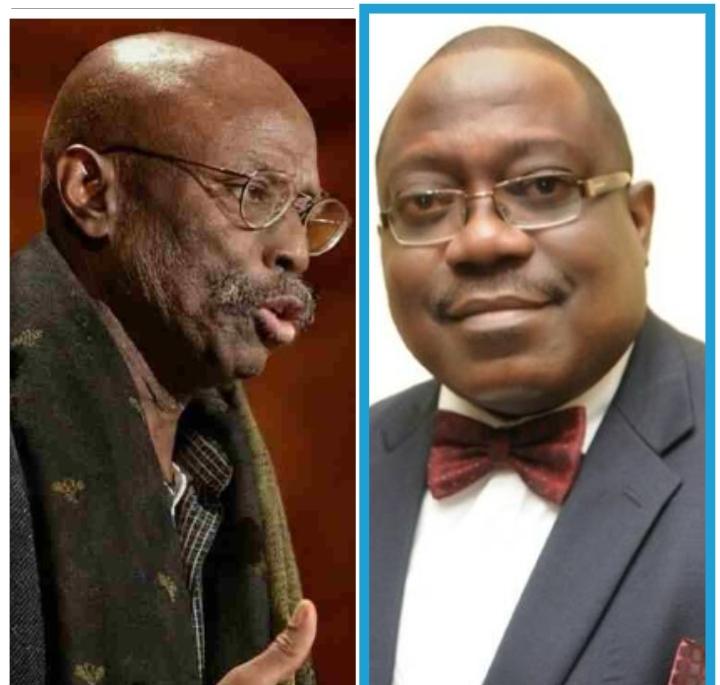
What Is Left When the Left Has Left Us
By Tunji Olaopa
The past few weeks have been dedicated to news of the demise of elder intellectual and scholar, the late Professor Biodun Jeyifo, and to the celebration of his towering legacies in scholarship and activism. BJ, as he was fondly called, is one of the few intellectuals whose scholarship comes attached with an imperative of active participation in the critique of government, in ways that connect the benefits of scholarship to the dividends of governance. BJ was a Marxist, and a very dedicated one to the end. That makes him a formidable member of a progressive left that is no longer so formidable. Hence the title of this piece.
I know BJ only by his significant reputation as a Marxist scholar and an activist. The spate of discussions and discourses that attended his passing attests to his colossal stature as someone who understood the enduring significance of Marxism as a theoretical means of social analysis and transformation. That is one lesson I took away from my political theory classes as a graduate student of political science. And so, with the legacy of Biodun Jeyifo, we are able to deploy the fundamental importance of radical scholarship in understanding Nigeria’s postcolonial predicament. With the late Biodun Jeyifo, we can connect the subtext of radical analytical criticism that Marxism provides with the malaise of postcolonial underdevelopment in Nigeria, and the role that Nigeria’s higher education sector ought to play within the framework of ASUU activism, of which BJ was a founding part.
Firmly grounded in performance studies, literary criticism, and cultural studies, BJ had a firm grasp of material realities in postcolonial contexts, enabling him to ignite political activism. That radical scholarship and political engagement, nurtured within the walls of a postcolonial university in Nigeria, became a lifelong passion and pursuit. From a critical engagement with Chinua Achebe’s Things Fall Apart and Wole Soyinka’s The Man Died to Ngũgĩ wa Thiong’o’s work on language, BJ began blazing scholarly paths with profound implications for how we understand the dynamics of human society. BJ was more than a teacher who basked in abstraction; on the contrary, his understanding of political economy and Marxism gave him a solid basis for analysing socio-historical and material realities.
The university was the hotbed of radical and revolutionary activities that gave birth to the Nigerian left—the group of Marxist scholars, teachers, and intellectuals, from Edwin Madunagu, Eskor Toyo, Bala Usman, Bala Takaya, and G. G. Darah to Claude Ake, Bade Onimode, Akin Oyebode, and BJ himself. The university was then a critical starting point for the formation and maturation of many Nigerian Marxists. It was also where the Academic Staff Union of Universities (ASUU) received its first ideological inspiration from BJ as its first president. ASUU thus took on a new lease of life as an association concerned not only with earning a living wage for its members but also with advancing the cause of higher education and transforming the ivory tower into a site for radical thought. The universities became watering holes for the emergence of Marxist and socialist traditions in Nigeria, and for the coalition of progressive forces—the Nigerian left—made possible by the dismal condition of postcolonial Nigeria itself: the stark divide between rich and poor, widening income and gender gaps, deepening mass impoverishment, weak governance dynamics, and dismal unemployment statistics.
All of these, along with the growing literature on Nigerian Marxism—from Bala Usman to Claude Ake—as well as socialist activism enabled by the Nigerian Labour Congress and Marxist analyses of strike actions in Nigeria, constituted the academic grist for our vigorous analyses in political theory classes at the University of Ibadan. The complex analyses of Nigeria’s political economy, under the grip of capitalist modernity, became our intellectual compass for understanding where Nigeria stands in terms of governance and development. We were able to channel our academic understanding into the lived realities of labour and academic industrial actions by the NLC and ASUU.
However, following the collapse of the former USSR, and what Francis Fukuyama described as the ideological victory of neoliberalism in The End of History, Marxism seems to have retreated from the intellectual space of global ideological contestation. This retreat has been facilitated not only by internal rivalries among various tendencies and schools of thought—Trotskyites, Jacobins, Stalinists, Maoists, Leninists, Bolsheviks, and Western Marxists—but also by evolving iterations now regarded as neo-Marxism. The increasing dominance of neoliberal capitalism on a global scale, reinforced by Bretton Woods institutions (the World Bank and the IMF) and the ideological pull of the Washington Consensus, appears to have driven the final nails into the coffin of Marxism. Yet Nigeria’s postcolonial condition simultaneously implicates neoliberalism and underscores the need for a Marxian resurgence in social analysis.
The passing of the titan BJ reinforces pessimism about the continuing decimation of the Nigerian left and the unfinished—and perhaps unfinishable—task of making Nigeria work. This is not mere lamentation. Biodun Jeyifo was an unrepentant and incorrigible Marxist. The fortunes or misfortunes of Marxism globally, or its internal rivalries, could not diminish his intellectual ardour. In “Who Is Afraid of Biodun Jeyifo’s Marxism?”—an essay he wrote to explain his steadfast attachment to Marxism—BJ outlines his understanding of Marxism as a critical stance that enabled him to pursue redistributive justice in a world undermined by capitalism and its economic and political dynamics. Yet BJ was no orthodox Marxist trapped in doctrinaire rigidity. His intellectual honesty and flexibility are evident in his engagement with Wole Soyinka’s work—from his initial critique of Soyinka’s “bourgeois aesthetics” to his later acknowledgement of its complexity. In this, BJ leaves us with the humane sensibility of a true humanist.
Biodun Jeyifo has died; the world is on fire; Nigeria is still burning. And the Nigerian left is being decimated—by death, calculated silence, or pragmatic withdrawal. While global critiques of neoliberal capitalism continue to flourish through thinkers like Joseph Stiglitz, Jeffrey Sachs, Thomas Piketty, Amartya Sen, Muhammad Yunus, Abhijit Banerjee, Esther Duflo, Paul Collier, Daron Acemoglu, James Robinson, Hernando de Soto, Ha-Joon Chang, and others, there are no longer sufficiently formidable and courageous Marxist intellectuals actively advancing bold analyses of how global capitalism shapes Nigerian society and how its crises might be resolved. Nigerian society does not need closet Marxists. Nigerian Marxism—and the Nigerian left—must consistently confront the cunning Nigerian state and its co-optation tactics. The indefatigable Edwin Madunagu was co-opted by the Babangida administration. The Nigerian Labour Congress—from Hassan Sunmonu to Adams Oshiomhole—has since declined under the weight of political corruption and realpolitik. And ASUU has been compromised by a repetitive strike logic drained of intellectual dynamism and vision.
This is where the persona of Biodun Jeyifo—as Marxist thinker and activist—leaves us with a framework for reconstructing the Nigerian left. BJ’s legacy rests on the coherent interplay of ideas and action. Ideas alone cannot win the fight against injustice and inequality. The Nigerian state is too strategic in its use of violence and co-optation. In Marxist analysis, ideas and action are inseparable in engaging material realities. Intellectual analysis and political engagement reinforce each other. Indeed, ASUU should commission a study of BJ’s leadership (1980–1982), examining his ideological consistency, administrative strategies, and intellectual framework. For BJ, Marxism was a theoretical framework for articulating human freedom. Intellectual freedom plays a fundamental role in achieving social transformation. This is where BJ’s academic activism becomes significant, and where Nigeria’s higher education system emerges as a legitimate arena for ideological contestation. Academic freedom, therefore, is not merely about improving lecturers’ welfare; it is about opening up the university as a space for reimagining the Nigerian state and society.
Biodun Jeyifo—husband, father, consummate teacher, mentor, unrepentant revolutionary, and consistent Marxist—remains, even in death, an exemplar. He embodies what can be right with Nigeria’s intellectual space: a sustained flow of radical and humane ideas, transmitted through flexible pedagogical practices into the minds of generations of Nigerians. The epitaph on his grave should become a ringing call—an epigraph—to rouse the comatose Nigerian left to deeds yet unimagined in defence of our collective patrimony.
* Prof. Tunji Olaopa, Chairman, Federal Civil Service Commission & Professor of Public Administration, Abuja
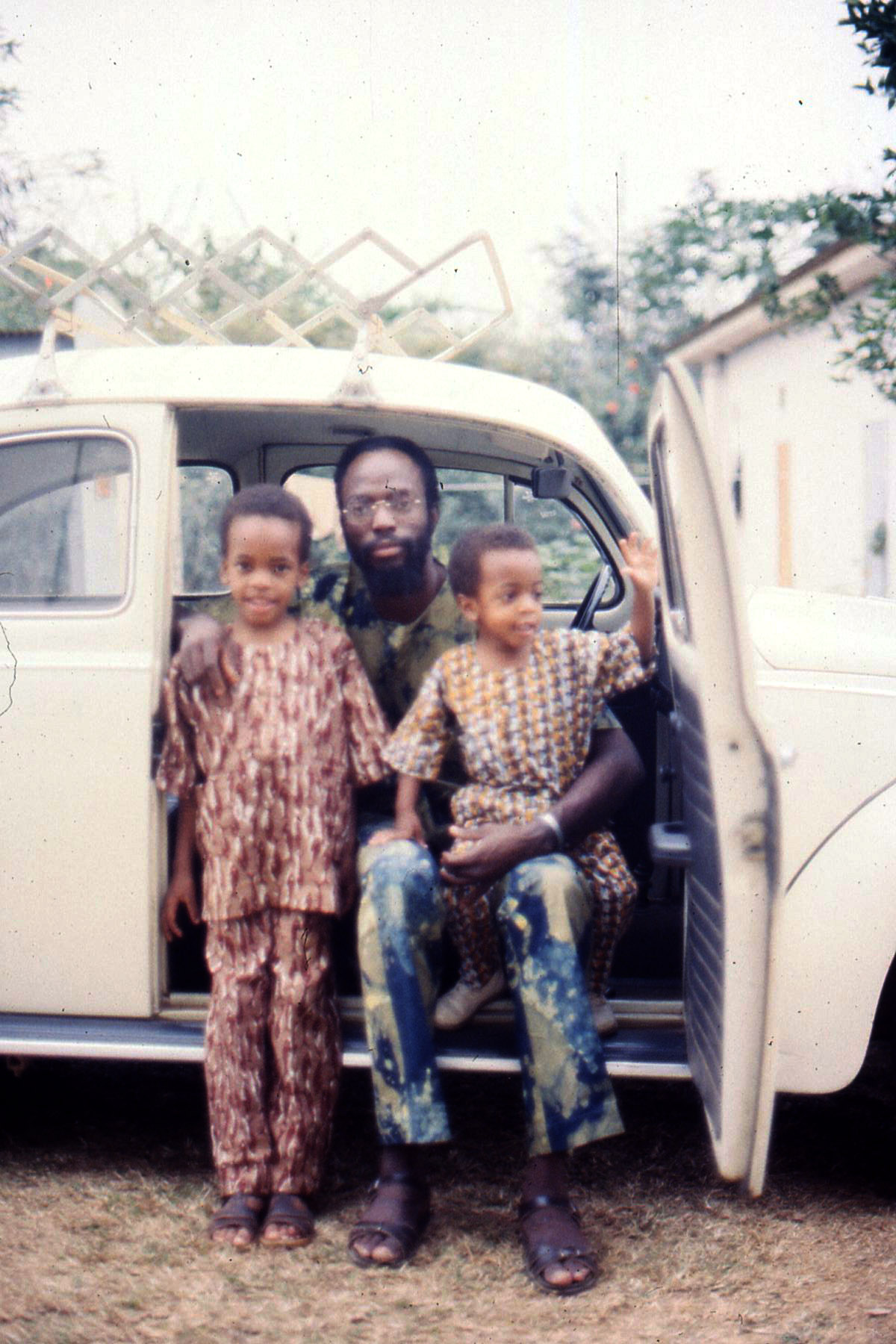
Biodun Jeyifo: The Giant Who Shaped How We Understand African Literature
By Toyin Falola
I read the news early in the morning of 11 February. The activist for African intellectual freedom, Biodun Jeyifo, had passed away at the age of 80. I had just seen him one month earlier in photographs from his 80th birthday celebration symposium held at the MUSON Centre in Lagos. BJ looked frail but was as mentally acute as ever. He was still being himself—asking hard questions and making us uncomfortable about accepting our past accomplishments.
He belonged to the generation of Nigerian intellectuals who matured in the 1970s, that magical period when anything seemed possible. We were only recently independent. The Civil War was over, and Nigerian unity was taken for granted. We were awash with oil money, funding our dreams and believing that scholarship could truly change Africa and elevate the Black race.
Jeyifo would follow a slightly different scholarly path: he became a literary critic and theorist. However, he shared the conviction that scholarship must serve the people rather than function as a vehicle to further individual careers. Over the decades, he attended conferences in Ibadan, Accra, New York, and London, asking uncomfortable questions when others preferred easy celebrations of incipient “African achievement.” His death seems like the end of an era when Nigerian intellectuals believed that ideas could change our world and were willing to sacrifice to prove it.
BJ was born on 5 January 1946 in Ibadan, the city that shaped many of his generation’s greatest minds. It was, and arguably remains, West Africa’s intellectual hub, hosting its first modern university and a robust cultural environment. The Ibadan of those years was a receptacle of British colonial education, fused with emerging Pan-African idealism to create something entirely new. BJ revelled in all of this, graduating with First Class honours in English in 1970—only the third student in UI’s history to do so at the time. This was unsurprising to many who knew him then; his intellectual ferocity had manifested at a young age.
What was unexpected, however, was the unusual path he chose. Defying the migration pattern of many intellectually gifted Nigerians who studied abroad and never returned, BJ remained in Nigeria to complete his Master’s degree at Ibadan. Immersion in Nigerian intellectual life first helped shape his ideas before he left for New York to pursue a PhD. He studied under noted performance studies scholar Richard Schechner, which may have informed his view of literature as an active process through which we create and perceive meaning.
His time in America never fully disconnected him from Nigeria. He once stated that no matter “how complex my theoretical armature grew, it would grow out of storytelling strategies and knowledge systems I absorbed at home.”
What many younger scholars do not realise is that before BJ became internationally renowned for his literary criticism, he was a revolutionary. He lived in a commune in the late 1970s and put his socialist principles into practice. When the commune dissolved, some mocked him, but many admired his willingness to test his theories in practice rather than merely talk about revolution from the ivory tower.
In 1980, at just 34 years old, BJ became the first national president of ASUU (Academic Staff Union of Universities). We watched him transform a loose collection of frustrated academics into a coordinated force capable of challenging gun-toting military regimes with their voices and pens. Those were dangerous years, when military administrations saw universities as opposition to be crushed in their bid to stifle independent thinking.
It was into this situation that the young, seemingly feather-light BJ stepped, unfazed. I remember him travelling across Nigeria, organising, strategising, and building solidarity, while somehow maintaining his teaching position at Ife. His biographer noted that “we never lost a single contention with the Federal Government, never,” because BJ and his team were “so well prepared” that “we baffled them.”
Rather than through violence, they prevailed through superior argumentation—using data, logic, and moral authority. Femi Falana would later say that “without doubt, we owe the vibrancy of the intellectual struggle of ASUU to Professor Jeyifo and his colleagues.” The vibrancy and fighting spirit he pioneered continue today, some forty years later. What impressed me most was that, at such a young age, BJ risked his future career for the genuine belief that universities must serve the public good rather than elite interests.
In 1987, something happened that many found unbelievable: when Ife refused to grant BJ unpaid leave to write a book, he simply resigned from his tenured position. The prevailing reaction among colleagues was, “Is he crazy? Throwing away that security?” But that was BJ—he valued intellectual freedom above material comfort or assured career advancement. For him, it was principle over position.
He moved to America, teaching for a year at Oberlin, then seventeen years at Cornell, before finally settling at Harvard—one of the world’s most elite institutions. At Harvard, he became Professor of African and African American Studies and Comparative Literature, bringing African perspectives into an institution that had long pioneered Western frameworks.
At Harvard, he promoted the study of African literature with the same rigour as Western literary traditions while retaining the essence of African philosophical frameworks. Some of his students from Cornell and Harvard are now distinguished professors who fondly remember him as exceptionally demanding—teaching them not only how to read literature but how to think.
Students gave him a nickname: “Professor O le gan ni o” (he’s tough beyond measure). It was said with affection, because they knew he pushed them out of respect and belief in their potential. In 2019, he received Harvard University’s W.E.B. Du Bois Medal, one of the highest honours in African and African American Studies, awarded for his lifelong contributions to expanding global perspectives.
His Marxism was infused with humanism, tempered by a recognition of culture’s autonomy and a deep attention to what makes us human beyond political economy. In his essay, “Who’s Afraid of Biodun Jeyifo’s Marxism?”, he wrote that his “absolute insistence now is that I be taken, I be judged on how consistent I am with my passion for redistributive justice in our country and our world.”
Scholars have compared him to leading postcolonial theorists: “No other scholar, apart from Edward Said, Gayatri Spivak, and Homi Bhabha, is more attentive to the radically dispersed strands of postcolonial thinking than BJ.”
Yet, unlike many theorists lost in abstraction, BJ always wrote clearly. He insisted that theory should illuminate reality, not obscure it. He wrote about Yoruba travelling theatre, popular culture, and performance, demonstrating that his Marxism was rooted in lived African cultural expression rather than imported political dogma.
Behind his fierce intellectual reputation was a gentle, generous man with a sharp sense of humour. He demanded excellence ruthlessly but invested deeply in helping others achieve it. His biographer described his life as “Spartan”—simple, disciplined, and devoted to scholarship and social justice, without any pursuit of wealth or personal enrichment.
He fathered three children—Okunola (a neuroscientist), Olalekan (an architect and muralist), and Ruth (an activist)—each successful in their own fields. Their diverse paths reflect BJ’s belief in individual freedom within a shared commitment to justice and service.
On his passing, many have described his death as “the end of an era in Nigerian and African literary scholarship,” noting that he belonged to a generation that believed literature was not merely aesthetic but a vital tool for understanding and transforming society.
For years to come, BJ will remain a benchmark for incisive thinking, intellectual honesty, and politically engaged scholarship. ASUU, the union he helped build, will continue to hold the Nigerian state accountable. Every successful struggle will stand as a tribute to his legacy.
A member of the Nigerian Academy of Letters described his work as “foundational and transformative, a bridge between generations of scholars.”
In writing this tribute, I know BJ would resist sentimentalisation or uncritical praise. He would want us to continue the struggle.
We will miss engaging him—arguing, learning, and reflecting with him on the slow pace of progress, and occasionally celebrating victories. We will miss his blistering honesty, his intolerance of laziness, and his insistence that whatever we do, we must do it well.
Rest well, activist in the struggle. The fight continues, and many will carry your legacy forward.
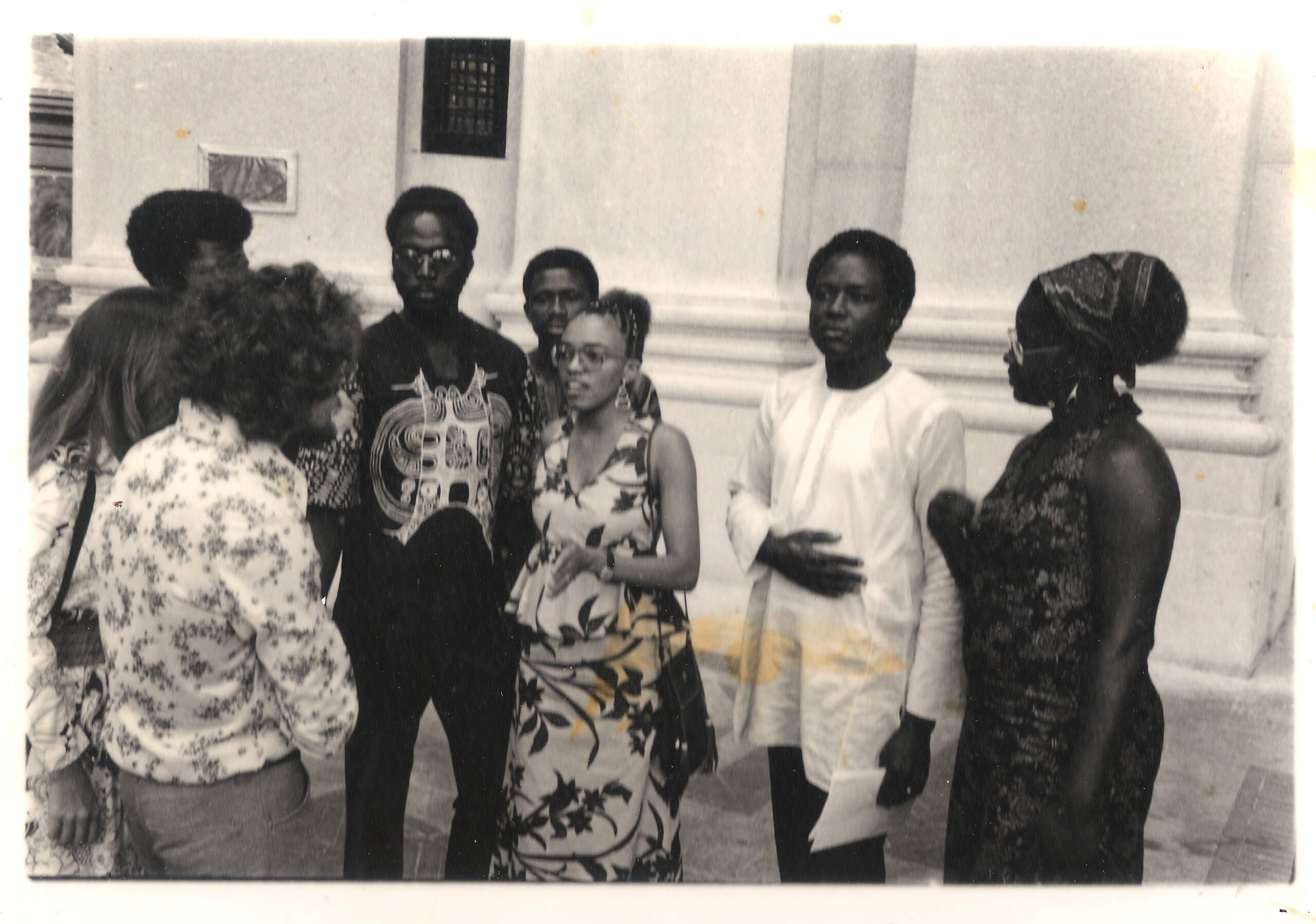
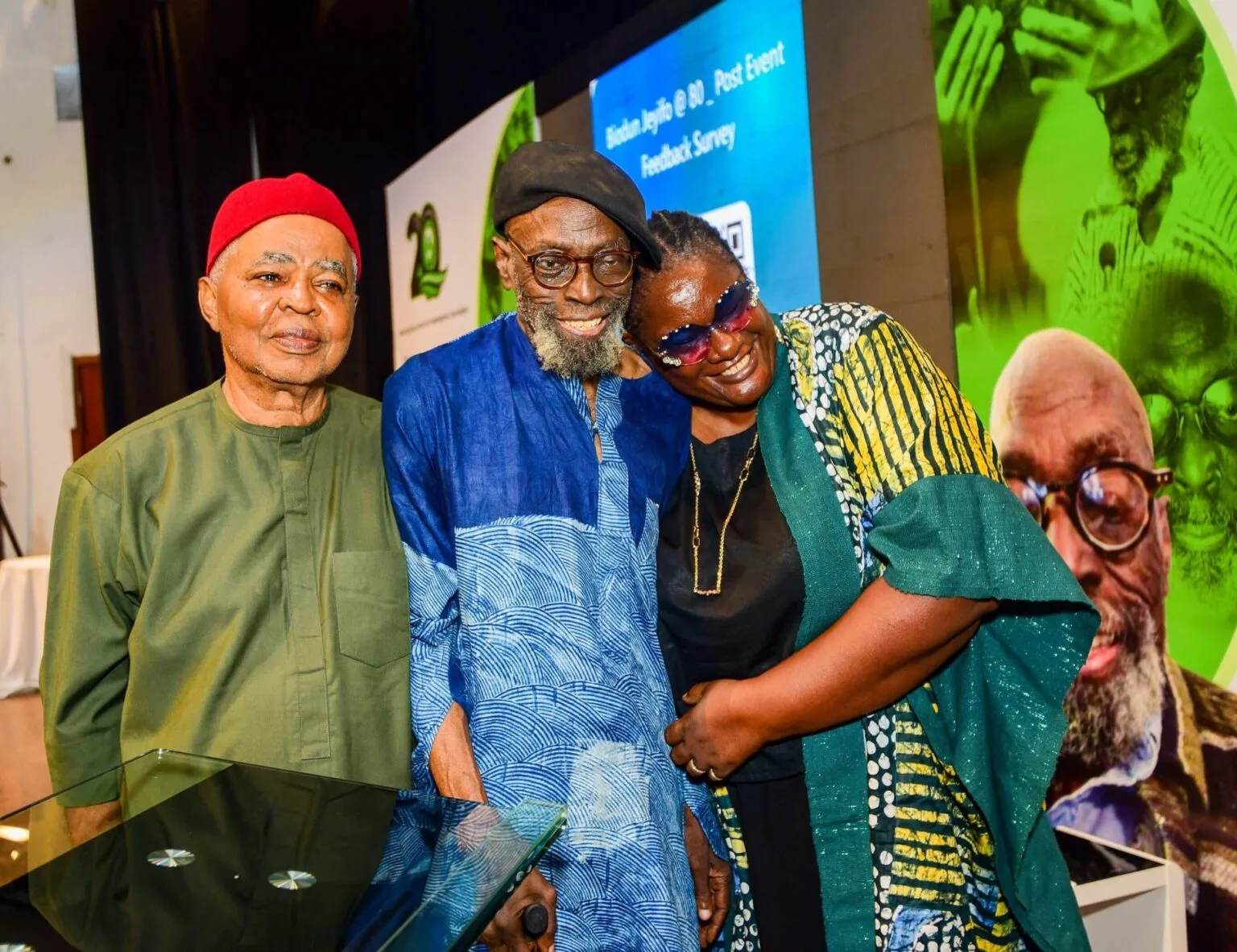
Biodun Jeyifo and Pedagogy for Liberation
By Bisi Anyadike
As I reflect on my journey, I am reminded of the transformative power of education and the impact one person can have in shaping our perspectives. Professor Biodun Jeyifo, my teacher and a beacon of intellectual curiosity and decolonization, has been that guiding light for many of us.
His unwavering commitment to challenging colonial narratives and promoting African cultural heritage has inspired generations of scholars, activists, thinkers, and teachers alike.
As we celebrate his 80th birthday, I am honoured to share my personal journey of growth and self-discovery, influenced by his teachings and philosophy.
Arriving in Ife at 18 from a deeply colonial background and an even more pseudo-colonial upbringing—and also as a 13-year-old returnee after four years abroad, a typical ‘been-to born’—I was pretty much doomed to a colonized existence as a Nigerian.
After a very brief stint at Adventist Grammar School, Ede, I moved to Federal Government Girls’ College, Calabar, where whatever colonial bits and pieces had been dented at AGS Ede were quickly panel-beaten back into place. Scottish principal, Irish vice-principal; no vernacular—so I no longer had to struggle with the harrowing pronunciations of Ojo-man, Ojo-day, Ojo-rain, or any other Nigerian language for that matter.
Literature was much more familiar to me: Greek Men and Gods, Brontë’s Wuthering Heights, and all the odes to ancient mariners. Yes, I was at home and comfortable, and my horrible London accent—expressing impeccable ‘Queen’s English’—was acceptable and respected, especially by my peers, rather than being rendered the laughingstock of the school, as it was back in Ede.
That was the young girl who came into Ife to study English Education in 1980. The trajectory would probably have followed its destined path had it not been for the Literature Department. (My learning in the Faculty of Education remained largely colonized, except in dear Helen Watson’s classes.) I would have ended up jumping on the next plane back to Her Majesty the Queen’s sovereignty upon graduation, but something was ignited by a great team of lecturers in Literature. They were not the majority in number, but their powerful and positive impact far outweighed that of many others combined.
Those who know me well know that two lecturers of that era stand out very significantly in my life, in similar yet different ways. Today, however, we are celebrating Prof. Biodun Jeyifo—Uncle BJ—so this is about him. I will share more about the other when he, too, clocks 80 in a few years’ time.
Prof. Biodun Jeyifo, like all our favourite lecturers, was the kind who held you spellbound from the very first class. He would walk in, scraggy in his brown needle-cord trousers, a barely buttoned-up shirt, and a vintage Ivy cap—yet, nonetheless, attractive in all his scragginess! But it was when he began his lectures that we truly became spellbound.
His classes were always dynamic, captivating, and deeply thought-provoking discussions. He never dictated notes. The only things he ever paused for us to write were a quote or a reference he suggested we check. Through lively and often heated debates—ranging from the books we read to current issues of the time and even glimpses into the future—I found that I had unwittingly begun to shed what I later recognized as the subtle remnants of my personal colonization, which I had once ignorantly taken pride in.
Through Prof. Jeyifo’s classes, it became clear to me—and then possible for me—to acknowledge how colonialism had shaped our societies, cultures, and minds, and to begin actively working towards undoing its impact. Interestingly, I do not recall him ever explicitly instructing me to take such steps. But I do remember the books I read, which led me as though I had a noose around my neck—or perhaps the other way round: the noose around my neck was being loosened.
I cannot now recollect whether I worked my way into his tutorial groups or was placed there by fortune. But it was in those one-hour sessions, twice a week—with classmates such as Femi Ojudu, Femi and Laolu Macaulay, Sam Omatseye, Nola Karunwi, Bola Anjorin, and Biola Agbebi, to mention a few—that a complete pro-Nigerian, pro-African renaissance took place within me.
During my second and third years, I found myself challenging both my own and imposed Western-centric views in history, education, and culture, reclaiming an identity I had failed to accept as mine. I also began making a concerted effort to revitalize my language (deeply regretting my “Ojo” lapses), embrace valuable Nigerian traditions, and appreciate our rich knowledge systems, which I learned had so much to offer.
In addition, his union activities outside the classroom were second to none in instilling the strength and courage in young undergraduates to question power imbalances and confront economic, political, and social inequalities subtly perpetuated by colonialism.
A major turning point for me was reading widely—very widely—on Prof. Jeyifo’s recommendations. He had us reading everything in print about Africa, by Africans, and on Africa. Two works, among many others, deeply moved me. One was Lewis Nkosi’s Tasks and Masks. Not as heavy as many of the others, but for me, it foregrounded the struggle to define ourselves amidst colonial influences and our rich traditional heritage—the challenge of navigating multiple identities, the “masks” we all wear to fit societal expectations. I did not put it down until I finished it. It brought home to me the role of art and literature in expressing our true identity and the importance of challenging colonial narratives.
The other was Fágúnwà’s A Forest of a Thousand Demons, which we discussed, debated, and grew quite animated about during tutorials. At first, many of us dismissed it as a simple folktale. Prof. Jeyifo nearly lost his patience. He painstakingly guided us to the realization that Fágúnwà had masterfully subverted colonial stereotypes, showcasing the richness and complexity of our culture and defying the simplistic portrayals we had grown up accepting.
If we were not in Auditorium 2 attending lectures, or in his office in Humanities Block 1 engaging in heated tutorials, or at the Sports Centre preparing for yet another protest, we were in the Pit Theatre or Oduduwa Hall, immersed in his passion for theatre. Once, he even held a special three-hour session where we learned by heart Wole Soyinka’s “Etika Revolution.” That day, I believe, my love for Nigeria soared, and I vowed to live and die here, no matter what.
As a teacher, Prof. Jeyifo did so much to steer us towards becoming truly decolonized beings. It was not an easy task, nor did it carry the whole class along. Even for those of us it did, the process was far from smooth.
I recall, in my fourth year, being invited to his home along with some of his students and colleagues. It was my first time there, and we were fascinated by his collection of African art—carvings and masks. I made the grave mistake of asking why African carvings were always so “ugly” compared to European statues and busts. This time, he did go berserk—but quickly calmed down and explained my folly in such detail that I have never seen an ugly piece of African art since.
I have often read criticisms that Prof. Jeyifo failed to deliver the revolution he promised. Personally, I see that he and his ideological comrades advocated for a more subtle yet profound revolution—one targeting the mindsets and perspectives of individuals rather than violently overthrowing power structures.
As Bob Marley sang, “Emancipate yourselves from mental slavery; none but ourselves can free our minds.” This is echoed in Fela’s songs such as “Suffering and Smiling,” “Zombie,” and “Beast of No Nation.” True revolution begins with a shift in consciousness. Education and personal transformation are powerful catalysts for change.
By influencing the thoughts, attitudes, and values of students like me, Prof. Jeyifo was quietly shaping a new generation of leaders and thinkers who would challenge and transform the status quo in their own ways. This is particularly evident among those who went into journalism, writing, academia, law, and politics. But many of us teachers continue the revolution quietly as well.
His approach has had a ripple effect far beyond his immediate circle. This kind of silent revolution is incredibly effective because it allows individuals to develop their own agency and autonomy rather than conforming to imposed ideologies.
Today, I have been a teacher for forty years. I proudly teach young children in primary school, and I am even more proud to say that being Prof. Jeyifo’s student shaped my approach to educating young Nigerians—an approach less taken, but one I believe should be the norm.
It is not an easy path. It is often misunderstood and resisted, showing how far we still have to go in achieving true decolonization.
Undeterred, my curriculum emphasizes mother-tongue learning, incorporates local histories and perspectives, and includes non-Western thinkers. Children are encouraged to think critically about colonial legacies, including learning about the darker histories of the Western world.
One of our most powerful tools is literature. Chinua Achebe’s Things Fall Apart and Wole Soyinka’s abridged Aké are at the top of the reading list for our 9–10-year-olds. We introduce them early to role models, past and present—including Prof. Jeyifo, whom they have encountered in various ways over the past thirty years.
We encourage them to use their voices. During the prolonged ASUU strike, my pupils took to the streets with placards, defending their future.
Convincing parents has not been easy, but we persist.
Each year, we host a Cultural Day festival celebrating traditions across Nigeria. One year, we showcased the Tiv Kwagh-hir of Benue State—a beautiful tradition of puppetry, dance, drama, and masquerade. The children were ecstatic. The parents, however, were outraged. An emergency PTA meeting was called, and I was asked to apologize. I did—but with a clause: no masquerades, no Father Christmas. In the end, Father Christmas stayed—and so did our Culture Day!
Prof. Jeyifo’s influence has had a lasting impact on my life, and it is important to me that I pay it forward. The success of his students across various fields is testament to his effectiveness as a mentor. His revolution is a slow-burning fire—quiet but profound.
I must end by highlighting perhaps the most personal impact of his teachings: the realization that “Prince Charming” is not necessarily the tall, dark, Western ideal—but a loving, caring African man. (Well, I concede the handsome bit… after all, decolonization is ongoing!)
This realization has shaped my life and given me the strength to become who I am today.
Evidently, I was a good student—even if I only managed a B grade in all Prof. Jeyifo’s courses. For all his generosity of spirit, he was famously stingy with grades!
As Prof. Biodun Jeyifo celebrates his 80th birthday, I wish him many more years filled with joy, love, and continued inspiration.
May his legacy continue to shape generations, and may his passion for decolonization and social justice remain a guiding light for us all.
Uncle BJ, today we honour you for the seeds you have sown—seeds that blossomed in your lifetime and will flourish for generations to come.
Happy 80th birthday, Uncle BJ! May your legacy continue to inspire and ignite minds for years to come.
-Anyadike is the Proprietor of, Sunshine Nursery and Primary School, Ile -Ife,
Osun State
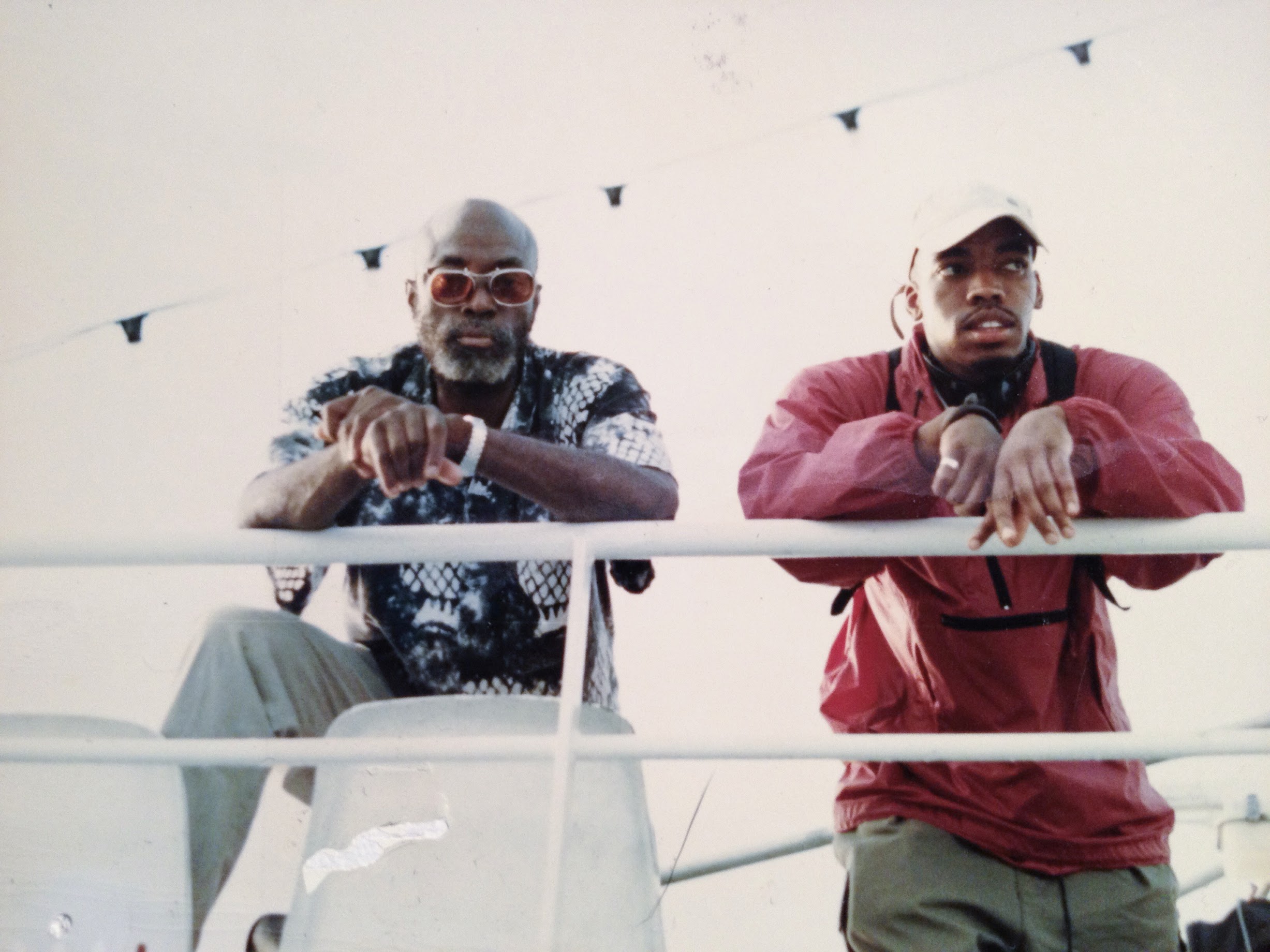
An Unforgettable Journey With Biodun Jeyifo
By Is’haq Modibbo Kawu
When the news broke of the passing of Biodun Jeyifo (BJ), one of the first persons I spoke with was Kayode Komolafe. I knew how close he was to BJ; we reminisced about the truly remarkable human being, revolutionary intellectual, and man of very deep sensibilities who had just passed at the age of 80. Indeed, BJ was one of the most outstanding members of the Nigerian revolutionary movement, who dedicated his life to the liberation of our country, while also becoming one of the greatest literary scholars of the contemporary world.
In 1980, I took time off from my work in broadcasting to study for a Diploma in Mass Communication at the University of Lagos. I became President of the Marxist League, and we took very seriously the task of organizational work among students in the very cosmopolitan setting of UNILAG. It was a challenging experience because of the strongly petty-bourgeois environment, with very few students drawn to radical ideas. The dominant trends were parties, social outings, and the attendant hustling, as well as an entrenched Christian religious current on campus.
That year, I attended the Ife Book Fair, which used to be one of the most celebrated annual cultural events in Nigeria. I now recall that each year, the defunct West Africa magazine devoted very extensive coverage to the Fair. Most people attending Obafemi Awolowo University in Ile-Ife today, or even younger members of faculty, can be forgiven for not knowing that their campus once hosted such an international gathering devoted to books. Publishers from all over the world used to converge at Ile-Ife, and we had the privilege of purchasing high-quality materials and the most recent publications.
As it turned out, a night of readings was staged as the finale of the Fair. BJ was to read passages from Wole Soyinka’s Jero Plays. However, that afternoon, he lost his voice, and as he agonized over what to do to regain it, I walked into his office.
BJ was delighted that, as a broadcaster, I might be able to prescribe something to help him recover his voice quickly for the reading scheduled in a couple of hours. I teased him to crack an egg and swallow the yolk and albumen raw. He objected, saying that he would vomit! I then urged him to maintain disciplined silence and avoid straining his voice further in the remaining hours before the performance.
By the time the event began, BJ had partially regained his voice—enough to present his reading for the night. That night of readings brought the Ife Book Fair for that year to a close. I was to return to Lagos the following day, and luckily for me, BJ was also going to Lagos. At the time, he was the National President of the Academic Staff Union of Universities (ASUU), and he offered me a ride.
The following morning, I met BJ in his office, and together we walked to where his very famous white Volkswagen Beetle was parked. Just the two of us in the vehicle, we set off on the journey to Lagos.
The first thing that struck me was that he fastened his seatbelt. At that time in Nigeria, practically no one who drove used a seatbelt! As a matter of fact, commercial drivers often cut off their seatbelts and used them to tow broken-down vehicles.
The second thing I noticed was how fast BJ drove. The speedometer reached its highest points, yet he remained very attentive, despite the wide-ranging discussion we had throughout the journey. Our conversations covered the readings from the previous night, the Fair, book culture in Nigeria, and organizational issues within the Nigerian socialist movement.
We stopped along the way to buy boiled maize, savoured the delight, and continued the trip. Our wide-ranging discussions resumed and continued all the way into Lagos and onward to the University of Lagos campus.
That journey has been etched in my memory because, over those few hours of driving from Ile-Ife to Lagos, I gained a measure of the man: a deep intellect, genuine human warmth, and sincere commitment to the liberation of our country. Over the years, long after he left the University of Ife—like many outstanding intellectuals of that era—he maintained regular newspaper columns, offering remarkable insights into his mind as a public intellectual. He consistently engaged with major national and international issues during a very turbulent period in human history spanning three to four decades.
With the passing of our dear Biodun Jeyifo (BJ), we have lost a man of encyclopedic knowledge and deep culture, who gave his all in the service of humanity and the liberation of Nigeria.
*Ishaq Modibbo Kawu, former Director General, Nigerian Broadcasting Corporation
Biodun Jeyifo: A Legacy of Struggle and Intellectual Courage
By Omotoye Olorode
I would want to contextualise this tribute to Comrade Biodun Jeyifo, also known as B.J., within what I characterise as the “Great Ife Mystique” and the proliferation of similar, contemporaneous radical academic “mystiques” across the Nigerian university system, especially after the Nigerian Civil War, i.e., post-1970.
In view of the foregoing, I consider that the radical academic movement in the Nigerian university system took a definitive trajectory and form immediately after the Nigerian Civil War. The Great Ifẹ Mystique, historicised more broadly elsewhere, took root especially around 1970, 1971, and 1972, with academics at the University of Ifẹ—from the Faculties of Agriculture, Science, Arts, Health Sciences, and Law—coming together to launch a committee known as the Ifẹ Dialogue Committee and its sequels, including the Socialist Forum Collective. It was around the mid-1970s that Biodun Jeyifo, Yemi Ogunbiyi, and Kole Omotosho moved from the University of Ibadan to the University of Ifẹ.
My first encounter with Biodun Jeyifo was in Comrade Ola Oni’s office at the University of Ibadan Faculty of Social Sciences. The radical socialist academics were trying to link up with the University of Ibadan socialists anchored by Ola Oni, Bade Onimode, Akin Ojo, and others. Comrade Ola Oni was already a well-known teacher of economics and a socialist at the University of Ibadan Faculty of Social Sciences. I do not remember clearly whether Dr Edwin Madunagu (then a Mathematics lecturer at the University of Lagos) was present, but Biodun Jeyifo, Segun Oṣoba (Ife History Department), and the late Kayode Adetugbo (who had just come to Ife from the UK) were all there, trying to forge a socialist alliance across the board. I think Tony Engurube, of blessed memory—a very forward-looking and courageous comrade—was also at the Ibadan meeting. That meeting was our rather conspiratorial response to what had to be done. I say this without equivocation and without any derogation regarding the needs of the Nigerian revolution.
That effort did not go very far; it occurred almost immediately before Biodun Jeyifo, Yemi Ogunbiyi, and Kole Omotosho moved to the University of Ifẹ from the University of Ibadan.
Once Comrade BJ was in Ife, our working relationship grew closer and closer. By that time, the Ife Dialogue Committee had already transformed into the Socialist Forum, also known as the Ife Collective. BJ was fully part of the “Ifẹ Mystique.” Among other key actors in the Ife Socialist Forum, we must mention Segun Adewoye, Bayonile Ademodi, Omotoṣọ Eluyemi, Idowu Awopetu, Emanuel Esiemokhai, G.G. Dara, and Olasope Oyelaran. It was in this process, of course, that the student movement also grew and developed militantly and independently.
The Obasanjo regime, in 1977/1978, was already preparing Nigeria for full takeover by international finance capital (via the IMF and the World Bank “Adjustment Programme”), through reductions in public service and public investment in education, withdrawal of subsidies, and increases in feeding and school fees in the Nigerian university system. This precipitated the “Ali Must Go” uprising led by the National Union of Nigerian Students (NUNS).
Nigerian academics gave full support to NUNS during and after the uprising. I believe BJ was briefly detained in 1978 or thereabouts over the protests. Segun Okẹowo (President of NUNS during the Ali Must Go uprising), who was expelled from the University of Lagos, was readmitted at the University of Ife—something that could not have happened elsewhere in Nigeria at the time. There was also the Mayfair killing of our students in Ife by the Nigeria Police Force. At that time, BJ was already President of the Academic Staff Union, which is another story altogether.
BJ’s emergence as National President of the Academic Staff Union of Universities (ASUU) was pivotal in shaping the union’s development. The epicentre of that development was the Socialist Forum Collective in Ife. As many have testified, BJ became legendary for his commitment, organisational energy, and courage.
BJ led ASUU for about a year or a year and a half before a health challenge made it necessary for him to emigrate to the United States. Those years were marked by intense radical intellectual work, including immersion in the struggles of Nigeria’s working people. This also coincided with the development of the interesting experiment at Odẹ-Omu, led by the late Dr Seinde Arigbede, in which BJ and many of us participated.
The first major assignment under BJ’s presidency of ASUU was to mobilise both the student movement and academic staff to secure the reinstatement of victims of the government’s response to the 1978 NUNS protests. Comrades such as Edwin Madunagu, Benedicta Madunagu, Ebenezer Babatope (all of the University of Lagos), Laoye Sanda (Ibadan Polytechnic), Ola Oni, Akin Ojo, and Omafume Onoge in Ibadan were sacked by the Obasanjo regime for supporting the student movement.
Thus, ASUU mobilised for their reinstatement. Another achievement under BJ’s leadership was the institutionalisation of collective bargaining within the Nigerian university system.
BJ’s brief leadership of ASUU was also a defining period of joint action and solidarity among the student movement, the Nigeria Labour Congress, and ASUU. Many courageous, independent working-class actions took place. One example was the killing of a student, Bukola Arogundade, in Ife. When students organised protests, the police compounded the tragedy by killing four students in front of the Mayfair Hotel.
This shocked the entire university community and the nation. Under BJ’s leadership, ASUU resolved to challenge the Nigerian state by conducting an independent investigation into the killings. A committee chaired by the late Chief Gani Fawehinmi, with members including veteran journalist Labanji Bolaji, was constituted. The resulting report, which indicted the police and state authorities, was perhaps the first independent public report of its kind in Nigeria.
Again, the triad of ASUU, the Nigeria Labour Congress, and the student movement stood united, particularly in response to the killing of students at Ahmadu Bello University (ABU). The regime used the crisis as a pretext to weaken these alliances, including removing ASUU from the Nigeria Labour Congress.
BJ’s colleagues in literature have also testified to his immense contributions to literary criticism—work that was deeply rooted in the struggles of ordinary people and resistance to imperialism in the post-colonial era.
The ascension of Comrade Dr Mahmoud Moddibo Tukur to the presidency of ASUU was also part of this broader response to the Nigerian crisis, particularly the sustained assault on the university system driven by the IMF and World Bank, later concretised through SAP in the early 1980s.
When BJ left around 1982, Moddibo Tukur succeeded him as President. This laid the foundation for the militant, patriotic tradition of ASUU, later strengthened under leaders such as Festus Iyayi and Attahiru Jega.
Today, the barricade built since the mid-1970s—by workers, radical academics, labour unions, and students—is weakening as our heroes pass on, one by one, as exemplified by BJ’s transition. Yet, we must remain steadfast. We must regenerate and strengthen the ideological commitment of those who stand at the barricade.
We must also lament that some former comrades have abandoned the struggle. The celebration of figures like BJ is increasingly becoming an occasion for such individuals to posture as part of the movement, thereby diluting our ideological clarity.
Nevertheless, we must continue to strengthen the barricade. We must interrogate and resist political positions that undermine our commitments. We must reinvent the militant, courageous, and principled socialist tradition in defence of our people.
As the enemies of our people grow stronger and more audacious, even co-opting some of our comrades, we must remain resolute in preserving the legacy of courage, intellectual commitment, and optimism that Comrade Professor Biodun Jeyifo embodied.
We commiserate deeply with his family, the socialist movement, and the labour movement. We must renew our struggle and our faith in it. If oppression does not diminish, then our struggle must grow stronger—in conviction, in unity, and in purpose.
In solidarity. And forever.
*Omotoye Olorode is a retired Professor of Botany, Obafemi Awolowo University, Ile-Ife
A Short E ku Ise to BJ
By Syi Cheney-Coker
It was in Harare, in 1993 (?), at a UNESCO-sponsored literary event, where we first met. But how irrelevant is the dating of an event when we are talking about a man who lived, and continues to do so, in the timeless voracity and perspectives of the West African universe? It wasn’t hard to recognise him: his lean, tall frame, with eyes made even more brilliant with thick glasses, had registered with me; just as I suppose my pipe-smoking, bearded self was not easy to miss! He threw his gangling frame around my stocky build, with that warm social generosity that the Yoruba extend even to strangers, and soon we were talking like two old friends; each with a special narrative about how we had arrived at the manifestations of our literary worth! But it wasn’t lost on me that his reputation, as a major literary critic, has been earned by tackling the output of that most brilliant, if contentious, of writers, his former teacher Wole Soyinka!! Whereas others lamented that ‘Kongi wrote mainly for himself (Haba, dat man sef go talk grammar!), BJ, with a lucid brilliance, yet without pandering, made the work of the great playwright easily accessible to many!
I recall one essay in particular, in which BJ seamlessly brought out one of the great merits in watching a Soyinka play. In addition to the fabulous ballets and choruses, it was always the joy and re-inventiveness of Kongi language that made his work so timelessly alluring!
Let me recall how, in one of his essential essays on the great playwright, BJ quoted a review by the English critic Penelope Gilliard that goes to the heart of Soyinka’s writing in her review of THE ROAD, Gilliard has said something to the effect that “Soyinka has done for our napping language what brigand Irish dramatists used to do to it. Rifle its pockets and scatter the loot everywhere.”
If it was Soyinka’s ambition to redefine language, it was BJ’s brilliant essays that made Kongi’s world much simpler for us!
If my memory serves me well, I recall that that other great Nigerian literary critic Biola Irele was also at that Harare fest. Now, BJ as gone to join him, in the pantheon of the ancestors!
But as the Krios/Creoles of Sierra Leone say, in one of our many proverbs derived from the Yoruba – an eye-opener that my brother and friend Niyi Osundare always finds fascinating. “No matter how tall the grass grows, it won’t reach the height of a fallen cotton tree!’
The Iroko that was BJ’s brilliance will always be more luminous than the light of the impertinent, upstart literary grass!
*Syl Cheney-Coker is an award-winning Sierra Leonean poet and novelist.
BJ was not just talk; he took action
By Omofolabo Ajayi-Soyinka
On Wednesday, February 11, 2026, BJ’s full name, “Emeritus Professor Biodun Jeyifo,” flashed across my screen. I thought it was either an update on the celebrations of his 80th birthday, celebrated just thirty-eight days earlier on January 5, an interview he had given, or a third-party authored article about him. The organizers of the stellar intellectual gathering of January 5 had promised that the celebration would continue in more not-to-be-missed, appropriate national activities, touching more deeply on BJ as a scholar, teacher, and activist.
I threw a closer glance at the headline. No way! How could BJ and RIP condolences be in the same sentence? I adjusted my phone, then my glasses. I must be dreaming. No, it must be a horrible nightmare. But the dawn continued to break, and the sun broke through the sky, its beams crashing into my bedroom. It was real; BJ was gone. Haba, BJ! Why? How could this be?
Simply BJ to all who knew and loved him, Emeritus Professor Biodun Jeyifo was a phenomenal scholar, a beloved teacher, and a passionate activist. Most of all, he was my friend.
My first memorable encounter with BJ was at the UI Bookstore. I was flipping through Solzhenitsyn’s Gulag Archipelago, trying to decide if I was ready for such a heavy read (over 600 pages). BJ suddenly materialized by my side, convinced me it was worth reading, and promptly bought it for me after giving me a brief literary review of the book. I thought it would be a book to read and cast aside, but it became defining. And for the next fifty years, BJ became a presence in my life.
A year or so later, I started work at the University of Ife, now Obafemi Awolowo University (OAU), where BJ was already a Senior Lecturer in the Department of English. BJ and the subtle mentoring continued through heated debates and arguments at the Staff Club on a sundry range of topics—the exploding corruption in the country, the revolving door of unbridled military power, the integrity and independence of the academe, and the talakawa, the downtrodden masses. BJ could argue from morn till sundown; he was an indefatigable debater. His impatience with the state of the nation was palpable, and his passionate quest for a better nation was sincere.
BJ was not just all talk; he took action to effect his reformist ideas. The Nigerian university system was at its nadir; scholarship had ceded independence to political favours. ASUU, which he helped to found, was radically committed to academic excellence. I was active in ASUU, and at BJ’s prompting, I became the Secretary of the OAU branch and soon became a representative at the national level. A clash with the government was inevitable. I, along with a few others, became a reluctant guest of General Babangida’s secret service outfit at Agodi, Ibadan. BJ also facilitated my postdoctoral Mellon Fellowship at Cornell University in 1988, where he was teaching at the time.
As a scholar, BJ bestrode the seamless field of knowledge as if it were a playground littered with hidden gems. He was rigorous and discerning, and his critical mind left nothing unexamined. He unearthed enough gems to reconstruct the structure and meaning of the playground to accommodate anyone willing to enter with probing questions in search of meaningful answers.
To BJ, knowledge was dynamic and purposeful and must be constantly subjected to rigorous analysis and questioned for truthfulness within the test of time and relevance as situations evolve. This was BJ’s “questing playground” for critical scholarship, progressive socio-national theories, and productive activism. They were all integrated in him—as academic, teacher, and socialist activist—for the advancement and liberation of all oppressed peoples, the talakawas of the world.
Ever the consummate teacher, no opportunity to impart or clarify a point could sneak past BJ. Not even on his 80th birthday could he resist seizing a teachable moment when a presenter made a not-so-clear analysis during the panel discussion celebrating him. I had to smile—so quintessentially BJ. No matter what, his passion and sincerity inspired and motivated his multitude of students to excellence, to seek more, and to question always. In debates and arguments, BJ was indefatigable. Anytime, anywhere—bring it on—he was ready, with indisputable facts rolling off his tongue effortlessly and fervently. Debating was an extension of his teaching that went beyond the classroom to anywhere he could find space to dissect knotty topics with friends and colleagues.
Activism was the third leg of the tripod of who BJ was. He was an activist dyed deep in the Marxist hue. The collapse of the Soviet Union affected BJ deeply, and it was reflected in his answering machine; his message went from a very lengthy exhortation of workers’ solidarity to a terse, “leave a message.” Nonetheless, BJ’s relentless quest for a more just, equitable, and less corrupt Nigeria was indisputable. He crisscrossed the country, raising working people’s consciousness wherever he could, and was deeply revered for his compassionate and genuine support for the voiceless, exploited workers in Nigeria.
Responding to the special card I created for his 80th birthday, BJ joked that he could not wait for my 80th birthday to “retaliate.” But here we are. BJ has become an ancestor. He is now in the esteemed company of all our past literati.
Akoni BJ, the scholar-activist-warrior, fought the battle of life well. He fought bravely and with determination. But as living beings, death is a constant reminder of the debt we owe life. My heartfelt condolences to the immediate and extended Jeyifo family. May you be consoled and find comfort in the memories you created together.
Sleep well, BJ. Good night, my dear friend and mentor.
*Omofolabo Ajayi-Soyinka is Emerita Professor of Theatre, Women, Gender and Sexuality Studies, University of Kansas
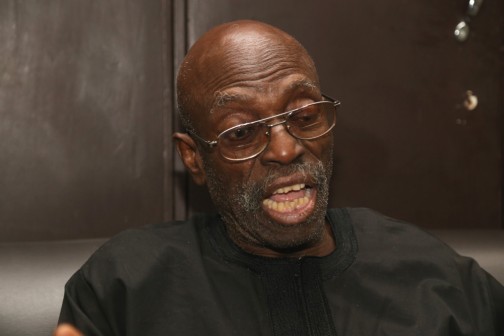
BJ made Wole Soyinka’s difficult texts understandable
By Jacob K. Olupona
Oga BJ, as I usually call him, has left us. I first knew him briefly at the University of Ife (OAU), when he was a senior lecturer, and I was just beginning my career as a research fellow. However, it was in his second coming to America, particularly as a professor at Harvard, that I got to really know him quite well, as we came to Harvard the same year. He came as a professor of literature, and I, religion. As part of the small circle of Nigerians on campus, Professor BJ, Abiola Irele, and I became fairly close.
Since BJ’s transition, stories of his good deeds and work, too numerous to recount here, have probably been pouring in. All these good stories confirm for me the Yoruba adage, “Iwa Lesin,’’ meaning it is not the institution of faith you belong to, it is your character that ultimately counts. BJ epitomizes this ancient proverb and reality. I never heard BJ talk about Christianity or the Church, and he often teased me about my own unapologetic devotion to the Church, particularly as the son of a clergy member. However, in retrospect, I think BJ was actually holier than many who call themselves Christians. His kindness and generosity knew no bounds, and he gave without counting.
BJ also made a significant contribution to scholarship in literary studies. He made Wole Soyinka’s difficult texts understandable to the students he taught here. One of our senior colleagues here once teased him, “BJ, o maa jeki Soyinka pa e’’ (Don’t let Wole Soyinka kill you). I interpreted our colleague’s comment to indicate BJ’s devotion to the interpretation of his teacher’s work. When I reflect on this, I ask myself, how many scholars have such disciples who were as devoted as BJ was to his teacher, mentor, and friend? BJ stands out among old and contemporary scholars of African literature. He was creative and brilliant, with the ability to apply diverse literary genres to social, political life, and human living, attracting many students to his classes. The remarkable richness of his scholarship will surely live after him.
We also shared many light moments, jokes, banters, and teasing about our Ile-Ife past. When I deliberately teased him about the politics of our former university, I would call him ‘’Dr. Jeyeofo’’ (“you should let the bird fly’’), a slang that one of our former vice-chancellors used to call BJ in Senate meetings to calm him down and save himself from BJ’s Marxist rhetoric. And BJ would quickly quip back to me “okowe’’ (secretary/scribe), a nickname that the vice-chancellor used to called me.
My family and I will miss him, particularly my children, who will forever remember him as a big ‘’uncle’’ who always graced our American Thanksgiving Dinner with his presence, which usually brought together several Nigerians in the Harvard community. BJ never greeted me without asking me how the children were doing.
A few months before his final trip to Nigeria. I ran into him twice, walking gently to the Widener Library. I was quite surprised to see him, and he told me he would soon go to Nigeria for the holiday. Until the end, BJ prioritised a life of learning. Now, our beloved Oga BJ has transitioned and while we will miss him, we will also continue to cherish his significant contribution to the world of scholarship, Nigerian civic life, and the personal lives of everyone he knew. May his ancestors welcome him home.
*Jacob K. Olupona, FNAL NNOM, Chair, Department of African and African American Studies, Hugh K. Foster Professor of African and African American Studies and Professor of African Religious Traditions.
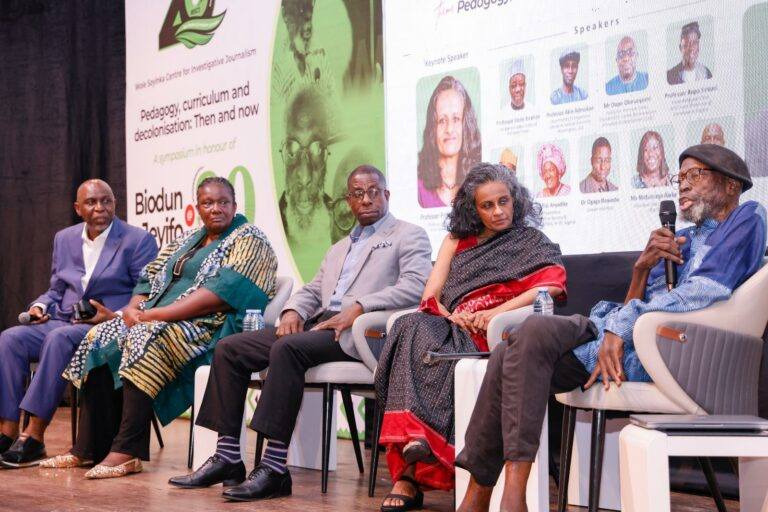
A secular priest
By Sam Omatseye
His photo, in repose, in Ibadan last week transported a chill to the spine. Professor Biodun Jeyifo was not made for silence, as he seemed in that terminal state in his casket. Only the first days of this year, just less than quarter ago, we all gathered at the Muson Centre to serenade him. Enter Wole Soyinka. Enter Professors Ropo Sekoni and Chima Anyadike and Dr. Yemi Ogunbiyi. Enter Governor Kayode Fayemi. Enter Marxists, activists, friends, mentees and well-wishers. Enter former students. Enter intellectual verve. Exit boredom. In that hall, all were glad to be with him to chat, chant, spar and pine over the spices of his life.
At the end, we sang a song of him as a jolly good fellow, a tune led by Femi Falana.
After anchoring a session of reminiscences that afternoon, I announced in a burst of naïve hope to an entranced audience: “See you on his 90th.” False prophets sometimes deserve pardon. I must do penance.
A touching moment on stage. I was beside him and he remarked, “Sam, I used to be as tall as you. See how I have shrunken.” Not really. B.J. was even taller in his bloomy years, in his days when he puffed his nifty cigar, when he loped rather than walk, when his hands made a furious circle of gesticulation in the air as he stressed a point of dialectic. I held his hand and tried to walk him off stage until a young lady overthrew my self-assigned role.
They don’t make Marxists like B.J. anymore. He was not a faithful in a pious sense, but even the very priests of established faith could learn a thing or two from him. If he were a Christian, he might have been an adherent of the injunction of Christ. “Be thou faithful till the end, and I will give you the crown of life.”
Karl Marx might have envied this faithful. He did it in his pedagogy, in his life as an activist, as ASUU president in duelling with capitalists on campus and outside. Few remember that B.J. gathered quite a few Marxists in a commune in the Southwest, and they wanted to build a society of believers in material progress. One of them was the unforgettable writer Edwin Madunagu. On his 70th birthday celebration at the Obafemi Awolowo University, B.J. listened with aplomb as Madunagu reeled out some of the failings and misadventure of a dream. They left all, just as religious faithful do, for the cause of showing to the world a commune as a model. It reminded one of the Aiyetoro experiment when a Christian sect tried to implant the virtues of Christ in a town. It also failed.
It was a testament to how theory fail when humans corrupt it. B.J. was a true believer. He was Karl Marx’s secular priest in this part of the world. Yet, he was a secular priest without the cants and canons in his daily life. As Kunle Ajibade recalls in his tribute, he was a man for all seasons, apology to Robert Bolt. Professor Anyadike penned a soulful tribute about his humanity. He was warm to his students, just like a good priests and teacher. I was his student, too, at Ife, and he did not carry dialectical materialism as a toga. He taught with aloof benevolence. I had heard of him as a great teacher, and mentor even before I attended his class. But it was in his tutorial that I knew him at close quarters.
I always saw Marx in his views even when he tried to play it down. I thought that was a virtue. He did not conceal. He moderated his convictions as a tribute to a world of diversity. For instance, in interrogating a work by Franz Kafka, Metamorphosis, many were looking at the other perspectives why Gregor Samsa turned into an insect on his bed. He looked at it from the fact that his family was exploiting him and his change of form was a rebellion against economic predation. But he allowed others to bring out their own views while showing a clear bias.
His play Haba director, about exploitation and tyranny, was his one strong move into creative writing. But he excelled as a critic. He was an expert on Soyinka and Achebe, and he never allowed his belief to undermine the works of these two artists when clearly were no Marxists, although Soyinka often shows a sympathy for socialism. The bard’s immersion in myth would not let him.
I recall during a lunch at Marcy College at the University of Toronto, a young professor teaching at the University of Queens in Canada wanted to know if I knew a certain professor in New York. She could not recall his name, but he described him with his beard and khaki and his Marxist ways.
“He was my teacher. His name is Biodun Jeyifo,” I announced. She almost hugged me. She raved about his brilliance and integrity. She did not know how proud I was that afternoon in Toronto.
In his 70th birthday celebration, I described him as a Marxist in a post-Marxist world. He responded generously in what I saw as a dig. He said I was right in a general sense but not in a personal sense. I agree. I did not undermine his faith. I admired his consistency in a world of shifting sands. Indeed, I believe that we need Marxist perspectives in this world of rabid acquisitions. This is the age of the superrich. Never has the earth, and even Nigeria, witnessed individual wealth as we know today. And never have the poor been so miserable as Thomas Piketty has demonstrated in his book Capital in the 21th Century and subsequent interventions. If you visit New York, you cannot forget the echoes of John Galbraith’s The Affluent Society, where he laments high rises looking over potholes in the richest district in the world, Manhattan, New York.
At the end of the symposium at Muson Centre, B.J. insisted that we must always fight for equality. It might be his last exhortation.
Yet, we cannot understand B.J. without his childhood. Dr. Ogunbiyi gave us a graphic mirror of an intransigent youth, a boy genius who would not obey rules, was expelled from his high school. He was redeemed by his brilliance to enter Government College Ibadan when the principal, a white man, accepted him in spite of warnings from his estranged principal. B.J.’s scores were irresistible. I think B.J. fermented his rage into a social and intellectual rebellion. He became man rather than brute. He converted his rebellion into legacy of value. Who knows Pyrates and Soyinka may have something to do with it.
Ogunbiyi’s wife recalls his father was a respected Christian in the community. He chose another piety. She also recalls an evening at the University of Ibadan when she saw B.J. in full Pyrate Confraternity gear. He hailed him to stop, but B.J. ignored the childhood friend and she followed him until he disappeared. The next day B.J. would deny. Yet, later in life, she sent a well-packaged fish delicacy through B.J. when both were living in Ijebu Ode to her then boyfriend Ogunbiyi in Ibadan. B.J. kept the dainty delight in his pocket through the trip. He met with Ogunbiyi but returned to Ijebu Ode before he remembered the message.
His relationship with Soyinka is fascinating as I have relayed before. He was mentee and rebel at the same time. He was an advocate of Soyinka’s poetics but not his ideology. He resisted Soyinka as a teacher and then became not only his favourite student but the bard defended him so he had a first class. Soyinka also opened his way to stardom with referrals.
As a secular priest, B.J. tended to his brood of students and activists, in ideas and attention. But his best gift was example. If Marxism is a relic, he was its living apostle.
* Sam Omatseye, novelist, poet, columnist, is the Chair, Editorial Board of The Nation newspapers