

By Abdullahi Hamza
“The rarest of human qualities is consistency.” ~ Jeremy Bentham
***
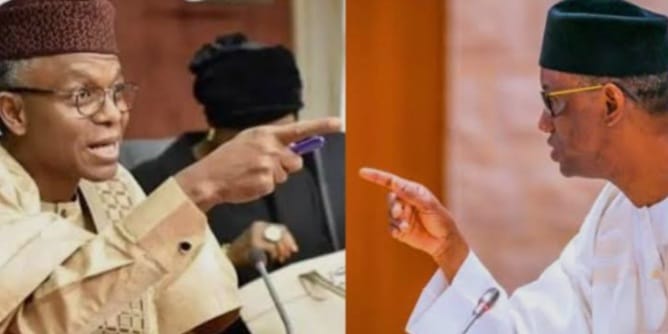
There is a certain theatre to Nigerian politics, a drama so perpetually staged that its scenery—the police stations, the government houses, the Aso Rock villa—has become indistinguishable from the props they truly are. The latest act unfolds with the former governor of Kaduna State, Nasir El-Rufai, stepping into the spotlight to hurl accusations at the National Security Adviser, Nuhu Ribadu, like a man throwing stones at a house he himself once helped to build. El-Rufai has confirmed, with the gravity of an espionage aficionado, that he tapped the phone of the NSA chief, listening to the private cadences of his conversations.
And yet, he does not stop at surveillance; he goes further, alleging that this same security apparatus is plotting to import lethal, toxic materials into the country, materials he implies will be used to settle political scores or, worse, to create an atmosphere of fear as we barrel towards another election cycle. It is a tale of former bosom friends, now circling each other with the wariness of strange dogs, their snarls echoing across the political landscape.
To the weary observer, it is tempting to pick a side, to decide whether the urbane former governor or the once esteemed anti-corruption czar is the true villain or the aggrieved party in this new brouhaha. But that is precisely the trap laid before the Nigerian public. We are being invited to invest our emotions in a feud between two titans, to see one as the oppressed and the other as the oppressor. This is a deception of the highest order. Whether this is a genuine fallout born of bruised egos and betrayed trust, or a calculated ruse designed to obscure a larger, more sinister game, the result is the same for the common man: we are being used as pawns.
Our anger, our support, our tweets and our arguments are the fuel they need to keep their relevance burning. As the elections draw nigh, these men are not fighting for our liberation; they are fighting for position, for leverage, for the spoils of a system they both have mastered. The philosopher Ayn Rand, in her novel The Fountainhead, captured this dynamic perfectly, noting that, “The hardest thing to explain is the glaringly evident which everybody has decided not to see.” The glaringly evident truth here is that neither man has our interests at heart. They are both creatures of the same swamp, and their wrestling match is merely churning the muddy water, making it impossible for us to see the bottom.
The question, then, is one of timing. Why now? Why does El-Rufai choose this precipice of a general election to unveil these grave accusations? It is a question that answers itself. This is a man whose tenure in Kaduna was a masterclass in the imperious use of power. He rode roughshod over the denizens of his state with an impunity that was breathtaking, his policies often feeling less like governance and more like an experiment in social engineering. His name remains tangled in the dark, conspiratorial whispers surrounding the disappearance of Dadiyata, a case that speaks to a chilling capacity for the state to make people vanish. To now hear this man speak of surveillance and lethal imports as though he were a shocked innocent is to witness a profound act of cognitive dissonance. The machinery he now decries is the very machinery he helped to oil. His sudden concern for the rule of law feels like the concern of a burglar who is upset that a new security system might keep him out.
We cannot afford to trust the theatrics of such men. Their proclamations are dishonest by their very nature, crafted not to illuminate truth but to serve a hidden agenda. Whether it is the consolidation of power, the settling of a personal vendetta, or the positioning for a political future, the motivation is entirely self-serving. They do not have your good or mine in their perspective; the horizon of their vision extends only as far as their own ambitions.
This is a man, El-Rufai, and a man, Ribadu, who were once described as bosom friends. They climbed the greasy pole together, sharing confidences and strategies. To witness them now, locked in this bitter public embrace, is to see a friendship immolated on the altar of personal gain. A man who can so easily discard a tight bond, a history of shared struggle, for worldly things that will ultimately benefit only himself is a man whose soul is a bargain bin. He is a Shylock, demanding his pound of flesh from a former ally, not because justice requires it, but because his own ledger of grievances demands payment.
In the end, this whole affair is a mirror held up to the political class, reflecting its ugly, narcissistic truth. And as the election approaches, we would do well to remember that we are not the audience they wish us to be; we are merely the stage upon which they act, and they will kick us apart as carelessly as any other piece of scenery in their desperate, selfish play for the final act.

Leave a Reply