

By Maduabuchi Nmeribeh
Katsina State Governor, Dikko Umaru Radda, has advocated for climate-informed planning to boost agricultural production across Nigeria.
Radda stressed the strategic importance of the 2026 Seasonal Climate Prediction in guiding agricultural planning, disaster preparedness, and infrastructure development across Nigeria.
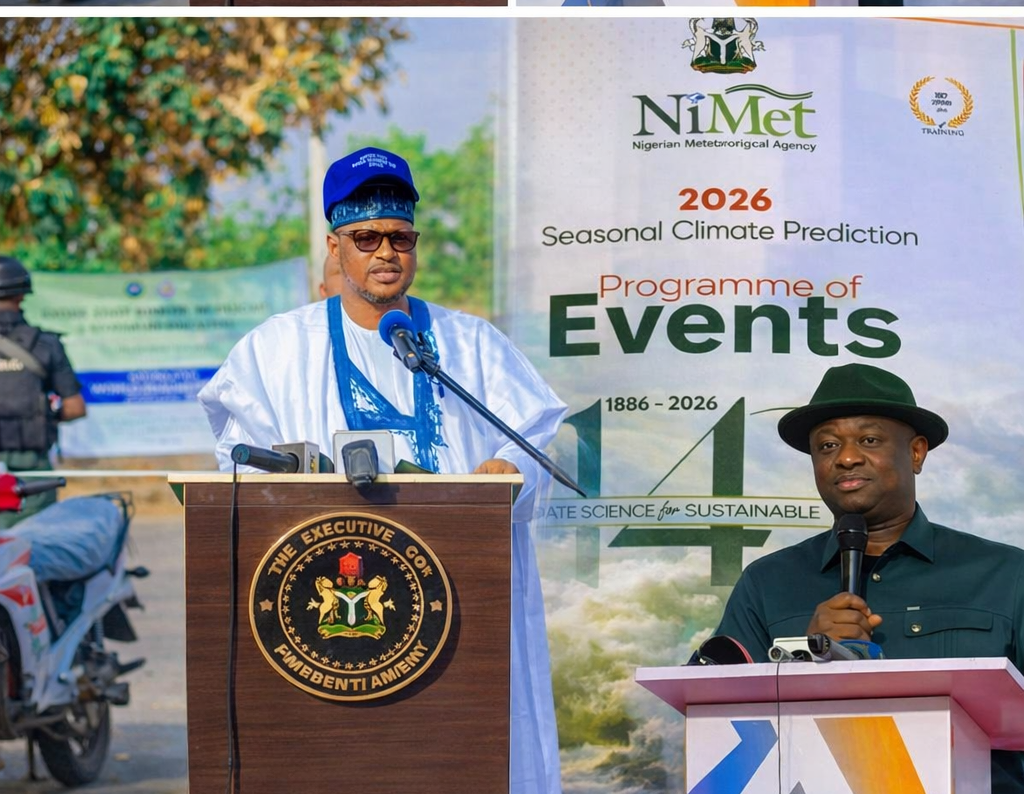
Governor Radda stated this on Tuesday at the Public Presentation of the Nigeria 2026 Seasonal Climate Prediction organized by the Nigerian Meteorological Agency at the NAF Conference Centre, Abuja.
He was represented by Prof. Al-Amin Mohammed, his Special Adviser on Climate Change.
Governor Radda’s Chief Press Secretary, Ibrahim Kaula Mohammed, in a Statement, said Governor Radda described the Seasonal Climate Prediction as a strategic decision-support tool with direct implications for agriculture, food security, disaster risk management, public health, water resources, infrastructure, energy, and economic stability.
“The 2026 SCP is not merely a scientific document; it is indispensable for evidence-based governance in a climate-stressed era,” Governor Radda stated.
He explained that Katsina State spans multiple rainfall and ecological zones, each with distinct vulnerabilities and planning needs.
According to him, “for the northern axis of Katsina State—covering areas such as Daura, Zango, Baure, Mai’Adua, Jibia, Mashi, Mani, and parts of Kaita, the 2026 outlook indicates later rainfall onset and earlier cessation, resulting in a shorter growing season and heightened exposure to dry spells and heat stress.
“In response, the state government is prioritizing early-maturing and drought-tolerant crop varieties, climate-informed planting advisories, water harvesting, small-scale irrigation support, and enhanced heat-stress and meningitis vigilance.
“In the central corridor—including Katsina metropolis, Batagarawa, Rimi, Charanchi, and Kurfi—the Governor explained that the 2026 SCP suggests rainfall onset and cessation largely within normal windows, though with risks of uneven rainfall distribution and intermittent dry spells.”
He further stated that, “the state government’s approach emphasizes strict alignment of planting calendars with NiMet advisories, integration of climate information into urban drainage and flood control, and stronger coordination between NiMet, local governments, traditional institutions, and communities.
“In the southern axis—covering Funtua, Malumfashi, Kafur, Danja, Dandume, and Bakori—Governor Radda noted that the 2026 SCP indicates earlier rainfall onset and later cessation, offering favorable conditions for rain-fed agriculture but increasing the risk of localized flooding, erosion, and post-harvest losses.
“The state’s policy response focuses on flood-smart agricultural practices, improved drainage systems, timely advisories on harvest scheduling and storage, and climate-informed planning for rural roads and water infrastructure.”
Governor Radda disclosed that, “Katsina State is institutionalizing SCP outputs by translating them into simplified, community-level advisories in local languages, integrating them into agricultural extension, disaster preparedness, and health surveillance systems, and aligning them with state budgeting, food security strategies, and emergency response planning.
“This is how climate science is transformed into climate action.”
Also speaking at the event, Minister of Aviation and Aerospace Development, Festus Keyamo, said climate variability has become a defining factor in modern governance.
He noted that extreme weather events now influence economic outcomes, national security planning, and the protection of lives.
Keyamo described the 2026 SCP as a science-to-action document aligned with national priorities.
He stressed that aviation safety and efficiency depend heavily on credible meteorological input, explaining that climate data now functions as economic infrastructure, supporting both flight safety and long-term investment planning.
However, he warned that development efforts not informed by climate science remain vulnerable and unsustainable.
Earlier, the Director General of the Nigerian Meteorological Agency, Prof. Charles Anosike, said the agency’s forecasts are designed to support informed decision-making in a rapidly changing climate.
He explained that timely and reliable climate information has become indispensable as extreme weather increasingly threatens lives, infrastructure, and economic growth.
“Climate variability and extreme events are no longer abstract risks. They directly affect livelihoods, food security, infrastructure, and national growth,” Prof. Anosike stated.
The 2026 Seasonal Climate Prediction was unveiled on 10th February 2026, in Abuja by the Nigerian Meteorological Agency.
Authorities say the 2026 SCP must now guide planning decisions across government and the private sector, with weather and climate data expected to play a central role in aviation operations, agriculture, disaster preparedness, and public health strategies.



Leave a Reply