

*Blames Govt, ASUU for University Strikes
The Chairman, Federal Civil Service Commission ( FCSC), Prof. Tunji Olaopa, has listed measures that could be deployed by the government to stem the tide of youth unemployment in the country.
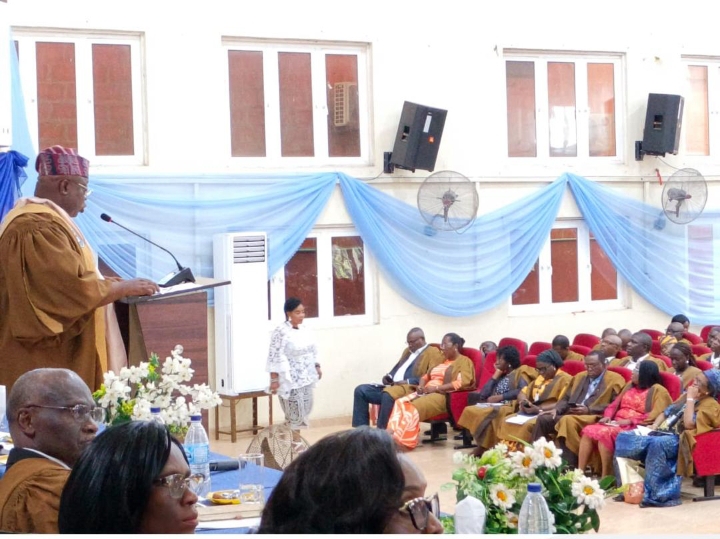
While delivering the 17th Convocation Lecture of Bells University of Technology, Ota, Ogun State on Friday, Olaopa noted the huge population of youth which could be converted to national capital.
Olaopa who spoke on the topic “The Nigerian Youth and the Challenges of Unemployment and Skills Mismatch in National Development”, however , deplored a situation where such a huge population is allowed to waste due to outright under-employment or outright unemployment.
Olaopa urged a stronger connection between the formal and informal education sub-sectors on the continuum of learning and training as a key to progress. In this connection, he said effort should be made to resolve the challenges being faced with the implementation of the “students industrial work experience scheme (SIWES), currently stalled due to total lack of synergy between students inchoate theoretical learning with a crippling lack of practical experiential learning functionally linked to workplace and labour market demands.”
Olaopa specifically identified a local solution to the unemployment crisis . He urged that the Igbo apprenticeship system should be encouraged as a nationwide job creation and entrepreneurship consolidation programme.
He described the system as one that thrives on pairing apprentices with experienced mentors for guidance and support.
Adopting this system nationwide, according to him, will require the establishment of a national framework of action setting it out to deepen existing apprenticeship systems, outlining appropriate standards for mentors- and mentees, specification of training duration, and certification procedures, including the setting up of programme self-evaluation mechanism and regulatory system.
He said that it would also require partnerships with industry to deploy it to reinvent and consolidate the SIWES and that this would entail having the Industrial Training Fund (ITF), NDE, etc. to undertake the identification of in-demand skills among the targeted youth, and the implementation of a systematic programme to match them with their apprentices’ interests and aptitudes.
“A well-equipped supportive startup training set of hubs to provide hands-on learning support to provide systematic learning of supportive skills as generating funding proposals, recordkeeping, etc. will be essential”, he added.
Olaopa blamed the crisis of youth unemployment on
factors which he said could be linked to the largely untransformed structure of the national economy.
“Indeed, the growth trajectory of the Nigerian economy has been largely uneven and socially non-inclusive”, he said.
Consequently, the economy to him has been generating limited sources of new employment, a low-employment intensity which is the key defining attribute of a non-diversified economy that is heavily and monoculturally dependent on oil and gas
He also blamed past reforms to restore the functional link between education, job creation and employability of graduates, which tends to be skewed in favour of formal education .
As he put it: “Whereas the informal sector of the economy is the largest job creator in Nigeria, limited attention has been accorded to building the skills needed nor has policy creativity been deployed enough to support the productivity and other required structural changes to unlock the potential of the informal sector in Nigeria.
“In a more concrete sense, past policies have concentrated resources and expertise in the former technical, vocational education and training (TVET), to the detriment of the traditional apprenticeship and non-formal training
“In spite of recent priority focus on TVET, there still does not exist a self-evaluation and regulatory mechanism for TVET institutions. The current AfDB-supported FG programme to deepen the implementation of the national vocational qualification framework (NVQF) directed at the incorporation of standardized certification procedures as a way of increasing the capacity of traditional apprenticeship and non-formal training to generate employment in the informal sector is unarguably a step in the right direction.
“The new policy and programme if pursued to its logical conclusion will no doubt check the mismatch between employment opportunities available in the labour market, and the type of qualifications and certification produced by education and training institutions.”
Olaopa Blames Govt, ASUU for University Strikes
At the Convocation lecture also, Olaopa argued that the government makes industrial tensions and strikes possible because of the manner it reaches agreements with ASUU. He decried a situation where government hastily signs agreements with ASUU which it knows it cannot implement
Consequently, Olaopa urged that “government should for no reason at all, sign an agreement that it cannot implement, as difficult as it is in view of the usually associated political expediencies.”
He also cautioned government against attempting to please unions and minimise heating up the polity which result in “taking decisions of far-reaching magnitude in a hurry, with full recognition that labour matters require diligence and technical correctness”.
Advising government on future dealings with ASUU, he said it was better to reach a “reasonable agreement with short-term horizon that is susceptible to review, than to make long-term commitments that hang on the neck like an albatross”.
He thus urged government to ” give life to veritable institutional mechanisms that would activate people with the right authority, skills and technical support who would negotiate for government since they are ipso facto empowered to take decisions at negotiation table.”
Turning his attention to ASUU, Olaopa deplored what he identified as an adversarial and a-developmental approach to industrial relations that negates national progress.
According to him, the Nigerian industrial relation system is characterised by fragmentation, weakened institutional mechanisms and authority of responsible institutions as the Ministry of Labour and Employment, IAP ( Industrial Arbitration Panel) and the National Industrial Court (NIC); and unwarranted zero-sum conflicts leading to prolonged and unnecessary industrial disputes.
Noting that there has been progress made to ratify and domesticate many relevant ILO Conventions that have direct impact on labour administration, he said that full compliance with these conventions would go a long way in shaping the future of work in Nigeria
For the existence of harmonious industrial relations in the universities, he urged what he called a “shared understanding among the tripartite, one rooted in commitment to Nigeria’s developmental progress, to drive a significant rethink and shift in conflict management practices around industrial disputes which currently yield themselves to self-serving radical and ostensibly politicised activism and workplace disruptions by trade unions; and one at that which has become a culture.”
For him, there exist institutional mechanisms to deal with unavoidable and seemingly irresolvable disputes especially arising from the reading and interpretation of what constitutes a dispute of rights and a dispute of interests among the tripartite, and thus if national progress is the ideological underpinning of actions, then conflict of interest should not always degenerate into a zero-sum game, as such interests are not mutually exclusive.
Olaopa stressed the significance of advocacy around the need to strengthen the National Labour Advisory Council (NLAC) for it to play a more proactive role in labour administration . He said that an effective NLAC should transform into a tripartite body to handle periodic reviews as minimum wage, etc, rather than the current recurring resort to ad hoc committees.
” It must also be pointed out that most Nigerian Labour Laws presently in operation which were carried over from the colonial and military eras in Nigeria are obsolete, and no longer in tune with international standard. Happily, many of the revised versions of these laws are already before the National Assembly as bills for passage”, he said.
He added: “It is expected that government will leverage the commitment of social partners to conclude legislative actions on the bills. In the end, the point cannot be overstated, that the health and sustainability of any enterprise (including the Nigerian enterprise) is the responsibility of all stakeholders.
” Indeed, we need a national economy that is thriving for most of what the trade unions are agitating for on behalf of workers to be realisable. We all therefore must invest in the productivity and sustainable development of the Nigerian enterprise as the overarching mission in all our struggles and campaigns.”
Leave a Reply