

Abdullahi Hamza
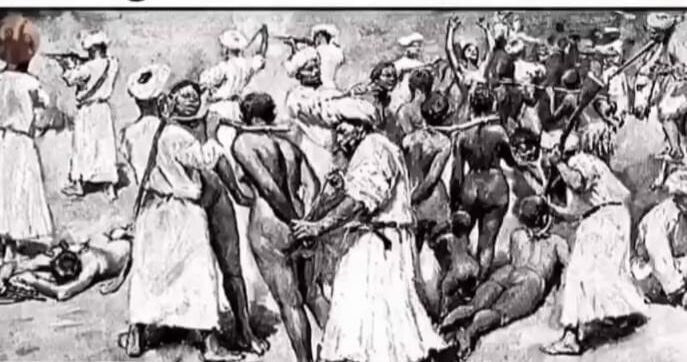
Though a lot is known about the history and scale of African slavery, far less is commonly understood about the systematic cruelty of castration that turned captive men and boys into eunuchs for the trans-Saharan slave trade.
Reading through volumes on the African trans-Saharan slave trade, even after decades, the sheer indignity and stupendous cruelty inflicted on enslaved people remain horrifying. The horror is palpable; imagine the deliberate act of granulating an infant’s testicles, hard-rubbing the groin until they became paste or burying a man waste-deep for three days following a castration.
There’s a lot of brutality that I left out to spare the reader greater ire and pain. But pain exists still, for the information herein is mind-bending, and only males can get an inkling of the torture. Reading through some passages I edited, I cringe in mortal disgust. How cruel the acts of man can be to one another.
This practice, conducted in gruesome “castration centers” en route to Arab states and the Middle East, stands as a distinct horror. In the Arab-involved trades, the creation of eunuchs was a response to the demand for trusted court servants and harem guards. The most extreme technique was total emasculation, involving the complete removal of both the penis and testicles, often with a single stroke of a sharp razor. Akin to your local butcher, flaying meat for suya.
The agony of this procedure was intensified by the surgical efforts to prevent immediate death; the victim had to be thoroughly restrained to prevent movement that could cause fatal hemorrhage, with assistants holding the victim down while ligatures were applied to restrict blood flow, all without anaesthesia. Crucially, a lead rod or metallic cannula was then inserted into the urethra to prevent the urinary passage from swelling shut. The ordeal was far from over; the man was kept immobile for approximately three days without being allowed to drink or urinate.
Only upon successful removal of the rod and the ability to pass urine was the victim considered to have survived the immediate danger. Even then, full convalescence from the wound and the systemic trauma took around 100 days, more than three months, but the overall mortality rate from hemorrhage and subsequent infection (sepsis) in these centers was catastrophically high, often reaching 60%. The castration practices in the Arab trades, meant that those enslaved populations were not self-reproducing and were instead maintained by constant, fresh imports. How utterly outrageous.
This piece on the brutal practices of trans-Saharan slavery, specifically the act of castration, prompted an insightful and challenging question from CM JaMeka Adebija. His inquiry:
“The question is why haven’t we been able to develop this superior military and economic technology since the dawn of age? Is there any time the black man has ever been superior? It is easy to lay claim to some sort of advanced civilisation in the past. Like having the oldest university and the riches of Mansa Musa. Outside that, there are really no records to prove that we have ever attained such heights or dominance such that we could also dorminate the other races.”
Walk with me…
Your question, echoes a weight that many have carried, a quiet hum of doubt in the face of a world narrated by others. It is not just a query about history, but a search for a lost mirror in which we can see a reflection of our own potential. To answer it, we must first gently dismantle the premise, for the question itself is built on a foundation laid by the very dominance it questions.
The notion of a linear, perpetual “superiority” in military and economic technology is a relatively recent chapter in the human story, one written largely by the victors of the last few centuries. To ask why “we” haven’t been able to develop it “since the dawn of age” presumes a constant state of lag, which is a historical illusion. Civilisations, like constellations, rise, blaze brilliantly, and fade, only for new ones to form elsewhere. For millennia, the technological and economic centers of the world were not in Europe, but in the Nile Valley, the Indus Valley, the Fertile Crescent, and the Yellow River. Africa was not a backdrop to this story; it was a primary stage.
The Hidden Voices of Africa. Photo credit, Sebastian Joseph
Consider the Kingdom of Kush, which conquered and ruled Egypt, building more pyramids than the Egyptians themselves. Imagine the ironworkers of Nok, smelting ore centuries before it became common in Europe, their technology spreading across the continent. Ponder the architectural genius of Great Zimbabwe, a vast stone city that was the heart of a wealthy trading empire, its scale and sophistication baffling early European explorers who insisted foreigners must have built it. These are not merely “claims;” they are archaeological facts, standing in stone and iron.
You rightly mention Mansa Musa and the University of Timbuktu, but then dismiss them as isolated examples. I would argue we must see them not as exceptions, but as peaks in a vast mountain range that has been systematically eroded. The “records” you find lacking were often destroyed, or they existed in forms that colonial historiography refused to recognise as records. The libraries of Timbuktu held thousands of manuscripts on law, science, and medicine, a written tradition of immense depth. The Benin Bronzes are not just art; they are a complex historical archive cast in metal, detailing court life, military campaigns, and foreign encounters with a realism Europe had not yet mastered. Our histories were kept orally, in sculpture, in the very fabric of our societies, modes of record-keeping that were dismissed as primitive by those who held the pen.
The great rupture, the event that fundamentally altered the trajectory you describe, was the transatlantic slave trade and subsequent colonialism. This was not a simple competition that “we” lost. It was a catastrophic, centuries-long hemorrhage. It was not a sprint where we fell behind; it was a race where our legs were broken before the starting gun fired. Enslavement and colonial extraction did not just take people and resources; they dismantled political structures, severed lines of cultural and technological transmission, and imposed an economic system designed solely for our subjugation and their enrichment. The dominance you speak of, the kind that “could also dominate the other races” is a product of that specific, brutal system of global power. To judge all of human history by its recent, violent standard is to accept its terms.
So, to your poignant question, “Is there anytime the black man has ever been superior?” I would answer: Superiority is an ephemeral, dangerous metric. But if we must use it, then yes, there have been times when African civilisations were the most powerful, the most wealthy, and the most innovative in their world. Their dominance was real, even if it looked different from the colonial model that followed.
The challenge for us today is not to yearn for a past where we dominated others as we were once dominated. That is to remain trapped in the same destructive logic. The real task is to reclaim the full, complex, and magnificent narrative of our past, to reassemble the mountain range from its scattered peaks. It is to understand that our ancestors were not just victims or footnotes, but pioneers, philosophers, and kings who shaped the human story. From that reclaimed foundation, we can build a future defined not by a desire to dominate, but by the resilience, innovation, and humanity that has always been our true inheritance.
The record is there. We just have to learn to read it in our own script.


Leave a Reply