

By Abdullahi Hamza
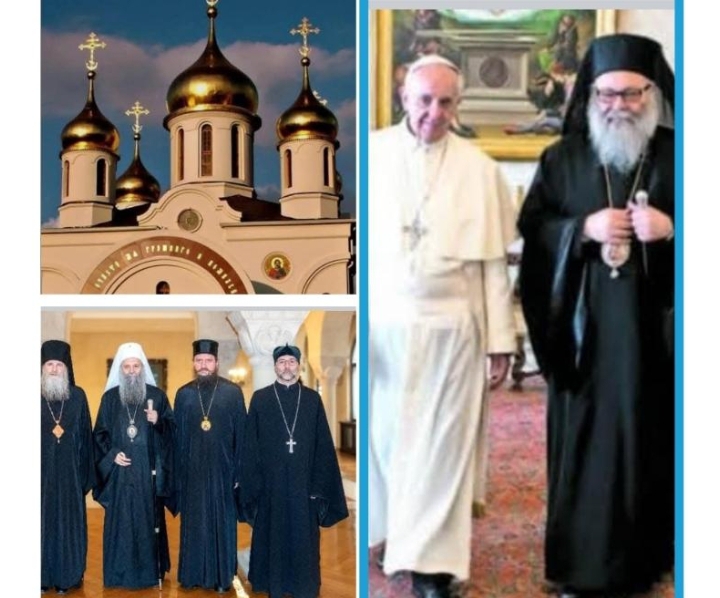
You think the Cathølic Church has a monopoly on ancient, intellectual depth? That’s only because you’ve been watching the West. While Rome was building its universal papacy and sending Jesuits to court, its older, quieter sibling in the East was engaged in a different kind of project, one not of conquest, but of ethereal transformation.
We treat the Eastern Orthodox Church like a museum piece, a frozen relic of icons and incense, shrouded in the smoke of 1,500-year-old liturgies. This is perhaps the greatest historical blind spot of them all.
Because the East wasn’t sleeping. It was mastering a concept the West is only now, frantically, trying to rediscover, resilience.
Let’s start with the obvious, survival. Orthodoxy is the institution that outlasted empires. For half a millennium, from 1453 until the collapse of the Soviet Union, the heart of Orthodoxy beat not in an independent state, but under the boot of hostile regimes. The Ottoman Empire and the USSR weren’t exactly tolerant landlords. But, the Church didn’t just survive; it became the very DNA of cultural identity. The Patriarch of Constantinople operated under the Sultan’s direct authority, a political tightrope walk that makes modern ecumenism look like child’s play. In Russia, the KGB infiltrated the clergy so thoroughly that the line between collaborator and confessor is still being untangled. And yet, the liturgy never stopped. This isn’t just faith; it’s institutional jiu-jitsu, using the weight of oppression to strengthen its core.
But here’s what they don’t teach you in history class; Orthodoxy is the reason you can read Aristotle. Full stop. While Benedictine monks in the West were preserving Latin classics, it was the Byzantine Empire, the political arm of Orthodoxy for a thousand years that never stopped studying the Greeks. Aristotle, Plato, Sophocles, their works were continuously copied, debated, and taught in Constantinople while Europe was fragmenting. The “Greek” knowledge that fueled the Italian Renaissance wasn’t discovered; it was repatriated. It was shipped west by Orthodox scholars fleeing the collapsing Byzantine Empire, carrying precious manuscripts as their ransom. The Renaissance, and by extension the Enlightenment, owes a direct debt to the scholarly monks and scribes of the East.
And then there’s the theology which is where the mind truly bends. Western theology is often forensic, like a courtroom drama about sin and redemption. Eastern theology is mystical physics. They were debating quantum entanglement in the 4th century, they just used different words.
Theosis: This is the North Star of Orthodox thought. It’s not just going to heaven; it’s the belief that humans can actually participate in the divine nature, to become “partakers of the divine nature” (2 Peter 1:4). It’s not metaphor; it’s a literal process of transformation through prayer, liturgy, and ascetic practice. This is the self-help hack, dreamed up 1,600 years ago.
The Hesychast Controversy: In the 14th century, monks on Mount Athos claimed that through deep contemplative prayer, they could see the “Uncreated Light” of God, the same light that shone from Christ during the Transfiguration. Their critics called it heresy. The Church, in a stunning move, sided with the mystics. Gregory Palamas, their defender, articulated a theology where God’s essence is unknowable, but His energies (His grace, His light, His power) are real, tangible, and can be experienced. This isn’t philosophy; it’s a theological framework for mystical experience that would make a Harvard neurotheologist weep.
Fast-forward to the 20th century. Under the militant atheism of the USSR, what did the Orthodox Church do? It went underground, into the catacombs. It was preserved in samizdat (clandestine self-publishing) and in the whispered prayers of babushkas who became the unbreakable link in the chain. Their stubbornness meant that when the Soviet Union fell, it wasn’t a new faith that rushed in to fill the vacuum. It was the oldest one they had, bursting back into the public square with a power that shocked everyone.
So why do we still see it as just chants and beards? Because its genius is in its subtlety. It doesn’t play the West’s game. It doesn’t need a Swiss Guard or a Twitter-savvy pope to prove its relevance. Its power is in its deep, patient, cyclical view of time where history isn’t a line of progress but a constant revelation.
The next time you hear a Byzantine chant, don’t just hear a pretty song. Hear the resilience of an empire that refused to die. See an icon not as a simple painting, but as a window into a cosmology where humanity and divinity are intertwined. The East isn’t a footnote to Christian history. It’s the forgotten lung, breathing a different, older air, and it has been for 2,000 years. It’s not a relic. It’s the original operating system, and it’s still running.


Leave a Reply