

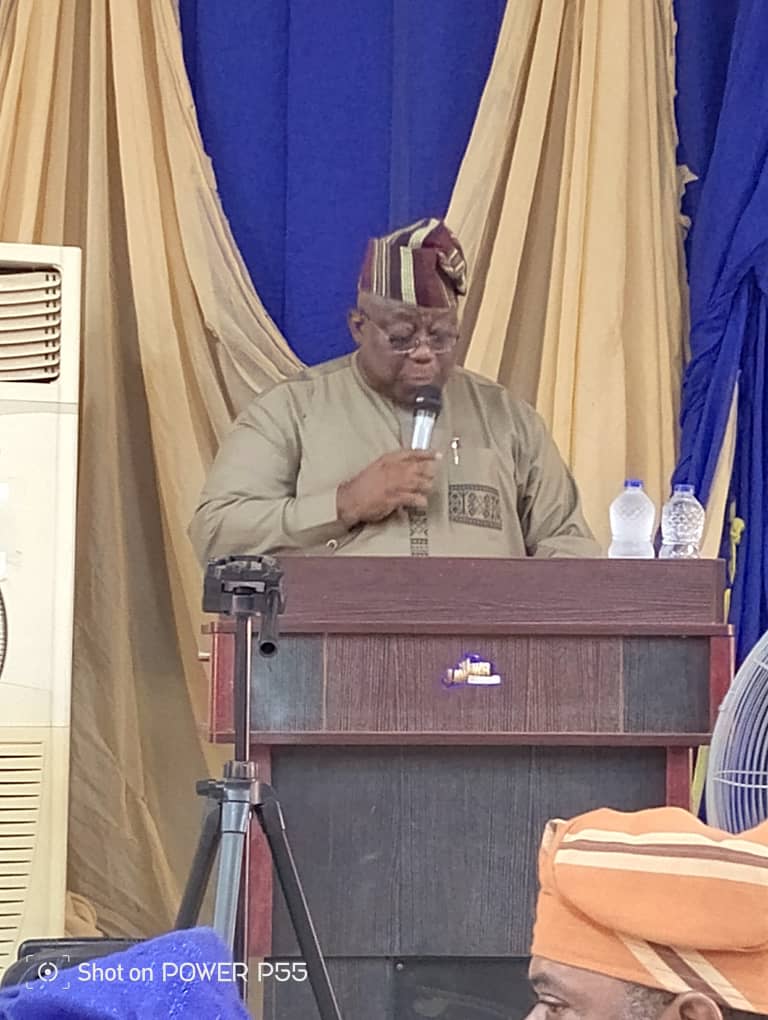
The Chairman, Federal Civil Service Commission (FCSC), Prof. Tunji Olaopa, has said that the current public debate on the political neutrality of civil servants has made reform of the civil service imperative.
Olaopa in a statement at the weekend responded to the disagreement between the Head of the Civil Service of the Federation ( HCSF), Mrs Didi Esther Walson-Jack and the Nigeria Labour Congress (NLC) President Joe Ajaero on the role of civil servants in politics.
Walson-Jack had said at a quarterly Stakeholders and Citizens Engagement interactive session that there was the need to safeguard the political neutrality of the civil servants in accordance with their responsibility to any government of the day. Olaopa recalled that “in response to the old Supreme Court judgement which reiterates the constitutional provision allowing any citizen of Nigeria to participate in politics, the HCSF argues that the constitutional provision (when conflated with the subordinate provision of the public service rule) permits civil servants the fundamental right to privately support any party of their choice without being drawn into the murky space of high-stake political activities. ”
In response to this, Ajaero argued that both the Nigerian 1999 Constitution and the 2003 Supreme Court judgement—in the INEC v Musa and Others—foreground the right of civil servants, like all other Nigerians, not just to be card-carrying party members, but to also be involved in all other political activities
laopa noted that both the HCSF and the NLC president pointed at the constitutional and the Supreme Court support for the provision of Section 40 of the Nigerian Constitution which states that every person shall be entitled to assemble freely and associate with other persons, and in particular he/she may form or belong to any political party, trade union or any other association for the protection of his/ her interests.
But Olaopa also noted that the HCSF insisted that civil servants, while adhering to this constitutional provision, must keep in mind the fundamental significance of the Public Service Rule which defines and constrains the administrative behaviour of civil servants. Section 4 of the PSR defines serious misconduct as “a specific act of very serious wrongdoing and improper behavior which is inimical to the image of the service and which can be investigated and if proven, may lead to dismissal.” The PSR then goes on to situate engaging in partisan politics as an act of serious misconduct
To Olaopa, the Supreme Court judgment which grounds the provision of the 1999 Constitution on partisan political engagement of Nigerians cannot be the final answer on the matter. “And this position is far from being counterintuitive, coming from the Chairman of the Federal Civil Service Commission. This is my argument. The Constitutional order of the Nigerian state cannot answer to all realities, economic, political, sociocultural, administrative, and even governance. The Nigerian state has weathered all sorts of circumstances that had to be handled through legal pragmatism. Thus, while the Constitution is fundamentally right, at the most general level of the fundamental, to state that every Nigerian has the right to be political and to hold political views and participate in politics, the said constitution cannot legislate at the level of the concrete on what is best for the civil service system as both an administrative system and a profession in its own right. That has to be handled with an administrative wisdom and legality that would not undermine the constitutional order. It is at this level that stakeholders in the administrative framework can decide what is best for the system to be.”
Olaopa said that this whole discourse on the status of civil servants in Nigeria’s political and constitutional order stressed “the urgency of what it takes to institutionally reform the Nigerian civil service system. The discourse, in other words, brings to the fore cogent and fundamental questions: How should the classic politics-administration dichotomy be reconceived within the framework of a new theory of change for institutional reform given Nigeria’s peculiar socio-political reality? What system of public administration is best for Nigeria at this stage in its evolution and for its transformation journey? What should be the role of the state and its constitutional order in that journey?”
According to Olaopa, these are key questions to reflect on in the light of two important objectives. “The first is that Nigeria needs to become a developmental state that pushes the boundaries of democratic governance that elevates the well-being of Nigerians. A developmental state has to plug into the fourth and fifth industrial revolutions in ways that provide the technological and infrastructural wherewithal to make development happen. The second objective is that the public service must in time, even if aspirational, become a world-class institution that can effectively and efficiently backstop the developmental aspirations of the Nigerian state” , he said.
To him, at the very heart of the institutional reform of the civil service system is indeed the nature and status of the civil servant as a public spirited and professional administrative persona with the twenty-first century public ethical conduct and competences to mediate the evolving knowledge society of the fourth industrial revolution.
“At the moment, the dysfunction of the system is due to its inability to jettison its old Weberian, “I-am-directed” structural modalities that engender bureau-pathology which prevents administrative efficiencies and promotes a culture that politicizes everything governance and development. This pathological condition calls for a re-professionalization strategy that capacitates the civil service system and its civil servants to function optimally in their vocational calling to serve Nigerians in a manner that insulates it from distortionary politics. This is where all critical stakeholders, from the OHCSF and the Federal Civil Service Commission to the NLC owe the public administration a sacred responsibility. This is a far better focus than the intermittent public filibustering over how political the civil servant can be. This is a democratic system that requires a competent, efficient and impartial civil servant to help the government achieve its policy objectives for Nigerians. The best way to go is not to embroil these civil servants in Nigeria’s political complexities. This, I believe, is the cogent insight the HCSF is trying to pass across.”



Leave a Reply