

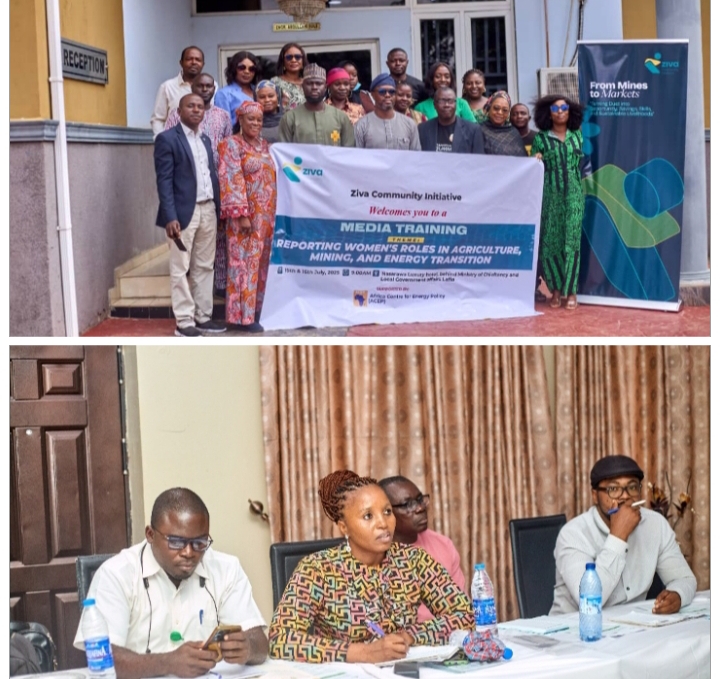
Zvia Community Initiative, a nongovernmental organisation, trains journalists on communicating on Mining and Agriculture
NKRUMAH BANKONG-OBI/Lafia
For two days, a group of newsmen and women, officials from the civil society and Nasarawa State government huddled in a quiet location in Lafia, the capital of Nasarawa State. The aim was to learn new ways of reporting issues pertaining to the segment of the Nigerian society that has been in the fringes of the country’s important sectors; agriculture and mining as well as energy transition., despite their enormous contributions.
At the end of the programme, the presentations made by individual participants left great impressions that the time was well-spent.
Ziva Community Initiative which organised the training said it aims to empower operators in the mining, agricultural spaces for the good of all. Samuel James Pam, Programme Lead, said “In Nigeria here, we are trying to see how we can build capacity of women in mining and agriculture, to see how we can amplify their voices and tell their stories within the mining space and within the climate smart agriculture space. The intention for organising this training is to see how journalists, as critical stakeholders can use their spaces to amplify the voices of women within the mining space and within the climate smart agriculture space,” he set setting the tone for the two-day event to begin.
With experts drawn from academia and media, the modules also reflected the pressing need of the organisers to draw the conversations on women and the fight against the adverse effects of climate change, in the context of agriculture and mining.
For instance, Shekwonyadu Iyakwara, a professor of mineralogy, at the department of Geology, Federal University of Lafia and Mr. Qosim Suleiman of Premium Times led the sessions that enunciated ways that reporters could help to cascade the impact that women are making in the agriculture and mining sectors. The focus was not just the challenges that they face but the success stories that they have faced.
For instance, in the module titled “Energy Transition and Renewable Energy Investment in Nigeria: Opportunities and Gaps for Women in Sustainable Agriculture and Mining,” Prof. Iyakwari noted that virtually everything that man has or uses is a product of mining. He noted that mining especially as the need to wean communities from fossil fuels, this he said informed the need even in Nigeria where hydro-power was adopted in part, for the country’s energy needs.
He said the old form of energy destroys the environment and impacts lives negatively, hence the need to find alternatives that are much tolerable by man and his environment. He said for example, that the evolution of electric vehicles gave rise to the need to power them. thus, research and investigations gave rise to the need to return to the need to find solutions. Part of which is the current use of lithium, a mineral that provided tremendous energy for such vehicles, among other things. In this, he draws attention to the surge in mining activities, the large but unreported activities of women and girls in the mining sites and the need for reporters to beam their lights on this category of miners.
The don encouraged journalist to cover successes recorded by women and not only their challenges or failures. By highlighting their strength, more of them would be encouraged to join, thus providing resources that can contribute to energy transition. In farming, he noted that if reporters deploy the strategy of pinpointing the successes and adaptive and mitigating ways that women deploy to overcome the impact of climate change, more people would be nudged to invest in the sector. “The woman has always been therefrom the beginning, from creation. The woman has been so helpful. But in some cases, she lacks the voice,” this is the voice he wants reporters to offer her and amplify her contributions in the trio of mining, agriculture and energy transition
In modules like “Sustainable Agriculture and Lithium Mining: Impacts, Opportunities and the Role of Women, The Nexus between Geology and Journalism…What Every Journalist Must Know About the Earth They Walk On,” Prof. Iyakwari continued to make the case for understand how human activities impact life on earth. He cites the devastating effects of fossil fuels, hence the need for renewable energy. He called on journalists to give prominence to initiatives to mining and agricultural practices that do not affect the environment negatively.
In his lectures, Mr. Suleiman drew attention of the participants to ethical practices in the reportage of energy transition, apart from setting agenda for discourse on transition energy and shaping public opinion, he said the media can intervene in the areas of investigating the appropriation of energy funds as well as climate-related concerns. He advised journalists to adopt solution journalism, a strand of reporting which prioritizes publication of success over the woes of society. He called for concerted efforts by reporters to engage in cross border investigations, so s to uncover wrongdoing, challenges and disasters.
To intentionally pursue these objectives, he admonished media practitioners to acquire enough scientific knowledge, understand the trends, cultivate trustworthy sources, complement with outlets for factchecking information they assemble. He called on reporters to hold rigidly to the justice and accountability angles of their investigative stories. Suleiman also noted that it imperative to abide by the tenets of non-disclosure of sources, if they choose to remain unnamed, eschew discrimination, stereotyping and undue exposure of children and minors while also stiving to shun plagiarism.
In “Telling the Stories that Drive Renewable Energy Investment and Story Mapping: Identifying Gender Stories In Agriculture, Mining and Energy,” Suleiman said it is unfair not to cover the activities of nearly half the country’s population. This he said, journalists can correct by being “gender-sensitive in their reporting”. He led the participants to under how the choices of sources, fair portrayal of the contributions of women and elimination of stereotype can shape the further participation of other women in the sectors of interest.
Through group story budget design, discussions, it was obvious that the news hounds had two days of intense manuals on how to report affairs of women in some the most accelerating sectors in the country.

Leave a Reply