

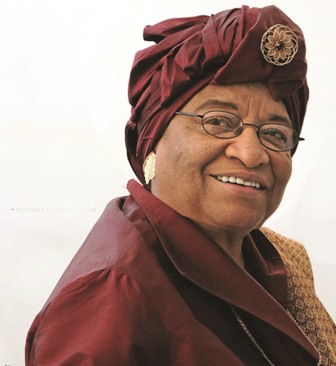
You’ve almost completed your final term. How has the journey been so far and what measures are in place so that your legacy will not be eroded by successive governments?
I believe in Liberia to be a democratic state and our democratic processes are irreversible. By the end of my term, despite the difficulties we have faced with decline in global commodity prices and the effect of Ebola, we will have restored growth and taken measures that will enable successive governments to build upon.
Let’s talk about your early life, down to the Military era. You suffered a lot of persecution and intimidation. What hope will you inspire to young people who may want to take leadership positions in the future?
I say to all young people, prepare yourself for future leadership. Get a good education. The discipline that is required to show leadership in society. Make sure that you are determined to be someone productive in life. Don’t be distracted by obstacles that are in place. Just pursue your goals.
In 2014, Forbes listed you among the most powerful 70 women in the world. What global role may we expect from you after retirement?
I expect to be very active after retirement from public service. I want to set example as a successful farmer. Secondly, I will be active in international matters. I will be able to speak at different fora, to be able to share with different people what we have faced in the country. More so, I will continue to encourage the promotion of women in society. I will be one of the champions to promote women for the Presidency in Africa and elsewhere. I believe good progress is being made in that direction.
As an experienced international public figure, what are the ways out for Africa to be economically independent?
Africa has to solve its infrastructure deficit. We cannot continue to be the provider of primary commodities. Even many countries, Nigeria inclusive, have made great progress in that regard. They are now on the path of becoming an industrial state, but most of our African countries are not economically-stable because of the deficit in infrastructure, like power, roads, communications, that will promote regional integration.
In West Africa, we are endowed with natural resources but we are deficient in infrastructural amenities. Unless we correct these deficiencies, we cannot be in a trajectory for sustainable economic development. So we can move onto a manufacturing and industrial state that can compete with other regions of the world.
As I stated, some of our sister African countries have gone ahead than others, but we need intra-African trade and communication. And to achieve these, we must do something to improve infrastructure.
Leave a Reply