

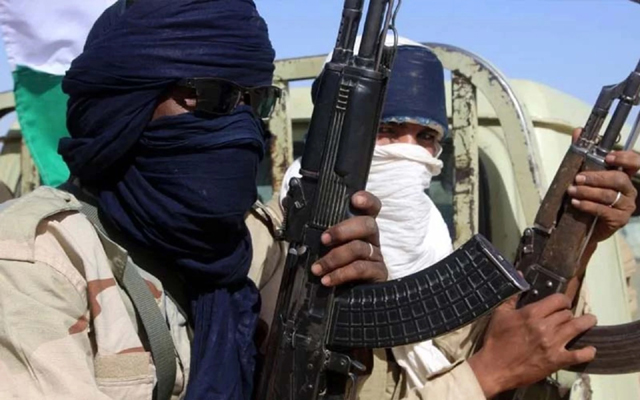
Do you think with alliances it claimed it has made with other jihadist organizations across the world the leadership of Boko Haram will still be open to negotiations like it was when the group was mainly a local affair?
You see, that is the difficult aspect of the whole thing because in the beginning we were with a group whose agenda is local, without any serious affiliation to any international terrorist organization. Now, we have a group that is acting as a franchise to a bigger terrorist organization and from which communications and directions with this group will now need the consent of their masters outside of Nigeria. But in all sense of the word, the use of force is very much necessary to help any process of dialogue. When the group find out they cannot win militarily, then they will begin thinking of ending their activities. But when they see they are on a pedestal of strength, they can still strike and inflict damage and they can kill as many people as possible, certainly the process of dialogue is not going to work. I do not subscribe to dialogue with a terrorist group, but we have found ourselves in a difficult situation whereby they are holding us by the groin with our children in their custody. And how we can get these girls out will also determine how we can prosecute this war. When you want to bomb a terrorist camp and you have children there, you have to now think twice abou what you would do. It happened in 2006 when terrorists in Russia took over a whole school and attempts to free those children led to the killing of more than 80 per cent of those children. So, I think we are in a situation in which we have to use force to protect our people, to assert our authority as a nation and as a Republic and we also have to open a window in which the girls have to escape.
As a senator, what would you attribute to the seeming difficulty in solving the problems inflicted on the Senate through the defiance of APC leadership by Senator Bukola Saraki and his caucus on the matter of the presiding and principal officers of the upper chamber?
The problem in the National Assembly is reflection of the party itself. APC is not a communist party; it is also not a socialist party. It was a convergence of strange political bedfellows with a common goal of evicting a common enemy which is the PDP and the Jonathan administration. The people were not brought together by ideologies, principles but by the compelling need to eject a tyrant and what they did was to unite to achieve that common goal, but what came out later is what can be called post-revolution crisis. Every revolution has a crisis in its aftermath- it has happened in Russia, United States, in countries that have experienced of revolution including China where after ejecting a common enemy, the people started fighting one another. If I should bring your mind back to the building blocks of APC, there was the ACN, there was the ANPP, there was the PDP and there was the CPC. Now, if you look at it from that very point, you will see that all the building blocks share very little in common and they do not have any history of fighting, living, working, failing or achieving together. Now, if you look at it from another point of view, Asiwaju Bola Ahmed Tinubu built the APC from the foundation to the lintel level, but it was also the new PDP that roofed the house. So, now we are in a situation whereby both sides are asking who owns the house and who should control the House. And that is where the problem is. Right now, the APC stands on a tripod of three Bs- Buhari, Bola Tinubu and Bukola Saraki. Now, if any of these is removed from the APC, the whole party crashes. So, the crises in the National Assembly is a reflection of the post-election crises which the party has found itself- the crisis of managing victory, the crisis of also managing the realities of our differences- that we have existed before. Reconciliation took place a few weeks ago, but the absence of Bola Tinubu and the Southwest party executives raises a lot of questions whether that reconciliation has actually worked or what the Southwest caucus of APC did was just to stay back and not cause any trouble and not endorse what was agreed upon. Another way to look at the issue is that this is a crisis that is projecting towards a post-Buhari era; there are interests that are interested in the presidency after Buhari. And now, everybody is trying to entrench himself and grab his own weapon with which he is going to fight the final battle. After our last meeting, people were told to bury their hatchets, but what most of the gladiators did was to bury their hatchets with leaves to which they can resort to anytime they want to start a fight. And if we zero in on the crisis in the National Assembly, there are two groups in the Senate- the Like Minded Group led by Saraki and the Unity Forum led by Lawan. Now, Saraki has proven to be a good doctor that has diagnosed the problems of the party and simply moved to achieve an advantage which has been able to work for him perfectly. Now, the other side was insisting on an ideal- that the party is supreme and it should decide what members should do and everyone is expected to comply. But they have no provision for a situation in which there was no compliance. Another point is that the supremacy of the party which was insisted upon by Asiwaju and Buhari stopped at the gate of the National Assembly. Once you are in the National Assembly, it is the pronouncements of the Senate President or the Speaker of the House that becomes law. So, the supremacy of the party is dependent on the goodwill and obedience of the presiding officers and not something that comes with a penalty. But we now found ourselves in a situation whereby we simply have to learn to live with it. Saraki now has the support of almost 85 per cent of Senators- both APC and the PDP. So, nothing at this very hour will be able to eject him as it is. And Dogara has also entrenched himself in the House of Representatives. There is nothing that can also eject him, including the party. The party has tongue, but it has no teeth. Now, the Tambuwal doctrine that was applied some years ago has now come into play- when we were in the opposition, we cheered and clapped when Tambuwal disregarded the party and emerged as Speaker. So, why should we now be crying when the same formula is being applied to us? I can remember we seriously commended Tambuwal for his action then, so why should we now condemn the very act which we commended a few years ago?
Leave a Reply