

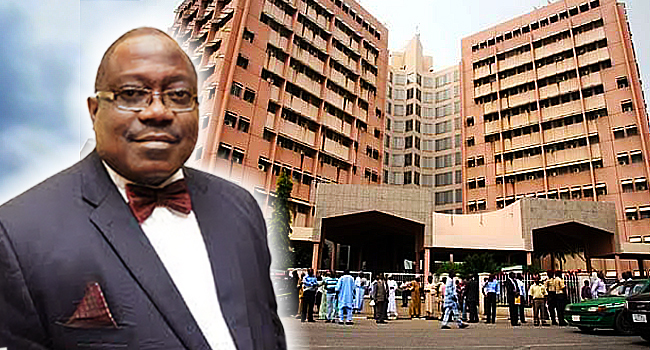
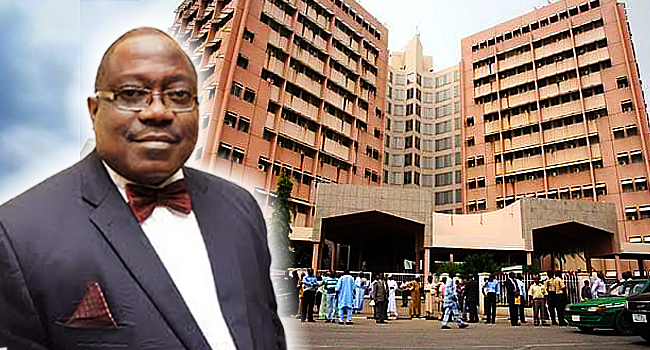
The Chairman, Federal Civil Service Commission (FCSC), Prof. Tunji Olaopa, has stressed the need for the rethinking of the training of public servants as a part of the reform to properly prepare the sector for the Fourth and Fifth Industrial Revolutions.
Olaopa spoke in Abuja on Wednesday during a courtesy visit to him by the Administrator of the Public Service Institute of Nigeria (PSIN) Barr. Imeh Okon and her management team.
According to Olaopa, the training of public servants in a bid to reprofessionalise them would be meaningless if it is not impactful.
To him, one major way to make the training impactful is to make it a part of performance for career progression as in the military.
“In this regard, we then must expand the criteria for career progression and promotion of officers to include training-based confidential assessments .
“This will make officers to take training seriously as they know that what they learn will count. This will in turn translate to better return on training investment as ROI for government – through rewiring of the suboptimal organizational brain and intelligence quotient (IQ) of service.”
Explaining the importance of the visit, Olaopa said that in view of the relevance of the manpower development institutes (MDIs) generally called government training institutions, it became necessary for leaders of the civil service to interact with their managers. He said that for him, the need for such interactions was reinforced by his decades of research on reform to reprofessionalise the civil service .
Olaopa noted that such reprofessionalisation would be done through training that would pave the way for skills upgrade to align with globally benchmarked professional skills for running the business of government as revised to accommodate new skills demands of the knowledge age .
According to him, training also ensures the rethinking of the intellectual bases of work and the world of work which underscores the deepening of the professionalisation of cadres, which has already been done in procurement and ICT while that of HRM is ongoing like planning, research and statistics departments to make them strategic partners in taking policy work in government and the policy process to the next level .
Noting that the FCSC was concerned with issues tied to reform to restore competency-based human resource and career management with strict merit-based and federal character policy compliant as order of business, he said that underscored the relevance of training and capacity development.
He noted the crucial roles of ASCON ( Administrative Staff College of Nigeria) and PSIN in the development of government workers. But he cautioned against the pitfalls of the duplication of the functions of these two institutes
In this regard, he said that their offerings to the public service ought to be strictly defined to be mutually reinforcing and for economies of scale.
Thus, for Olaopa, he wholly supports the vision of the Head of the Service of the Federation which entails elevating ASCON to the status of a School of Government, while the PSIN would focus on the civil service, building on the bureaucratic skills of officers.
On how to make the institutes more relevant, he urged that their faculty and their core skills must fit a scholar-practitioner-bureaucrat competency balance. He decried a situation of teaching theoretical contents that fit university standards, or MBA industry curriculum, which civil servants, bureaucrats, policy makers and development workers cannot relate with through role plays, case studies, video games or illustrations, thereby making courses offered by MDIs so disconnected from the reality of the world of work .
Olaopa recalled that in the days of his active service, ASCON was so structured in a way that it had a diversified faculty made up of borrowed faculty members drawn from career civil servants, policy experts, among others, deployed from time to time from the mainstream service; staff exchange between the service and MDIs, and others.
According to him, those were days when MDIs worked with the service to undertake training needs assessment (TNA) periodically. “It is on the basis of the evidence so generated that MDIs training programmes and courses are developed year in year out”, he said.
He said further that MDIs also had service guarantee designs that made them to follow up on their trainees for training impact assessment, and that this gave the MDIs the leverage to offer another level of service to the MDAs through performance consulting .
According to him, all this makes the partnership between the public service and MDIs a symbiotic one.
Earlier, the administrator of the PSIN said that the visit should have been done earlier as Olaop was a critical stakeholder.
Okon gave two reasons for the visit which were to introduce the team to Olaopa and to build a partnership with him .
She explained the functions of the PSIN to include training and research. She said that retiring civil servants should be sent to PSIN for retraining to equip them with the skills necessary for the world outside. She said that in view of the wealth of experience of Olaopa, the PSIN would have much to learn from him for the efficiency of the institute.


Leave a Reply