

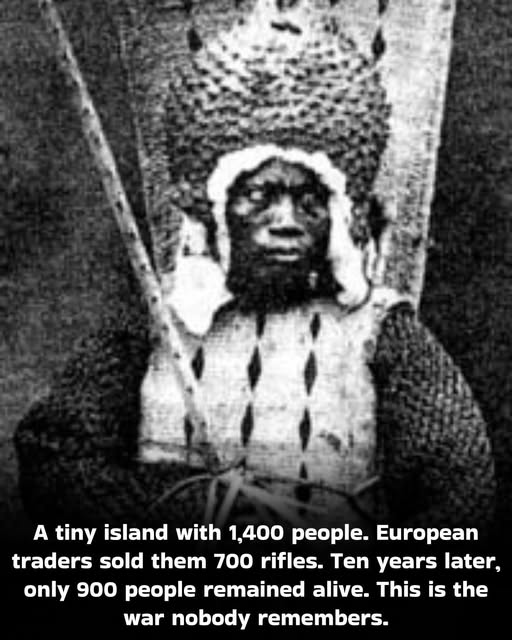
A tiny island with 1,400 people. European traders sold them 700 rifles. Ten years later, only 900 people remained alive. This is the war nobody remembers.
In 1878, Nauru was one of the most remote places on Earth. A tiny coral island in the Pacific—just 8 square miles, smaller than Manhattan—inhabited by about 1,400 people living in twelve different tribes.
For centuries, these communities had coexisted. They had conflicts, certainly—disputes over fishing rights, boundaries, resources. But these disputes were settled with spears, clubs, traditional weapons that limited how deadly conflict could become.
Then European and American traders arrived. And they brought guns.
The traders didn’t come to conquer Nauru. They came for coconuts, for fresh water, for provisions. They came to rest between longer voyages across the Pacific.
And they sold rifles to the islanders.
At first, it seemed like a simple transaction. The Nauruans traded coconuts, fish, and supplies for these powerful new weapons. Some tribal leaders saw rifles as a way to gain advantage over rivals. Others bought them defensively, afraid of being outgunned.
Within months, Nauru had hundreds of firearms. And no one understood what they’d unleashed.
In 1878, a dispute erupted between tribes. The details are lost to history—it might have been about land, about fishing, about a personal insult. The kind of dispute that had happened countless times before.
But this time, both sides had rifles.
The fight that would have once ended with a few injuries and negotiation instead became a massacre. Guns turned minor conflicts into bloodbaths.
And once the killing started, it didn’t stop.
What began as a single tribal dispute cascaded into a decade-long civil war that consumed the entire island.
Twelve tribes, each armed, each with grievances against others, each seeking revenge for previous attacks. Alliances formed and broke. Families were torn apart. The island—just 8 square miles—became a battlefield with nowhere to escape.
The weapons that were supposed to provide security had created catastrophe.
Nauru’s traditional society had systems for resolving conflict, for limiting violence, for restoring peace. But rifles overwhelmed all of those systems.
Traditional leaders who’d once mediated disputes found their authority meaningless when anyone with a gun could ignore them.
Young men who would have been constrained by community pressure now had the power to act independently, with deadly force.
The social structures that had maintained peace for centuries collapsed in the face of firearms.
The war was brutal. Tribes attacked each other’s settlements. People were killed in raids. But the indirect deaths were even more devastating.
With constant warfare, farming became impossible. Fishermen couldn’t go to sea safely. Food production collapsed.
Famine spread across the island. People died not just from bullets but from starvation.
Families fled their traditional lands, becoming refugees on their own island. But Nauru is so small—you can walk across it in an hour—that there was nowhere truly safe to go.
The population began to collapse.
In 1878, Nauru had approximately 1,400 people. By 1888, fewer than 900 remained.
Five hundred people dead. More than one-third of the entire population, lost in a single decade.
For perspective, imagine if the United States lost 110 million people to civil war in ten years. That’s the proportional devastation Nauru experienced.
Entire families were wiped out. Whole lineages ended. The cultural knowledge held by elders—stories, traditions, skills—died with them.
The island was destroying itself, and there was no clear path to peace. Tribal leaders who wanted to end the fighting couldn’t enforce agreements when both sides had rifles and neither would disarm first.
It was a classic arms race dilemma, shrunk down to an island you could walk across in sixty minutes.
Then, in 1888, the German Empire arrived.
Germany was expanding its colonial empire in the Pacific, claiming islands for their resources and strategic value. Nauru, rich in phosphate deposits (though this wasn’t yet widely known), became part of German New Guinea.
German colonial authorities found an island in ruins. A population decimated. Communities shattered. Constant violence.
The Germans had no interest in negotiating between tribes or mediating complex grievances. They had a simpler solution: disarmament.
German administrators announced that all firearms must be surrendered. Anyone caught with a weapon would face severe punishment.
Then they went village to village, collecting rifles.
In total, the Germans confiscated over 700 rifles from the island—from a population that now numbered fewer than 900 people. Nearly one gun for every surviving person.
Without firearms, the violence stopped almost immediately.
Tribes still had grievances. People still wanted revenge. But without rifles, they couldn’t wage war the way they had for the previous decade.
Traditional conflict resolution systems—weakened but not destroyed—could begin functioning again. Leaders could negotiate. Communities could start rebuilding.
The war was over, not because people made peace, but because they were disarmed by force.
Under German rule, Nauru began a slow recovery. The population stabilized and eventually started growing again. People returned to farming and fishing. Communities rebuilt.
But the scars remained. Five hundred people gone. Knowledge lost. Families destroyed. An entire generation traumatized.
In the decades that followed, Nauru’s history would be dominated by colonial powers and phosphate mining. Germany ruled until World War I. Then Australia took control. The island gained independence in 1968.
Today, Nauru is known primarily for phosphate mining (which made it briefly wealthy, then environmentally devastated), for being one of the world’s smallest countries, and for hosting an Australian immigration detention center.
The ten-year civil war is often just a footnote in Nauru’s history. But it shouldn’t be.
Because Nauru’s war teaches us something crucial about technology, conflict, and small societies.
The introduction of firearms didn’t just change how Nauruans fought. It destroyed the systems that had prevented total war.
Traditional societies had evolved ways to limit violence—cultural norms, mediation, weapons that made mass killing difficult. Rifles bypassed all of that.
Suddenly, any dispute could become lethal. Any angry young man could start a massacre. Any tribal conflict could spiral into total war.
The same pattern has played out across human history. Groups that coexisted for centuries start destroying each other when new weapons arrive. Not because people become more violent, but because the tools of violence become too powerful for existing social controls.
Nauru was just 8 square miles. Fewer than 1,500 people. And still, the introduction of rifles nearly destroyed the entire society.
It’s a stark reminder that size doesn’t protect you. That isolation doesn’t save you. That when technology outpaces social structures, catastrophe can follow.
The German intervention ended the war, but it came at the cost of Nauruan sovereignty. Colonial rule brought peace but also exploitation.
It’s a complicated legacy. The Germans stopped the killing. They also colonized the island, exploited its resources, and imposed foreign rule.
Today, Nauru remains one of the world’s smallest and most isolated countries. Most people have never heard of it. Even fewer know about its civil war.
But the story matters. Because it shows how fragile peace can be. How quickly societies can unravel. How external forces—whether traders selling guns or colonizers imposing order—can reshape entire communities.
Fourteen hundred people. Seven hundred rifles. Ten years of war. Five hundred dead.
The island that almost destroyed itself over weapons it never should have had.
The war nobody remembers that nearly erased an entire nation.
*This is a This Day in History Post



Leave a Reply