

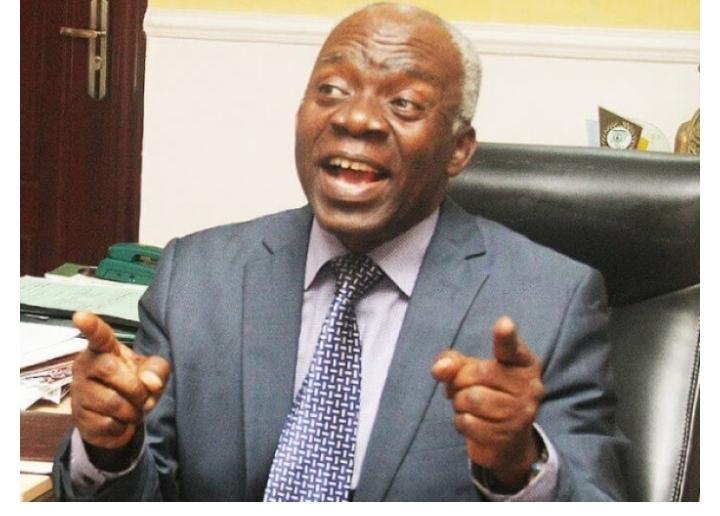
Mr Femi Falana, a Senior Advocate of Nigeria and the Chair, Alliance on Surviving Covid 19 and Beyond (ASCAB) has said that the Federal Government should lead by example by funding the welfare programmes that have been codified in Nigeria.
In particular, he argued that the Social Investment Programme Agency Act 2023 has imposed a duty on the Federal Government to fund the following poverty reduction programmes.
Falana said this in a statement he signed on Monday 4 August 2025, published below
Time to fund welfare programmes for the poor citizens
By Femi Falana
While addressing the Governors elected on the platform of the All Progressive Congress about two weeks ago, President Bola Tinubu
acknowledged the terrible economic hardship being experienced by poor citizens as a result of the implementation of neoliberal policies. The President said that “Nigerians are still complaining at the grassroots. To you, the governors, you must wet the grass more and deliver progressive change to Nigerians. May God bless our democracy and grant us more fertile lands.”
The Federal Government should lead by example by funding the welfare programmes that have been codified in Nigeria. In particular, the Social Investment Programme Agency Act 2023 has imposed a duty on the Federal Government to fund the following poverty reduction programmes:
i. N-Power programme — an initiative aimed at building the skills of youth and promoting entrepreneurship.
ii. Government enterprise and empowerment programme (GEEP) — an intervention to address the challenges of access to credit facilities and to provide soft loans to Nigerians through the trader moni, market moni and farmer moni initiatives.
iii. National home-grown school feeding programme (NHGSFP) — an initiative to provide one nutritious meal a day to public primary school pupils to increase school enrolment, reducing the incidence of malnutrition.
iv. Conditional cash transfer (CCT) programme — an initiative to provide cash transfers to vulnerable households as grants.
In January 2025, President Bola Tinubu was reported to have approved the release of N32.7 billion for the implementation of the National Social Investment Programme (NSIP), a key initiative designed to support the country’s most vulnerable groups.
A government that recently claimed to have spent the sum of N39 billion for the renovation of the International Conference Centre at Abuja at the Federal Capital Territory cannot justify the allocation of N32. 7 billion to fund the National Social Investment Programmes for 2025 to support the 133 million people that are said to be multi-dimensionally poor in the country.
Instead of begging state governments to “wet ground more”, President Bola Tinubu is urged to ensure that the National Social Investment Programme Agency Act is adopted and enacted into law by the 36 state governments in Nigeria, rather than committing billions to renovating state houses while the masses wallow in abject poverty.p They can fund effective social investment programme in view of the fact that a total of N11.195 trillion disbursed to the 36 states and local governments as well as the Federal Capital Territory through the Federation Accounts Allocation Committee (FAAC) in the past one year.
A few months ago, BudgIT, an organisation which promotes budget transparency and accountability in Nigeria and other African countries, revealed that the 2025 budget of the Federal Government was padded with 11,122 projects worth N6.93 trillion by the National Assembly. It said the amount discovered in the budget represents 12.5% of the N54.99 trillion budget signed into law by President Bola Ahmed Tinubu on February 28. Apart from implementing the so called constituency projects, every Senator and every member of the House of the House of Representatives receive a monthly emolument of N21 and N15 million, respectively.
At its meeting held at the Presidential Villa last week, the Federal Executive Council approved the sum of N3. 5 trillion for Roads, Airports and other infrastructure. Therefore, the Federal Executive Council should, as a matter of urgency, approve not less than N5 trillion to fund the National Social Investment Programme. However, the fund should be managed by the accredited representatives of the Federal Government, elected representatives of trade unions and other credible civil society groups.
Femi Falana SAN,
The Chair,
Alliance on Surviving Covid 19
and Beyond (ASCAB)


Leave a Reply