

Achieving this objective on its own would have been difficult as its North African militants did not master the region’s human and physical terrain as well as they had ideologies and aspirations of the desert-dwelling Tuaregs. So the jihadists changed their strategy from recruiting sub-Saharan Africans to helping them form their own groups with local ideologies that appealed to people in the region in a way that AQIM’s ideology did not. Hence the historical context put forth by Ansaru.
In this vein, AQIM oversaw the formation both of Ansaru and the Mali-based Movement for Unity and Jihad in West Africa (MUJAO), which later became part of al Murabitoun, a notorious Islamist group led by AQIM founding member Mokhtar Belmokhtar.
The way these organizations split off and spin off suggests just how difficult it is to identify, target, and disrupt the activities of jihadist groups whose venomous heads multiply more quickly than those of the mythical Hydra.
Ansaru’s al Barnawi, for instance, trained under Belmokhtar and even fought under the militant leader in Mauritania and Algeria in the mid-2000s when the terror kingpin was military commander of AQIM. MUJAO’s military commander, Oumar Ould Hamaha, an Arab from northern Mali and a relative of Belmokhtar’s, had been an AQIM kidnapping mastermind. The two groups also adopted names that explained their desired areas of operation. Ansaru’s Biladis Sudan translates to Black Africa while MUJAO’s Gharb Afriqqiya translates to West Africa.
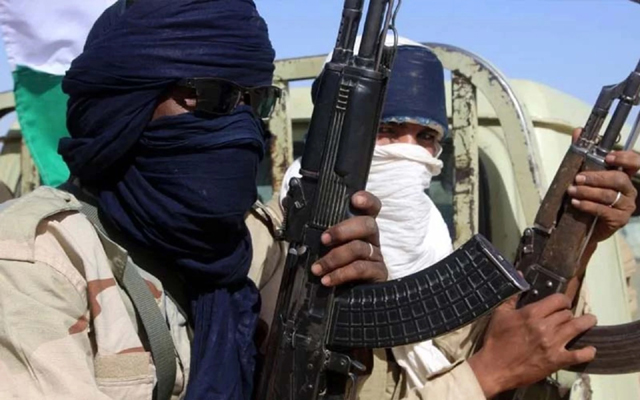
The two terror groups had designated areas of operations at their creation and may have been the elite units AQIM trained for attacking Western interest in the Sahel. Ansaru operated in northern Nigeria and southern Niger, and MUJAO operated in Mali, Senegal, Algeria, and Mauritania. Both groups considered themselves to be the ideological descendants of Usman dan Fodio and other pre-colonial West African Islamic leaders who fought the colonial invaders.
AQIM has always taken responsibility for attacks, especially those carried out by Ansaru. When a German engineer, Edgar Fritz Raupach, was kidnapped in Nigeria’s northwestern city of Kano on Jan. 26, 2012, the same day Ansaru announced its split from Boko Haram by circulating flyers in Kano, AQIM’s official media wing, al Andalus, took credit for the abduction. In a video sent to ANI in Mauritania it demanded that Germany release from prison a Turkish-born female jihadist website administrator whose German husband fought with the Taliban in Afghanistan and was arrested in 2007 while planning to bomb Ramstein Air Base, a key American installation in Germany.
Nigerian forces then carried out a rescue operation of Raupach in May 2012, but the captors shot the German immediately. AQIM, rather than Ansaru, again warned European nations against using force to resolve kidnappings and specifically warned Germany to stop violating Muslim holy sites.
Ansaru up until this time never took responsibility for attacks it carried out; rather, it always let AQIM take the credit, despite evidence that AQIM did not operate directly in Nigeria.
In the case of Raupach, security sources said the German’s abduction had been masterminded by Ansaru’s Abu Mohammad, whom Nigerian authorities say died in custody of gunshot wounds sustained during his arrest in the northwestern town of Kaduna.
“This group [Ansaru] doesn’t always take responsibility for its attacks,” said Ushie Michael, a prominent Nigerian security analyst. “They just want to do what AQIM wants them to do.”
After the death of Abu Mohammad, and the disappearance of his mentor, Khalid al Barnawi, Ansaru became loosely organized. Its militants began to travel up north into Mali to realign with the parent group, AQIM.
The report in 2012 that dozens of Nigerian militants attacked the Algerian consulate in northern Mali and in 2013 that Ansaru literature was found in Belmokhtar’s compound in Gao the day after he fled the city did appear to confirm that Ansaru’s operation was now coordinated from Mali.
“Many of Ansaru’s militants are well trained, well educated, and have huge respect for al Qaeda’s leadership in Algeria,” said Mohammed Yusuf, an Arabic scholar based in Nigeria’s northeastern Maiduguri. “They see their mentors as lords and will do anything for them.”
In a New York Times dispatch from 2013, an Ansaru militant, Mujahid Abu Nasir, said he considered notorious AQIM commander Abu Zeid to be a personal mentor and “a wise somebody.”
Leave a Reply