

Abdullahi Hamza
“The very emphasis of the commandment: Thou shalt not kill, makes it certain that we are descended from an endlessly long chain of generations of murderers, whose love of murder was in their blood as it is perhaps also in ours.”
“[W]ar cannot be abolished; as long as the conditions of existence among races are so varied and the repulsions between them are so vehement, there will have to be wars. The question then arises whether we shall be the ones to yield and adapt ourselves to it. Shall we not admit that in our civilised attitude towards death, we have again lived psychologically beyond our means? Shall we not turn around and avow the truth?
Were it not better to give death the place to which it is entitled both in reality and in our thoughts and to reveal a little more of our unconscious attitude towards death which up to now we have so carefully suppressed? This may not appear a very high achievement and in some respects rather a step backwards, a kind of regression, but at least it has the advantage of taking the truth into account a little more and of making life more bearable again. To bear life remains, after all, the first duty of the living. The illusion becomes worthless if it disturbs us in this.”
This ancestral inheritance Freud describes does not manifest equally in all men; it pools in the ambitious — in Tehran’s mullahs, in Jerusalem’s strategists, in Washington’s architects of foreign policy — each mistaking their particular pride for the will of their tribe or their God. The tragedy of unyielding conviction lies in the graveyard of missed opportunities stretching across the Persian Gulf. When strong-headedness is rebranded as “divine resolve” or “national security doctrine,” compromise is viewed not as a tool for survival, but as a stain on one’s legacy.
This psychological deadlock transforms leaders into architects of their own isolation: Iran builds walls of intransigence around its nuclear ambitions; Israel builds walls of security around its existence; America builds walls of sanctions and sabotage. They stare across these barriers until they can no longer see the humanity of those on the other side. In this rigid posture, the weight of pride becomes a crushing burden, ensuring that even when a path to de-escalation appears; a paused centrifuge, a withheld strike, a returned diplomatic call, it is ignored in favour of a familiar, albeit fatal, consistency.
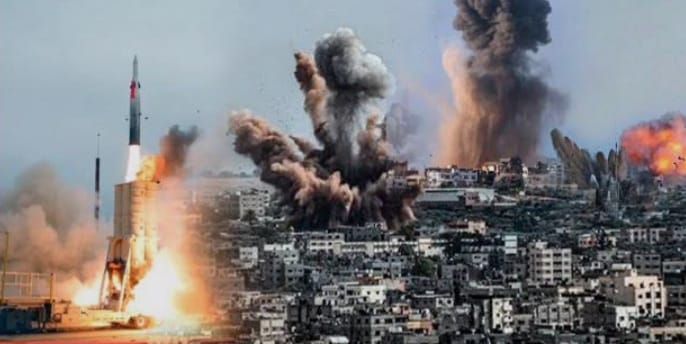
War, in its futility, is a cycle of high-interest loans paid for in the currency of the next generation’s blood; whether Iranian, Israeli, or American. It is an exercise in diminishing returns where the “victor” often inherits nothing but a more expensive version of the status quo and a fresh set of ruins to govern. Each Israeli F-35 sortie and each Iranian missile salvo serves only to fertilise the soil for future grievances, proving that while a nuclear facility can be leveled by a bomb, the idea of regional hegemony can never be buried by a tank.
The machinery of conflict produces a singular, haunting output: a realisation that after the smoke clears over the Middle East, the original problem remains — a Persian leadership seeking influence, a Jewish state seeking security, a superpower seeking stability — now accompanied by a thousand new reasons to weep.



Leave a Reply