

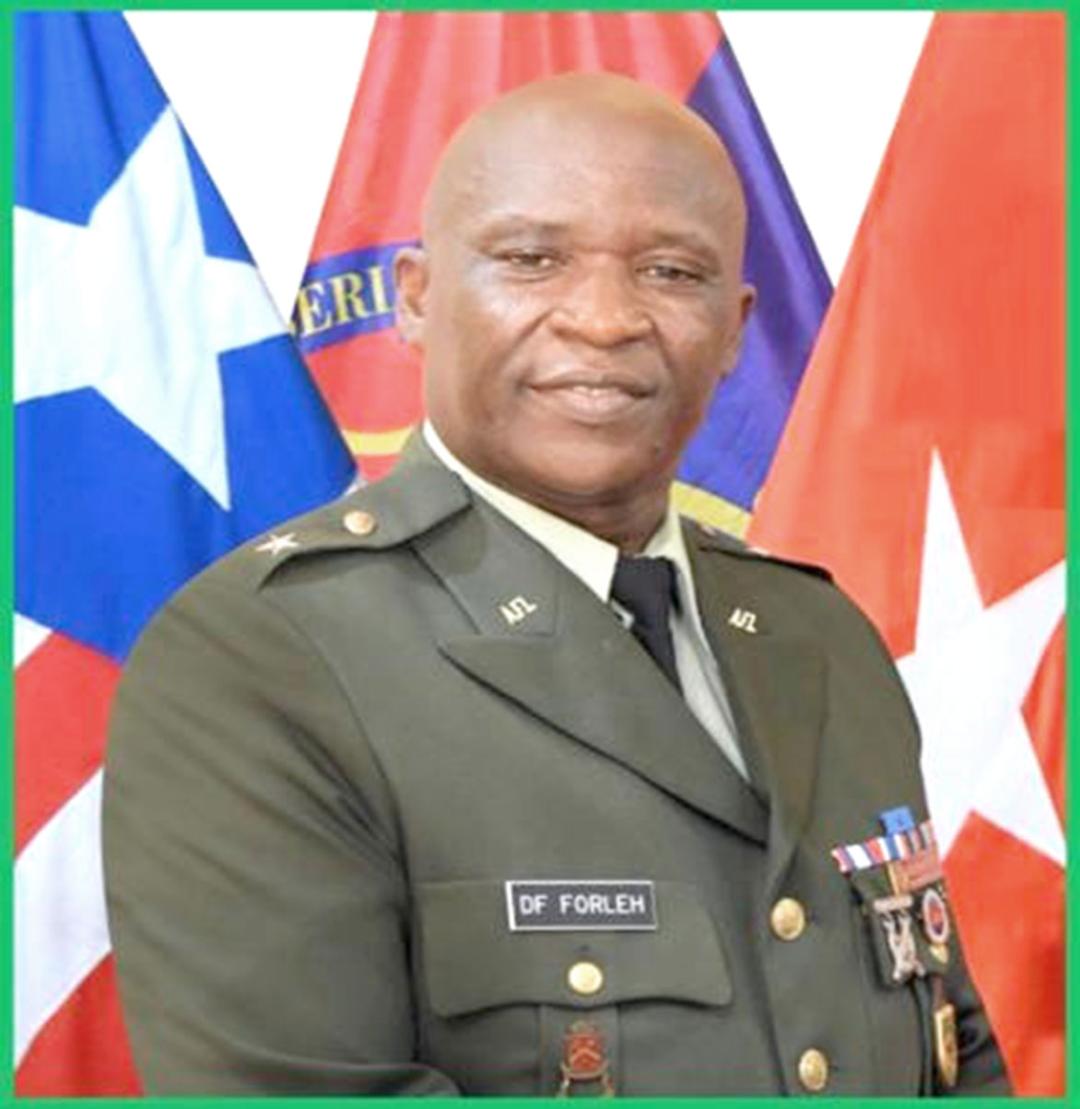
Liberia Chief of Defence Staff, General Davidson Fayiah Forleh
Liberia’s Chief of Defence Staff, General Davidson Fayiah Forleh, was appointed by President Joseph Boakai on February 1, 2024. Forleh has an unbroken record of service in the Armed Forces of Liberia (AFL) for 17 years, sequel to a security reform that ushered in a new Armed Forces of Liberia (AFL). He was among the first crop of recruits in 2006, with training in USA and Nigeria. In this exclusive interview with Abubakar Hashim, General Forleh spoke on the new Armed Forces Liberia that is constitutionally democratic, the military relations with Nigeria, and related developments in West Africa
What is the current state of the Armed Forces of Liberia (AFL)?
The Armed Forces of Liberia (AFL) is now a new Force for good. It’s totally submissive to the civil democratic order and professionally inclined.
It’s apolitical, strictly professional to military engagements and procedures. The AFL has participated in various international peace-building and peacekeeping exercises globally. I was among the first batch of recruits in 2006. Since then, the AFL has demonstrated total loyalty to the civil rule of law.
What is the current relationship between Liberia and Nigeria in military capacity building?
That’s a very interesting question. Nigeria has been supportive of Liberia for many years. It continued even after the war. Nigeria remains one of Liberia’s strongest and oldest military partners.
Since the civil conflict, Nigeria has been instrumental in helping rebuild the Armed Forces of Liberia, first through ECOMOG. You remember during the civil war, then through the right mentorship in training teams. During the restructuring of the force, you can recall the Cotonou agreement that calls for the African standby force, where you have our African brothers coming to our soil.
At the first time, it was a peace intervention, then it became peacekeeping, then they went to peacebuilding. Nigeria played a vital role. The first group of military personnel that landed on our soil was from Nigeria, right after the war. Today the relationship is very warm, active, and mutually respectful.
Nigeria continues to support Liberia through training opportunities, advisory support, joint courses at its major military institutions, and strategic guidance.
The recent engagement between the Armed Forces of Liberia and the Nigerian Army under the leadership of Lieutenant General Waidi Shaibu, the current Chief of Army Staff, has further strengthened this relationship.
If you can recall, General Abdul Rahman was one of the Chiefs of Staff who was sent here to give mentorship and training to the Armed Forces of Liberia.
The AFL had had two Nigerian Generals and they were sent here to mentor the young Army of which I am a member.
In 2005, we got recruited into the military, and because we were new recruits, so we had to equalize, had to arrange for a certain general and that was General Yusuf in 2005, who is late. Then, after his administration, came Major General Suraj Alo Abdurahman.
The Nigerians were to provide mentorship and leadership, together with some training, along with the United States Government. So this is how far we have gone from the AFL perspective.
Nigeria is not just a partner, it is an elder brother that has consistently invested in Liberian peace, stability, and military professionalism. As Chief of Staff, I was also trained in Nigeria.
I did my senior division at the Command and Staff College in Jaji Kaduna in 2012. So I was privileged to have attended that prestigious military institution where officers are turned into staff officers, having a very limited stay in the armed forces of Liberia. Then I went to Jaji. I think that was a plus, not only for me.
A lot of our officers at this headquarters and even at the brigade and other units, are privileged to have gone to Jaji at the Armed Forces Command and Staff College, where we did our first schools at a senior division. At the same time, we’re also privileged to also do a Master’s program. I did my Master’s program at the Nigeria Defense Academy in the same 2012 when I obtained a Master’s degree in International Affairs and Defence Studies.
Nigeria remains our partner, and we also look at them as a big brother when it comes to supporting our military.
How many Nigerian military advisors are currently in Liberia and at what capacity?
At present, Liberia hosts a small but high-powered Nigerian advisory. Senior Nigerian officers are serving in strategic mentorship roles.
These advisors support the AFL in professional development of officers training, coordination, strengthening staff procedures, and enhancing Nigerian/Liberian military corporations.
The initial staff officers in the AFL were all Nigerians and Ghanaians. I remember G7 was a retired Major General. He was a J7, by then Chief of Training.
Then I remember General Okoro was also here. He played a very major role.
General Shaibu was here; currently, we have over 12 of them that are still working alongside our military, advancing our commanders in some strategic areas in the military.
Do Liberian military personnel still undergo strategic training in Nigeria?
Absolutely, yes. Like I told you, I happen to be one of the first to go through the Commanding and Staff College. Then I did the Master’s program. Then a lot of other officers followed. At present, we have one Major Doulo at the Command Staff College. And this has been happening for almost two decades. The AFL continues to send both officers and NCOs to Nigerian military schools for professional courses. In fact, at one point we had to send 200 at the time, a company size. And that was led by my present Deputy Chief of Staff. And they did what we call the Jungle Welfare School. And these were the people who were sent to the Sapo Forest, to clear the Sapo Forest upon the President’s mandate. So because of the training they got from Nigeria, we can impart in Liberia today.
Our people have attended the Nigerian Defense Academy, NDA. We have been at the Armed Forces Command and Staff College in Jaji. We have the Army War College of which a lot of our officers attended. We have our defense trainings at the Defense College in Nigeria. We have also had officers attending these institutions’ specialty courses in engineering, logistics, infantry, and administration.
Nigerian army training institutions provide these courses for our military.
How do you rate Nigeria’s development activities not only in Liberia but in the West African region? As a military officer who has undergone strategic training in various important courses, you are vast, not only in military duties but in other strategic development areas. So how do you assess Nigeria’s development activities in terms of support in the West African region, not only in Liberia, but in neighboring West African Countries like Sierra Leone, The Gambia, Guinea and others? What’s your assessment of Nigeria’s development activities so far in the West Africa region?
You would agree with me, and a lot of other people would agree with me that Nigeria stands as a major power in West Africa, that is, politically, economically, and militarily.
It is the region’s largest economy; it has the largest population, and capable armed forces that helped Liberia. Nigeria’s leadership in peacekeeping, democratic promotion, and regional stability has been invaluable.
Nigeria consistently played a frontier role in ECOWAS decision, conflict resolution, and capacity building for small states like Liberia. Nigeria is a cornerstone of West Africa’s development and security architecture.
Liberia deeply values its continuous leadership and friendship. Today, you can see that in Liberia, our Nigerian brothers are involved in a lot of trade.
If you go across the Bushrod Island around the Vai and Clara Town, these places are dominated 95 to 98% by Nigerians in automobiles. They help us a lot in the trading sector. It’s not just in Liberia, you go to Sierra Leone, you see the same thing. You go to The Gambia, you see the same thing.
Even Guinea and Cote d’, Ivoire, because I have traveled to all these places, they have a very good population and they are engaged in a lot of businesses, trying to bring some level of economic stability. In the formal sector, Nigeria dominates extensively. Dangote has spread all over West Africa and beyond in 17 African countries. Nigeria is impactful when it comes to economic activity, and it bolsters West Africa and Liberia, of course.
Leave a Reply