

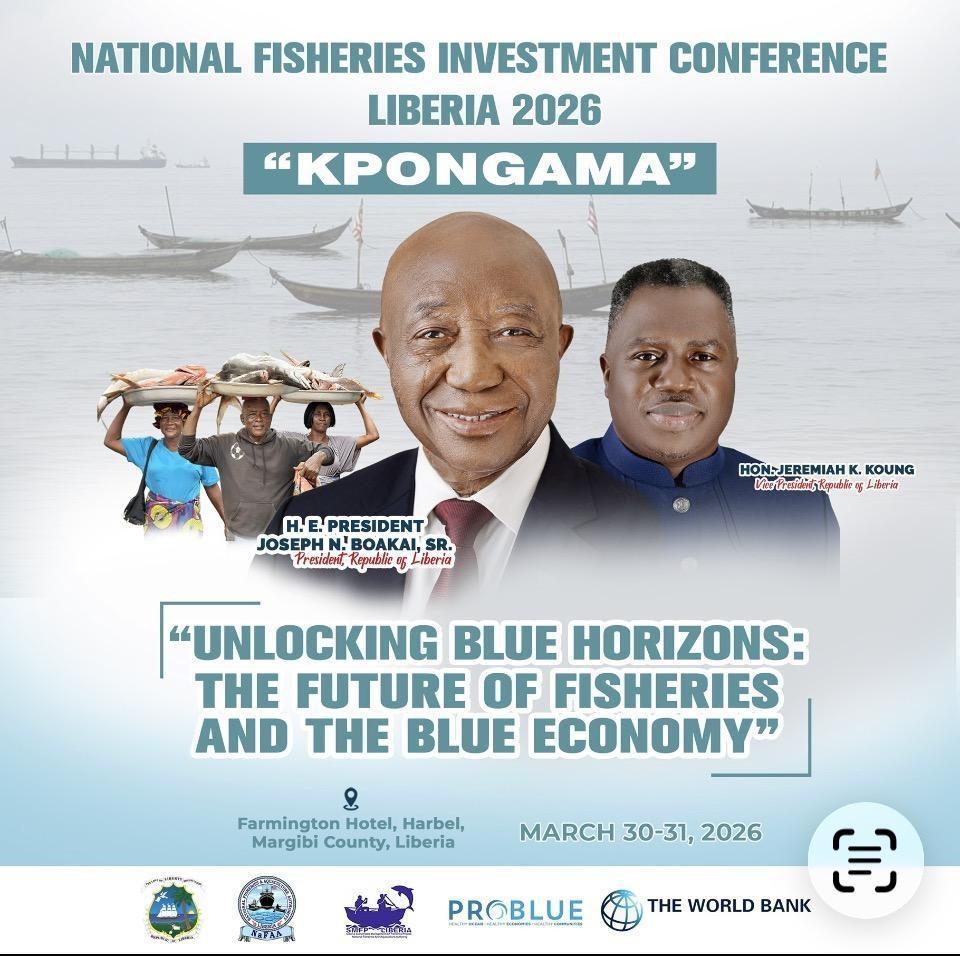
Liberia is casting its net wider than ever before. In a historic move to position the country as a regional hub for aquaculture and blue economy innovation, the Government of Liberia, through the National Fisheries and Aquaculture Authority (NaFAA), announced the KPONGAMA National Fisheries Investment Conference, which will take place on March 30–31, 2026, at the Farmington Hotel in Margibi County.
The conference, styled and named KPONGAMA—meaning “large gathering” in the Kpelleh language—is a landmark event, bringing together private sector actors, development partners, government ministries, agencies, and commissions (MACs), philanthropic organizations and others
The conference underscores the Government’s commitment to modernizing Liberia’s fisheries sector, enhancing transparency, and promoting sustainable economic growth.
A Convergence of Policy, Investment, and Partnerships
KPONGAMA 2026 will be more than a traditional conference; it is a high-level platform designed to attract private investment, foster public-private partnerships, and catalyze policy reform. The event will see the President of the Republic of Liberia launch three transformative frameworks that would chart the future of Liberia’s fisheries and aquaculture sector:
- Liberia’s 10-Year Strategic Plan for the Fisheries Sector, providing a roadmap for sustainable growth and industrialization,
- A comprehensive Fisheries and Aquaculture Investment Plan, aimed at mobilizing public and private capital, and
- The National Aquaculture Strategy, designed to expand aquaculture from a subsistence activity to a commercially viable and export-ready sector.
The Blue Investment Marketplace: Unlocking Opportunities
One of the conference’s standout features will be the Blue Investment Marketplace, a showcase designed to highlight bankable opportunities across the fisheries value chain. Investors and stakeholders will explore ventures including:
- Commercial aquaculture and fish farming systems,
- Cold-chain logistics, storage, and processing infrastructure,
- Solar-powered fish preservation and post-harvest technologies,
- Hatchery development and fingerling production,
- Fish feed mills and supply chains, and
- Laboratories and quality assurance systems aligned with international standards.
Building on Real Progress
The KPONGAMA conference builds upon significant strides already achieved under the LSMFP. Notable milestones include:
- The disbursement of Women’s Empowerment grants, providing financial and technical support for women-led fisheries enterprises.
- The reconstruction of the Klay Hatchery in Bomi County, set to enhance national aquaculture production and support fish feed supply
- Ongoing reforms under the Semi-Industrial Fisheries Management Plan, which is to regulate fishing practices, enhance compliance, and ensure sustainable resource management.
Liberia Sets Sail into the Future with the Launch of Sea King
Liberia has officially charted a bold new course in fisheries development with the commissioning of Sea King, the country’s first-ever semi-industrial fiberglass fishing vessel—a historic milestone signaling the dawn of a modern, inclusive, and investment-ready fisheries sector.
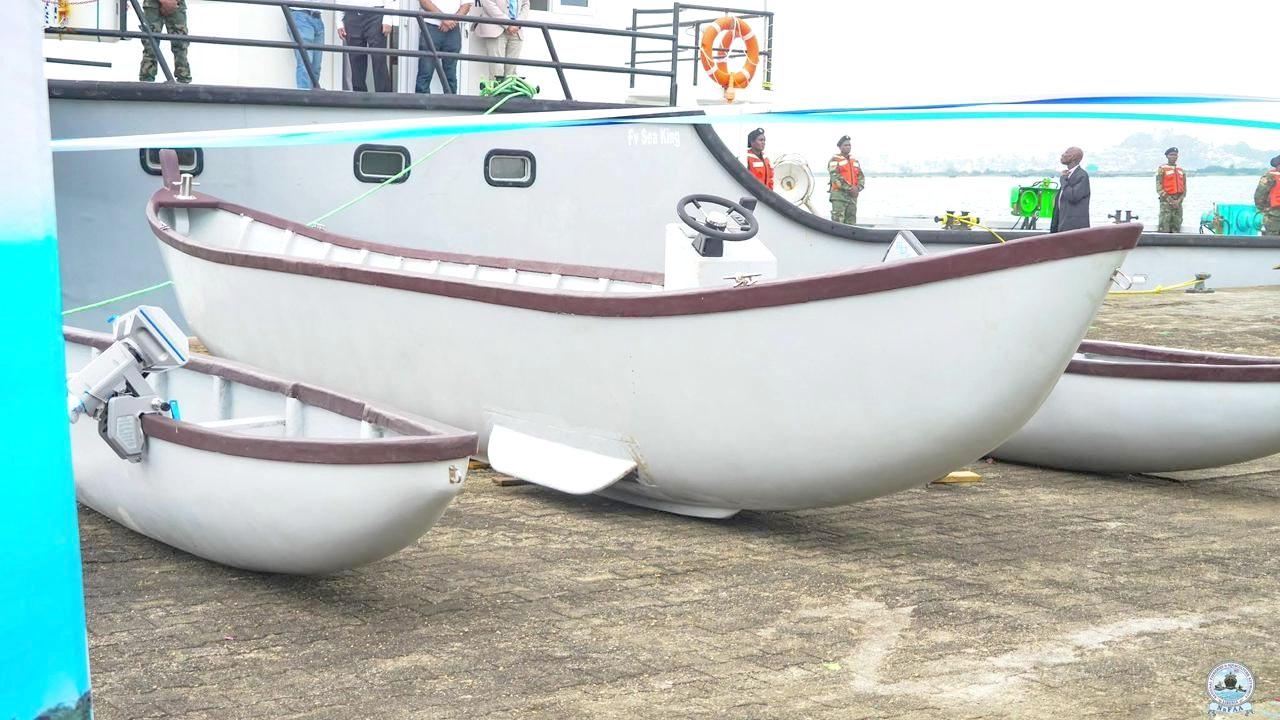
The landmark ceremony, held at Mesurado Pier, was more than a vessel launch. It was a declaration of intent. Alongside the Sea King, three of twenty-three newly constructed fiberglass Kru and Fanti canoes were unveiled.
A Vessel, A Vision, A National Awakening
Describing the occasion as “not just a milestone, but a national awakening,” NaFAA Acting Director General, Mr. J. Cyrus Saygbe Sr., highlighted the profound significance of Liberia’s Sea King semi-industrial fishing vessel.
In a complementary stride toward innovation, 23 artisanal fiberglass canoes have also been fabricated as part of Liberia’s climate-smart and environmentally friendly fisheries program.
Government Commitment at the Highest Level
The commissioning ceremony was presided over by Vice President Jeremiah Kpan Koung, representing President Joseph Nyuma Boakai. He emphasized the administration’s ambition to transition marine fisheries into a fully industrialized and competitive sector—one capable of reducing fish imports, generating employment, and creating wealth for coastal communities.
Empowering Artisanal Fishers and Women Entrepreneurs
While the Sea King will operate under a transparent Public–Private Partnership (PPP) framework, the fiberglass canoe program places artisanal fishers at the center of reform.
Global Confidence, Local Impact
World Bank Country Manager, Ms. Georgia Wallen, described the initiative as a pivotal step toward building a modern and investment-ready fisheries sector. She highlighted the importance of inclusive engagement, infrastructure development, and skills training—particularly for women and youth—as essential pillars for sustainable growth.

Leave a Reply