

By Ademola Araoye
Nigerian statehood is anchored on a hegemonic falsehood around every facet of its life. That applies to its claim to nationhood. The imperative to sustain glaring myths as sacred facts has been the bedrock of the perennial political instability and turbulent inter-communal relations that have characterized Nigerian statehood and its claim to nationhood. Accordingly, the pervasive falsehood in plain sight is at the heart of all the demons that continue to haunt it as a state and its febrile nation. At another level, that overarching falsehood motorizes the atrocious opportunism that underpins the operative mantra of all the human agencies operating in its dystopian universe. Denials, dissembling and the abdication from truth are the convenient immoral elite settlement across the board as a national motto. See, hear and smell no evil and all shall be well. In the face of grating empirical realities, falsehoods are bandied. The longitudinal mirror image is so ugly that the nation has spared itself the agony of acknowledging its own monstrosity. The past has a capacity to haunt. The outcome of this contrived derogation from the natural order is expectedly tragic. Unfortunately, in the fullness of time, every falsehood must crumble in the light of the undeniable factual. It is the law of the essential indissoluble human truism. We have lived in an age and era when the validated fad has been the instigated repudiation of the very quintessence of our truths in favor of a vacuous myth.
Yet, the falsehood is strategic to Nigeria’s claim to statehood and nationhood. It can be forgiven. A myth can acquire the impulses of the factual and reality in certain human situations. To attain that height though, everyone must live that myth constructively as a desired reality. As sociologists affirm: When men define a situation as real, they are real in their consequences. The real challenge of Nigeria is the insolent and indolent determination of its critical opportunistic human agencies to live the myth of Nigeria’s nationhood like the myth that it is. The myth is exploited not for the good of the generalized public or the universal commonwealth but directed to fulfil the dubious aspiration of individuals and the controversial agenda of partisan groups. Thereby, the process engendered by the dynamic of ordained national immorality perpetuates the myth. The state is condemned to lie at all levels to protect the hegemonic falsehood on which it is founded. The truth in relation to our past and present is that Nigeria had no founding fathers. Instead, Nigeria was born into the hands of ethno-regional and clerical gladiators who labored implacably to advance partisan hegemonic projects. The ultimate objective has been the appropriation and partisan control of the totality of the socio-cultural and political space. Toward that end, convenient ad hoc alliances, with domestic, transmestic (elements across contiguous national borders) and external allies, were forged and irresolvable enmity were consecrated. Accordingly, the struggle for ethno-regional/religious partisan appropriation of the totality of the state space has been the central motif our national life. Embedded in the unending struggle for partisan totalistic appropriation of the state is the seed of the ultimate unravelling of the experiment of a multi-national state. In the course of the nasty struggle, every, and all means available, from the manipulation of ethno-regional to religious sentiments, have been instrumentalized in our inter-communal throes to maim, kill and decimate our neighbors. Death or submission. The compromised state is counted on to blatantly lie about our reality in order to keep the nation afloat. The survival of the state is above all. No sacrifice in blood and souls extinguished is too costly for the state to live. Our wounding or some would say founding, fathers often economized on truth saying, although some did not hide their contempt for other worldviews and cultures. The wounding fathers handed stained and dirty banners to intoxicated hard line scions bred to be ever protective of the dangerous legacy and agenda with impunity. The visible impetus of the established genocidal charge of the fundamentalist inheritors of the old agenda and banner has led to global denunciations. That is the case except, of course, within like-minded continental associates that interpret and rationalize the unfolding Nigerian tragedy in their own self-interest. In the name of a feigned sense of nationhood and sovereignty, the state and its operatives as well as the poliprenueral (political entrepreneur) beneficiaries of the nightmare defend genocidal criminality. But, the world is not deceived.
Times have changed though. It is not easy to get away with genocide, even with the feigned ignorance of that permanently disoriented continental platform called the African Union. In contemporaneous times, technology is that big all-seeing uncle with an all intrusive penetrating lenses into every bedroom in state houses across the globe. Satellites, when trained on a desired location, can even date when the latest grave of a massacred Nigerian Christian community in Benue, Plateau, Ondo or Zamfara was dug and by whom. The internet neither sleeps nor forgets. It can vividly recall the roll of highly placed functionaries of the state in mobilizing terror as a political instrument. Satellites have muted the dissembling voice of the Ambassador. The age of a diplomat as a gentleman sent abroad to lie for his country has long been over. Such falsehood disseminating and lying gentleman in fine garb loses credibility immediately he belches out a first lie. Satellite-generated hard evidence is hard to controvert. The invisible eyes are penetrating. And then, the toxicity of the dehumanizing dimension to the lie. Only recently, I shook my head in shameful disbelief as I watched a highly educated and cerebral Catholic Bishop, as they always are, at one of those barely camouflaged jingoistic patriotic platforms that they baptize as seminars incinerate his intellectual integrity as he infused in the concept of a “nation” such bizarre parameters and characterization that are antithetical to conventional understanding of that simple concept in sociology or politics. What a price to pay for infection by the status quo virus! The bishop was driven by the imperative to distort the meaning of an age long and universally acknowledged understanding of that concept to accord with the Nigerian lie! Tragic.
Such atrophying indignities that afflict good natured men and women are not unusual in settings where a dominant force formulates the strategic falsehood to validate a social system contrived to serve the peculiar partisan interest of the hegemonic power. Associated with the hegemonic falsehoods are other linkages such as social mores, values and worldviews that define identities and shape social policy. All these dissonances foment the tumultuous character of inter-communal relations at the group level and acrimonious interpersonal dynamics at the individual level. The greatest problem of an entrenched falsehood driven socio-political process of any political space or universe is that it impedes the necessary process of constructive cognitive contamination that the acknowledgement of harsh existential and structural realities would elicit in a system imbued with a common vision and a clarity of purpose. As with all falsehoods that are often designed to advance partisan interests and causes, they are consolidated by operational or tactical falsehoods, such as falsifying national population figures or equating the standards of solid mediocrity to the equivalence of national excellence. Tactical lies are required to perpetuate the system until the truth catches up with it. The quality of tertiary education is driven down for political expedience. Because such falsehoods fly in the face of the subsisting empirical experience and demonstrable inter-subjective human sentiments, the longevity of the system is assured only until the subordinate or operational falsehoods that motorize the workings of the system or rationalizations are denounced for what they are. It is only logical that at some point and in the face of the contradictions, something has to give way. The whole edifice is threatened with collapse by the weight of its internal contradictions. So much for a system anchored on hegemonic falsehood.
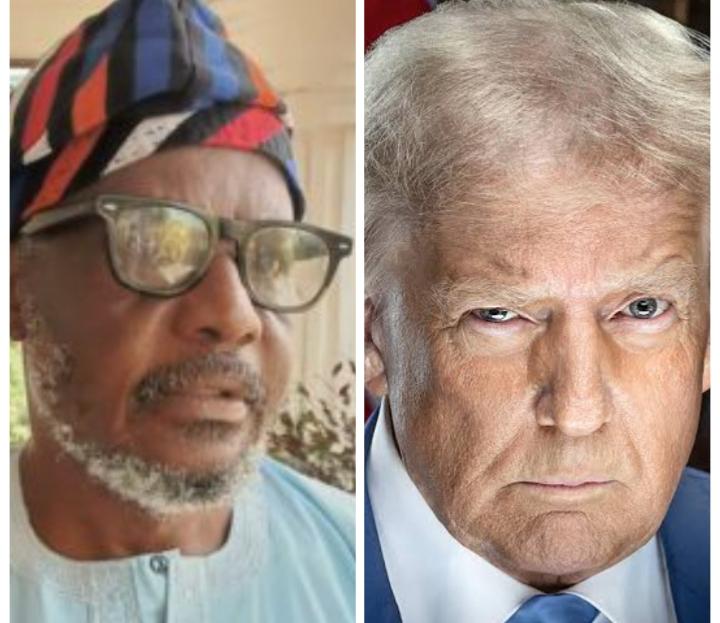
While the focus of this intervention relates to the consequences of the entrenchment of idealistic falsehood of Nigeria as of a nation and the implications of pretenses to a commonly shared sense of nationality, hegemonic falsehoods towards otherwise lofty ideals are not peculiar to Nigeria. Such aberrations are the fundamental axioms on which inter-racial, inter-human and inter-societal relations across the globe have been forged because such dominant falsehood serve the purpose of validating the hierarchical structure of human relations. Apartheid South Africa was the classical example of the enthronement of hegemonic falsehood. Eventually, it crumbled. But in a universe of Nigeria’s peculiar construction it can pose a mortal threat as the denunciation of the hegemonic lie can only lead to the implosion of the mythical world built around its falsehood. As Nigeria is witnessing, President Trump, however mercurial his temperament may be and as far away from conventional diplomatic protocols his methods may suggest, has more than just episodic data on which his infamous threat to eliminate terrorists who are avowed to decimate Christians in Nigeria is based. We can spare ourselves the internal factors in the United States that have shaped domestic reaction to Trump’s threatened kinetic intervention in Nigeria. Trump’s interests in Nigeria may be properly contextualized within the evolution of the global system itself.
In a broader evolutionary context, the end of the twentieth century coincided with the dissipation of historical conjunctures that had been central to the social construction of the world of black Africa. This has implied untold stresses on the groundings, which are often falsehood based, of the continued vitality of the political structures inherited from that era. The historical conjuncture is constituted by the confluence of a number of developments. These developments include the end of the Cold War that transformed traditional thrust of the calculus of super power strategic concerns in relation to Africa. The era saw a devalued commitment to safeguard historic interests of hitherto allies in the Western European hemispheres to the idea of exclusive control of African states by their European imperialist creators. The United States in particular challenged the notion of an exclusive zone of French influence, and, by implication, exclusive British control of any inch of the so-called Anglo phone Africa. Lately Italy and Turkey have, in steps that would have been unusual and undiplomatic until now, publicly blamedchastised France for the underdevelopment of Africa through robbery of the assets of colonial people. Turkey has taken steps, under the guise of Islamic brotherhood, to extend its influence into West Africa through the avenue of religion. Kuwait has deployed more aid to retain salience the affairs of Islamic states like Senegal and Gambia, in particular under irascible Yayah Jammeh. As this has happened, Angola, enjoying good bilateral relation with the United States, has banned Islam from the country. Accordingly, the strategic fluidity inspired by the end of the Cold War may have initially put on hold the need of hegemonic forces to manipulate the African space for common ideological ends. However, elite states have exploited the structural incongruences and associated contradictions in the internal management the processes of neo-colonial states as pawns in their grand global strategies across ideological lines of the cold war. A few states have counteracted against this new thrust, even as the rally for a more vibrant continent has floundered. Given the turbulence in the evolution of the global strategic template in the strategic reshuffling across the globe, elite powers are recruiting through various means new crony states.
Yet, the bottom line is that the sacking of France from the Sahel and the toe hold that Russia has gained in that zone have opened up avenues for the strategic realignment of the West Africa region. A Nigeria floundering and fixated on false operational mantras and operated on hegemonic falsehoods that have run their courses of contrived illicit legitimacy is a prime area of particular interest to all global forces. A national order largely perceived by a significant proportion of the population as lacking in solid legitimacy is an incentive for elite powers to intervene. Finally, the paradoxes of a globalization process set in motion by the end of the Cold War has also called into question in various African states and disaffected communities the continued relevance of colonially inspired political institutions that have remained dysfunctional to the transformation, emancipation and developmental aspiration of all peoples entrapped in these excruciating silos. The state soon degenerates into a dystopian monstrosity. Also, the twentieth century, as a historical era, was underpinned by a dominant Euro-centric and an entrenched, even if residual, Arab-Islamic structures of knowledge and values. These values defined identities of numerous black communities that are ferociously determined to hold on to their way of life. These knowledge systems and the values associated with them have imposed contra-pulling interests and reinforced the hegemony of the extra-Africa structures of ideas within the African world. There has been in Nigeria, a major front of the struggle, a massive rejection of the attempt to impose that particularistic worldview on the state and on the pretend nation. In the face of this and motivated by the constant desire to protect continued personal illicitly legitimate access to state wealth, the political entrepreneurs and elites have scrambled to cobble together a national political settlement that has ensured the protection their respective personal partisan interests over the will of constituencies that they claim to represent. The defection of the political elites permanently from the legitimate interests and aspiration of their respective constituencies demands the perpetuation of a lie necessary to stabilize a system that distorts critical existential realities. In the latest irrationality, Nigeria is to be further Balkanized into only God knows how many states. That way every local champions is assured control over a portion of the vast booty at stake in the country. It is the “Kari’le” syndrome!
While these have evolved, significant new legal developments that provide avenues for external interventions in the affairs of weak states unfolded in the United Nations. In 2005 the United Nations at a World Summit unanimously adopted the new concept of a Responsibility to Protect (R2P). The “responsibility to protect” (R2P) is a doctrine asserting that “a state has a primary responsibility to protect its own population from genocide and mass atrocities, and if the state is unable or unwilling to do so, the international community has a subsidiary responsibility to step in.” Although couched as a humanitarian enterprise, the doctrine of R2P has roots in the realist political traditions and has taken many of its salient characteristics from the realism and unilateralism of the neoconservative bloc in the George W. Bush administration. The concept of proactive war was born! It was only natural for development of international legal codes that enable international forces to intervene in internal affairs to protect the individual against a capricious state to confront the absolutist interpretation of state sovereignty. The idea of absolute sovereignty was killed. Meanwhile, with the coming into effect of this resolution, restraining predatory elite states contemptuous of the sovereignty of weak states from unilaterally projecting their strategic interests has been futile. Trump in South America is a prime example. Given the tensions between unilateral humanitarian interventions as, Trump has couched his threat on Nigeria, and sovereignty, the doctrine of Responsibility to Protect (R2P) is advanced as a new international legal framework legitimizing enforcement action to protect citizens from grave harm from their own government. Paradoxically, the doctrine is a refinement of realist principles conferring on powerful states the rights to advance their strategic objectives in the internal affairs of weak states. It was the legal basis of the NATO intervention to oust Moammar Gaddafi in Libya.
Against this background, the managers of the affairs of Nigeria must realize that in the evolved digital age there is no place to hide from its own its paralyzing falsehoods. Nigeria must understand that its self-preservation necessitates re-orienting its national life to overcome its historic demons that are embedded in the axiomatic falsehood around its statehood and its claims to nationhood. Whatever the outcome of a genuine national process of rigorous thinking, it must pluck the courage to move away from its destructive old pretenses. The irrational vociferous noise making of ego maniacs of the old and not so old guard of self-serving political jobbers must give way to unfettered rationality in national affairs. Given the dilapidations confronting this house, in the larger scheme of things, the focus on 2027 is provocative. It is the continuing distraction of a self-serving elite from the challenge of a nation literally bleeding to extinction before our very eyes.
*Professor Ademola Araoye is a retired official of the United Nations and former Director of Abuja Leadership Center, a TETFUND Center of Excellence in Public Governance and Leadership at the University of Abuja. He is author of Sources of Conflict in the Post- Colonial African State (AWP, 2012).

Leave a Reply