

Chikwado Nwobodo
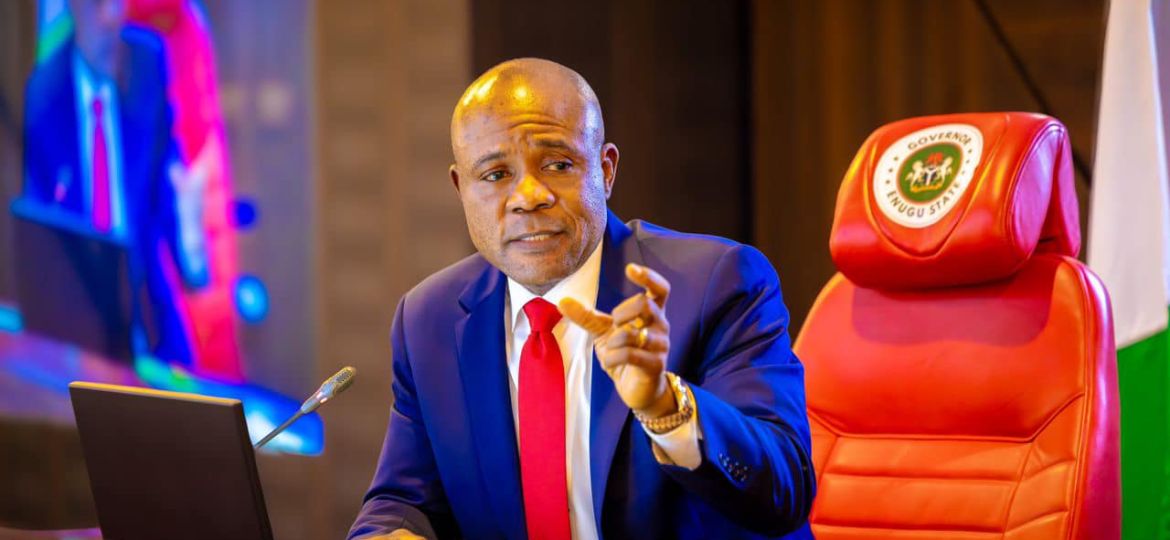
When Peter Ndubuisi Mbah stormed into Lion Building in May 2023, he came carrying the garb of a private-sector technocrat, a lawyer-businessman promising to reinvent Enugu as a modern, investment-driven state. His gospel was efficiency, his hymn was transformation, and his chorus was wealth creation.
Two years down the line, the melody sounds different. Across Enugu, murmurs have risen into a chorus of discontent: punitive taxation choking small businesses, land seizures masquerading as development, flagship projects shrouded in secrecy, and the mother of all scandals — the ₦5.7 billion Sujimoto contract mess that has dragged the state into a national storm.
In political circles, the talk is even sharper: defections of lawmakers to rival camps, whispers of alienation within PDP, and speculation that Mbah is becoming an unelectable liability who carries more baggage than benefits for any political party — especially the APC .
The central question therefore is this: is Peter Mbah the reformer he claims to be, or a costly political albatross Enugu and Nigeria can ill afford?
From the start, Mbah leaned heavily on foreign contractors, contractors based in Lagos and partners. His flagship project, New Enugu City, was trumpeted as a smart-city wonder, with China Communications Construction Company (CCCC) unveiled as key partner. He also re-launched Hotel Presidential with glossy fanfare and birthed Enugu Air, a state-backed airline positioned as a symbol of renewed pride.
On paper, these sound like visionary steps. But behind the press statements lies a gnawing worry: opaque contracts, limited disclosure, and an unmistakable pattern of outsourcing the very soul of Enugu’s economic destiny to foreign firms and proxies. Critics argue this is not development but a cleverly disguised siphoning channel.
And it does not end there. Mbah has been accused of using proxies to “privatise” state assets under the table — from Hotel Presidential to Nike Lake Resort to Enugu Air — projects loudly presented as public assets but allegedly run by insiders with hidden stakes.
If there is one scandal that crystallises the chaos of Mbah’s Enugu, it is the Sujimoto debacle. The story reads like a crime thriller: a flamboyant Lagos developer, a state contract for “smart schools”, a performance bond from one bank, money moved into another account, and projects left unbuilt.
The Enugu State Government has accused Sujimoto of diverting billions, calling it a clear case of fraud. The developer has pushed back, insisting he is innocent. Anti-corruption agencies have since taken an interest, and the public is left aghast.
Here lies the tragedy: even if Sujimoto is guilty, the scandal exposes the rot in Enugu’s procurement system. How can a ₦5.7 billion contract awarded without airtight due diligence? Why were payments released before physical work was verified? Who in the state government signed off the transactions?
Whether this ends in convictions or endless probes, one thing is clear — Mbah’s administration cannot wash its hands of complicity.
Beyond grand projects, ordinary Ndi Enugu feel the heat in their pockets. Under Mbah, taxation has become a sledgehammer. From multiple levies on small traders to the controversial rental income tax, households and businesses are being squeezed dry.
For the real estate sector, the pain is worse. Developers complain of sudden demolition drives, high property taxes, and land-grabbing disguised as “urban renewal.” Families have lost homes, investors have lost properties, and litigation is piling up.
The ripple effect is severe: construction has slowed, housing costs have skyrocketed, and Enugu is now whispered about as the costliest state to live and do business in Nigeria. What was meant to be an “ease of doing business” reform has become a nightmare of state-sanctioned extortion.
Mbah’s style of governance is that of a cocooned sole administrator. Decisions are centralised, state functions tightly controlled, and local political actors sidelined. In a state where political patronage and inclusivity oil the wheels of governance, this has backfired spectacularly.
Today, 99% of Enugu politicians feel alienated. Instead of rallying around their governor, many are quietly defecting to the camp of the Hon. Minister of Innovation, Science and Technology Chief Uche Nnaji— leaving Mbah to preside over a fractured PDP.
Even more telling, defections in the National Assembly are not heading toward Mbah’s camp but away from it. For a sitting governor, that is a damning indictment. Politicians know how to read the weather — and they clearly sense Mbah is fast becoming a sinking ship.
Every government acquires land, but none in Enugu’s history has done so with the ferocity of Peter Mbah. Entire estates have been reclaimed under the New Enugu City project, with developers crying foul over lack of compensation or outright disregard for court injunctions.
One judge even fined a state agency for illegal demolition. Yet the demolitions continue, wrapped in rhetoric about modernisation. The result? Distrust, lawsuits, and an image of a government that treats its own citizens as squatters on their ancestral land.
Politically, Mbah has presided over the fastest disintegration of Enugu PDP in living memory. Once a fortress, the party is now bleeding members daily. His leadership has alienated power brokers, undermined grassroots trust, and created fertile ground for the opposition APC.
But here lies the paradox: while APC benefits from defections, many within its national leadership are wary of embracing Mbah. They see him not as an asset but a liability — a man carrying the baggage of land controversies, tax oppression, and other allegations.
In politics, perception is everything. And the perception around Mbah is toxic.
Taken together, the picture is grim:
A governor who outsources state control to foreigners and proxies.
A ₦5.7 billion scandal that taints his procurement system.
A suffocating taxation regime that kills enterprise and real estate.
A political style that alienates allies and fuels defections.
A legacy of demolitions and land-grabbing unmatched by predecessors.
This is not a man who strengthens a party; this is a man who weakens it. Far from being an asset to APC or any national coalition, Peter Mbah represents the very definition of political baggage.
Enugu deserves better. The people deserve a government that develops without dispossessing, that raises revenue without strangling, that builds without bleeding. They deserve leaders who unite, not divide; who create trust, not fear; who empower, not exploit.
For Peter Mbah, the time to change course is running out. Without transparency, accountability, and genuine inclusion, his administration risks being remembered not as the government that modernised Enugu, but as the regime that pillaged its commonwealth and fractured its politics.
And for National APC leadership. The lesson is simple: avoid Mbah like the plague. He may come dressed as a reformer, but beneath the cloak lies a liability too heavy to carry and the reformed APC at the state is too refined to accommodate such a baggage.
Chikwado Nwobodo
Public Affairs Analyst And Political Strategist.
Leave a Reply