

By Folorunso Fatai Adisa
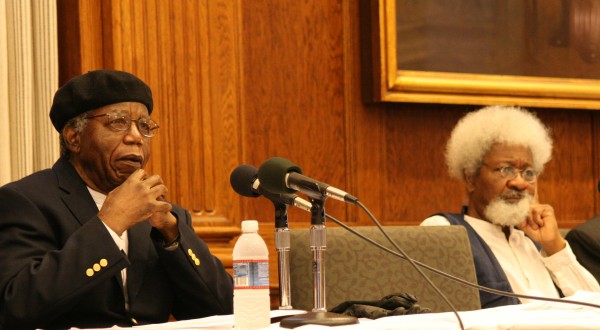
A troubling pattern mars our national discourse: the urge to elevate one icon by diminishing another. That Chinua Achebe and Wole Soyinka, two of Africa’s greatest literary minds, are often pitted against each other is not a harmless coincidence. It is the symptom of a deeper affliction: tribal nostalgia dressed as cultural critique, and an unwillingness to let excellence breathe outside the shadows of ethnic rivalry.
I just read an article published in Vanguard on May 1, 2025, titled ‘Chinua Achebe, Nobel Prize and African Literature,’ written by Ugochukwu Ejinkeonye. This piece attempts a revisionist manoeuvre: praising Achebe not on his own luminous merits, but as a foil to belittle Soyinka’s Nobel Prize.
Achebe and Soyinka are not rival deities in an ancestral drama. They are twin peaks in African letters, distinct, towering, and irreplaceable. But a recent article by a Nigerian journalist attempts a revisionist manoeuvre: praising Achebe not on his own luminous merits, but as a foil to belittle Soyinka’s Nobel Prize. It presents Achebe as the “true voice” of African literature, while casting Soyinka’s Nobel as a political appeasement, granted more for optics than for art. This is not literary analysis; it is weaponised nostalgia.
Without mincing words, no serious student of world literature disputes Chinua Achebe’s greatness. Things Fall Apart remains a cornerstone text across five continents. It has been translated into over 60 languages and has sold more than 20 million copies. Achebe opened the gates of African storytelling to the global imagination. His prose reclaimed narrative sovereignty for the colonised. He was the first to make the coloniser truly listen.
But to suggest that Soyinka’s Nobel Prize was a result of apartheid-era guilt or international tokenism is to display either ignorance or mischief. The Nobel Committee awarded Soyinka in 1986, “who in a wide cultural perspective and with poetic overtones fashions the drama of existence.” This was not a symbolic laurel. It was a literary coronation for a polymath whose body of work spans theatre, poetry, memoir, political philosophy, and classical tragedy.
Death and the King’s Horseman, The Man Died, The Interpreters, A Shuttle in the Crypt, A Dance of the Forests, Season of Anomy: these works alone form a monumental canon. But Soyinka did more. He fused Yoruba metaphysics with Western literary forms, wrote in both verse and voice, and spoke truth to power not only from his desk, but from prison, exile, and the barricades. His voice is as thunderous in the classroom at Harvard as it is in the theatre houses of Johannesburg and Berlin.
Achebe, while equally iconic, was not snubbed by Stockholm. According to the Swedish Academy’s published archival notes, he was shortlisted in 1989. His literary contribution was deeply respected. But respect does not equate to laureateship. The Nobel does not operate on turn-by-turn sentimentality. It prizes depth, consistency, and artistic innovation over familiarity. If Toni Morrison didn’t win for Beloved alone, Achebe’s brilliance in Things Fall Apart, Arrow of God, and Anthills of the Savannah, powerful though they are, were weighed against a relatively smaller oeuvre post-1990.
There is, however, a glaring inconsistency in the revisionist camp. Achebe’s admirers, many of whom once dismissed the Nobel as a colonial validation tool, now clutch at its absence like a grievance. Which is it? If the prize is flawed, let’s move on. But if it matters, as it clearly does to these critics, then it must be respected for what it is: a recognition of enduring literary innovation, not a reward for ethnic pride.
Soyinka’s global stature goes beyond Stockholm. He has held professorships at Harvard, Oxford, Yale, Emory, and Cambridge, to name a few. He is one of only a handful of writers whose works are taught in both the African and Western canon simultaneously. His influence is not limited to literary circles but spans civil liberties, governance, and even post-colonial theory.
Achebe and Soyinka both critiqued their own people when it mattered. Achebe exposed Igbo political failures during and after Biafra. Soyinka has been no less scathing of Yoruba complicity in national dysfunction. Neither man wrote with a tribal lens. Both wrote with a pan-African conscience. It is the height of dishonour to reduce them to mascots of ethnic resentment.
What Achebe started, Soyinka expanded. Achebe cleared the bush path. Soyinka laid the foundation for the theatre. And others, Ngũgĩ wa Thiong’o, Nuruddin Farah, Ama Ata Aidoo, Tsitsi Dangarembga, Mariama Bâ, have since built rooms in the house of African letters. Praise is not a limited resource. We can honour Achebe without diminishing Soyinka’s well-earned glory.
Notably, this is not just a rebuttal but a reminder. Laurels are meant to crown genius, not cloud our judgment. To turn literary honour into ethnic contestation is to insult both history and artistry. We must teach our children to read Things Fall Apart and The Man Died not as competing ideologies, but as complementary visions. One shows us where the rain began to beat us; the other how to dance in the storm.
Soyinka’s Nobel was not a trophy; it was testimony. And Achebe’s absence from its roll does not erase his brilliance. But we do not have to rewrite history to soothe wounded pride. If Stockholm rang for only one, it was not by mistake. It was by merit.
History, like literature, is a mirror. But it only tells the truth when we polish the surface, not scratch it with petty agendas.
*Folorunso Fatai Adisa is a writer, communication specialist, and media scholar. He holds a Master’s degree in Media and Communication from the University of Strathclyde, Glasgow. He writes from the United Kingdom.

Leave a Reply