

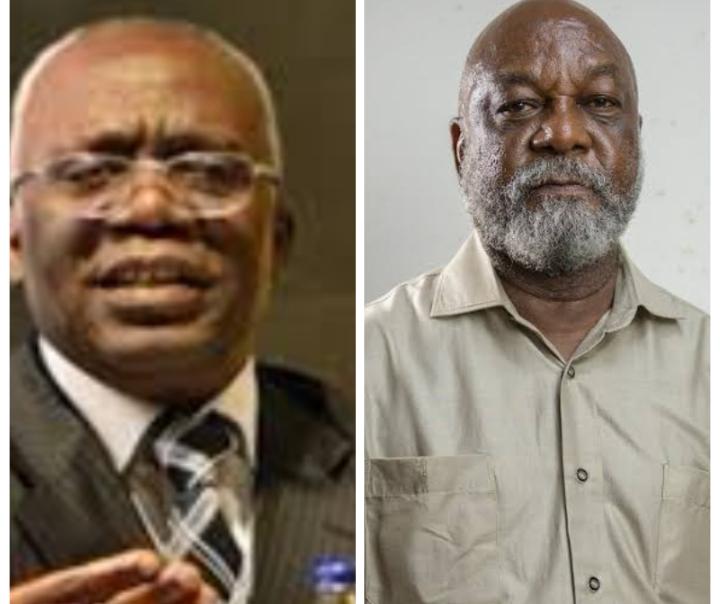
Professor Kwame Karikari at 80, Commitment and Service , Free Expression, Democracy, Social Justice, Femi Falana
By Femi Falana
(Being the Keynote Address delivered by Femi Falana SAN in honour of Professor Kwame Karikari at His 80th Birthday Lecture – July 17, 2025, GNAT Hall, Accra, Ghana)
Salutations
Distinguished guests, esteemed colleagues, comrades in the struggle for democracy and human rights, members of the Media Foundation for West Africa, friends and family of the celebrant, fellow Africans committed to justice and truth.
I am deeply honoured to stand before you today on the occasion of Professor Kwame Karikari’s 80th birthday. We are gathered here not merely to celebrate a long life, but to salute a life lived in unwavering commitment to the ideals of free expression, democratic accountability, and social justice. In celebrating Professor Karikari, we celebrate a man who has become a conscience of the African public sphere, a moral compass and a tireless defender of our collective liberties.
Framing the Theme: Free Expression, Democracy, and Social Justice
These three ideals—free expression, democracy, and social justice are not separate domains. They are interwoven strands in the fabric of a truly emancipated society. Without the right to speak and to dissent, democracy becomes a shell. Without democracy, there can be no real social justice. And without justice, freedom itself becomes an illusion.
Professor Kwame Karikari has spent his life demonstrating the indivisibility of these principles. Whether through media advocacy, civic education, or institutional reform, he has worked to make these ideals real in the lives of ordinary Africans. In a continent too often burdened by authoritarianism, impunity, and elite capture, his life has been a light in the darkness. His efforts also underscore the importance of resisting sectarian and partisan biases in journalism. In his own words, journalism must transcend “religious, political, and tribal biases,” for such tendencies diminish the integrity of the profession and corrode the journalist’s social mission.
The Life and Legacy of Professor Kwame Karikari
Born in Ghana in 1945, Kwame Karikari came of age during the final decade of colonialism, matured politically in the aftermath of independence, and found his intellectual voice amid the turbulence of Ghana’s political upheavals. He studied journalism in the United States and later returned home to serve as a lecturer, media critic, and reformer.
He was one of the founding editors of The Free Press, and later established the Media Foundation for West Africa (MFWA) in 1997, a regional powerhouse for media development and freedom of expression. The MFWA has today become a vital institution defending press freedom across the member States of the Economic Community of West African States (ECOWAS), documenting abuses, providing legal support to journalists, and advancing public interest journalism in West Africa.
The late Comrade Akoto Ampor, an accomplished public interest lawyer of blessed memory and I were persuaded by Professor Karikari to offer our legal services to the MFWA pro bono publico. Sometime in 2006, the MFWA instructed my law firm to seek legal redress for two journalists who had been arrested and detained by the Yahya Jammeh’s tyrannical regime in The Gambia. At the material time, the judiciary of The Gambia had been captured by the faschist dictatorship. Hence, we had to turn to the Ecowas Court which had then been empowered to protect the human rights of community citizens in Ecowas member states in accordance with the Supplementary Protocol of the Court.
In the case of Manneh v. Republic of The Gambia (2004-2009) CCJELR 181, the Plaintiff, who worked for the Daily Observer newspaper, was arrested sometime in 2007 and detained by the former National Intelligence Agency (now renamed State Intelligence Service). The suit, filed at the instance of the MFWA at the ECOWAS Court, was determined in favour of the Plaintiff. The Court ordered the government to release the Plaintiff and pay compensatory damages of US$100,000 to him. It was when MFWA wanted to enforce the judgment that we confirmed that the Plaintiff had disappeared while in custody.
In Musa Saidykhan v. Republic of Gambia (2010) CCJELR 139, the Plaintiff, then editor-in-chief of the Independent newspaper, was arrested by the NIA and subjected to severe torture in detention. He escaped from the dungeon and fled the custody. The MFWA filed a suit at the ECOWAS Court on behalf of the Plaintiff. With the assistance of the MFWA, he gave his oral testimony at the Ecowas Court in Abuja. In 2010, judgment was delivered in the case. The Ecowas Court condemned the torture meted out to the Plaintiff and ordered the authorities to pay the sum of US$200,000 in damages to him.
Based on the success recorded in the cases of Manneh and Saidykhan, other victims of gross human rights violations perpetrated by President Jammeh filed several cases in the ECOWAS Court. One of the cases is that of Deyda Hydara v. Republic of Gambia (Suit No ECW/CCJ/APP/30/11), instituted by two of the children of the Plaintiff. Deyda was a co-founder and editor of The Point newspaper. He was murdered in cold blood by suspected official assassins on 16 December 2004, as he drove home from the premises of The Point newspaper in Banjul. In a judgment delivered in 2014, the ECOWAS Court indicted the Yahya Jammeh government for its failure to inquire into the cause of the brutal murder of the journalist.
The Jammeh regime had refused to pay the damages awarded to the victims by the ECOWAS Court. But following consultations between the Adama Barrow administration and the Media Foundation for West Africa, the Gambia Press Union, and representatives of the families of the victims, the government paid 50% of the compensatory damages to the families of Ebrimah Manneh and Deyda Hydara. The post-judgment negotiations with Musa Saidykhan by the Government have not been concluded.
Professor Karikari played critical roles in revising Ghana’s media laws and advised on similar frameworks in other countries in West Africa. To his credit, Ghana, Liberia and Sierra have substantially decriminalized freedom of expression.
As a teacher, Professor Karikari mentored generations of journalists and scholars at the School of Communication Studies, University of Ghana. He also served as Director-General of the Ghana Broadcasting Corporation (GBC) between 1982 and 1984. In a remarkable moment of forthrightness, he expressed satisfaction upon being dismissed from the role by President Rawlings, stating that the decision, though unexpected, freed him to maintain his ethical bearings. His teaching and mentorship extended to platforms like the Next Generation Investigative Journalism Fellowship, where he equipped young journalists with practical lessons in ethics, curiosity, accountability reporting, and professional independence.
In 2014, Professor Karikari handed over the leadership of the MFWA to Sulemana Braimah, a visionary and transformational leader in his own right. Since then, the MFWA has been going from strength to strength.
Free Expression: A Lifelong Campaign
To appreciate Professor Karikari’s impact, one must understand the context in which he worked. At a time when military regimes gagged dissent and censored the press, he stood up for the independence of the media. He challenged authoritarian decrees and called for constitutional protections of press freedom. Under his leadership, the MFWA provided sanctuary to journalists in exile and legal defence to those wrongly arrested.
Today, even as we contend with newer threats such as surveillance technology, disinformation, and digital censorship, his message remains clear: a silenced people cannot be free. The freedom of expression is not a Western luxury, it is a fundamental right essential for human dignity and democratic governance.
His advocacy recently extended to championing the establishment of Ghana’s Coordinated Mechanism on the Safety of Journalists, an institutional structure to process complaints and address threats against journalists. He has also urged media owners to take the safety of reporters seriously and called for justice in the unresolved murder of investigative journalist Ahmed Suale.
Democracy and Democratic Culture
Professor Karikari has been a consistent voice for participatory democracy. His work has gone beyond periodic elections to the deeper question of democratic culture, civic consciousness, media literacy, and popular accountability. He has warned us repeatedly that “electoralism” without an informed and active citizenry is a dead end. At a time when West Africa is witnessing a resurgence of military coups, clampdowns on civic space, and constitutional manipulation by incumbents, we must return to Karikari’s vision of democracy: one rooted in people’s sovereignty, not elite consensus; one anchored in truth, not propaganda.
In that same spirit, he has called on state-owned media to fulfill their constitutional role by interrogating government policies and offering platforms for dissenting views. Public broadcasters, he insists, must not merely echo power but hold it accountable.
Professor Karikari is a recipient of many awards. In 2023, the University of Ghana conferred on Prof Kwame Karikari the degree of Doctor of Letters, honoris causa in recognition of his contribution to press freedom, media development, media and communication scholarship over the years. In January 2025, Professor Karikari was appointed a member of the Constitution Review Committee by President John Mahama. The Committee is tasked with assessing and proposing amendments the 1992 Constitution of Ghana.
Social Justice and the African Intellectual Tradition
Beyond media and democracy, Professor Karikari’s commitment to social justice aligns him with Africa’s radical intellectual tradition. Like Amílcar Cabral, Walter Rodney, and Frantz Fanon, he saw no contradiction between rigorous scholarship and political activism. He has always insisted that knowledge must serve liberation.
He has advocated for the rights of workers, rural communities, women, and students, groups often marginalised by state power and market logic. He has criticised neoliberal development models that enrich a few and impoverish the many. He has used his platform to challenge not just governments, but also multinational corporations, aid agencies, and corrupt elites. This is what distinguishes his legacy: he is not a public intellectual content with commentary; he is an engaged intellectual committed to transformation.
The Power of Ethical Leadership and Moral Courage
The moral courage that Professor Karikari represents is rare. In times when it was dangerous to speak truth to power, he did not retreat. When it was easier to remain silent, he spoke up. When many academics chose comfort over conscience, he took a stand. His life is a testimony to ethical leadership, not the kind rooted in titles and offices, but in values and sacrifice. As a mentor, he has nurtured generations of principled activists and communicators who now carry his torch across the continent.
As he has often reminded younger colleagues: journalism must be rooted in curiosity, honesty, and broad-mindedness. “Don’t take anything for yes or no,” he told budding journalists. “Dig out the other half of the story’’
The Task Ahead: Continuing the Struggle
If this were merely a celebration of the past, we could end here. But this is also a call to the future. Free expression is still under threat in too many African countries. Democracy is increasingly under siege, manipulated by civilian autocrats and eroded by disinformation. Social justice remains elusive for millions struggling with poverty, displacement, and systemic exclusion.
The challenge now falls on us—the younger generation of lawyers, journalists, activists, scholars to take forward the ideals Professor Karikari has championed. We must defend our digital spaces. We must push for media reforms. We must challenge economic injustice sponsored by imperialism in Africa. And above all, we must speak, even when it is inconvenient.
Realizing that many citizens have no access to print and television, Professor Karikari has consistently championed the crucial role of community radio. It is his firm belief that community radio stations are vital for giving voice to the people in rural communities. He advocates the deepening of the professionalism of journalism, including the often-neglected arena of local language broadcasting. However, Professor Karikari has rightly challenged journalism institutions to introduce language-specific training to stem the growing misuse of indigenous tongues on radio.
Conclusion: A Name That Is a Call to Action
As we celebrate this towering figure at 80, we must remember that the true measure of a legacy is not in honours or positions but in the lives changed, in the systems challenged, and in the freedoms won. Professor Kwame Karikari is not just a name in African media history; he is a living embodiment of civic courage. And more than that, his name has become a call to action, a call to build a continent where every voice matters, where democracy is not a ritual but a right, and where justice is not a slogan but a structure.
As the Akan proverb goes, “The one who climbs a good tree deserves a push.” Today, we push this good tree not only in honour but in commitment to continue the journey he began.
I thank you all for your patience.
Leave a Reply