

Richard Elesho
Humans must learn to challenge classical set theories, embrace alternatives, and try out contradictions in their search for truth and meaning in the complexities of life.
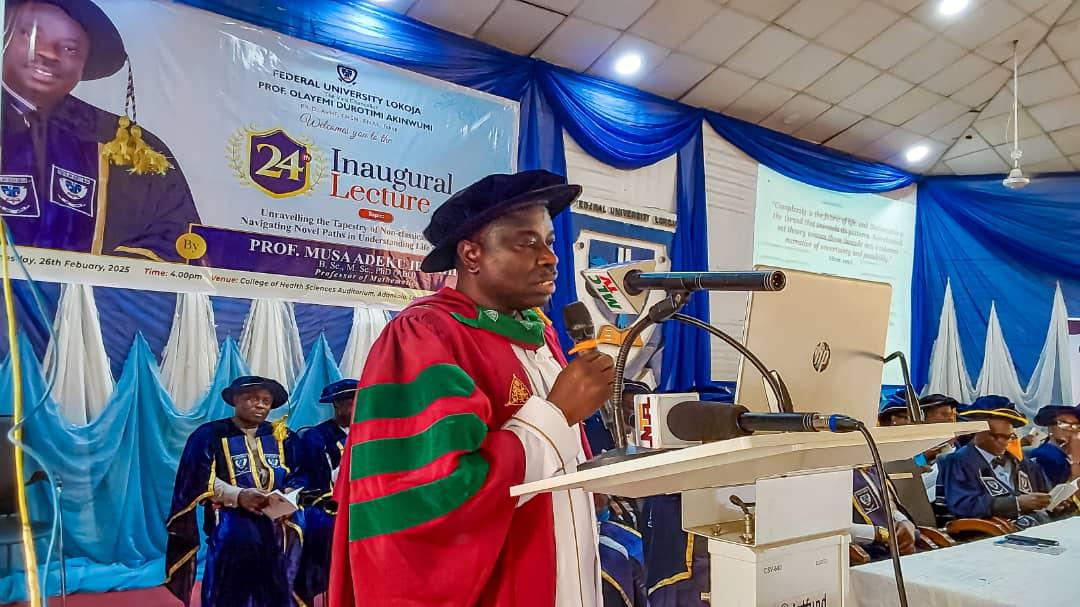
The charge was given recently in Lokoja, the Kogi State capital, by Ahmodu Bello University (ABU, Zaria, professor of Mathematics, Musa Adeku Ibrahim, while delivering the 24th inaugural lecture of the Federal University, Lokoja, FUL.
In his presentation on the topic “Unravelling the tapestry of non-classical set theory: Navigating novel paths in understanding life’s complexities,” he listed culture, upbringing, and personal beliefs among multiple factors that shape identities.
Musa defined mathematics as studying patterns, structures, and relationships developed through rigorous reasoning and abstraction. He said that its methods rely heavily
on logical deduction to establish consistent and universal truths, adding that mathematics is an invaluable instrument for gaining deep insights into other disciplines.
“While classical set theory aligns with struc�tured, rule-based reasoning, fuzzy logic mirrors the adaptable, context-sensitive nature of human thought and decision-making.
Recognizing this
duality helps us better understand and navigate the complexities of life.
“Finally, the advancement of non-classical set theory offers profound insights
into both theoretical mathematics and practical problem-solving.
“By challenging traditional paradigms and embracing uncertainty, non-classical set theory provides a more comprehensive framework for addressing real-world
challenges.
“As research in this field continues to evolve, it will further enrich
our understanding of mathematical logic, artificial intelligence, and human
cognition, reinforcing the essential role of mathematics in unravelling the
intricate patterns of existence.
“Vice-Chancellor, sir, esteemed ladies and gentlemen, I began this presenta�tion with borrowed words; now, I would like to conclude with phrases you
may one day quote me on:
“i Understanding life’s complexities requires a willingness to let go of rigid
thinking, embracing nuance, and adopting a framework that accommodates contradictions and allows truths to evolve.
“ii Let us embrace a life where lamentations have no place.”
Earlier, Vice Chancellor, FUL, Prof. Akinwumi Olayemi commended the lecturer and extoled the importance of inaugural lectures.
“This series is a celebration of academic excellence and an opportunity for our distinguished Professors to share the fruits of their research and intellectual pursuits with the broader University community and the public. Inaugural lectures are among the most significant traditions in academic institutions around the world. They offer a platform for our Professors—who have reached the pinnacle of their academic careers—to present the culmination of years of research, reflection, and scholarly contributions.
He said Prof Musa’s topic “stands out for its intellectual depth and interdisciplinary relevance, inviting us to engage with concepts that push the boundaries of traditional mathematical thinking while offering profound implications for other fields of study.
Beyond merely presenting an academic lecture, today’s discourse is of immense relevance to our University community and the world at large. As a center of learning and innovation, our University must embrace groundbreaking ideas that challenge conventional knowledge and open new frontiers of discovery.”



Leave a Reply