

By Yinka Elujoba, Art Critic
Through flowing brushwork and radiant desert tones, Uthman transforms a simple caravan journey into a poetic meditation on history, movement, and African cultural endurance.
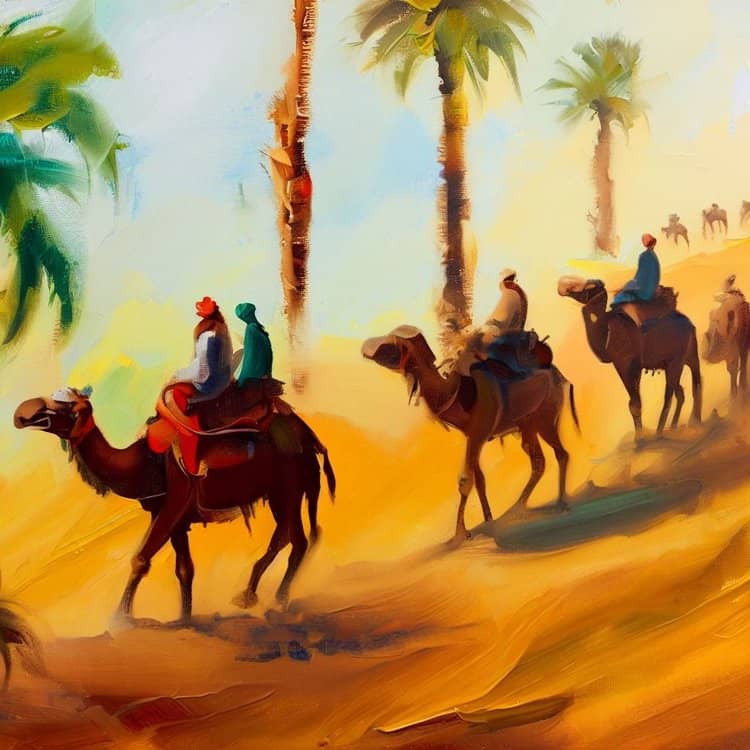
Sand, Dunes and Camels, by contemporary artist Shogo Olalekan Uthman offers a visually compelling interpretation of the desert as both a physical landscape and a historical pathway. Presented at Madeke Gallery UK, the painting captures a caravan of riders journeying across glowing sand dunes, their camels moving in a quiet rhythm beneath tall palm trees and a luminous sky. The scene appears tranquil at first glance, yet beneath its visual serenity lies a layered narrative about mobility, cultural exchange, and the long-standing traditions that shaped African societies.
The composition is defined by movement. A line of camels and riders travels diagonally across the canvas, drawing the viewer’s eye naturally from the foreground toward the horizon. This sense of progression gives the painting an almost cinematic quality, as though we are witnessing a moment within a larger story unfolding across the desert. Uthman deliberately avoids rigid structure, allowing the figures and landscape to flow organically through the space of the canvas.
The desert landscape is rendered through radiant shades of golden yellow, amber, and burnt orange, reflecting the intense warmth of the sunlit dunes. Colour is a defining role in establishing the painting’s atmosphere. These colors create an immersive visual experience that conveys both the harshness and the beauty of the desert environment. Contrasting this warmth are subtle washes of pale blue and soft green within the sky and vegetation, which provide visual balance while enhancing the painting’s sense of depth.
Uthman’s technique is characterized by fluid and expressive brushwork that prioritizes atmosphere over strict realism. The camels and riders are painted with gestural strokes that capture their essential forms without excessive detail. This painterly approach allows movement to remain central to the composition. The figures appear almost suspended within the shimmering heat of the landscape, emphasizing the rhythm and continuity of their journey.
Stylistically, the work sits at the intersection of contemporary African painting and modern impressionistic landscape traditions. The textured surface of the canvas and the layering of color suggest an artist deeply engaged with the tactile possibilities of paint. Yet the painting’s narrative clarity keeps it grounded within a storytelling tradition that resonates strongly with African cultural history.
The forms within the composition are simplified yet powerful. The camels, rendered through elongated silhouettes, stand as iconic symbols of desert travel and survival. Meanwhile, the riders clad in garments of red, blue, and green introduce moments of vibrant contrast against the golden dunes. These small color accents bring life and individuality to the scene while reinforcing the communal aspect of the journey.
Culturally, the imagery of camel caravans carries profound historical significance across African and trans-Saharan societies. For centuries, these caravans served as lifelines connecting distant communities through trade routes that facilitated the exchange of goods, languages, and cultural practices. Salt, gold, textiles, and knowledge moved across these vast landscapes, shaping the economic and cultural development of entire regions.
By revisiting this imagery within a contemporary artistic framework, Shogo engages in an act of cultural remembrance. The painting does not merely depict a historical scene, it revives the spirit of journeys that helped define African connectivity long before modern borders existed. In doing so, the artist situates the desert not as an empty space but as a landscape rich with stories and human movement.
The presence of palm trees within the composition subtly introduces another symbolic layer. In desert environments, palm trees often mark the location of water sources or oases vital points of rest and survival for travelers. Their tall vertical forms punctuate the sweeping horizontality of the dunes, suggesting moments of refuge along the caravan’s path.
Emotionally, the painting communicates a sense of calm determination. The riders are neither hurried nor burdened; they move with steady confidence, embodying a rhythm shaped by experience and endurance. This quiet persistence echoes broader themes of resilience found throughout African cultural narratives, where survival often depends on patience, adaptability, and communal strength.
Within the context of the exhibition at Madeke Gallery UK, Sand, Dunes and Camels stands as a compelling example of Uthman’s ability to merge visual beauty with cultural storytelling. The painting invites viewers not only to admire the landscape but also to consider the deeper histories embedded within it.
Ultimately, the work reflects the broader artistic vision of Shogo Olalekan Uthman, an artist who consistently explores the relationship between environment, identity, and memory. Through luminous color, expressive technique, and symbolic imagery, Sand, Dunes and Camels becomes more than a landscape painting. It becomes a meditation on movement, heritage, and the enduring cultural pathways that continue to shape African identity today.
*About Author: Yinka Elujoba is a New York–based art critic with The New York Times, known for sharp writing on contemporary African art. His work includes Re-imagining Futures, and he has received the 2021 Rabkin Prize from the Dorothea and Leo Rabkin Foundation, the 2020 SVA MFA Thesis Award, and the 2018 Apexart Grant.



Leave a Reply