

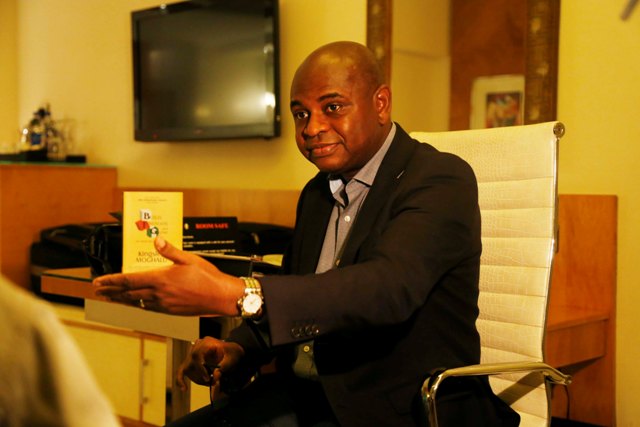
How do you do that?
Number one: You have to create employment opportunity for young Nigerians that means building an entrepreneurial capitalist economy in the context of a developmental economy. This is what has to be the philosophy that guides the economic management of Nigeria, we don’t determine economic philosophy this time but in my government there will be a very clear economic philosophy that is spelt out and all policies will derive from that philosophy. Now education must be based on acquisition of skills, practical skills that will enable students to create employment to create new businesses and enterprises for themselves. Skills that are in demand for the growth and development of an economy such as this. Skills that are in demand that can help in industrial transformation, that is where our educational policy should be channeled to. So, the first thing is educational system reform, to skew the curriculum towards Science, Technology, Engineering and Mathematics and Entrepreneurship.
The curriculum of our universities right now is not suitable for this type of development, we are not going to abolish courses that are engineering and humanities because humanities are also important but we recognize that where we are at this time requires a technical skill and therefore we will shift more numbers, we will make opportunities more available for students who want to acquire those type of skills because when they go into the job market, they are more flexible, not those who graduate and looking for those to employ them. We are going to move more to self employment and this comes into what I say all the time that we are going to create a venture capital fund to finance new devices, it will enable capital to be available to unemployed youths in the system. With that they can create new businesses, those businesses will create job for them and create jobs for others.
This is how you begin to structurally address poverty, first to insure that the quality of people that are coming out of the schools is high and skilled, then by making sure that their qualifications meet finance and there is a handshake between the two. This is how the economy will be skewed towards productive enterprise, and with those type of skills it is easy for them to go into manufacturing and that’s why it is easy for them to find job in the manufacturing sector because those sectors need those gifts. But if you are producing a lot of graduates whose qualifications are not directly matched to those that are needed in industrial economy, then you cannot successfully have an economy. So you must align the educational system with the economic requirements that the country has at this time and this requires a lot of thinking and planning, and consistency in execution.
Now healthcare is very important, primary healthcare is what determines primarily the quality of life that people have in Nigeria. We will ensure that the there is a support, a provision of primary healthcare across all the 36 states, beyond that we will also establish good quality hospitals in each of the six geopolitical zones so that when you move from the level of primary care to more complicated diseases that take Nigerians on medical tourism abroad, you can have those diseases handled in Nigeria very effectively. We will make investments in the teaching hospitals and universities in the six geo political zones so they become a level of secondary tertiary health care. We are going to be bringing back a lot of qualified Nigerians from the Diaspora because we will be establishing a Diaspora fund that will fund the return of the diaspora especially in the area of healthcare.
How accessible will this health care programmes be to the poor? Will it be free.. will you establish health insurance…
Yes.. it will be subsidized, we have health insurance but it is not working very well now, so we will look at the health insurance scheme to make sure that it actually functions better if it is possible to subsidize primary healthcare for the poor to a certain level of their income if that is necessary we will do it. That is a better subsidy than subsidizing the importation of petroleum products.
Still on the economy, how do hope to diversify the economic?
The government that I will lead will run an innovation economy. We will create incentives for business to invest on mass production, a product of invention for many intelligent Nigerians. That is how economy is actually industralised, the first thing to is to make sure the intellectual property is protected because whoever invents anything is protected and rewarded, so when the product is mass produced, every sale, the person gets the reward. That is why we encourage people to invest in inventing to solve some practical problems. For example somebody in Nigeria invented an iron that can iron clothes without any electricity, it was written of in the newspapers but I haven’t seen it in the market. If a Nepaless iron were mass produced in Nigeria today do you not know that it will be a successful product in the market but why is it not in the market?
The next thing to do to move away from oil is that the NNPC will have to be partially privatized, that is necessary to bring discipline into that sector. Two, we must deregulate the downstream sector, the government has no business fixing the price of petrol, allow the private sector to handle the refinery, sell off these refineries that we spend money every year, voting billions of money and you say you are doing turn around maintenance, meanwhile they are not functioning. If you hand these things to the private sector they will function more efficiently. The problem we have in the economic management of the country is that there is too much of the government in the economy, the government role is to create the environment and get out of the way and regulate the market and set the overall policy direction for the industrialization that we are talking about, create the incentives for industrialization and allow the private sector to move in. There will be difficulties in the initial stage, lets not pretend about it but over time the market will find a way to correct itself, that is what happens in the economy, because Nigeria is big enough to be a market for its own goods not the ones I will be exporting, so you combine both the domestic market and export market that will bring in foreign exchange.

How will you tackle what you describe as vested interest of Nigeria’s political class?
Well it comes from the political will and the political leadership, the presidency. If you say your focus is on the people of Nigeria and you make policies that are economically sound and overtime we will go through poverty. I think it requires political will, but it is very easy to be captured by the vested interest because those are the godfathers that support political aspirants in this country, when the political aspirant come in, their governments are already sold to the vested interest of the country who financed their coming to office. And that’s why we are not going with the godfather model because we want a government that will focus on the people of Nigeria.
And in addition to that you have been advocating a kind of ballot box revolution in 2019 but given the way that our people sell their votes, how do we manage that?
We are trying to educate Nigerian people. Nigerian people are poor so it is difficult to them to say when politicians come in to give them things, don’t take, when they haven’t fed for the day, but we say if you want to take it, take but vote the right way, nobody is with you inside the ballot box, you can take whatever they have given you and still vote for the right candidate. Vote on the basis of competence, capacity and track records of candidates, that is what should guide your votes not the fact that somebody gave you a wrapper or somebody gave you milk and because of that you go and vote for that person. When people give you money to vote for them when they enter into the office you cannot be their priority. Their first priority is to go and steal money to recover the money they gave you and make profits. So we will be educating Nigerians on this, it is a process, it cannot happen overnight because truly poverty is a factor
Are Nigerians reformable?
They are. Nigerians are reformable. With the right type of leadership to set example, Nigerians are actually very good followers if they have the good role models.
Your foreign policy, what will be your cornerstone, then do you have any plans for Nigerians in diaspora?
Oh, we have very serious plans. We are going to make Nigerians in diaspora a cornerstone of the development, so there is going to be a diaspora reform and engagement strategy, it will not be haphazard, it will not be ad-hoc, a proper strategy will be developed and executed. Part of this is the diaspora fund, part of it is the strengthen of diaspora commission that has been approved by the National Assembly
Leave a Reply