

Putting thought to action
More than the conceptualization of the idea of progress, the practical implementation of the idea and the fulfilment of its promise in the lives of citizens is the distinguishing mark of a progressive government. While it is true that practice without a thoughtful conceptualization is blind; it is also true that thoughtful conceptualization without practice is empty.
The purpose of governance, its raison d’etre, is first and foremost the security of the lives and property of citizens. Next in order of importance is the enhancement of their freedom and liberty; and finally, there is the welfare function of promoting equal opportunities and happiness for all.
In these areas to which a purposive government is required to pay attention and work effectively, Nigerians have been short changed in the last sixteen years. Surely, some very important personalities have fared a lot better than the majority of ordinary citizens. Some others have taken advantage of and exploited the atmosphere of lawlessness and gross indiscipline to make way for their interests. Those at the short end of the stick of insecurity and unfreedom are the hoi polloi of society; the helpless and hapless masses that a progressive government cannot ignore.
The starting point is the understanding that if an enabling environment is provided for them, our people are resourceful and ingenious. This is why the present syndrome of dependency is distressing because it misrepresents who we are as a people. It’s doubly sad that the syndrome is encouraged, indeed canvassed, by politicians who should know better. The syndrome is at the institutional and individual levels, with states dependent on the federal government, while individuals are dependent on both state and federal governments.
Where does a progressive government begin? What practical actions must it take to procure for the people the goods of security, freedom, equal opportunity and happiness? If security is a foremost item in the contract between the governed and the government, how does the latter deliver on its side of the contract?
No citizen, including those that find themselves in the highest echelon of leadership, can sincerely negate the verdict that Nigeria has been playing an unfair game with the lives of its citizens for many decades. We tend to blame colonialism for everything even more than half a century after independence. But I am not sure that we saw our current level of insecurity in our colonial past. At least I have not come across a documented record of the loss of more than two hundred innocent school girls to terrorists between 1900 and 1960. That is not to diminish the evil that colonialism represented. It’s simply to observe that while we have it in our power to make progress in the matter of the security of the lives and properties of citizens, we chose to retrogress.
Progress requires that we move with the times. In the matter of crime prevention and detection, to move with the time is to dismantle the anachronistic system of policing that has proved embarrassingly ineffectual. Before 1966, the crime bursting function of the police was adversely impacted by the politicization of the force. Party leaders, government officials, and traditional rulers abused their positions of authority and used the police against their political enemies.
The military took this aberration as the norm and, since it is unacceptable in a civilized society, the reaction of the armed forces was to centralize the police ostensibly to avoid the evils of politicization and abuse. This would be a valid argument and a logically sound approach if the new system was an effective and better alternative. But it wasn’t and it still isn’t. Politicization is still the bane of the Nigeria Police.
A progressive government in a federal system will seek the benefit of community and municipal policing as practiced in the United States. It is baffling to common sense that we consider the American constitution ideal for our situation but judge ourselves immature relative to its approach to law and order. Assume, however, that immaturity truly describes our condition. A progressive government will lead the inquiry into why this malaise is our lot and design a plan of action to confront it. We came out of colonial rule as a dehumanized lot. It required the foresight of one of the visionaries of our time to proffer a solution with his insistence that human capital development was the indispensable key to the development of a nation.
The ever-present obstacle to national advancement that a progressive government must confront head-on is the hydra-headed monster of corruption. A serious progressive government will confront corruption at its root. It will make the center less attractive and make government accountable to the people. In doing so, it will create the possibility of its own weakness. But, indeed, that is the virtue and strength of progressivism. As a progressive party, the APC must enter into a binding contract with Nigeria to eradicate corruption, invest in the education of the young, create an enabling environment that fosters job creation and entrepreneurship, and restore the confidence of citizens in the nation without abetting religious fanaticism and ethnic jingoism.
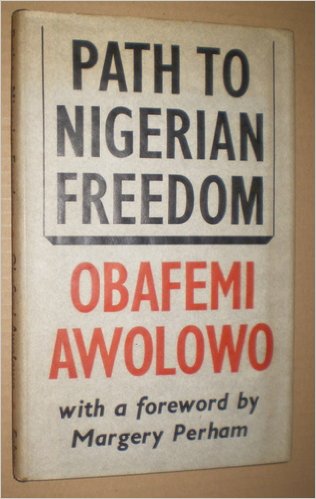
Summing up: Awo then and now
From the foregoing it is clear that Chief Awolowo and his progressive party were confronted with the issues of:
education: particularly the issue of access and quality
economy: especially the issue of growth and development
politics: including the matter of structure, constitution and leadership
The issues now are not different. They are similar if not identical.
Awolowo and his team intervened with solutions to the problem and responses to the challenges by tapping into progressive and liberal solutions including:
Free education
Economic diversification, including rural integration and development
True federalism, by means of a national constitution that they were fortunate to struggle for and achieve, and
Strong and committed leadership which they furnished.
The advantage that Awolowo and his team had was that
the facts were on their side
the moral was on their side, and
the masses were on their side
The challenge that they faced included
1. dealing with peers and adversaries unperturbed by facts, masses, or morals.
2. control of economic and political institutions by those whose objective was to advance political and economic interests with little or no attention to the end of the common good
NOW: The country is fortunate that the facts are still there, the moral is still there and
the masses are still there.
In the circumstance, the solutions and responses of Awolowo and his team are still unassailable, especially for a self-acclaimed progressive party, which has as a pillar of its manifesto, political restructuring and devolution of power to the states.
If it will leave up to its identifier, therefore, the new progressive party must focus its laser beam on the development of human beings as the most important resource. It must educate the nation’s children. It must revive and strengthen the system of public education. It must revisit the challenge of school drop outs who end up in the slaughter slab of political thuggery and terrorist camps. The country is long overdue for 2-year community colleges as bridge institutions. Teacher education and retraining are important aspects of what must be a new philosophy of education in the progressive era.
Security matters, and it must be taken seriously as the first duty of government for which it has a monopoly. Everyone now appears to be open to the idea of state police. There is no reason a progressive government cannot initiate a pilot program. There are a number of ways in which state policing can be set up to take care of the fear of politicization. Every state may be made to establish an independent Police Board or Council with an independent budget.
Corruption is a substantive subject. I remain convinced, however, that this is one area where the whole world will be watching and evaluating the new administration. The matter of emoluments and compensation for political office holders from the Presidency to National Assembly, State Assemblies and even Local Governments is the 100 Ib. gorilla. There is no doubt that many Nigerians are resentful of the exorbitant take-home of political office-holders.
Finally, of course, is the economy. With a mono product which is daily losing its value and relevance in the world economy with competition from everywhere, we have the immediate task of diversification. This will take time given where we are. However, as the Chinese teach us, the journey of a thousand years starts with the first step. We needed that first step long ago.
In spite of his thoughtful solutions, there are, as in his time, significant challenges to Awolowo. Today, there are still the usual conservative adversaries who still support
(a) political and economic institutions that are hostile to economic growth and equitable development: decades of military rule and extractive political institutions benefitting the few,
(b) rentier and extractive economic institutions,
(c) the status quo because of the fear of creative destruction: a condition in which breakthrough in economic growth ushers in egalitarianism that disadvantages and displaces erstwhile political elite.
(d) Strangely, however, there are even more challenges from some of his followers and other progressives deriving from
(i) a general fear of loss of elite advantages enjoyed on the back of the poor: house help, chefs, security, drivers, etc. Illustrate: inclusive educational system guarantees independent lives for many and block servitude. No cook, no driver, no domestic security for most middle and upper class in US;
(ii) an adulterated commitment to progressivism;
(iii) too much ego-centeredness; and
(iv) crippling DISUNITY among core progressives that stood tall with Chief Awolowo.
What is to be done?
PROGRESSIVES UNITE!
1. – Unity across ethnic and class divides ensured independence on a platter of gold
2. –Unity across ethnic and class divides ensured defeat of impunity in First Republic
3. –Unity across ethnic and class divides ensured victory of SDP in 1993
4. –Unity across ethnic and class divides ensured defeat of dictatorship in 1998
5. –Division ensured defeat of progressives in 1999, 2003, 2007, 2011
6. –Unity across ethnic and class divides ensured merger and registration of APC
7. –Unity across ethnic and class divides ensured victory of APC with renewed hope for a new era of progressivism again in 2015
Today, there are original disciples of Awo. There are also second and third generation followers. They all take seriously the man we all know as the Sage, the Avatar, Baba, Philosopher, and Politician-benefactor, one of his kind. The irony is that while they all accept him as their political leader, study his words and try to emulate his deeds, and look forward to a reunion with him some day, while here on earth, they would rather not get together to push the agenda he bequeathed to them. They would rather be like the proverbial snakes who wander around alone until they become victims of their loneliness.
The post-Awo Awoists would not even cooperate to uplift the message of their great master and leader. How are they different then from his adversaries? And considering that they would want one day to resume their dinner time chats with Awo Mimo, what will be their report? How will he respond? I challenge each and every Awoist here today, old, young, and young at heart, to rethink and reflect on what has been lost to progressivism in the last 29 years of his passing. What have they collectively contributed to the progressive maturation and practicalization of his philosophy? How will the present chaos and confusion in the camp of Awo shape the future of his ideas in Yorubaland, in Nigeria, and in Africa? Are they, by their inability to get together as Awoists, inadvertently contributing to the strength of his known political enemies who had predicted his political death more than fifty years ago? Oro sunnukun, oju sunnukun laa fii woo.
In Odu Ifa, the story is told of how Orunmila in his prime years was so proud of what his eight children had turned out to be as kings of notable kingdoms over the land, that he invited them to his annual ceremony. With filial respect, they all responded to their father’s invitation. However, not all was there with respectful demeanor. The last born was prepared to assert himself as an equal of his father in every respect. When others pay obeisance to their father, he stood erect. To their father’s challenge, he responded that he couldn’t care less. After all, Orunmila wore a beaded crown and he too wore a beaded crown. Orunmila had a beaded walking stick and he also did. Just as his father had beaded shoes and necklace, he, the son, also had his own. So why should he pay a stupid obeisance? Orunmila was hurt and he decided that it was time to go back to where he belonged. He retired to the land of the spirits. But the aftermath wasn’t pleasant for the land of humans. Rain withdrew from the land. Crops refused to germinate. Hunger and disease appeared. The children, with the disrespectful one, repented and went in search of their father. They found him but he refused to go back with them. Instead, he gave them the tools they needed to reach him anytime they were in trouble. These included opele, opon, irokin and the paraphernalia of Ifa divination.
Chief Awolowo did what was humanly possible to make Nigeria great. But like the last son of Orunmila, Nigeria shunned and disrespected him. He left for the land of ancestors. But for the faithful who believe in him and his strategies for making Nigeria great, he left them the tools, the outcome of his sleepless nights, the result of his deep thoughts, to consult and reflect upon as we continue to struggle for the progress and development of dear country. In this address, we have made reference to some of them. It is in our interest as a nation to go back to him from time to time to make our nation as great as it is destined to be.
Leave a Reply