

Q: But there should still be a way for the polytechnic graduates to be able to advance to whatever level they want even up to PhD level if they so desire, that I believe will make polytechnic education more attractive to our teeming youth?
A: Polytechnic graduates don’t even need to advance to a PhD level except you want to embark on academic career. The main function of polytechnic is not to produce PhD but to produce those that can work with their hands to sort out things. So, when you are asking them to do PhD, we are missing the point except you want to producing teachers for technical schools.

“I was in the red chamber (during ministerial screening) sweating. How I performed, I wouldn’t know but people said that I performed well.”
Q: What about technical schools?
A: They are dead. Nobody wants to go to polytechnic because we all declare them inferior and nobody wants to be labelled inferior in a society. If I get to education, I will them to pay them well and equip polytechnic. And when people know that when you finish there you will get job, it will be more attractive. I will also encourage government to give free education in agriculture and education in the university. We don’t have teachers. Nobody wants to read agric forgetting that we must eat. I will also make sure that UBEC is well repositioned to take care of education.
Q: Generally, do you see solution to the nose-diving of education in Nigeria?
A: There is a ray of hope. There is a need for sustainability of the recovery process. What government did is to put in place interventions. We have intervention for the 6-3 through UBEC, we have intervention at the tertiary level through TETFUND, but what we keep the education system going is not intervention, is regular sustainability. This country must move away from interventions. You have a child who has no food to eat and all you did is that once in a while you open the door and said take this rice and you shut the door. Let us assume that a week ago, you also gave plantain or pounded yam and at the assessment time you now say this child is not growing well in spite your intervention with occasional food. What can sustain that system is regular food not intervention. Intervention is a kind of disease and malady saying that something is wrong.
There is a need for better budgetary allocation for education. As of today according to World Bank report, Nigeria commits only 1.7 percent GDP to education. In sub-Sahara Africa, average expected to keep education going is 4 percent. For growth to occur, for education sector to be robust and to drive the economic recovery and development of this country, the minimum we can do is to keep increasing the budgetary allocation and ensure that in the next 10 years, we can be talking about allocation of 6.8 percent not 1.7 percent. When you look at the table for the 41 countries in sub-Sahara Africa, we only surpass three countries: Zambia, Zimbabwe and South Sudan. To me, that is shameful in this country. We have the largest GDP in Africa. We have the largest population in terms of endowment. So, what is happening to us? We are not putting our money where it matters and to me let us put our money where it matters. In spite of the reduction in out-flow occasion by the fall in the petrol price, Nigeria as a country, must take a conscious decision to protect education and health. The two of them will develop the mind, the brain and the body. The three essential are needed to drive the country.
Q: The expectations of people are high for Buhari-led administration in all spheres. With the short time he has, how much do you think he can achieve?
A: The way I look at it is that putting certain things on paper is a goal and expected. If we are able build strong foundation for system to work, I think that is good enough. Without the president lifting a finger, electricity improved, people are scared to ask for bribe. In other words, we are already reaping the benefits of an administration that is committed to a change and if we can sustain that over four years and beyond, this country is on the part to greatness.
Q: Let us come to UI, what were your experiences as VC especially with strike, students protest and the rest?
A: Let me clearly state that other than national strikes, we didn’t major strike. That demonstrates the understanding we have with the workforce and the students. As an activist, I never against strike but I think strike is something that we need to embark upon as a last result. I believe in unionism. When you outlaw unionism, you turn management leaders to monsters. I believe union keeps us on our toes. They make us accountable and keep us alive. I support unionism but I believe that management should be proactive and open. We have had near misses, one or two day uproar but we have been able to manage them because we reach out to them.
When we lost a student in Zik Hall, and the students protested, we went to them and listened to them and we showed them that we will put things right and we did that. If we didn’t do that, we would have set the stage for another crisis. We had some problems over electricity and we made the students to know that we are part of the larger society. I commend the students’ body, UI workforce and administrative team for supporting us. No VC can do it alone. I think what happens is that when things go on well, they praise the VC and so, I smile, knowing full well that I am only taking the glory on behalf of the team. The right way to end it is that I am the most fortunate with the type of team that I worked with.
Q: Despite paucity of fund, how did you manage to achieve so much especially in the construction of many structures including DLC complex?
A: Truly, there is reduction in in-flow. We used internally generated resources to execute some of our projects. Where we have biggest funds, we blocked linkages. There are two ways to make funds available: you either bring more or you reduce loss. We block linkages in DLC and restructure its financial system. With this, the in-flow from DLC increases from N300m to N900m. So, for the first time in the history of the unit, we are able to procure a building in Lagos costing about N375m and we also have the complex in Shasha. Let me tell you that we have approved the recruitment of lecturers for DLC. They will be based in DLC. Very soon, advert will come out for the recruitment.
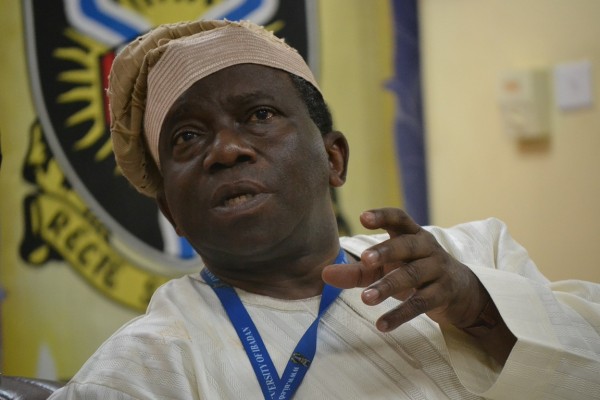
“We need more technical hands than we need university graduates. It is computed that for each graduate engineer, there is a need for about ten technicians. The problem with Nigeria education is that we are producing wrong type of products for the right type of market. The skill building system is dysfunction. The industries don’t talk to us. So, I don’t know what they need. We need to talk to one another.”
Q: Did you succeed in fulfilling your dream for UI or there is a left over to be passed to incoming administration?
A: When we came on board, we had four strategic teams of good governance, welfare of staff, improvement in academic profile and upgrade of infrastructure. In terms of all the four, we have done all we wanted to do. When you look at improvement in academic profile, upgrade of infrastructure, it is continuous exercise. If you look around UI, there are on-going projects. I will implore my successor to complete them. In terms of upgrade of academic profile, it also an on-going exercise. We need to do more. My handover note will contain area of failure and area of success.
Q: Talking about blocking the linkage, is that why you centralized the institution finances? What is your take on TSA?
A: In terms of centralization of fund, I want to say clearly that we didn’t centralize fund. What we did when we came on board was to have a second look at what we call sharing formula of our resources. Before we came on board, only 15 percent of the resources would come to the central administration. I thought that was unfair. The central administration was a beggar. Fortunately, January 2011, we had a visitation panel, the chairman of the panel said, I have never seen any university in Nigeria where funds are shared and recommended that this should stop and that the central administration should take charge of the resources of the institution. However, in a situation where the central administration was only getting 15 per cent and the rest will go to the faculties and the department, taking 100 percent will create chaos.
What we did was to send a memo to council to say that the visitation panel had called for the abolition of the sharing formula. We will not want to adopt wholesome recommendation. We recommend that 60 per cent will come to the centre and that is still what is obtainable. For the first time in the history of UI, the central administration can survive without being on oxygen from either the department or faculties. That is why we were able to do few things. I must also admit that in spite of the fact that only 15 percent gets to the central, all units in the departments will rely on the central to even change the bulb in their departments and offices. So you can’t hold on to the money and expect the person without money to look after your needs. To make things worse, many of the departments and faculties kept this money and fail to use them such that we have to print out the level of resources that is available to them and said you have this money, use it to develop your facilities.
With respect to TSA, it is excellent. It will enable the Federal Government to have an overview of all the resources that are available. We did something similar here. Weekly, we publish funds available in UI. All of us will know what we have and where they are located, so, there is a similarity. The only challenge with TSA is that we started implementing without putting the guideline in place. I believe in the future, the government will put in place guideline, train and sensitize before implementing.
Q: Is UI grossly short staffed?
A: It is a dicey question. We are not short staffed in the junior non teaching cadre and senior non teaching cadre but relatively short staffed in the senior technical and academic staff level.
Q: What did you do to improve the university ranking?
A: It is the collective efforts and hard work of both the academic and non academic staff. The fact that we have been placed on the category 600-800 is a testimony that we are climbing the ladder. We will not rest until we are among the top 10 in Africa. I don’t believe in the ranking because some of the parameters are unfair to us. But ranking drives us to aspire to higher level.
Q: Do you think universities can be self-reliant?
A: They can be. UI can be self-reliant without the Federal Government allocation. For this to happen, government must hands off. The ALUMNI Association has requested that the school should be handed over to them. I think the government should experiment. If it works then, try it with other universities. I am sure UI can stand alone.
“The first thing about health insurance is to improve the access and quality. As of today, I think it is only three percent of Nigerians that have health insurance and that is not good enough. In the shortest possible time, we need to increase its patronage by at least 30 percent as well as improving on quality for people to get value for their money.”
Q: Now that you are going to Abuja, what will happen to your initial plan to go into farming after your VC tenure?
A: fortunately, I have tree crops. I will employ people to look after my farm. I actually wanted to prove a point that with commitment, Nigerians can operate farms well. Unfortunately, I will not be able to prove that.
Q: Any ground breaking plan for the convocation?
A: The ceremony will witness the inauguration of the new chancellor, Sultan of Sokoto, Said Abubakah, 111. We are also going to honour the longest serving VC in the history of UI, Professor Emeritus Ayo Banjo. He served for two terms and had a remarkable tenure. The water treatment plant we are using in UI was put in place by Professor Banjo. This administration is the only one that put in place the second water treatment plant since Professor Banjo left the office. To us, we are not only celebrating the titan but we are also celebrating what he calls the nation’s treasure and heritage in his autobiography. For the first time in the history of UI, we are graduating about 22,000 students in the PAN African University. These are students drawn from all over Africa.
Q: What is your advice to the youth?
A: They should be patient because I am positive that this government will work out something for them. Many of them should think about starting their business and government should provide incentive for them.
Q: How are you sorting out the problem you have with the Oyo State Government concerning taxation?
A: We are handling it. As soon as we agree, each party will fulfil its own part.
Q: How lucky do you think you are considering the fact that whatever you want, you have it?
A: I am very lucky. It is not whatever I want that I get, it is whatever God gives that I take
Q: In your stay in the office, do you have any regret?
A: Yes, I do but is not for public consumption. I am writing my memoirs and they will all be there. There were moments when one feels like giving up. I read two biographies, one by Roger Makanjuola, Water must Flow up and in the saddle written by Prof Banjo. Both gave me strength because they went through turbulent periods and they survive it. I told myself, if they could survive, I must also survive and I thank God that I survived.
Q: What would you have done better?
A: A lot of things could have been done adopting different approaches. Some decisions could have been taken earlier, some could have been avoided, some could have been done the other way but I will keep them for my memory otherwise, the book will not sell
Leave a Reply